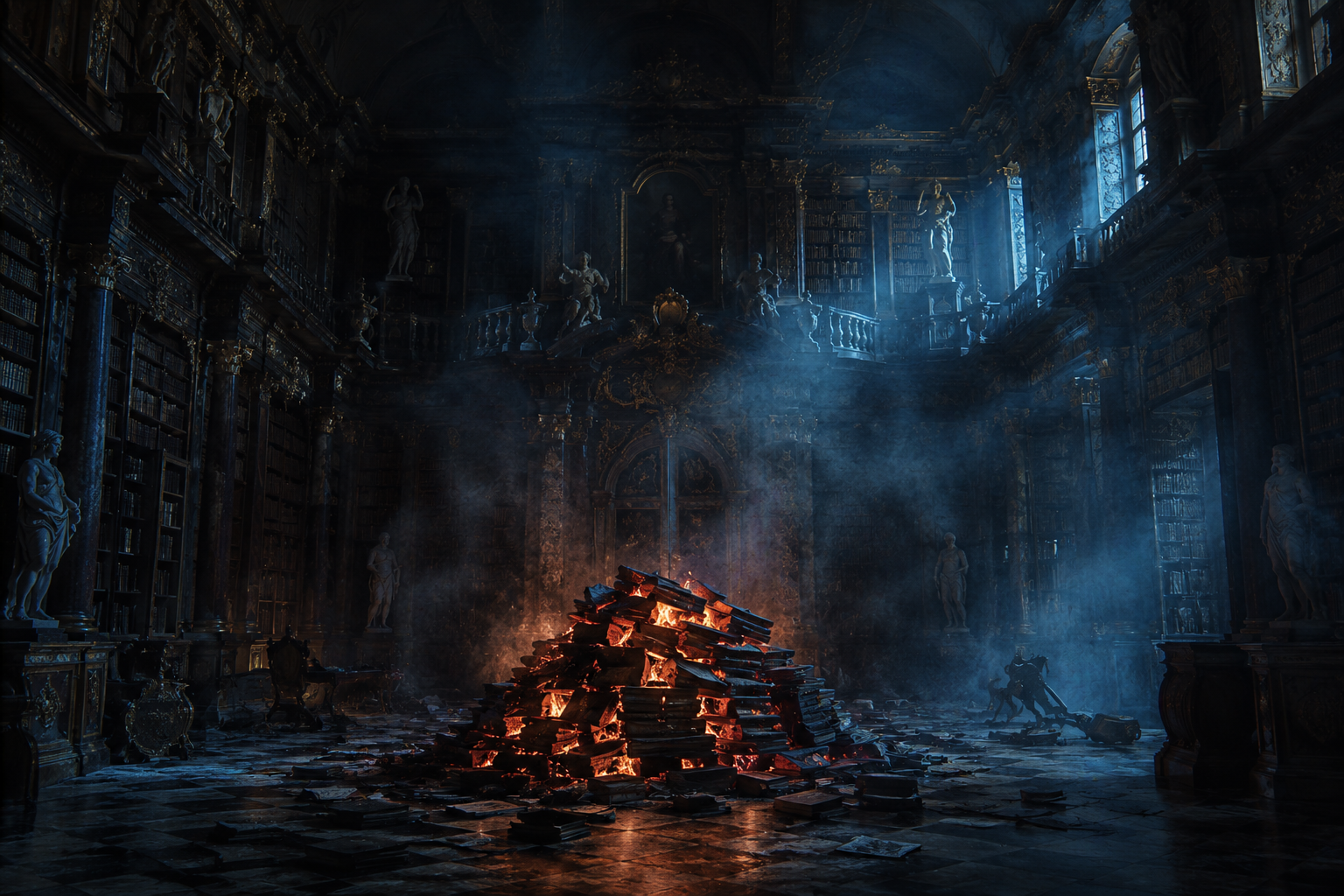
In 2004, fire claimed 50,000 volumes from Goethe’s library. Discover the “Ash Books”—12,500 unique manuscripts now existing as carbonized ghosts.
Introduction: The Fire as Cultural Symptom
There is a particular species of grief reserved for things that cannot be replaced because they were never replicated. Not the grief of losing a car, or a house, or even a person—all of whom leave traces, photographs, memories distributed across other minds. This is the grief for a singular object: a manuscript written once, in one hand, on one afternoon that will never return. The kind of grief that is not personal but civilizational; diffuse, low-frequency, and almost impossible to fully locate.
On September 2, 2004, the Herzogin Anna Amalia Bibliothek—the Duchess Anna Amalia Library in Weimar, Germany—began to die. A faulty electrical cable in the attic ignited what would become a catastrophe measured not in dollars or square footage but in irretrievable centuries. Approximately 50,000 volumes were incinerated outright. Another 118,000 sustained heat and water damage severe enough to render them near-illegible; these are what archivists now call the Aschebücher—the Ash Books. Of the collection’s rarest holdings, some 12,500 unique manuscripts and early modern prints from the 16th through 18th centuries are considered permanently lost or so severely fragmented as to constitute a kind of archival ghost: present in the catalogue record, absent from reality.
This is not a story about a fire. Fires are accidents. This is a story about what a society reveals when it loses something it cannot name the value of—and what it chooses to say, and not say, about how that loss became possible.
The Cultural Anatomy: Goethe’s House of Time
To understand the scale of what burned, one must first understand what the Anna Amalia Library was—not institutionally, but cosmically, within the specific gravity field of German intellectual history.
Johann Wolfgang von Goethe served as the library’s director for 35 years, from 1797 to 1832. This is not a trivial biographical footnote. Goethe was not merely a poet who happened to administer a collection; he was the organizing intelligence of what historians call Weimar Classicism—that brief, luminous period when a small German city became the intellectual capital of Europe. The library was not a repository adjacent to this project. It was the project. Schiller worked there. Herder used its holdings. The manuscripts it housed were not artifacts from the Enlightenment—they were instruments by which the Enlightenment thought.
The collection’s temporal depth compounded this significance. The volumes that burned were not 19th-century reprints of older ideas; they were primary nodes in the network of early modern European knowledge production. A 16th-century print is not interchangeable with its later transcription. The marginalia are different. The paper stock carries different information about trade routes and guild economies. The orthography evolves between editions in ways that linguists spend careers parsing. Each unique copy is not a copy of a text—it is a text, slightly different from every other instantiation of itself.
What burned in Weimar was therefore not a library in the colloquial sense. It was a distributed archive of how ideas actually moved through time—in specific hands, through specific channels, modified by specific readers who left specific marks. That network of specificity was vaporized in a single night.
The political prehistory of this loss is where the official narrative begins to develop its first significant elision. The Anna Amalia Library did not arrive at the night of September 2, 2004, in pristine condition. Decades of East German Democratic Republic management had left the building in a state of deferred maintenance that the post-reunification German state had not yet fully addressed. The renovation scheduled to begin almost immediately after the fire was not cosmetic; it was structural. The faulty attic wiring that caused the blaze was itself a legacy of this neglect—old infrastructure, known to be aging, allowed to persist because institutional inertia and budgetary constraints are universal phenomena that transcend political systems.
Western accounts of the fire tend to present this as a technical accident—the language of tragedy without agency. The narrative of GDR mismanagement as a contributing condition appears less frequently, and when it does, it arrives hedged, softened, treated as background rather than as a causal thread. This is not surprising. Attribution of blame to defunct political systems requires a precision that grief rarely affords; it is easier, and perhaps more honest in some registers, to mourn a fire than to prosecute a policy. Nevertheless, the gap exists—between what happened and what is said to have happened—and it is worth sitting with.
Structural Dissection: Anomalies in the Signal
Examine the loss with clinical detachment, and several structural anomalies emerge.
The first concerns timing. The fire occurred on September 2, 2004—just before a scheduled major renovation was set to begin. The renovation would have, almost certainly, addressed the aging electrical infrastructure. The proximity of these two events—the faulty wire igniting weeks before the work that would have replaced it—has the structure of tragic irony in the Greek sense: fate arriving precisely at the threshold between catastrophe and prevention. This is not to suggest conspiracy; the evidence points unambiguously to an electrical accident. But the timing encodes something true about institutional failure: systems do not collapse at random moments. They collapse at the moment of maximum accumulated deference, when every previous decision to wait has compounded into the conditions for disaster.
The second anomaly concerns the survivors. Among the items saved from the fire was the 1534 Luther Bible—one of the most historically significant printed objects in the German-speaking world. Humboldt’s manuscripts also survived. These rescues were achieved not by automated fire suppression systems or professional archival emergency protocols but by a human chain—library staff and ordinary Weimar citizens passing volumes hand-to-hand through smoke and heat. The image is extraordinary; it is also telling. The fact that human chains were the operative rescue technology in 2004 indicates something about the state of the building’s emergency infrastructure. Advanced suppression systems were not in place. The people who loved the books stood between the fire and the books, and they saved some of them, and it was not enough.
The third anomaly is classificatory. The 118,000 “Ash Books”—the damaged but physically surviving volumes—occupy a category that has no precise precedent in the archival literature. They are not lost; they are present, catalogued, shelved in the library that reopened in 2007. But they cannot be read by conventional means. Their pages are carbonized—sheets fused by heat into rigid masses, their ink and graphite at temperatures that altered the very chemical structure of legibility. They are objects that are simultaneously present and inaccessible; records that register their own existence but cannot communicate their content. The archivists who work with them call them Aschebücher with a precision that the English translation “Ash Books” almost, but not quite, captures. In German, Asche carries connotations of funeral ash—the residue of cremation—that render the compound noun something closer to “cremation records” than simply “burnt volumes.”
Psychological Necropsy: Why This Silence Disturbs the Western Mind
The Western response to the Anna Amalia fire has been shaped by a specific and revealing cognitive framework: the Library of Alexandria comparison. Commentators reach for Alexandria almost reflexively when describing Weimar, and the reflex is instructive precisely because it is partially incorrect.
The Library of Alexandria burned—or more accurately, was damaged across multiple incidents spanning centuries—in antiquity. Its loss is legible to the modern imagination because it is total and ancient; it cannot be remedied and its contents can only be inferred. It exists as pure negative space, which is in some ways easier to mourn than a loss with edges. Alexandria’s destruction has the clean geometry of myth.
The Anna Amalia fire is something different and, in certain respects, more disturbing. It happened within living memory—within the era of digital photography, satellite communication, and networked information storage. The volumes that burned were catalogued; many of their contents were known to scholars; some had been partially digitized. The fire occurred inside a system that believed itself equipped to preserve things permanently—and discovered, in approximately four hours, that it was not. This is the particular horror that Alexandria cannot supply: the horror of infrastructure failure in an age of infrastructure confidence.
There is also the question of the Ash Books as aesthetic objects—a dimension that European media has engaged with more directly than Anglo-American outlets. The surviving damaged volumes have been photographed extensively; the images show objects of genuinely uncanny character. Books do not burn uniformly. The heat of the fire, reaching temperatures near 1,000°C in certain sections, transformed the volumes in ways that vary by material composition, proximity to flame, and the specific chemistry of their inks and papers. Some volumes are mere charcoal blocks, their pages fused beyond separation. Others retain legible spines above ruined interiors. A few show pages that are visually intact—text visible at first glance—until examination reveals that what appears to be ink is in fact a carbon residue that will crumble at the slightest contact.
The Ash Books are not dead, in any simple sense. They are not alive either. They occupy the category that the philosopher Giorgio Agamben, writing about different subjects, called bare life—existence stripped of function, of the capacity to participate in the systems that gave it meaning. A book that cannot be read is not a book in any operational sense; it is a book-shaped object. The 118,000 Ash Books that sit in the Anna Amalia Library today are, in this sense, a library of gestures—the form of knowledge without its content.
This is why the comparison to digital lost media—deleted YouTube videos, corrupted hard drives, taken-down websites—ultimately fails as an analogy, despite its intuitive appeal. Digital loss is loss of data; the substrate is either intact or absent. The Ash Books present a third condition: the substrate is intact, the data is present in some physical form, and neither human perception nor current technology can reliably access it. This is not deletion. This is something closer to a coma.
The Evidence of Void: Physical Decay Versus Social Erasure
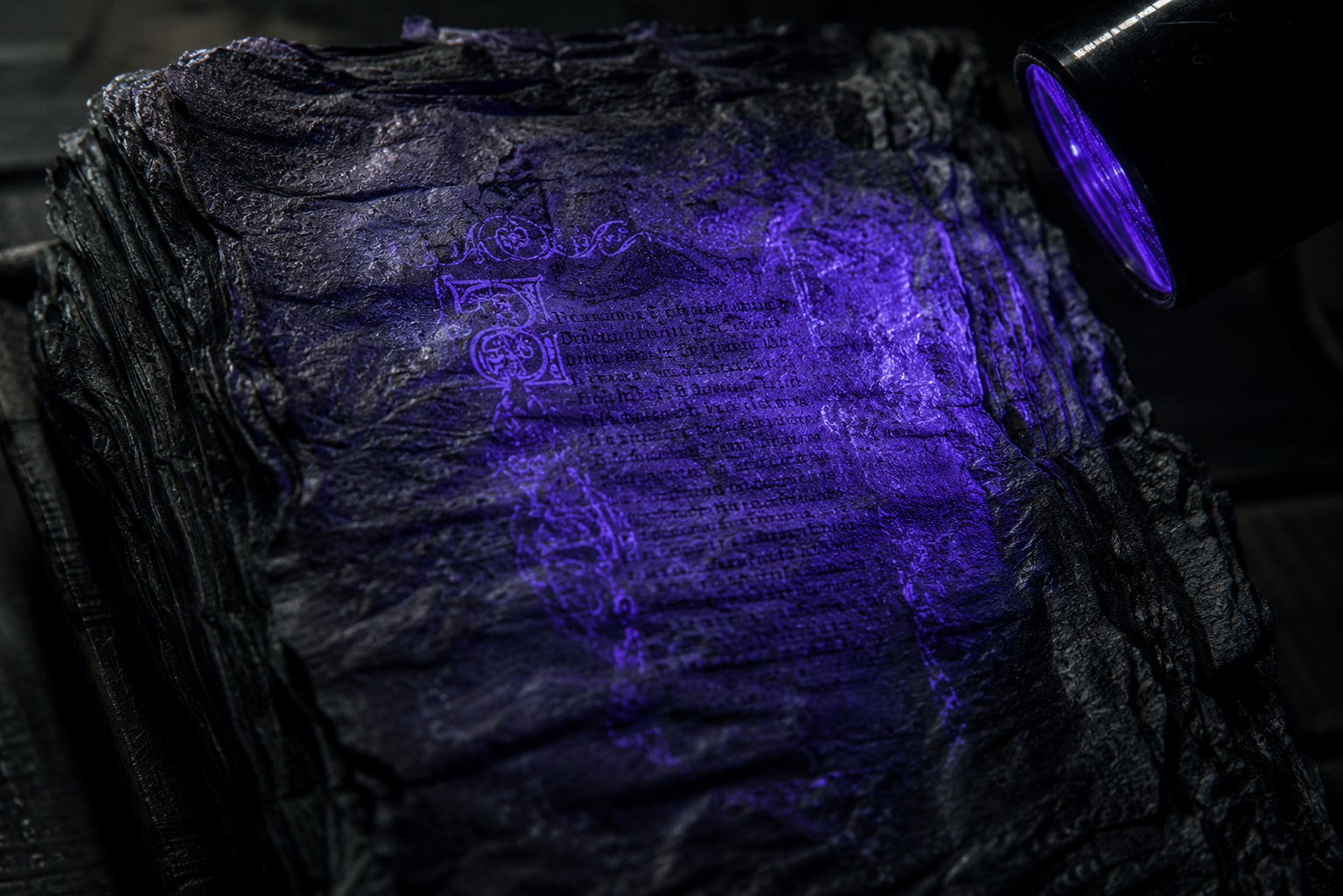
The restoration effort that began following the library’s 2007 reopening is one of the most technically ambitious archival projects in contemporary European history. Since 2008, the “Restoration Workshop for Fire-Damaged Documents” has been deploying multispectral imaging—a technique borrowed from satellite remote sensing and art conservation—to illuminate text invisible to the naked eye. The 1.5 million loose sheets salvaged from the fire are being processed using, among other methods, a “paper-pulp” technology that can, in certain cases, reconstitute page surfaces damaged by moisture and compression.
The science is genuine and the progress is real. Multispectral imaging works by capturing reflected light at wavelengths beyond the visible spectrum; carbon-based inks, even when invisible to human eyes in normal light, respond differently than their surrounding substrates to infrared or ultraviolet illumination. In favorable cases, text emerges from apparent blackness with startling clarity. The technique has been used successfully on Herculaneum scrolls carbonized by Vesuvius in 79 AD—objects that had been unreadable for nearly two millennia.
But the favorable cases are not the majority. The physics of fire at 1,000°C are not merely aggressive; they are transformative at the molecular level. The cellulose structure of paper begins to decompose above 250°C. The binding compounds in iron gall ink—the most common ink in early modern European manuscripts—volatilize. By the time temperatures reach the peaks recorded in the Anna Amalia attic, what survives is not a degraded version of the original; it is a different chemical substance entirely. Multispectral imaging can read ink that is present; it cannot reconstruct ink that has become gas and dispersed.
The physical loss, then, is partially irreversible by definition. But the physical decay is only one vector of the void. The second vector—social erasure—operates more quietly and is, in some respects, more tractable.
The Anna Amalia fire remains substantially underrepresented in anglophone cultural discourse relative to its significance. This is partly a function of language and geography; the loss was German, the surviving scholarly literature about it is largely German, and the international media cycle of 2004 moved on within weeks. But it also reflects something about how Western cultural memory allocates attention. The fire damaged a library; it did not produce a body count. It destroyed manuscripts; it did not destroy a building with a recognizable silhouette. The loss was interior to institutions—to libraries, to universities, to disciplines whose names most people cannot pronounce correctly—and interior losses are difficult to make legible to public grief.
The political prehistory of neglect under GDR administration adds another layer of social erasure. Attributing institutional failure to a defunct authoritarian system is uncomfortable in a reunified Germany still navigating the mnemonic politics of division; it is equally uncomfortable internationally, where such attribution can read as retrospective Cold War score-settling. The result is a narrative that emphasizes the fire’s accidental character—the electrical cable, the faulty insulation, the unfortunate timing—and minimizes the decades of deferred maintenance that made the attic a combustion hazard. Accidents require mourning. Institutional failures require accountability. The former is more manageable.
The Point of No Return: Digital Memory and the Illusion of Permanence
The Weimar fire occurred in the same decade that witnessed the rapid expansion of digital archiving as a conceptual solution to exactly this kind of loss. The Internet Archive launched in 1996. Google began scanning library collections in 2004—the same year as the fire, an irony that has not received the attention it deserves. The prevailing assumption of that moment was that digitization represented a form of immortality for physical culture: scan it, store it, replicate it across distributed servers, and it becomes effectively indestructible.
The Ash Books challenge this assumption not by disproving digitization but by exposing its precondition. Digitization preserves what has already been digitized. It cannot retroactively rescue what burned before the scanner arrived. The Anna Amalia collection was partially digitized before 2004; the portions that were most urgently in need of preservation—the rare, the unique, the 16th-century prints with no surviving duplicate—were the least likely to have been processed, because archival digitization, like all institutional projects, tends to proceed by priority and proximity rather than by prescience.
The deeper discomfort, however, is not logistical. It is philosophical. The fire at Weimar is a demonstration—irreversible, conducted at scale—that digital memory is not a successor to physical memory but a parallel system, with its own vulnerabilities, its own failure modes, and its own relationship to the question of what it means for something to be permanently gone.
Digital files can be deleted; servers can be decommissioned; formats can become unreadable; platforms can be acquired and shut down. The obsession with digital lost media—the missing YouTube videos, the taken-down forums, the games whose servers no longer exist—reflects a growing and entirely justified anxiety about the fragility of distributed digital culture. But this anxiety tends to treat digital loss as a novelty, as though the combustibility of analog materials were a solved problem that digital storage superseded. The Ash Books of Weimar are evidence against this framing.
What the fire actually represents is something more precise than the burning of the Library of Alexandria—a comparison that flatters our sense of historical continuity by placing us in the same narrative as antiquity. It represents a temporal lobotomy: the surgical removal of a specific layer of the historical record, not by time and entropy but by a single night’s accident occurring within a fully modern institutional system. The Enlightenment timeline that runs through the Anna Amalia collection is not merely incomplete. It is interrupted; there are places where the record simply ends, mid-thought, mid-sentence, mid-page, and what follows those interruptions is silence.
The necromancy currently being performed by the multispectral imaging teams in Weimar is real, and it is valuable, and it will recover things that would otherwise be permanently unreachable. But necromancy is, by definition, the reanimation of something dead—not its restoration to life. The 1.5 million loose sheets being processed in the restoration workshop are not being saved. They are being read, for what may be the final time, before the carbon structures that preserve their content degrade past the threshold of any possible imaging technology.
This is the most uncomfortable insight the Ash Books offer: permanence is not a property of information. It is a property of the specific material and institutional conditions in which information is housed—conditions that are always, without exception, contingent. The ghost library in Weimar is not an anomaly in the history of human knowledge preservation. It is a demonstration, unusually vivid and unusually recent, of what that history has always been: an ongoing negotiation with fire, with neglect, with the gap between what institutions intend to preserve and what they actually protect when the attic wiring fails at 10 p.m. on a Thursday in September.
The books that burned knew nothing of their own irreplaceability. Neither do ours.
🔍Search Update: Call to Action
To Western Lost Media Seekers: While the digital preservation community focuses on BitRot and server shutdowns, Weimar reminds us that physical “Analog Horror” is still a present threat. We are seeking accounts of similar regional archival losses that have slipped through the cracks of anglophone documentation. If you have leads on “contextual” lost media or unique manuscripts destroyed by infrastructure failure, contact the Archive. Your contribution helps protect the default archive of human experience.
The Herzogin Anna Amalia Bibliothek in Weimar is open to the public. The restoration workshop continues its work. As of the library’s last public reporting, the 1.5 million salvaged sheets remain under active processing—a project with no projected completion date.
This document is an investigative archival reconstruction based on fragmented public records, media remnants, community accounts, and verified historical sources compiled by The 3AM Archive.
The article examines how incidents, forgotten media, internet folklore, and unresolved public memories evolve through cultural preservation and digital decay.
This is a cultural investigation document — not fictional horror content.
All visual materials used in this post are exclusive AI-generated assets created for The 3AM Archive.
