A forensic examination of corporate amnesia, early-web fragility, and the Korean promotional artifact that became the rarest lost Pokémon media in East Asian archival history.
There is a particular species of psychological discomfort that arises not from destruction, but from incompleteness. Archaeologists have a word for it—the feeling provoked by a burial site with the skeleton intact but the skull missing. The bones confirm a life; the void confirms an erasure. The mind, unable to resolve this contradiction, manufactures anxiety in the gap. The 포켓몬 불가사의 던전 황금 구조대—Pokémon Mystery Dungeon: Gold Rescue Team—is precisely this kind of artifact. It is not a lost game. It is a lost proof of existence; a promotional demonstration from a mid-tier regional office of a multinational corporation, released in August 2007, discontinued within a year, and then quietly swallowed by the early internet’s most reliable mechanism: institutional indifference.
What makes it disturbing is not what is missing. It is what has been found.
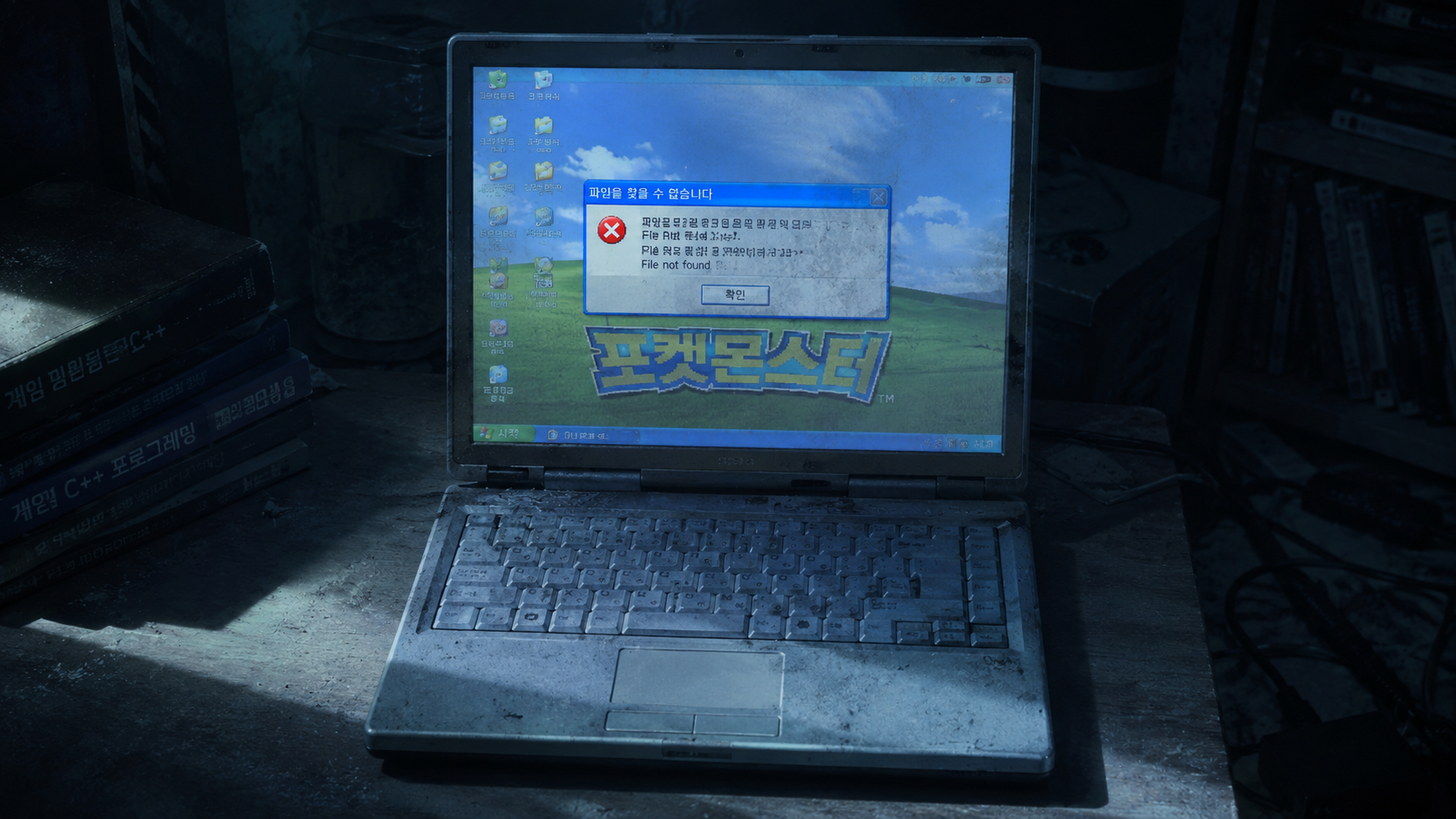
In February 2024, a launcher executable surfaced—a small, intact .exe file, structurally sound, waiting to initialize a program. The launcher works. The launcher breathes. But the data files it was built to call—the audio, the assets, the interactive guts of the promotional port—remain absent, presumably dissolved on a server that stopped paying its domain fees somewhere between 2008 and the present. We have, in clinical terms, recovered the skeleton without the soul. This is not a ghost story. It is a forensic report.

The Cultural Anatomy: A Promotion Born in Managed Silence
To understand why this artifact exists at all, one must understand the precise bureaucratic moment that produced it. The year was 2007. Pokémon Korea—a licensed regional operation orbiting the gravitational center of Nintendo and Game Freak’s Japanese headquarters—was tasked with promoting Pokémon Mystery Dungeon: Blue Rescue Team, the Nintendo DS title released in South Korea that year. The standard promotional toolkit was insufficient; the Korean market, with its PC-café infrastructure and Windows-centric consumer computing culture, demanded something native to the desktop.
The solution was elegant in conception and catastrophic in preservation: a Windows-ported demo, a .exe file, designed to run the DS game’s introductory sequences on a PC. This was not a fan project. This was not a leak. This was official corporate product, commissioned and distributed through Pokémon Korea’s promotional website, offered as a free download during the promotional window.
Here is where the cultural anatomy becomes interesting. In the Western Pokémon ecosystem, the word “Gold” carries an almost devotional weight—it refers to Pokémon Gold, the 2000 Johto-region entry in the mainline series, a game regarded by a generation of players with the specific tenderness reserved for formative childhood media. The Korean promotional team named their demo the 황금 구조대—the Golden Rescue Team—deploying “gold” as a simple quality signifier, a mark of prestige. The word meant excellence. It meant nothing more.
But the semantic collision this created, seventeen years later, among Western lost-media communities is instructive. When anglophone archivists and YouTubers first encountered references to a “Golden” Pokémon Mystery Dungeon game from Korea, the word landed wrong—it carried ghost-meanings, suggestions of a parallel mainline entry, a “third version” in the tradition of Emerald and Platinum that had somehow been exclusive to one national market. The confusion was a linguistic collision. Korean promotional logic met Western franchise taxonomy, and the result was a myth: that somewhere in the Korean internet’s archaeological layers, a unique version of a beloved game was waiting to be recovered.
The myth was false. The artifact is not. Both matter.
Structural Dissection: The Anomaly in the Signal
Any forensic investigation worth conducting must eventually confront the evidence in clinical terms. The Gold Rescue Team demo presents one technical anomaly so severe it constitutes the primary reason for both its size and its disappearance: the file was approximately 460 megabytes.
The original Pokémon Mystery Dungeon: Blue Rescue Team DS cartridge contained approximately 32 megabytes of data. The demo was, functionally, a promotional excerpt of that content—not the full game, not an expanded version, not an alternative build with additional assets. It was a subset of an already-small product. By every principle of file compression and digital economics, it should have been smaller than 32MB; perhaps dramatically so.
It was fifteen times larger.
The explanation, when uncovered, is simultaneously mundane and revealing. Pokémon Korea’s technical team—or the contractor responsible for the port—converted the game’s original audio from MIDI sequences to uncompressed .WAV files. The MIDI format, which stores musical instructions rather than recorded audio, is extraordinarily compact; a three-minute musical composition in MIDI format might occupy a few kilobytes. The same composition as a full-fidelity .WAV file could require thirty megabytes. Multiply this across an entire game’s soundtrack and the arithmetic becomes grotesque.
Why convert MIDI to WAV? The most probable explanation is technical compatibility. In 2007, MIDI playback on Windows PCs was inconsistent; different hardware and software configurations produced wildly different sonic results, from adequate to genuinely offensive. The .WAV conversion guaranteed that every PC running the demo would hear the same audio, the intended audio, without requiring the user to possess specific MIDI synthesis hardware. It was a quality-control decision. It was also a preservation disaster.
In 2007, a 460MB file existed in a peculiar technological purgatory. It was too large to be distributed on standard CD-ROM without dedicated production; too large to be casually downloaded on the ADSL connections that served the Korean consumer market at anything approaching speed; and too large to be the kind of file that a casual user would re-host on a personal server or early file-sharing platform. The file’s size was not merely an inconvenience. It was a structural barrier to the informal redundancy that preserves most digital artifacts.
When the promotional website closed in 2008, there were no mirrors. There was no torrent. There was no archive.org snapshot with the file intact. The launcher—small, lightweight, incidentally preserved—survived. The data it was built to call did not.
Psychological Necropsy: Why the Western Mind Is Disturbed
The Gold Rescue Team entered Western consciousness primarily through the lost-media community’s particular subculture—a community that has, over the past decade, developed what can only be described as a forensic romanticism. The subreddit r/MysteryDungeon, the YouTube channels that narrate recoveries of regional television broadcasts and promotional cassettes, the Discord servers cross-referencing archive.org metadata with Wayback Machine snapshots—these are communities defined by the conviction that the disappeared past is worth the labor of recovery.
This community is overwhelmingly Western in its architecture; its primary language is English, its reference points are anglophone, its aesthetics are borrowed from documentary filmmaking and investigative journalism. When it encountered a Korean promotional artifact, it applied its own interpretive frameworks, and those frameworks did not map cleanly.
The dissonance produced is diagnostic. Western lost-media hunters are accustomed to recovering things that were culturally lost—television specials pulled for legal reasons, theatrical cuts replaced by director’s editions, promotional materials that a corporation chose not to distribute broadly. These are losses with legible causes; there is a decision to point to, an agent of erasure. The Gold Rescue Team was lost for reasons that are almost insultingly banal: a website expired; a domain was not renewed; a file was too large to survive the era’s infrastructure.
The $200+ bounty currently active on Reddit—contributed piecemeal by community members who have never held a Korean promotional CD and may not read Korean—represents something beyond monetary incentive. It is a form of ritual refusal; a collective insistence that “too large for 2007 servers” is not an acceptable reason for cultural loss. The bounty exists because the alternative—accepting that corporate inefficiency and early-web fragility are sufficient to erase official cultural artifacts—is genuinely uncomfortable to the archival community’s operative premise, which is that loss is recoverable if the effort is sufficient.
The Gold Rescue Team tests that premise with clinical severity.

The Evidence of Void: Physical Decay Versus Social Erasure
Lost media scholarship—to the extent that scholarship has developed around what is primarily a hobbyist community—tends to distinguish between two categories of loss. Physical decay accounts for the destruction of the storage medium itself: magnetic tape decomposing, nitrate film burning, data sectors failing on aging hard drives. Social erasure accounts for the failure of human systems to preserve what the medium could theoretically still hold: distribution decisions, copyright concerns, institutional neglect, corporate reorganization.
The Gold Rescue Team sits at the intersection of both categories; but the balance is weighted decisively toward social erasure, and that weight implicates specific actors.
Nintendo’s Japanese headquarters, as the parent organization of Pokémon Korea, did not preserve regional promotional materials as a matter of archival policy. This is not unusual; the vast majority of large entertainment corporations do not maintain comprehensive archives of every regional marketing artifact. The resources required would be substantial; the apparent cultural return was, at the time, negligible. A promotional demo for a DS game in the Korean market, available for a promotional window, then discontinued—this is not the kind of asset that triggers a preservation protocol.
Pokémon Korea itself, as a licensed regional operation with a constrained operational mandate, was not in the business of archiving its own promotional materials beyond the promotion’s active period. When the website closed, the files were not migrated. They were simply not maintained.
The early Korean internet of 2007—characterized by high connection speeds relative to global averages but a file-sharing culture that had not yet developed the systematic archival orientation of later communities—did not produce the informal redundancy that might have preserved the demo on peer-to-peer networks or fan servers. The file was too large, the promotional window too short, the cultural moment too narrow.
What remains is the launcher. Found in February 2024, likely preserved in a personal archive or a cached directory on a machine that survived the intervening seventeen years, it functions. It executes. It attempts, faithfully, to locate the data files it was built to call; and it fails, because those files no longer exist on any reachable server. The launcher is not a clue. It is a monument to the shape of what is missing.
The Point of No Return: Memory Without Permanence
The final uncomfortable insight—the one that the Gold Rescue Team’s particular history forces into view—is about the nature of digital memory itself.
There is a persistent intuition, operating beneath most people’s engagement with digital culture, that the internet remembers. This belief suggests that the internet acts as the default archive of human experience. This intuition implies that the permanence of digital files, their perfect reproducibility, and their resistance to the physical degradation that erases books and films constitutes a guarantee. The file that existed on a server yesterday can, in principle, be recovered tomorrow. The bits have not rotted. The data structure is intact somewhere.
The Gold Rescue Team demonstrates that this intuition is wrong in a specific and important way. Digital preservation is not a property of the medium; it is a property of the network. A file that exists on a single server, behind a domain that lapses, is not preserved by the internet—it is isolated by it. The same connectivity that enables instant global distribution enables instant global inaccessibility the moment the server stops responding. The file did not decay. The infrastructure that made it findable did.
The 2024 launcher discovery is, in this light, not an encouraging development. It confirms that a portion of the artifact survived seventeen years of infrastructure churn in someone’s personal archive; it does not suggest that the data files survived in the same way. The probability that the full demo still exists, intact, on a storage medium accessible to someone who does not know its value—a burned CD in a storage closet, a directory on a backup hard drive acquired with secondhand hardware—is non-zero. It is also not recoverable through any method the archival community currently possesses short of physical, person-by-person contact with every Korean PC user who downloaded the demo in 2007.
We are not, in this sense, looking for a game. We are looking for the cache of a dead server that may have been cloned, once, onto a physical medium, by someone who no longer remembers doing so. We are looking for the shadow of a data transfer; for the residue of an institutional promotion that no institution cared to preserve; for a moment in the early Korean internet that lasted perhaps six months and was attended by perhaps a few thousand users, none of whom knew they were witnesses to something that would become—by the logic of scarcity and collective attention—culturally significant.
The Gold Rescue Team is a clean diagnosis of early-web fragility: not the dramatic destruction of the archive, but its quiet expiration. The domain lapsed. The files dispersed. The launcher persisted, because launchers are small, because someone kept it, because seventeen years is not long enough for all hard drives to fail.
The soul of the artifact, however—the audio, the assets, the interactive data that made it a thing rather than a pointer to a thing—remains missing. We have the skeleton. We have the name. We have a $200 bounty on Reddit and a community of archivists running search queries in languages some of them do not speak.
And we have the launcher; executable, faithfully executing, calling out across a server address that no longer exists, receiving nothing in return.
That silence is the most honest thing the early internet left us.
🔍Search Update: Call to Action
The search for the ‘Gold Rescue Team’ data files is currently ACTIVE. If you lived in South Korea circa 2007-2008 and participated in official Pokémon Korea promotions, please check your legacy hardware. We are looking for a folder or ZIP archive approximately 460MB in size containing .WAV audio files and PMD assets. Reward: A community-funded bounty exceeding $200 USD is currently active on r/MysteryDungeon for the successful recovery of the core data files.
This document is an investigative archival reconstruction based on fragmented public records, media remnants, community accounts, and verified historical sources compiled by The 3AM Archive.
The article examines how incidents, forgotten media, internet folklore, and unresolved public memories evolve through cultural preservation and digital decay.
This is a cultural investigation document — not fictional horror content.
All visual materials used in this post are exclusive AI-generated assets created for The 3AM Archive.
