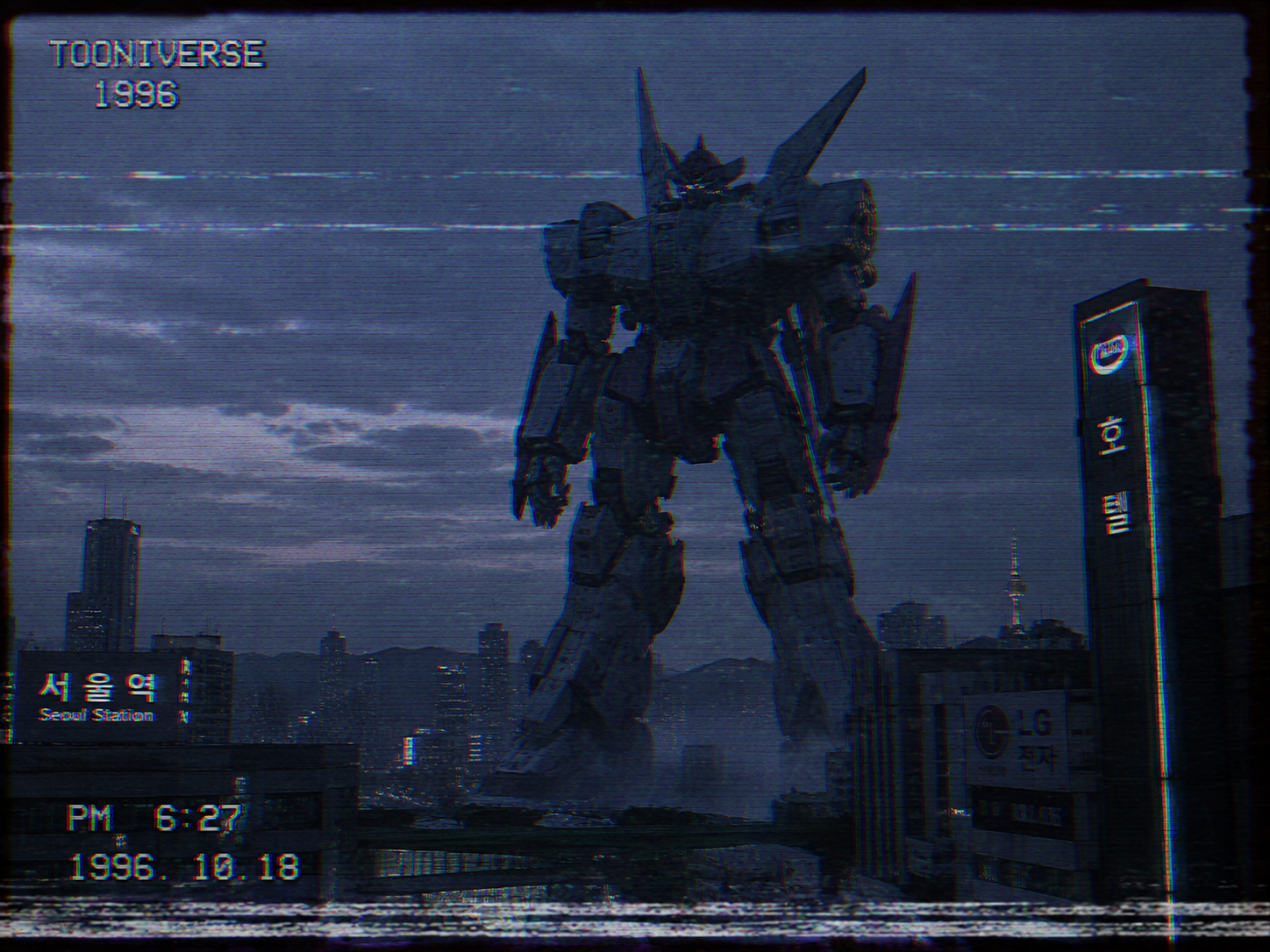
There is a category of loss that forensic archivists understand better than anyone: the clean disappearance. Not the gradual erosion of a reel left in a damp warehouse, not the slow rot of magnetic tape inside a forgotten crate—but the vacuum. The trace so complete in its absence that doubt becomes a diagnostic tool. When researchers first encounter Robot Warrior Ariel (로봇전사 아리엘), the 1996 South Korean cable broadcast that occupies exactly one line in a NamuWiki record, the instinct is to assume the researcher has made an error. They have not. The show aired. And then, by every metric archival science possesses, it ceased to exist.
This is not a story about a show someone loved and lost. It is a forensic case study—a dissection of how a piece of animated media can enter the broadcast infrastructure of an entire country, be received by cable subscribers across a metropolitan television market, and then fail to deposit a single recoverable artifact into the historical record. No cast list. No theme song audio. No episode title. No production credit. The cultural metabolism of 1996 South Korea processed Robot Warrior Ariel and expelled it without a trace. We examine that process here not with nostalgia, but with the clinical detachment the anomaly demands.
The Cultural Anatomy: Korea’s Cable Frontier and the Economics of Erasure
To understand how Ariel vanished, one must first understand what Tooniverse was in 1996—and what South Korean cable television was in that period more broadly. The Cable Television Broadcast Act had only been enacted in 1991; cable licensing and infrastructure were still being normalized when the first multichannel operators went live in 1995. Tooniverse launched into a market where the concept of cable animation archiving was not merely underfunded—it was not conceptualized at all.
The channel existed to fill programming hours. Korean broadcasters in this era operated under a content-acquisition logic that prioritized throughput over documentation; import licensing was fast, cheap, and disposable. Domestic animation studios were emerging but costly. The practical result was that a significant portion of early Tooniverse’s library consisted of licensed foreign content—Japanese OVAs, American Saturday morning imports, obscure European productions—acquired on short-term deals with minimal contractual obligation to retain materials. A title could air for a four-week run, exhaust its licensing window, and have every physical element returned to its country of origin or destroyed. No broadcast archive. No continuity of custody.
This was not malfeasance; it was standard operating procedure for a channel that had not yet developed the institutional memory to know it should preserve itself.
The censorship environment of mid-1990s South Korea added a second layer of complexity. The Korea Media Rating Board’s predecessor bodies maintained content review authority over imported animation—a bureaucratic friction that occasionally caused titles to be aired in edited, retitled, or otherwise modified forms. A Japanese OVA could enter the Korean market under an entirely new title, with dubbed credits that bore no resemblance to the original production, and with episode edits that rendered the source material unrecognizable. This matters forensically: if Robot Warrior Ariel was a retitled import, the original production may exist somewhere under an entirely different name, in an entirely different country’s archives, with no cross-reference to its Korean incarnation. The erasure would then be less a failure of preservation than an act of deliberate administrative compartmentalization—the Korean broadcast treated as ephemeral from the moment of its conception.
Structural Dissection: Analyzing the Anomalies in the Signal
What makes the Ariel case genuinely anomalous—rather than merely typical of period-appropriate Korean cable content—is the pattern of its absence. Most lost media from this era leaves what archivists call a “shadow”: a residual trace in adjacent records that confirms the primary record’s former existence. A voice actor’s career page will list an uncredited appearance. A music publisher’s ledger will show a licensing fee for a theme song. A production studio’s employment history will mention an unnamed project from a given quarter.
Robot Warrior Ariel has produced none of these shadows.
Manhwa Dongsan—one of the most comprehensive Korean animation theme song repositories maintained by the fan community—contains no entry. This is significant because the site documents obscure single-episode OVAs and forgotten direct-to-video titles from the same period with reasonable density. The gap in its database for Ariel is not the gap of an item that was documented and later removed; it is the gap of an item that was never submitted, never discussed, never brought to the community’s attention by anyone who remembered it.
Casting Bank, the Korean voice actor database, presents a parallel anomaly. Voice dubbing in South Korea during the 1990s was a small, professional community with documented guild relationships. Actors cycled through productions with regularity; their credits were tracked informally through industry relationships even when formal documentation was absent. The complete silence of Casting Bank on Ariel suggests one of three possibilities: the production used non-union talent operating outside established dubbing channels; the production was not dubbed at all and aired in its original language with subtitles (atypical for children’s animation of this era); or the production ran for so few episodes—potentially a single broadcast event—that it never generated enough professional contact to propagate through the industry’s social network.
Each of these explanations is individually plausible. Their convergence is not. The absence of data in a theme song archive and a voice actor database simultaneously, for the same title, in the same period, suggests a systemic failure of documentation rather than a gap in any single record-keeping institution. The signal itself may have been too weak—too brief, too peripheral, too contractually constrained—to excite any archival response.
Psychological Necropsy: Why This Silence Disturbs the Western Mind
The Western internet’s relationship with lost media is, at its clinical core, a grief response directed at epistemological uncertainty. The communities that organize around r/LostMedia, the Lost Media Wiki, and their adjacent forums are not primarily motivated by nostalgia—they are motivated by the unbearable condition of almost knowing. A piece of media that was definitively destroyed can be mourned and released. A piece of media that might still exist, somewhere, in an uncatalogued form, in a basement, on a deteriorating tape that no one has thought to digitize—that is psychologically intolerable in a specific and productive way.
Robot Warrior Ariel activates this response with unusual precision. It is not lost in the way that the first episode of Doctor Who is lost—destroyed by a broadcasting institution that later came to regret the decision. It is lost in the way that a conversation is lost: it happened, people were present for it, and then no mechanism existed to retain it. The NamuWiki record confirms the broadcast. The community’s silence confirms the forgetting. The gap between those two data points is where the obsession lives.
There is a secondary psychological mechanism at work here, one that intersects with the contemporary “Analog Horror” genre of internet media. The formal properties of Analog Horror—its VHS grain, its institutional fonts, its implication that official channels concealed something—map directly onto the phenomenology of the Ariel case. Here is a broadcast that thousands of children in Seoul may have watched on a Tuesday afternoon in 1996. They ate their after-school snacks. They watched a robot fight something. The credits rolled. And now that experience is, in an almost metaphysical sense, unverifiable. The witnesses exist; the evidence does not. This is not horror, precisely, but it occupies the same cognitive space—the space where reality and its documentation refuse to align.
The Evidence of Void: Physical Decay Versus Social Erasure
Lost media literature tends to privilege physical explanations for archival absence: fire, flood, magnetic deterioration, institutional negligence. These are real and frequent causes. The Ariel case, however, presents a rarer etiology—one that might be termed social erasure; the failure of a media object to generate the social infrastructure that would have preserved it.
Physical decay requires that an object exist in physical form for some duration before its destruction. Tapes degrade; prints burn; hard drives fail. But the precondition for decay is possession—someone must have held the object long enough for time to act on it. In the Ariel case, the evidence suggests that no social actor ever possessed it in a durable sense. The broadcast licensee returned or destroyed the materials. The production company—domestic or foreign, unknown—did not maintain a Korean-market archive. The viewers who watched it were children, not archivists; they had no mechanism and no motive to document what they saw.
Social preservation of media, in the pre-digital era, required at minimum one of the following: institutional retention by the broadcaster; commercial afterlife through VHS release or soundtrack publication; or fan community sufficient in size and organizational capacity to maintain informal records. Robot Warrior Ariel appears to have triggered none of these mechanisms. It was too short-lived to develop a fan community; too commercially marginal to merit VHS distribution; too institutionally peripheral for Tooniverse, in its early, under-resourced years, to archive.
The digital transition of the late 1990s and 2000s—which rescued enormous quantities of Korean animation ephemera through fan scanning, ripping, and upload campaigns—arrived too late and too unevenly to capture Ariel. By the time Korean animation fans developed the archival consciousness to ask “what did we lose?”, the window for recovery had closed. The tapes, if they had ever existed in fan hands, were gone. The people who might have remembered the show were adults with adult concerns. The title was not famous enough to trigger memory; it was not obscure enough, in the moment of its airing, to trigger the collector’s instinct.
The Point of No Return: Digital Memory and the Illusion of Total Documentation
There is a comfortable myth embedded in the contemporary digital moment: that we have solved the archival problem. That the internet, with its redundancy and its indexing and its millions of simultaneous observers, has made the Ariel scenario impossible going forward. This is incorrect. The Ariel case is instructive precisely because it illuminates the conditions under which digital documentation also fails.
Documentation is not automatic. It is social. It requires actors who possess the object, recognize its value, and expend effort to preserve it in a form accessible to others. For mainstream media, these conditions are routinely met—the commercial infrastructure of intellectual property ensures that studios archive their products and that fans create secondary archives. But at the margins—the short-run cable broadcast, the regional OVA with limited licensing, the production that existed for one contractual window and then legally ceased to matter—the social infrastructure of documentation is as thin in 2024 as it was in 1996.
The difference is that in 1996, we did not yet believe in total documentation. We accepted, with the resigned pragmatism of the analog age, that things were lost. The digital era has produced a generation that experiences archival gaps not as natural but as failures—specific, attributable, potentially reversible failures. This makes the Ariel case more disturbing now than it would have been to a researcher in 2000, because its persistence as a void indicts not just the 1996 broadcasting infrastructure but the entire default archive of human experience.
Robot Warrior Ariel was not lost because anyone decided it should be. It was lost because no one, at any point in its brief existence, possessed both the material and the motivation to ensure its survival. That is not a conspiracy. It is not a tragedy in the literary sense. It is a systems failure—a precise and replicable set of conditions under which a piece of human cultural production can pass through a broadcast infrastructure, enter millions of homes, and vanish without a recoverable trace.
The robots fought. The credits rolled. The tape was returned or erased. And somewhere in Seoul, there are adults in their late thirties and forties who carry a fragmentary memory of a cartoon they cannot name, cannot describe with any accuracy, and cannot prove they ever saw.
🔍Search Update: Call to Action
The 3AM Archive is issuing a formal request for information regarding Robot Warrior Ariel (1996). Given the likelihood that this was a retitled international acquisition, we are looking for:
-
Broadcast Captures: Any VHS home recordings from Tooniverse (Korea) circa 1996-1997.
-
Visual Matches: Mecha designs or character descriptions that resemble the name “Ariel” or “Robot Warrior.”
-
Industry Leads: Former Tooniverse acquisition logs or dubbing studio records from the mid-90s.
If you have a fragmentary memory or a physical tape that fits this vacuum, contact us immediately. The archive contains no record of them yet.
This document is an investigative archival reconstruction based on fragmented public records, media remnants, community accounts, and verified historical sources compiled by The 3AM Archive.
The article examines how incidents, forgotten media, internet folklore, and unresolved public memories evolve through cultural preservation and digital decay.
This is a cultural investigation document — not fictional horror content.
All visual materials used in this post are exclusive AI-generated assets created for The 3AM Archive.
