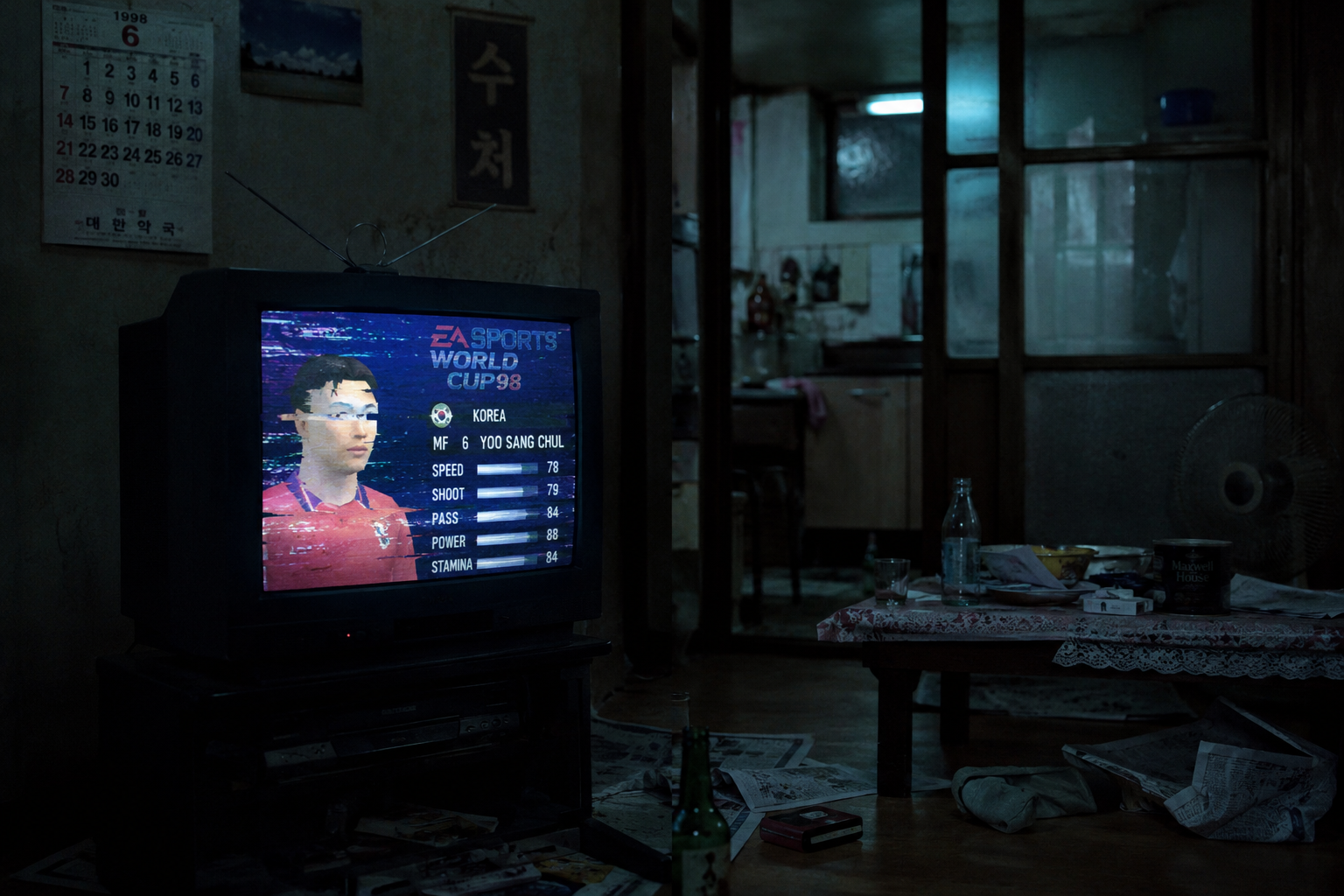
There is a peculiar cognitive dissonance in being unable to find something that, by all rights, should exist. We live in an era of compulsive digital preservation—every moment photographed, every transaction logged, every embarrassing statement cached on a server farm in Virginia. Yet certain cultural artifacts slip through this net not through catastrophic deletion, but through something more unsettling: the quiet indifference of an era that did not yet understand what it was making. Cyber World Cup 98 (사이버 월드컵 98) is one such artifact. It is not a lost film reel, misplaced in a studio archive. It is not a corrupted hard drive awaiting forensic recovery. It is, by every available indication, simply gone—the magnetic residue of a broadcast that no surviving institution thought worth preserving, and no individual thought worth recording.
This is not a mystery with a solution. It is a symptom.
The Cultural Anatomy: Crisis, Competition, and the Screen That Filled the Void
To understand what Cyber World Cup 98 was, one must first understand the precise atmosphere of South Korea in 1997 and 1998. The IMF financial crisis—called simply “the IMF” in Korean public memory, as though the institution itself were the disaster—had detonated the country’s economic confidence with extraordinary speed. The Korean won collapsed. Corporations that had seemed immovable disintegrated. Citizens melted down gold jewelry and donated it to the national reserve; the gesture was both practical and totemic, a civilizational reflex.
Into this atmosphere of suspended anxiety, the 1998 FIFA World Cup in France arrived as a permitted fantasy. Korea had qualified. The national team—not yet the force it would become under Guus Hiddink’s 2002 campaign—was a source of restrained, almost superstitious hope. The World Cup provided a narrative structure to a public that badly needed one: clear opponents, defined rules, a scoreboard that could not be manipulated by currency speculators.
Tooniverse, the cable animation network that would carry Cyber World Cup 98, was itself a creature of this transitional moment. Launched in 1995, it occupied a slot in the burgeoning Korean cable landscape alongside adult programming and news channels that were still calibrating their purpose. By the standards of the time, Tooniverse was a channel for children and young adults—Sailor Moon aired there; so did Neon Genesis Evangelion—but “young adult” in 1998 Korea included the first generation of students who had grown up adjacent to personal computing. They understood, at least intuitively, that a game engine could simulate something real.
The collaboration with iTV (Incheon Television) gave the broadcast a regional anchor; Incheon’s role as Korea’s primary port city—the point of entry and departure—lends the partnership an almost allegorical quality in retrospect. Cyber World Cup 98 was, structurally, a program about arrival and departure too: the arrival of algorithmic entertainment into the living room, the departure of the human performer as necessary intermediary.
Structural Dissection: The Anomalies in the Signal
The mechanics of Cyber World Cup 98 were, by modern standards, elementary. The program used the EA Sports World Cup 98 game engine—itself a licensed product of considerable commercial ambition at the time—to simulate matches between AI-controlled national teams. No human hands were on the controller. The CPU played itself, and the results were broadcast as predictive content: here is how the simulation believes France will perform against Brazil; here is what the algorithm assigns to South Korea’s probability of advancing.
What makes this structurally strange, examined from a forensic distance, is the category confusion it enacted. Sports broadcasting had always relied on the unpredictability of human performance as its core value proposition. The athletic body—fallible, pressured, sometimes transcendent—was the product being sold. Cyber World Cup 98 quietly replaced that body with code. It asked its audience to invest emotionally in outcomes generated by a sports simulation engine’s internal probability functions; and, critically, that audience appears to have found this acceptable.
In the Western broadcasting context of 1998, this would have been near-unthinkable as prime content. The closest analog—SaltyBet, the Twitch channel that streams AI-versus-AI fighting game matches—would not emerge until 2013, and even then it occupied an ironic, self-aware corner of internet culture, appreciated precisely for its absurdity. The Korean audience of 1998 was not engaging with Cyber World Cup 98 ironically. The IMF crisis had calibrated their appetite for controlled, legible conflict. A simulation in which outcomes were governed by statistical modeling may have felt less alienating than an economy governed by the same.
The program’s position on Tooniverse also bears examination. Airing alongside Japanese animation—much of it concerned with exactly the themes of machine intelligence, adolescent anxiety, and civilizational rupture that characterized Evangelion—Cyber World Cup 98 absorbed some of that context by proximity. It was consumed by a viewership already primed to take seriously the idea that artificial systems could produce meaningful, emotionally resonant events. The channel’s programming philosophy, whether by design or accident, had prepared its audience for exactly this content.
Psychological Necropsy: Why the Silence Disturbs the Western Mind
The Western media scholar—and, more broadly, the Western enthusiast of eSports history—encounters Cyber World Cup 98 through a framework that makes its disappearance feel like a moral failure rather than a logistical one. The dominant Western narrative of eSports origins centers on the late 1990s American and European PC gaming scenes; Quake tournaments; the gradual professionalization of StarCraft strategy. Korea’s role in this narrative is acknowledged, but it is usually positioned as a parallel development that converged with Western structures rather than preceded them.
Cyber World Cup 98 disturbs this because it suggests that the Korean broadcasting infrastructure was not merely parallel to Western eSports development—it was, in certain respects, ahead of it. The program predates the legendary OGN StarLeague, which itself predates virtually everything the West recognizes as “early” eSports broadcasting. More specifically, it demonstrates that a Korean television network was willing, in 1998, to surrender its airtime to an autonomous algorithm—to treat machine decision-making as entertainment—before any Western broadcaster had considered the concept seriously.
The disappearance of Cyber World Cup 98 thus creates a kind of historiographical wound. If the founding document of a multi-billion dollar global industry is simply absent, then the industry’s official history is not merely incomplete; it is structurally misrepresented. Every timeline that begins with the StarLeague, every documentary that treats 2000 as a Year Zero for broadcast eSports, is operating with a missing variable. The absence does not merely leave a gap. It actively reshapes everything adjacent to it.
There is also a subtler disturbance. Western digital culture has developed what might be called a preservation instinct rooted in abundance. Hard drives are large; bandwidth is cheap; the default archive of human experience now assumes that the decision about what is significant can always be made retroactively. This perspective is built upon the false comfort of modern capacity. The assumption that the archive can be compiled after the fact persists only because the raw material is expected to remain. Cyber World Cup 98 is a case study in the failure of this assumption. The raw material did not persist. The decision was made—implicitly, by inaction—at the moment of broadcast, and it was the wrong decision, made by people who had no way of knowing it was a decision at all.
The Evidence of Void: Physical Decay Versus Social Erasure
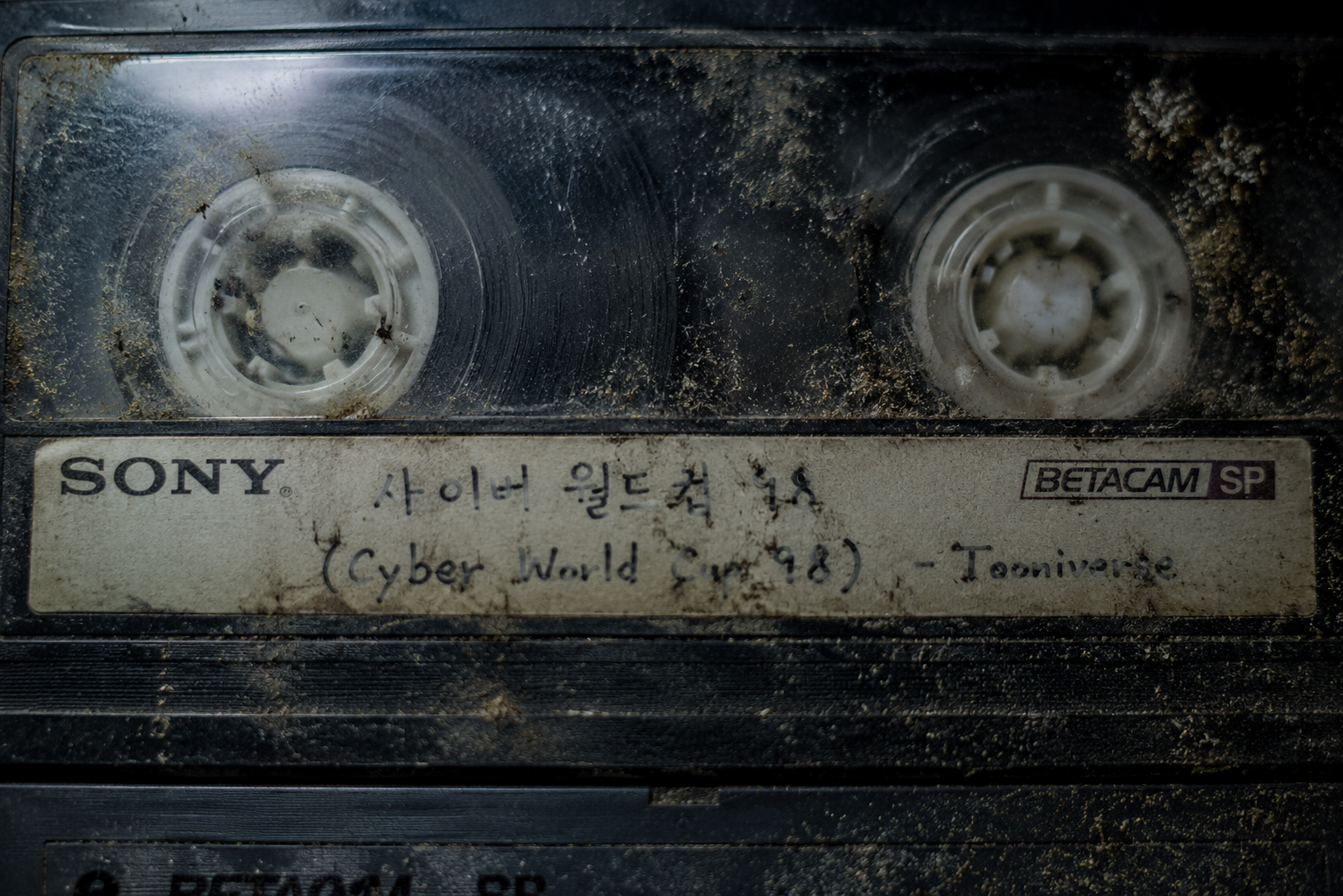
Two mechanisms could account for the total extinction of Cyber World Cup 98, and they are not mutually exclusive. The first is material: magnetic tape degradation. The broadcast would have been recorded on Betacam SP or U-matic cassettes—the professional formats of the era—and these degrade through a process called sticky shed syndrome, in which the polymer binder that holds magnetic particles to the tape base absorbs moisture and disintegrates. Without climate-controlled storage and periodic migration to newer formats, a master tape from 1998 may, by now, be unplayable even if it physically exists.
The second mechanism is institutional: the deliberate or negligent erasure of content deemed exhausted. Tape was expensive in 1998; the common practice at smaller broadcasters was to record over old content once it had aired and its immediate rebroadcast window had closed. iTV, as a regional broadcaster, would have had limited archival infrastructure and limited incentive to preserve what was, at the time, a novelty program without obvious lasting value. The decision to erase—if erasure was the mechanism—would not have felt like a decision. It would have felt like maintenance.
The absence of amateur recordings is perhaps more revealing than the absence of master tapes. In 1998, Korean households with VCRs capable of recording cable broadcasts were common enough that one would expect, in a program with any significant viewership, at least a handful of private recordings to have survived. That none has surfaced—not on Korean vintage media forums, not in the collections of eSports historians, not in any documented private archive—suggests either that viewership was genuinely small, or that the recordings that were made have themselves degraded or been discarded in subsequent decades.
The legal status of any hypothetically recovered footage compounds the problem. The FIFA brand’s transition to EA Sports FC has rendered the original licensing framework obsolete; the player likeness rights embedded in the World Cup 98 game engine are governed by contracts that may no longer have identifiable counterparties. Even if a master tape were discovered tomorrow in a Seoul storage facility, the path from discovery to legitimate public distribution would be, at minimum, years long and, more likely, permanently blocked. The void is not merely physical; it has been institutionally reinforced by the passage of time and the restructuring of intellectual property regimes.
The Point of No Return: Digital Memory and the Uncomfortable Arithmetic
The uncomfortable insight at the terminus of this forensic exercise is not that Cyber World Cup 98 is gone. It is that its disappearance was structurally inevitable given the conditions under which it existed, and that those conditions are less remote than we prefer to believe.
The digital preservation infrastructure that Western audiences take for granted—Internet Archive, YouTube’s effective permanence, the distributed redundancy of online communities—is younger than it appears. The culture of deliberate archiving did not exist in 1998; it barely existed in 2005. The assumption that digital objects persist by default is a behavior learned in the age of broadband and cloud storage, not the age of magnetic tape and analog cable broadcast. Cyber World Cup 98 existed in the gap between two archival cultures: too late for the institutional preservation practices that had saved major film and television from the mid-20th century, too early for the community-driven digital preservation that would eventually save early internet culture from itself.
This gap is not closed. It is merely smaller. Content that exists only on proprietary platforms—platforms with terms of service that prohibit archiving, platforms that can and do delete material without notice—is subject to a version of the same vulnerability that consumed Cyber World Cup 98. The mechanisms differ; the outcome does not. The algorithm that determines what a platform preserves and what it discards is, in structural terms, not so different from the implicit decision made by an Incheon television archivist in 1999 who looked at a shelf of old tapes and reached for one that seemed expendable.
What Cyber World Cup 98 represents—its fossil-record significance, to use the appropriate metaphor—is the moment when a television network first treated algorithmic output as a primary entertainment product and delivered it to a mass audience. That moment happened. It was witnessed by real people who remember it, hazily, as a strange interlude in a strange year. It generated, in a quantifiable sense, cultural meaning: it shaped the expectations and appetites of a viewership that would, within five years, make South Korea the global capital of competitive gaming.
The record of that moment is gone. Not hidden, not misfiled—gone. And the industry that moment founded has, as far as the available evidence indicates, not made a serious institutional effort to recover it. This is not an accusation; it is an observation about how industries treat their own prehistory when that prehistory is inconvenient, invisible, or simply unfamiliar. The eSports industry knows what OGN built. It does not know, and may never know, what Tooniverse and iTV were doing in the months before OGN existed.
Patient Zero does not appear in the case files. The epidemiologists have reconstructed the outbreak anyway, from secondary evidence and inference, and they are reasonably confident in their conclusions. But the original data is lost; and without it, every conclusion carries an asterisk—a small, permanent notation of the thing we could have known, and didn’t think to save.
🔍Search Update: Call to Action
The 3AM Archive is officially listing Cyber World Cup 98 as a Priority 1 Lost Artifact. We are calling upon the global Media Archeology community and r/LostMedia to assist in the recovery of any magnetic residue. If you possess VHS recordings of Tooniverse or iTV broadcasts from June-July 1998, or have leads regarding the OGN/OnMedia internal archives, please submit your evidence. We are looking for the ‘Patient Zero’ of digital sports. Do not let the signal fade into absolute zero.
This document is an investigative archival reconstruction based on fragmented public records, media remnants, community accounts, and verified historical sources compiled by The 3AM Archive.
The article examines how incidents, forgotten media, internet folklore, and unresolved public memories evolve through cultural preservation and digital decay.
This is a cultural investigation document — not fictional horror content.
All visual materials used in this post are exclusive AI-generated assets created for The 3AM Archive.
