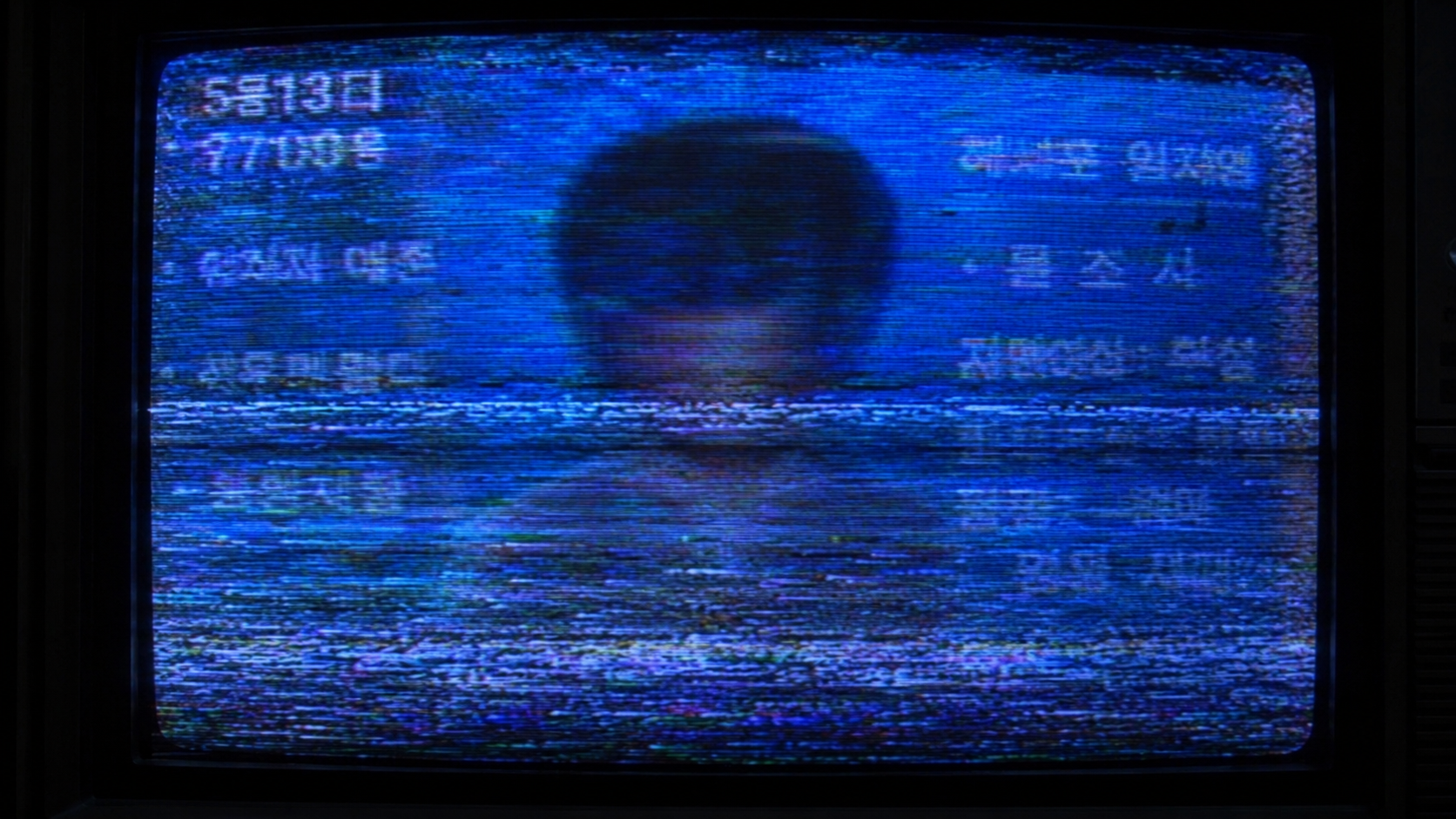
Certain cold cases resist standard true crime framing: they lack a clear predator, a forensic trail, or an easily identifiable villain. The case of Kim Tae-geuk—eight years old, 127 centimeters tall, last seen leaving his front door in Jeongeup at approximately 18:00 on September 30, 1998—belongs to this category. Yet to classify it as merely “unsolved” is to participate in the same institutional failure that allowed it to happen. Kim Tae-geuk vanished at a precise historical inflection point: when the host nation’s administrative and social safety infrastructure was actively fracturing. What the internet now calls a cold case, forensic sociology would more precisely call a structural casualty—a child-shaped gap in the record produced not by criminal cunning but by the coordinated collapse of economic, bureaucratic, and archival systems across an entire peninsula.
While the official 1998 police file remains bare, the digital mythology surrounding it has expanded significantly over twenty-seven years.
Historical Anatomy
To understand September 30, 1998, one must first understand March 1998, when the Kim family arrived in Jeongeup. They had not chosen to return. The 1997 Asian Financial Crisis—known locally as the “IMF Crisis”—forced thousands of working-class families to abruptly downsize. In the span of weeks, Seoul’s financial architecture had partially imploded; middle-class families who had leveraged themselves into the capital’s economy found their assets dissolving faster than the legal machinery could process the losses. The Kim family was among the hundreds of thousands who liquidated what remained and retreated to provincial towns of origin.
This rapid internal migration fundamentally disrupted typical neighborhood witness dynamics. In typical child disappearance investigations, a community’s social network is established and legible; in this instance, the family had arrived only seven months prior. Seven months is insufficient, in any insular rural Korean community, to establish the granular social embedding that produces reliable witness networks. The neighbors who might have noticed an unfamiliar adult near the child, who might have registered an anomaly in the evening’s pedestrian patterns—those neighbors did not yet know the family well enough to be watching.
Institutional records from 1998 highlight severe systemic vulnerabilities. Due to IMF-mandated public sector budget cuts, regional precincts faced immediate understaffing and resource depletions. Police departments in provincial cities like Jeongeup were operating with depleted staffing, degraded equipment, and the organizational demoralization that accompanies any institution asked to do more with substantially less. The officers who received the Kim family’s report that night were not negligent individuals so much as representatives of a systematically compromised institution.
The weather on September 30 completed the environmental isolation. Heavy, unseasonal autumn rainfall had cleared the streets by the time the parents realized Tae-geuk had not returned. Rain in Korean provincial neighborhoods in 1998 was not the minor inconvenience it might register as in a surveillance-dense contemporary city; it meant the erasure of physical traces, the retreat of potential witnesses indoors, and the narrowing of the investigative window to near-zero before anyone in authority had even opened a file.
Structural Dissection of the Record
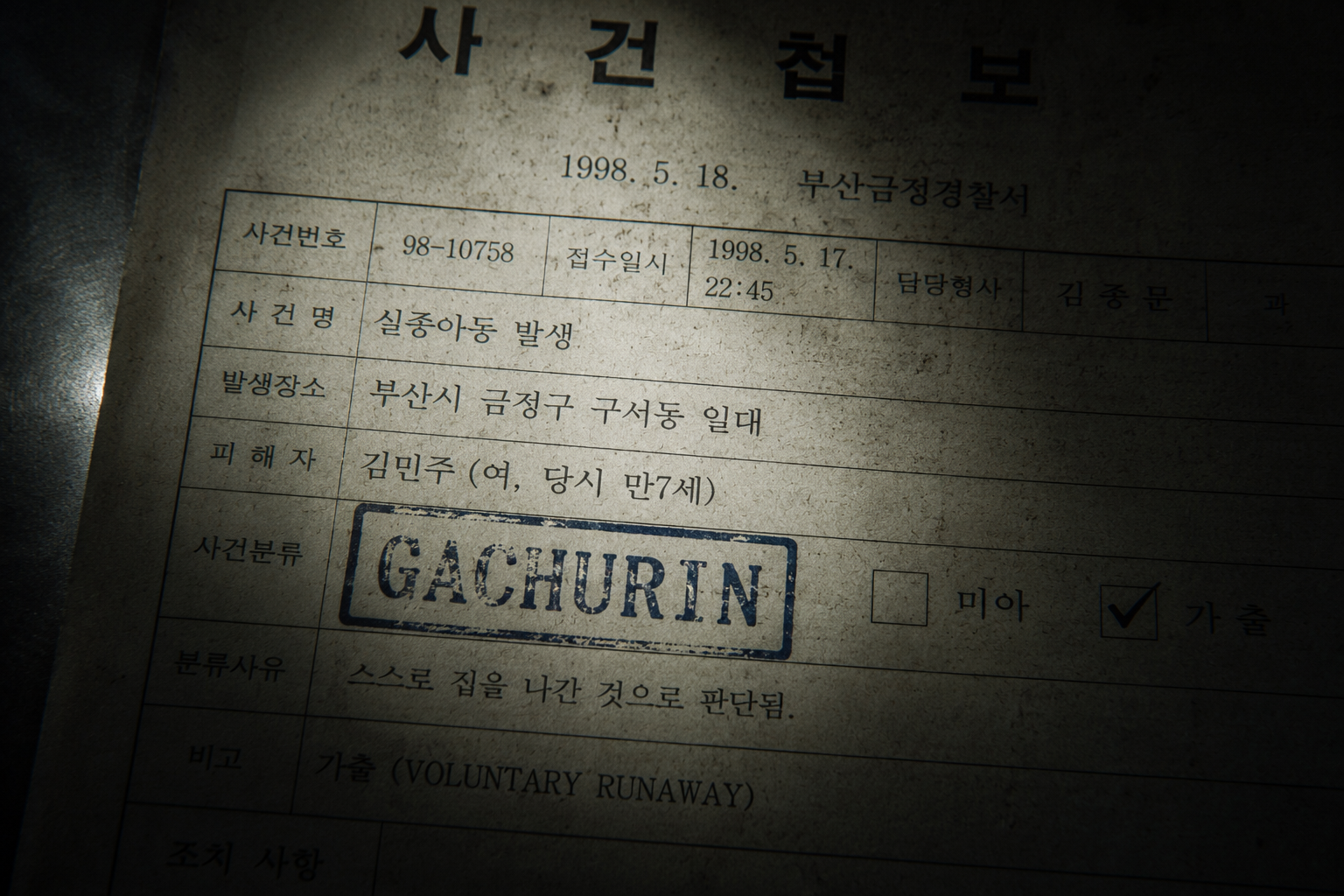
Initial law enforcement mobilization was restricted to a localized neighborhood loudspeaker announcement. It is a response calibrated for inconvenience, not emergency. More critically, Jeongeup police classified the eight-year-old as a gachurin—a voluntary runaway—within the initial response window. The bureaucratic implications of this classification are significant and deserve explicit examination.
Gachurin status in the South Korean police administrative system of the late 1990s functioned primarily as a statistical and procedural category; its application to young children was a known systemic practice for managing caseload and suppressing kidnapping statistics in official reporting. An eight-year-old classified as a runaway does not trigger the same investigative resource allocation as an eight-year-old classified as a missing person or abduction victim. Search units are not mobilized. The critical initial hours—during which physical evidence degrades, potential witnesses’ memories remain fresh, and a living child remains findable—pass without coordinated institutional action. By the time the classification was likely reconsidered, the rain had continued, the night had deepened, and whatever had happened to Kim Tae-geuk had finished happening.
The physical evidence record is a study in absence. Searches of the Jeongeupcheon stream and the downstream drainage network extending toward the Saemangeum reclaimed land region produced nothing—no clothing fragments, no personal items, no biological material. This total evidential void is itself a data point, though an ambiguous one; it neither confirms nor forecloses any particular hypothesis about what occurred between 18:00 and 20:00.
Official documentation notes three specific physical identifiers that complicate the total lack of historical sightings:
-
A pronounced speech impediment triggered under acute anxiety.
-
A distinct motor tic involving the lifting and shaking of his left arm when stressed.
-
A half-grown right front incisor tooth.
That none of these markers produced a confirmed sighting or identification in the weeks and months after the disappearance suggests either that no one who encountered him afterward was positioned to report it, or that he was never in a position to be encountered.
The local media footprint remains an archival black hole. Because regional television in 1998 relied entirely on physical VHS and Beta tape formats without digital backups, the original news broadcasts have physically degraded in un-audited regional warehouses. This is not metaphorical archival silence; it is the literal physical deterioration of information stored on formats that were already commercially obsolete by the time anyone might have thought to transfer them.
Psychological Necropsy
The case disturbs the Western investigative imagination for reasons that are worth examining with some precision, because those reasons reveal as much about the Western investigative imagination as they do about the case itself.
Anglo-American true crime culture has developed, over decades of media saturation, a highly specific set of narrative expectations: a credible suspect or perpetrator framework, a forensic evidence arc, a geographic theater that can be mapped and bounded, and a resolution—however partial—that confirms the fundamental legibility of criminal events. The Kim Tae-geuk case violates all of these expectations simultaneously. There is no suspect framework; the investigation never advanced far enough to generate one. There is no forensic arc; the evidence record begins and ends with the family’s testimony. The geographic theater is a provincial Korean town in 1998, which resists the kind of dense documentary reconstruction that sustains Western cold case analysis. And the resolution is a permanent open question.
What disturbs is not the violence—violence is, paradoxically, what true crime culture processes most fluently. What disturbs is the bureaucratic indifference; the possibility that the most consequential decisions in this case were made not by a perpetrator exercising agency but by a desk officer applying a standard procedural classification to an eight-year-old child and thereby functionally ending the search before it began.
The Evidence of Erasure
The absence of verified primary sources has turned the case into a prime subject for modern digital folklore.
The most structurally significant is what might be called the “Ghost Twin” narrative. Kim Tae-geuk had an identical twin brother, Kim Mu-geuk, who was inside the family home at the time of the disappearance. Online forums have repeatedly attempted to insert Mu-geuk into the immediate scene—generating scenarios in which he witnessed an abduction but experienced dissociative memory suppression, or in which both twins disappeared and one was returned or recovered under unclear circumstances. Official statements are unambiguous on this point; the twin’s presence inside the house is documented. Yet the narrative persists because twins introduce a doubling mechanism that is deeply generative for speculative reconstruction. The real twin becomes a vehicle for hypotheticals that the actual evidentiary record cannot support.
The waterway theory represents a second, distinct failure mode. The Jeongeupcheon flash flood hypothesis—in which Tae-geuk was swept away by surge water during the rainfall—has achieved significant traction in digital discussions because it provides something the actual record cannot: a definitive causal mechanism. The problem is that extensive downstream searches, extending to the Saemangeum region, produced zero physical evidence. The flood theory is not supported by the search record; it is supported by the psychological need for resolution that ambiguity frustrates. It transforms a disturbing open question about human agency or institutional failure into a natural disaster narrative, thereby exporting moral responsibility from human actors to meteorological event.
The archival vacuum that enabled both of these narrative mutations is a direct product of the digitization gap. The web has become the default archive of human experience. However, because no reliable digital record of 1998 regional Korean media coverage is publicly accessible, the evidentiary cost of manufacturing claims is functionally zero. A forum user asserting a specific detail about local police communications or neighborhood witness accounts faces no accessible primary source that could falsify the claim. The digital absence does not merely allow mythology. It actively incentivizes it, because confident specificity in a vacuum reads as research.
The Kim family’s own trajectory through the aftermath of the disappearance represents a form of evidence in itself. The father, Kim Beom-cheon, became a co-founder of a coalition organization connecting parents of long-term missing children—aligning his case with other high-profile unresolved disappearances including the Choi Jun-won and Mo Young-gwang cases—and contributed to the legislative effort that produced South Korea’s early Missing Persons Protection Acts. This is institutional activism born directly from the experience of bureaucratic failure; it is, in the clearest possible terms, a man attempting to reconstruct at the legislative level the protective infrastructure that did not exist on September 30, 1998.
The Point of No Return
The Kim Tae-geuk case does not resolve. This is its final and most durable truth—not as sentiment, but as structural fact. The physical evidence has degraded past recovery. The broadcast record has likely decomposed on magnetic tape in provincial archives, or was never recorded with sufficient thoroughness to be recovered even if the tapes survive. The witnesses, such as they were, are twenty-seven years older and operating from memories that have been subject to the normal cognitive erosion of time, compounded by the narrative overlays of decades of public discussion.
What survives is the administrative record of a classification decision—gachurin—made sometime in the late night hours of September 30, 1998, by an officer in a provincial police department operating under institutional conditions that the South Korean government’s own fiscal compliance requirements had deliberately degraded. That classification is the most forensically significant artifact in the case; it is the precise moment at which an eight-year-old child was officially redefined as a problem that did not require emergency intervention, and the machinery of forgetting was set in motion.
The internet has responded to this machinery not with archaeology but with confabulation. The digital communities that discuss Kim Tae-geuk do not primarily search for primary sources—which are mostly inaccessible—but generate secondary narratives that feel sourced. The left-arm tic. The half-grown incisor. The twin standing inside, behind the door. These details are real; they are documented. But they have been embedded in fabricated frameworks—the witnessed abduction, the flood sweep, the returned twin—that the actual record does not support. The details lend the fabrications the texture of research, which is precisely what makes the fabrications durable.
This is the final uncomfortable arithmetic of the Kim Tae-geuk case: the most reliable evidence of what happened to an eight-year-old boy in Jeongeup in 1998 is a bureaucratic category, applied in haste, by an underfunded institution, during a national economic emergency—and even that evidence points primarily to what did not happen in the hours immediately following his disappearance, rather than to what did. A child is missing. The archive is missing. What remains is the silence between them, and the stories people tell to fill it.
🔍Search Update: Call to Action
For the Western lost media and internet archaeology communities tracking the digital vacuum of the late-90s East Asian web, the Kim Tae-geuk files present a critical point of concern. Because local broadcasts from Jeonbuk Province (September–October 1998) remain locked on physical magnetic tape, uncovering any digitized fragments, missing child flyers distributed in regional transportation hubs, or early Korean web index listings (e.g., early Daum or Yahoo! Korea directories) is vital. If you have access to un-digitized VHS regional news archives from late 1998 or early community forum scrapes, contact the archive database.
This document is an investigative archival reconstruction based on fragmented public records, media remnants, community accounts, and verified historical sources compiled by The 3AM Archive.
The article examines how incidents, forgotten media, internet folklore, and unresolved public memories evolve through cultural preservation and digital decay.
This is a cultural investigation document — not fictional horror content.
All visual materials used in this post are exclusive AI-generated assets created for The 3AM Archive.
