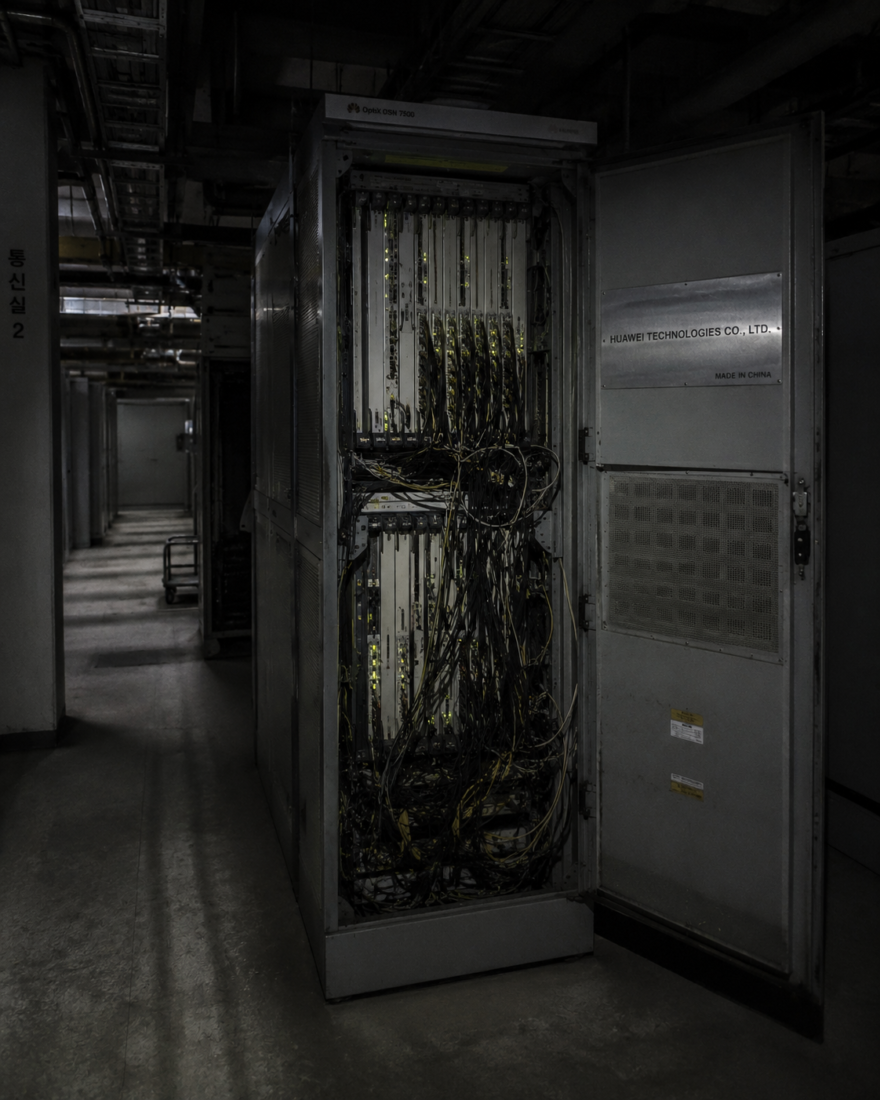
There is a particular kind of institutional failure that does not announce itself. It does not arrive with a breach notification, a press conference, or a cascading outage that forces the evening news to improvise graphics. It arrives the way sediment arrives—incrementally, invisibly, layer by layer, until the geology of a nation’s communications infrastructure has been quietly rewritten by a foreign hand. South Korea’s entanglement with Huawei telecommunications hardware is precisely this kind of failure: not a rupture, but an accumulation. Not a wound, but a slow architectural possession.
What makes this story structurally unusual—and culturally diagnostic—is the degree to which the contamination was chosen. The hardware was purchased; the contracts were signed; the base stations were installed within operational range of some of the most sensitive military terrain on the Korean peninsula. The espionage infrastructure was not smuggled in. It was delivered, invoiced, and accepted. The question the record forces us to ask is not how this happened, but why an entire institutional apparatus—corporate, governmental, and public—conspired, whether through negligence or calculation, to look away.
Historical Anatomy
The conditions for the compromise were established well before 2013, when LG U+ formally introduced Huawei LTE base stations into Seoul and the northern military border corridor. To understand why this decision encountered so little resistance, it is necessary to understand the telecommunications environment South Korea inhabited at the time.
The country had built its identity as a broadband nation on the twin engines of state-directed investment and ferocious corporate competition. Speed was a geopolitical statement; connectivity was a civic virtue. Within this framework, hardware procurement decisions were evaluated primarily through the lens of deployment efficiency and cost optimization. The intelligence implications of network architecture—a domain that Western agencies had been openly theorizing since at least the mid-2000s—registered as background noise in Seoul’s boardrooms. The prevailing attitude, which would later calcify into something resembling institutional doctrine, treated backdoor risk as an abstract, probabilistic concern; something that belonged to defense white papers rather than vendor contracts.
LG U+’s decision to deploy Huawei equipment in areas adjacent to US Forces Korea installations was not, at the time, experienced as a security event. It was experienced as a procurement win. The cost differential between Huawei and its Western competitors—Ericsson, Nokia—was substantial. In a market defined by infrastructure buildout velocity, the choice made a certain narrow-gauge commercial logic.
What the commercial logic failed to account for was the legislative architecture being constructed in Beijing. China’s 2017 National Intelligence Law, and the Internet Safety Supervision Regulations that followed in 2018, formalized what security analysts had long suspected was already operationally true: every Chinese technology company, regardless of its nominal private status, was legally bound to cooperate with state security organs. The implications for any hardware embedded in foreign telecommunications infrastructure were not theoretical. They were statutory.
Structural Dissection of the Record
The public record of the South Korean Huawei compromise is not a single document. It is a dispersed archive—fragments from regulatory proceedings, leaked contractor files, military advisories, and forum speculation—that must be assembled with some care, because the institutional actors involved have strong incentives to prevent a coherent picture from forming.
The clearest single entry point into the record is the iSoon leak of February 2024. The document cache—deposited anonymously on GitHub and attributed to Shanghai Anxun Information Technology, a contractor operating within the orbit of the Ministry of State Security—provided the most granular public confirmation to date that South Korean telecommunications infrastructure was a systematic, named target of Chinese state-sponsored intrusion. Internal contractor logs detailed the mechanics of telecom backbone infiltration and government endpoint access, treating South Korean networks not as incidental targets of opportunity but as persistent collection priorities. The leak did not reveal new capabilities; it confirmed the operational reality of capabilities that had been structurally available since the base stations were installed.
What the iSoon files illuminated about South Korean exposure, the September 2025 Personal Information Protection Commission investigation corroborated from the regulatory side. The PIPC’s formal probe into KT and LG U+—triggered by unauthorized micropayment anomalies and security breaches traceable to deep-system intrusions that had first surfaced in international cybersecurity publications—marked the moment the compromise became an administrative fact rather than an intelligence inference. The regulator’s involvement did not produce rapid accountability; it produced careful procedural language and the quiet beginning of what would become a years-long institutional negotiation over culpability.
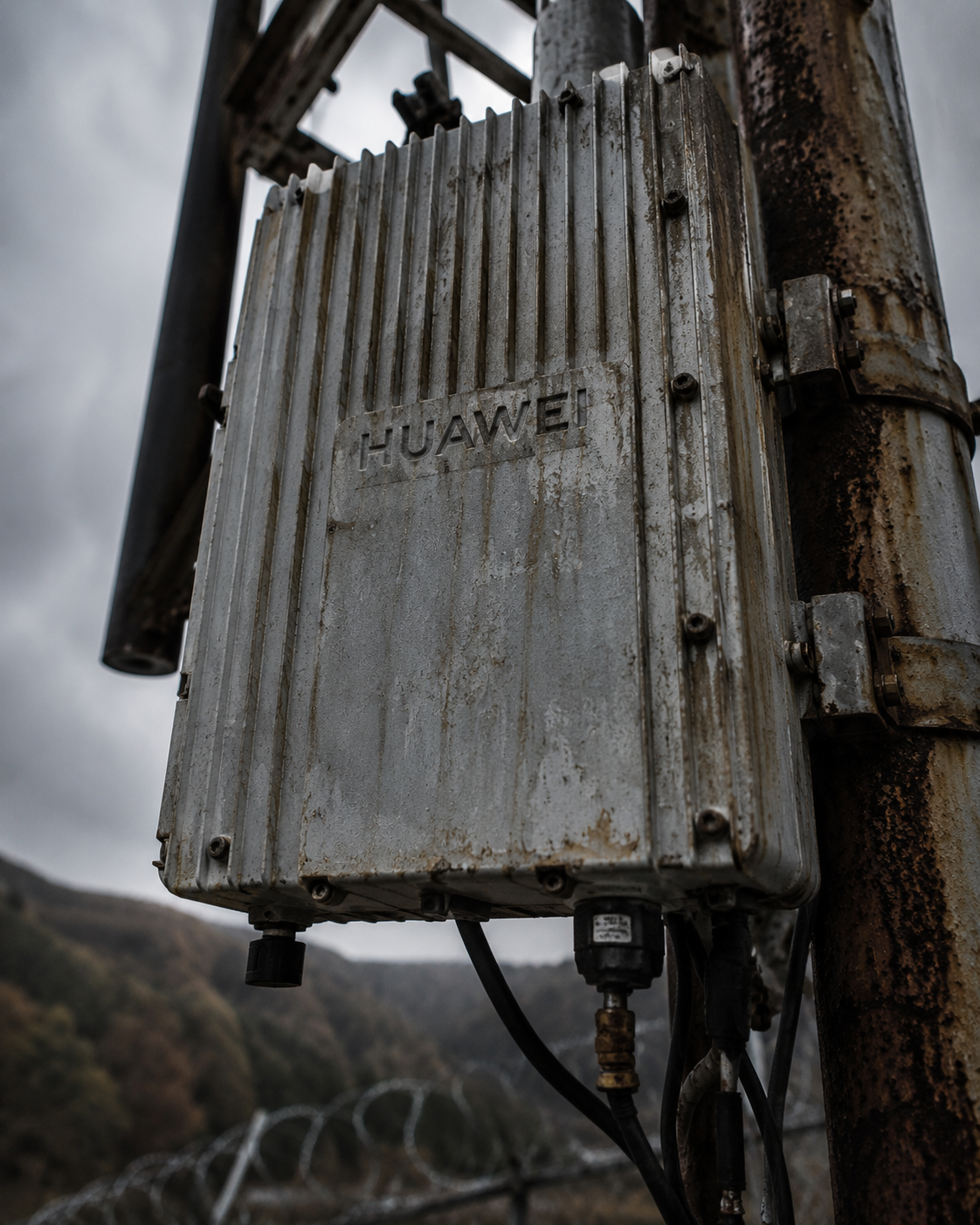
The physical record is, in some respects, even more difficult to contest than the documentary one. Remote Radio Units bearing Huawei branding remain physically embedded across forward military sectors in Gyeonggi and Gangwon provinces. These are not legacy systems awaiting scheduled replacement; they are active infrastructure elements positioned at the signals intelligence interface between South Korean civilian networks and frontline military communications. Their continued presence in that geography constitutes, in the language of hardware forensics, a permanent access window—one that exists independently of any particular software exploit or zero-day condition.
The May 2026 disclosure of a critical undocumented vulnerability in Huawei enterprise router firmware added a new dimension to the structural analysis. Investigative reporting revealed that specific patterns of highly structured network data could trigger an undocumented packet parsing failure, driving affected routers into unrecoverable reboot loops. The significance of this disclosure extended well beyond the immediate remediation challenge; it demonstrated that the architecture of network paralysis did not require a volumetric attack. Control could be extinguished silently, by a single precisely constructed packet traversing the right node. The midnight replacement of routing cabinets that followed—documented in fragmented form across technical forums and logistics procurement records—represented the most urgent physical acknowledgment to date that the hardware problem was not theoretical.
Psychological Necropsy
The Western intelligence imagination tends to construct its narratives of espionage around discrete events: the penetration, the discovery, the response. It is a framework organized around the dramatic arc of breach-and-remediation—comforting because it implies resolution, because it situates the intrusion as an interruption rather than a condition.
The South Korean Huawei compromise does not fit this framework. There is no clean breach date. There is no recoverable pristine state to which the network can be restored. The hardware is not a foreign body that can be extracted; it is now structural tissue. This is what the Western analytical imagination finds genuinely unsettling about the case—not the espionage itself, which is banal in its mechanics, but the irreversibility. The scenario that security theorists had long described as the worst-case outcome of infrastructure capture was realized not through sophisticated covert operation but through ordinary commercial procurement, across a decade, in plain sight.
The particular anxiety the case generates is compounded by the military geography. South Korea is not a generic target; it is the host of approximately 28,500 US military personnel, positioned along one of the most intensively monitored borders in the world. The signals intelligence value of persistent access to telecommunications infrastructure in that environment is not difficult to calculate. Military logistics, supply chain routing, personnel movement, social network mapping—the aggregate value of years of passive collection through a contaminated network backbone represents a category of strategic advantage that no single operational intrusion could replicate. The iSoon files made this calculus explicit; the physical presence of Huawei hardware in Gyeonggi and Gangwon made it structural.
There is also a secondary anxiety, specific to South Korean institutional culture: the degree to which the public was systematically misdirected. The retail-level decoy campaign—window signs around US military base perimeters falsely advertising Huawei-free equipment—represents a striking instance of localized information management. The signs were not produced by state actors; they were produced by distributors protecting merchant revenue. This granularity of deception, occurring simultaneously at the corporate, regulatory, and retail levels, suggests not a coordinated cover-up but something more diffuse and perhaps more disturbing: a self-organizing ecosystem of motivated non-disclosure.
The Evidence of Erasure
The fragmentation of the public record on this subject is not accidental, but neither is it the product of a single organizing suppression. It is the outcome of multiple overlapping incentive structures, each of which independently produces the same result: the foreclosure of coherent historical accounting.
At the corporate level, LG U+ and KT possessed strong commercial interests in preventing the infrastructure compromise from becoming a consumer-legible narrative. The subscriber base of both carriers encompasses tens of millions of South Korean nationals; the reputational and legal exposure attendant on a formal acknowledgment that customer data had been systematically accessible to Chinese state security organs was, and remains, existential. Corporate disclosure strategy in such circumstances predictably tends toward procedural minimalism: acknowledgment only of what the regulatory record compels, framing of systemic failures as isolated incidents, and the strategic exploitation of technical complexity to discourage lay comprehension.
At the governmental level, the political geometry of the compromise created its own archival pressures. South Korea’s relationship with China is structurally constrained by economic interdependence—China remains the country’s largest trading partner—while its security architecture is anchored to the US alliance. A formal governmental acknowledgment that domestic telecom infrastructure had been operating as a Chinese intelligence collection platform would have forced an explicit confrontation with both dimensions of this structural tension simultaneously. The regulatory investigation launched in September 2025 can be read, in part, as an attempt to occupy the procedural space between acknowledgment and accountability—active enough to satisfy allied intelligence partners, contained enough to avoid diplomatic rupture.
The internet mythology layer—the kill-switch legend, the “firmware exorcism” documentation in technical forums, the “3TB ghost cache” speculation surrounding the iSoon leak—performs a separate but complementary archival function. It absorbs public anxiety into a register of folklore that is, by definition, deniable. The rumors are not false in any simple sense; they are extrapolations from verifiable structural facts, amplified and aestheticized by communities that understand the technical substrate well enough to know the extrapolations are plausible. But their folkloric form immunizes the institutional actors involved against the rumors’ specific claims. Ghost caches cannot be subpoenaed; kill-switch legends cannot be litigated.
The physical decay of the evidence base is also operative here. Base station hardware does not produce a ledger of the data it has transmitted. Firmware logs at the compromised nodes—if they exist in accessible form—are not subject to South Korean legal process in any jurisdiction that matters. The evidentiary record of what the hardware actually transmitted, and to whom, is almost certainly irrecoverable through conventional forensic means.
The Point of No Return
What the South Korean case ultimately documents is a structural property of modern telecommunications infrastructure that the industry’s procurement frameworks were never designed to account for: the possibility that hardware, once embedded at sufficient depth and scale, achieves a kind of archival permanence that transcends its original commercial context.
The iSoon leak confirmed the collection. The PIPC investigation acknowledged the breach surface. The May 2026 firmware disclosure proved the paralysis potential. The midnight cabinet replacements began the physical remediation. But none of these events—not even their aggregate—constitutes a return to the antecedent state. The data that moved through the compromised nodes over the course of a decade does not un-move. The military personnel whose call metadata traversed the border base stations in Gyeonggi and Gangwon do not become unidentified. The social network graphs assembled from years of subscriber-level collection do not dissolve.
What South Korea purchased in 2013 was not merely telecommunications equipment. It purchased a permanent layer of foreign archival access—one that now exists in whatever form Chinese state security organs have chosen to preserve it, outside the jurisdiction of any Korean court, beyond the reach of any firmware patch, unaffected by the midnight replacement of physical cabinets. The cabinets can be swapped. The record cannot be expunged.
This is the point at which the case transcends the conventional espionage narrative and becomes a problem of historical epistemology. Modern digital infrastructure is not merely a channel through which events pass; it is, itself, a default archive of human experience. Every call routed, every session logged, every packet parsed by compromised hardware contributed to a dataset that is, by any reasonable definition, a record. This record now exists in a foreign archive, produced directly from South Korean national life, and remains entirely inaccessible to South Korean accountability mechanisms.
The “Invisible Citizen” fallacy—the folk logic that a superpower would have no interest in an ordinary person’s call records—fails to account for this aggregate dimension. Signals intelligence is not interested in individual calls; it is interested in the population-level patterns that individual calls, in the aggregate, produce. The military logistics maps. The supply chain rhythms. The social network topologies of communities adjacent to forward operating positions. None of this requires the content of any single call; it requires only that the calls be logged, routed, and preserved—which, for a decade, they were.
The silent cabinets are being replaced. The architecture of the compromise—the permanent foreign archive of South Korean network life that the decade of contaminated hardware produced—is not replaceable at all. It simply persists; in some server room, in some jurisdiction, waiting to be useful in ways that have not yet been imagined. This is not a warning. It is already a fact. The only remaining question is how South Korea, and the allied network of nations whose personnel moved through those compromised nodes, will choose to account for a decade of archival production they cannot audit, cannot recover, and cannot erase.
🔍Search Update: Call to Action
For digital archeologists, analog horror creators, and lost media researchers tracing the physical fragments of this compromise: the evidence base is rapidly undergoing localized erasure. If you are operating within the Gyeonggi or Gangwon border corridors, document and archive any legacy Remote Radio Units (RRUs) still displaying unpainted manufacturer typography before the ongoing “firmware exorcisms” finalize their physical removal. Technical forum logs regarding the mid-2026 midnight cabinet swaps, independent packet analysis from the 2024 iSoon GitHub repository, and data dumps from early telecom vulnerabilities represent critical, endangered records of structural infrastructure capture. Help us catalog the physical and digital footprint of the silent cabinets before the institutional vacuum seals them away forever.
This document is an investigative archival reconstruction based on fragmented public records, media remnants, community accounts, and verified historical sources compiled by The 3AM Archive.
The article examines how incidents, forgotten media, internet folklore, and unresolved public memories evolve through cultural preservation and digital decay.
This is a cultural investigation document — not fictional horror content.
All visual materials used in this post are exclusive AI-generated assets created for The 3AM Archive.
