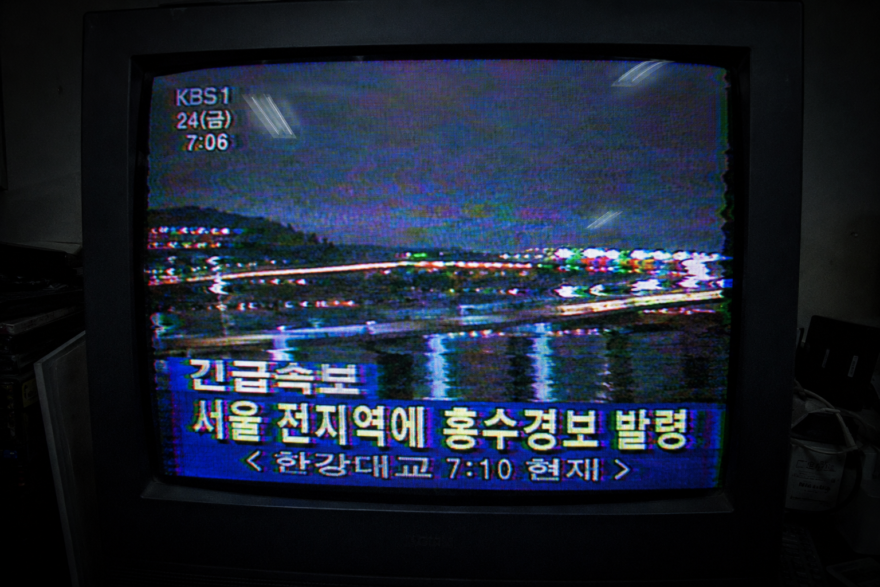
There is a specific kind of societal amnesia that afflicts nations after a crisis that cannot be cleanly categorized. Not the amnesia of forgetting—but the amnesia of mis-remembering; of allowing the emotional residue of an event to calcify into myth while the technical reality quietly dissolves. South Korea has experienced two such moments, separated by a decade, both detonating on precise calendar triggers, both producing mass panic that the country’s media infrastructure was structurally unequipped to explain. The 1999 CIH virus outbreak and the 2009 DDoS logic bomb are, on the surface, straightforward entries in the history of malware. Examined more carefully, they reveal something more uncomfortable: the portrait of a society that sprinted into hyperconnectivity before it had developed any cultural antibodies against the consequences. What follows is not a celebration of digital catastrophe. It is a forensic accounting of two events that South Korea has partially digested, partially mythologized, and partially buried—and an investigation into why the burial happened at all.
Historical Anatomy
To understand the shock of April 26, 1999, it is necessary to understand what South Korea believed itself to be in the late 1990s. The country had made a conscious, state-directed bet on broadband infrastructure following the 1997 IMF financial crisis—a gamble that high-speed internet connectivity would serve as both economic engine and national identity. By 1999, South Korea was, by several metrics, the most densely networked society on Earth. PC Bangs—internet cafés operating around the clock, packed with teenagers playing StarCraft on machines running pirated copies of Windows 95 and 98—had become the defining cultural institution of a generation. This was the substrate into which Chen Ing-hau quietly introduced his creation. A computer science student at Tatung Institute of Technology in Taiwan, Chen wrote the CIH virus in June 1998 as a proof-of-concept intended to expose the inadequacy of commercial antivirus software. The code was elegant in a genuinely alarming way; it hid itself inside the unused padding bytes of Portable Executable .exe files without altering their file sizes—invisible to the signature-based scanning methods that dominated the antivirus industry at the time. It spread without apparent symptoms for months, propagating across networks and pirated software distributions with the patience of something that understood it had time on its side. The calendar was its weapon. CIH was engineered to activate on April 26th—a date Chen selected deliberately, as the anniversary of the 1986 Chernobyl nuclear disaster. This choice, seemingly aesthetic at the time, would have profound consequences for how the event was eventually remembered. The infection vector into South Korea was not subtle. Rampant software piracy meant that infected .exe files circulated freely through PC Bangs and home networks alike, and the absence of regulatory oversight meant nobody was checking. In March 1999, IBM inadvertently deepened the contamination by shipping thousands of Aptiva consumer PCs pre-infected from the factory floor. By the morning of April 26, 1999, the trigger was already inside an estimated 240,000 to 300,000 South Korean machines—nearly half of all infected computers worldwide.
Structural Dissection of the Record
At precisely 09:00 KST on April 26, 1999, the screens went black. What CIH actually did is worth stating clearly, because popular memory has consistently mis-stated it. The virus did not melt hardware. It did not fry circuit boards. What it did was trigger two distinct payloads under the Ring 0 privilege level available in Windows 95 and 98—a level of system access that later operating systems would permanently restrict. The first payload overwrote the first megabyte of the hard drive, obliterating the Partition Table and rendering the disk unreadable. The second payload flashed the motherboard’s EEPROM BIOS chip with garbage data, leaving the machine unable to boot. The distinction matters. A corrupted BIOS chip can, in principle, be re-flashed or swapped. The damage was serious but rarely permanent in any truly irreversible hardware sense. Yet the narrative that emerged—amplified by early internet forums, major Korean news channels running emergency ticker messages, and a public completely unfamiliar with what a BIOS chip even was—collapsed this nuance into a single, terrifying image: the computer had been destroyed. Mechanics charged customers for brand-new motherboards. Repair shops reported weeks-long backlogs. State television issued advisories warning citizens not to turn on their computers at all, a directive that, for a generation that had only recently been told to put computers at the center of their daily lives, carried an almost surreal cognitive dissonance. The “Chernobyl Curse” mythology emerged almost immediately. Because the activation date coincided with the nuclear disaster’s anniversary, Korean internet culture—young, wired, and steeped in the kind of irony that flourishes in online spaces—began detaching the event from its human creator. Chen Ing-hau became incidental; the narrative preferred a more satisfying villain. The virus was discussed as though the radiation from the 1986 reactor had somehow mutated into a digital entity, finding its way into machines thirteen years later. A secondary legend claimed that looking directly at a monitor when a CIH-infected PC booted on April 26th would cause the motherboard to emit a high-frequency pop and short-circuit, blinding the viewer. There is no documented case of this occurring. The legend spread anyway.
Psychological Necropsy
Western cybersecurity history has largely absorbed CIH as a medium-severity footnote—a clever piece of code notable for its payload design, classified and filed. The 2009 DDoS incident fares similarly in the global record: a large-scale denial-of-service attack attributed, with qualified confidence and no formal charges, to North Korean state actors. This casual categorization fails to account for what these events meant inside the society they hit. South Korea in 1999 was not simply a country whose computers stopped working. It was a country that had been publicly evangelizing hyper-connectivity as a form of national destiny—and then watched that destiny switch off, in unison, on a Tuesday morning. The state television advisories, the emergency tickers, the nationwide injunction against booting electronics: these were the structural tools of a 20th-century wartime air-raid broadcast, deployed against a 21st-century software payload. The mismatch between threat and response framework is jarring in retrospect; at the time, it was experienced as pure crisis. For Western observers, the most disorienting element is the collectivism of the panic. The response was not individualized—users were not simply advised to check their machines. The entire population was addressed simultaneously, as a single body that had been infected. This framing, borrowed from biological quarantine logic, reveals something about how South Korean institutions in 1999 understood the relationship between citizens and networked technology: not as individual users making individual choices, but as a single nervous system that had, without warning, begun to malfunction.
The Evidence of Erasure
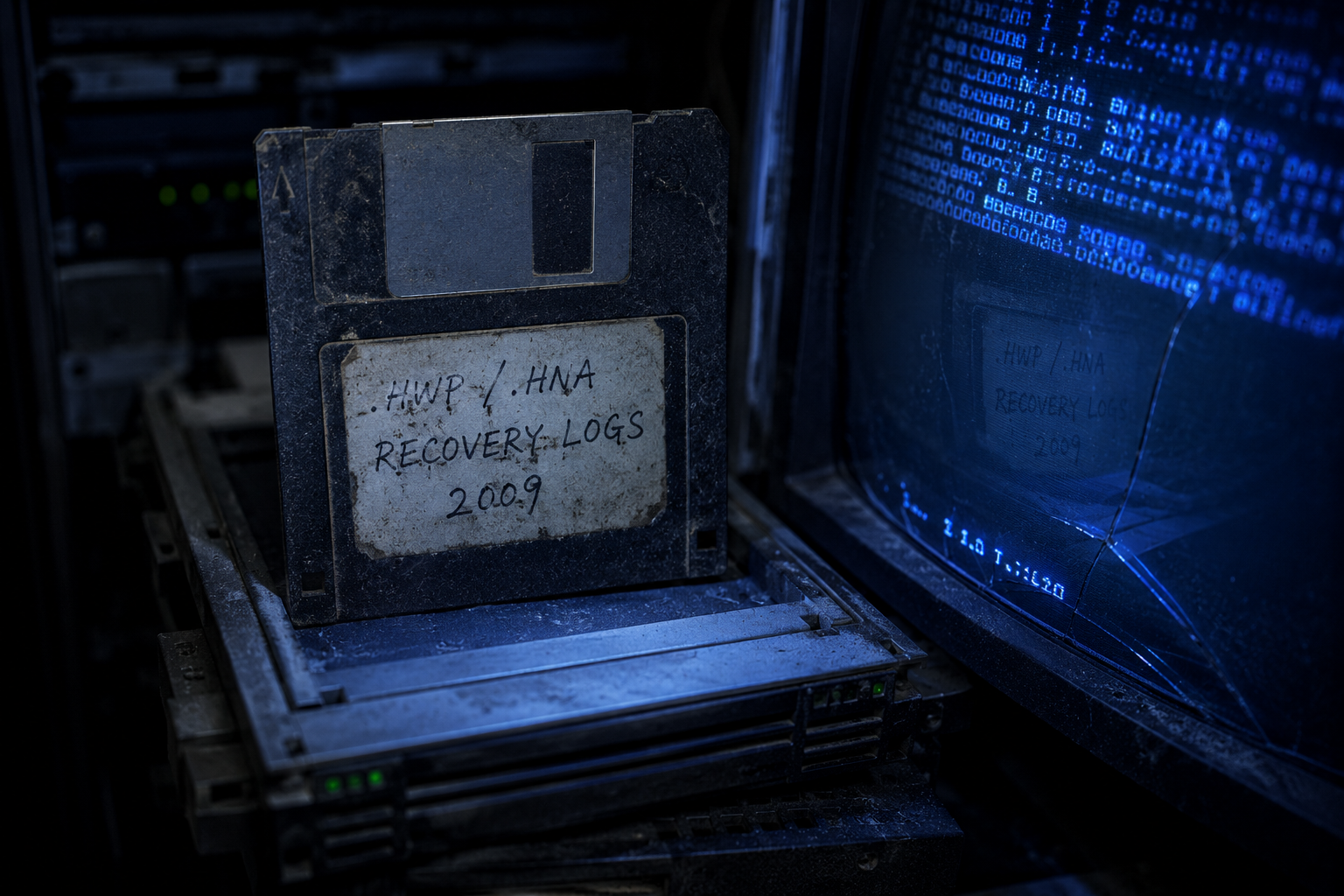
Ten years later, the architecture of the crisis had not substantially improved. On July 7, 2009, at 18:00 KST, the first wave of a coordinated DDoS attack knocked the Blue House, the Ministry of Defense, and the National Assembly offline simultaneously. This was not an improvised flood of traffic; subsequent forensic analysis revealed a professionally engineered botnet operating under a Command and Control server traced to an IP address registered in Miami, Florida. The malware that powered it contained a secondary payload—a logic bomb set for detonation at midnight on July 10th. AhnLab, South Korea’s dominant cybersecurity firm, uncovered the countdown on the evening of July 9th. The secondary payload was methodical in a way that suggested something beyond opportunistic attack. It was programmed to locate 35 specific file extensions, compress them into archives with structurally unbreakable passwords, and then wipe the original source files permanently. Among those extensions: .hwp, the native format of Hangul Word Processor—South Korea’s dominant office suite and the standard for virtually all government documentation; .hna and .kwp, obsolete formats associated with the Hana Word Processor used extensively in South Korean public institutions during the 1980s and 1990s. The inclusion of .hna and .kwp is the detail that does not resolve comfortably into standard cyberattack logic. These formats were not chosen for their prevalence or their strategic disruption value—they were too obscure for that. They were chosen for their specificity. An attacker targeting .hna files knew what .hna files were; knew that they contained legacy public sector documents; knew that those documents were unlikely to exist in backed-up, redundant formats. Internet archaeologists working the case in the years since have used the word “ethnocide” carefully and controversially—a deliberate strike against the un-backed-up, semi-analog archives of early South Korean government records, permanently erasing chunks of bureaucratic and cultural history that had no other extant copy. At 23:30 KST on July 9th—thirty minutes before the bomb detonated—millions of South Korean citizens rushed simultaneously to download AhnLab’s emergency patch. The volume of concurrent requests crashed AhnLab’s servers. At midnight, the logic bomb executed on hundreds of unprotected civilian and public enterprise systems. The Miami server was never fully explained. South Korean investigators traced the botnet’s command infrastructure to that Florida IP; intelligence analysis flagged a routing path involving North Korea’s Ministry of Post and Telecommunications. Shortly afterward, official investigation records stopped accumulating. No perpetrators were ever charged. The archival trail went cold in a way that felt less like an unsolved case and more like a case that had been deliberately left unsolved—or, at minimum, unresolved at the public record level.
The Point of No Return
What remains, a decade and a half after the second of these events, is a peculiar shape in the historical record: two incidents of significant magnitude, both involving calendar-triggered payloads, both producing collective societal panic, both generating mythological sediment that has partially replaced the factual substrate underneath. The CIH virus is remembered as the event that melted hardware—a more dramatic and less accurate version of what actually occurred. The 2009 DDoS is remembered as a North Korean attack—a probable but legally unproven attribution that the absence of any official conclusion has allowed to harden into received fact. In both cases, the mythology is more emotionally coherent than the technical reality; and in both cases, the official record contains gaps that no public institution has subsequently moved to fill. This is the uncomfortable endpoint of the forensic examination. South Korea built the most connected society in the world at the turn of the millennium—then discovered, twice, that connectivity without redundancy is vulnerability; that speed without institutional maturity produces brittleness; that a society can simultaneously be the most wired and among the most exposed. The state television advisories, the crashed patch servers, the unclosed Miami investigation: these are not failures of technology. They are failures of the frameworks built around technology, frameworks that were optimized for expansion rather than resilience. The logic bomb that searched for .hna files knew something the architects of South Korea’s digital infrastructure perhaps did not fully reckon with: that a record which exists only in one place, in one format, on one set of machines, is not a record. It is a vulnerability. Historically, the web has been viewed as a default archive of human experience. However, these localized detonations prove that digital permanence is a selective privilege. Entire institutional eras can vanish overnight when target formats are systematically purged from unprotected nodes. And vulnerabilities, as the calendar repeatedly demonstrated, are patient.
🔍Search Update: Call to Action
The 3AM Archive is actively seeking surviving system drive images, uncorrupted .hna/.kwp documentation, or recorded VHS television broadcasts of the emergency ticker messages from both the April 1999 and July 2009 incidents. Because official data collection abruptly ended following the identification of the Miami C2 nodes, public citizen recordings remain the last line of defense against complete archival silence. If you possess legacy storage media containing raw logs from these specific blackouts, contact our processing desk securely.
This document is an investigative archival reconstruction based on fragmented public records, media remnants, community accounts, and verified historical sources compiled by The 3AM Archive.
The article examines how incidents, forgotten media, internet folklore, and unresolved public memories evolve through cultural preservation and digital decay.
This is a cultural investigation document — not fictional horror content.
All visual materials used in this post are exclusive AI-generated assets created for The 3AM Archive.
