There is a particular species of cultural anxiety reserved for things that should exist but do not. Not the grief of loss—that is clean, mappable, mournable—but the vertigo of erasure; the sensation of reaching for something confirmed to have once occupied a specific coordinate in space and time, only to find the coordinate itself has gone soft. The Mountain Eagle (1926) produces exactly this sensation. It is not merely a film that has been lost. It is a film whose director—Alfred Hitchcock, the most architecturally deliberate artist in the history of cinema—told the world, without remorse, that he was glad it was gone. That fact does not function as context. It functions as the wound.
The Cultural Anatomy: A Director’s Second Work and the Machinery of Silence
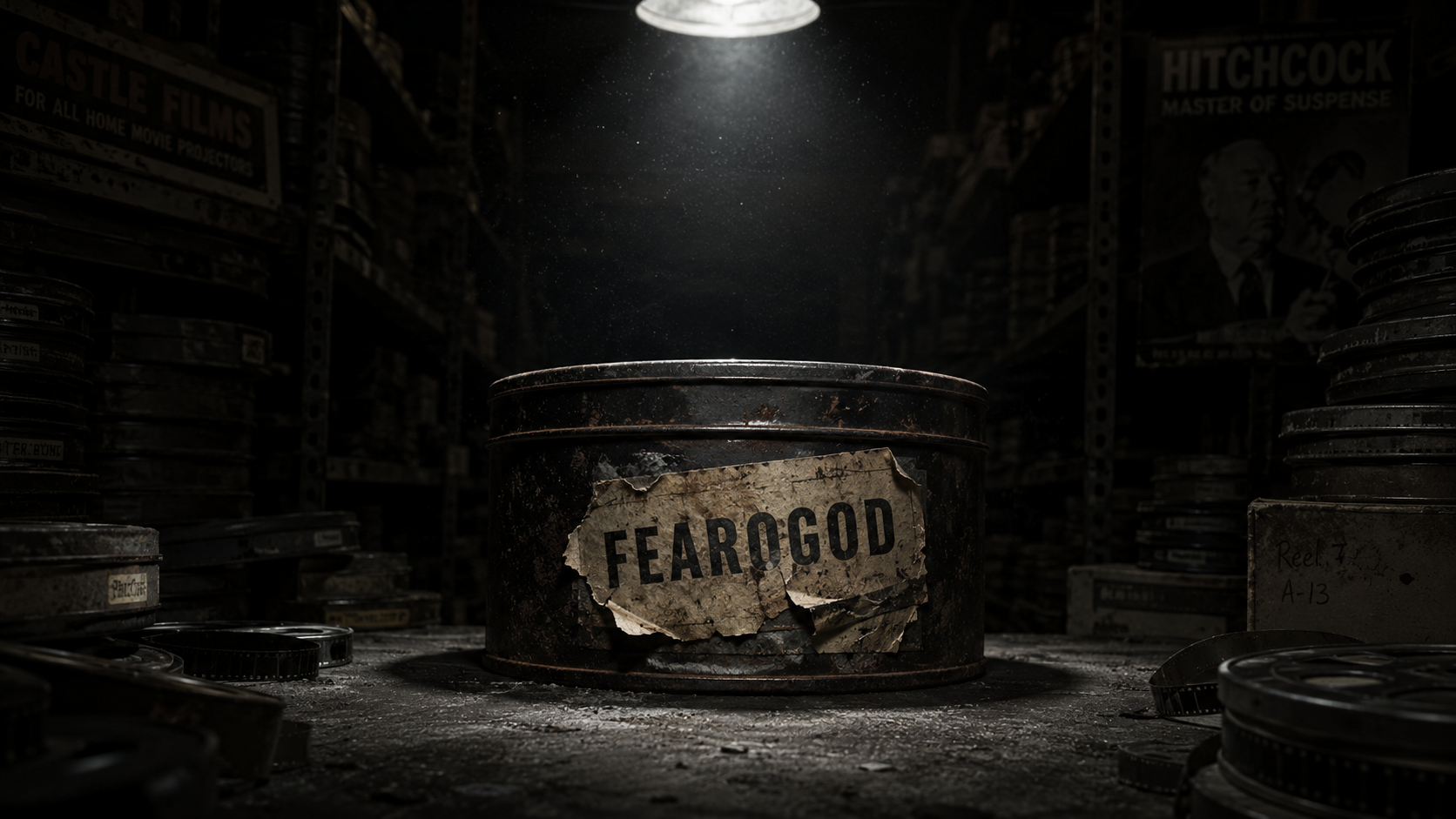
To understand The Mountain Eagle as a forensic object, one must first understand what it was before it became a ghost. Hitchcock’s second completed feature—shot in 1926, distributed in 1927 under British auspices—was an Appalachian melodrama about a Kentucky mountain community; a genre exercise dressed in the rugged aesthetics of American rural isolation. It starred Nita Naldi and Malcolm Keen. It had a working title—Fearogod, drawn from a character in the script—that now reads less like a production note and more like an omen.
The production’s geography was already a lie. Though the film was set in the Kentucky highlands, it was shot entirely in Obergurgl, Austria. This is not a trivial detail. The Austrian Tyrol standing in for Appalachia creates what film archaeologists might recognize as a kind of spatial uncanny valley—an inherent falseness baked into the film’s physical record before a single reel decayed. The locations do not match the story; the setting contradicts the setting. Whatever The Mountain Eagle claimed to be, its visual evidence was, from the outset, constructed from displacement.
This detail matters because it is the film’s first structural dishonesty—and in Hitchcock’s career, dishonesty of that particular kind would later become his primary instrument. In 1926, it was merely a production compromise. In retrospect, it reads as the film eating its own credibility. The censorship The Mountain Eagle experienced was not political; it was personal. Hitchcock did not restrict access to the film. He simply refused to mourn it. In his landmark 1966 interview with François Truffaut—the conversation that functions as the Rosetta Stone of his self-mythology—Hitchcock was direct to the point of violence: the film was “awful,” the story “ridiculous,” and he was “not sorry” it had disappeared. He did not describe a work that had been corrupted or mishandled by distributors. He described a work he wanted the world to forget. This is not how directors speak about lost films. This is how directors speak about mistakes.
Structural Dissection: The Anomalies in the Signal
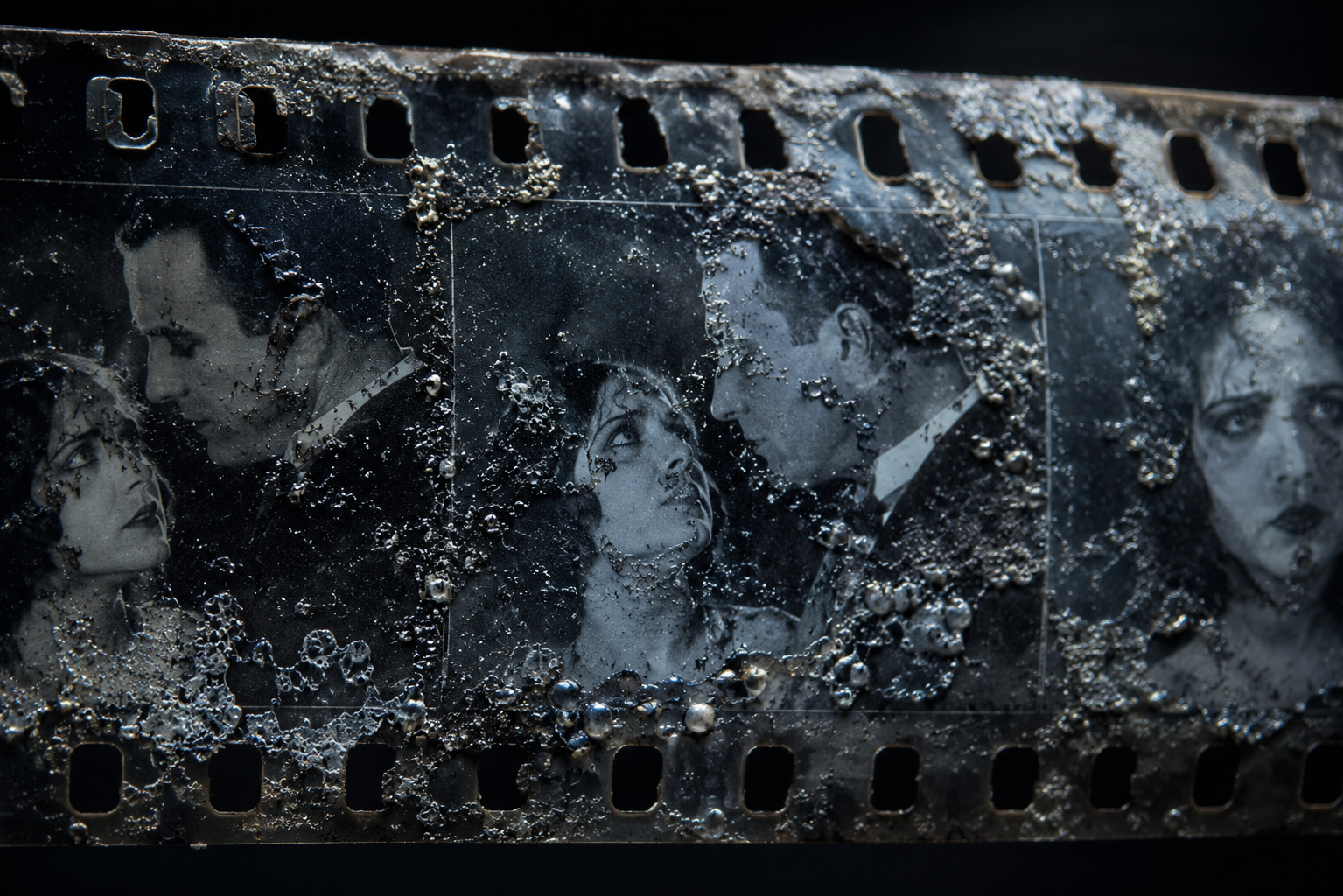
What survives of The Mountain Eagle is, by any archival standard, almost nothing. Approximately thirty production stills. An original screenplay. No prints—not damaged prints, not partial prints, not rumored prints in a private collection someone is reluctant to confirm. The British Film Institute (BFI), which maintains what functions as the default archive of human experience in cinema, has placed The Mountain Eagle at the top of its “75 Most Wanted” list. It is, in the parlance of both professional archivists and the communities of amateur media archaeologists who hunt these things online, the “Holy Grail of Cinema.”
The language of sacred recovery is instructive. It tells us what the culture needs from this film—not the film itself, which by any reasonable estimation is a competent but unremarkable early Hitchcock melodrama—but rather the idea of it; the proof-of-existence that would close a loop that has remained open for nearly a century. In 2012, a cache of twenty-four production stills surfaced in the archive of a close friend of Hitchcock’s estate. The stills sold at auction for over six thousand dollars. This is the kind of figure that makes sense only if you understand that what was being purchased was not photography. It was evidence. It was the closest thing to a fingerprint that a confirmed-absent corpse has left behind. Twenty-four frames of a film that no longer exists sold for the price of a used car; the calculus of that transaction reveals everything about the hunger driving the search.
The working title Fearogod—rendered as a single compressed word in production documents—has become one of the primary keyword identifiers used by media archaeologists combing through mislabeled film reels in estate sales, regional archives, and the increasingly digitized backlogs of national film libraries. This is not a marginal activity. Reddit’s lost media communities, particularly those active through late 2025 and into 2026, maintain ongoing threads cataloguing rumored “hoax” reels—canisters allegedly surfacing at estate sales, identified by sellers who either do not know what they have or know precisely what they are pretending to have. The hunt has developed its own grammar of authentication and fraud; its own subspecialty of forensic doubt.
Psychological Necropsy: The Western Mind and the Rejected Child
Western media archaeology has a particular appetite for the “Artist’s Curse” narrative—the story of a creator undone or haunted by their own creation. What The Mountain Eagle offers instead is something rarer and more disturbing: the “Artist’s Absolution.” Hitchcock did not lose this film. He survived it. He had the luxury of watching it disappear and feeling, by his own account, something approaching relief.
This disturbs the Western archival imagination at a structural level. The dominant mythology of lost media is elegiac; it presumes that every lost work is a tragedy, every missing reel a wound in the cultural record. The director-as-bereaved-parent is the emotional architecture on which institutions like the BFI and the Library of Congress have built their recovery missions. The Mountain Eagle refuses this architecture entirely. Hitchcock was not the bereaved parent. He was, by his own testimony, the parent who watched the child walk into traffic and did not call out.
The psychological dissonance this creates is productive—but it is also, in a precise clinical sense, a form of horror. If Hitchcock hated the film and it vanished anyway, the loss is not a tragedy. It is, at worst, a successful act of artistic self-censorship; a work deleted from the record by the combined force of material entropy and the creator’s indifference. At best, it is nothing at all—a mediocre early effort that rotted because nobody cared enough to preserve it.
The Evidence of Void: Physical Decay Versus Social Erasure
The distinction between physical decay and social erasure is the central forensic question in any lost media investigation. For The Mountain Eagle, the answer is almost certainly both—but weighted, perhaps counterintuitively, toward social erasure. Early film stock—cellulose nitrate—was notoriously unstable. It is flammable; it degrades into a powder that retains none of its original image; it requires climate-controlled storage that most regional distributors in 1927 did not have. The material explanation for the film’s loss is entirely plausible on its own terms. Prints that are not actively preserved do not survive. This is not a mystery; it is physics.
But physical decay explains the mechanism, not the motivation. The more corrosive force acting on The Mountain Eagle was the complete absence of any institutional will to preserve it. Hitchcock himself provided the cultural permission for the film’s neglect. When the Master of Suspense announces that a work is unworthy of memory, the gravitational pull of that judgment is enormous. The film was given, in effect, a cultural death sentence before physical entropy could finish the job.
The Point of No Return: Digital Memory and the Persistence of Deliberate Forgetting
There is an uncomfortable final question that the forensic examination of The Mountain Eagle places in front of us. It is not the question of whether the film will ever be recovered—though it may be; estate sales continue, private archives continue to surface, and the global digitization of regional film collections is an ongoing process with unpredictable outcomes. The uncomfortable question is what we would do with it if it were.
The digital era has fundamentally altered the conditions of cultural memory. Nothing that exists in digital form is ever truly lost. It is, at worst, waiting to be indexed. The Mountain Eagle predates this condition by sixty years. It belongs to the analog era of scarcity, where preservation was a physical act requiring physical resources, and where the failure to preserve was as consequential as active destruction.
But the communities searching for The Mountain Eagle are digital communities. They operate in an environment where the concept of irreversible loss has become nearly impossible to metabolize. Reddit threads that catalogue “hoax” reels are, at their core, communities formed around the proposition that loss of this magnitude should not be possible. Somewhere, in some uncatalogued basement or flooded archive, the film must exist.
This faith is touching. It is also, the evidence suggests, probably wrong.
🔍Search Update: Call to Action
The BFI continues to list this as their #1 priority. If you are scouring estate sales in Europe or the American South, look for nitrate canisters marked “Fearogod” or “Hitchcock #2.” Any lead, no matter how faint, should be reported to the British Film Institute or the Lost Media Wiki coordinators.
The suspense, it turns out, has always been ours.
This document is an investigative archival reconstruction based on fragmented public records, media remnants, community accounts, and verified historical sources compiled by The 3AM Archive.
The article examines how incidents, forgotten media, internet folklore, and unresolved public memories evolve through cultural preservation and digital decay.
This is a cultural investigation document — not fictional horror content.
All visual materials used in this post are exclusive AI-generated assets created for The 3AM Archive.
