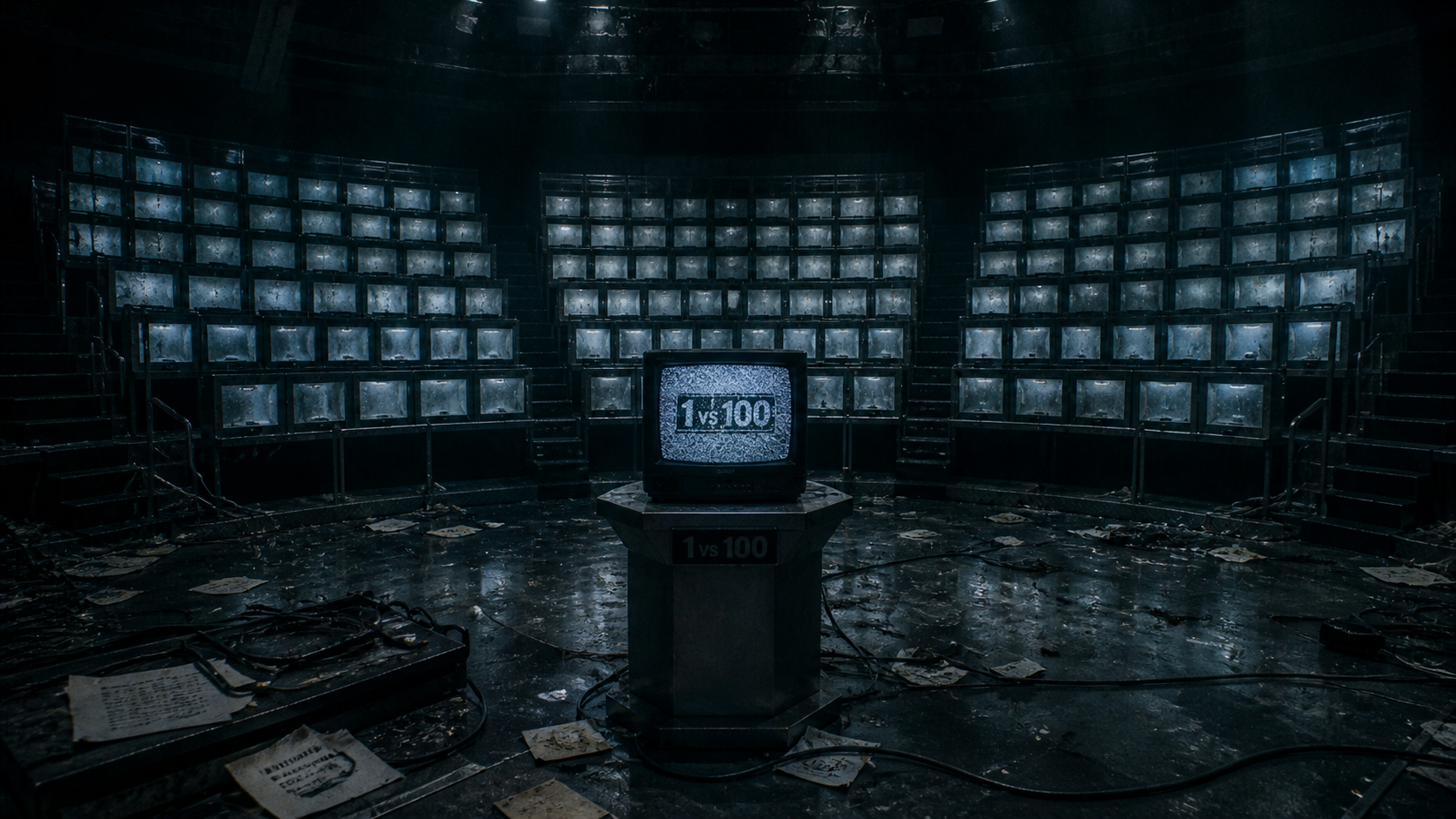
The episodes still exist. That is not the problem.
The problem is that a legal mechanism was embedded into the format contract before the first episode ever aired, specifically designed to ensure that what you watched could not be watched again. Not by accident. Not through negligence. By design.
You were permitted to see it once. The contract said so.
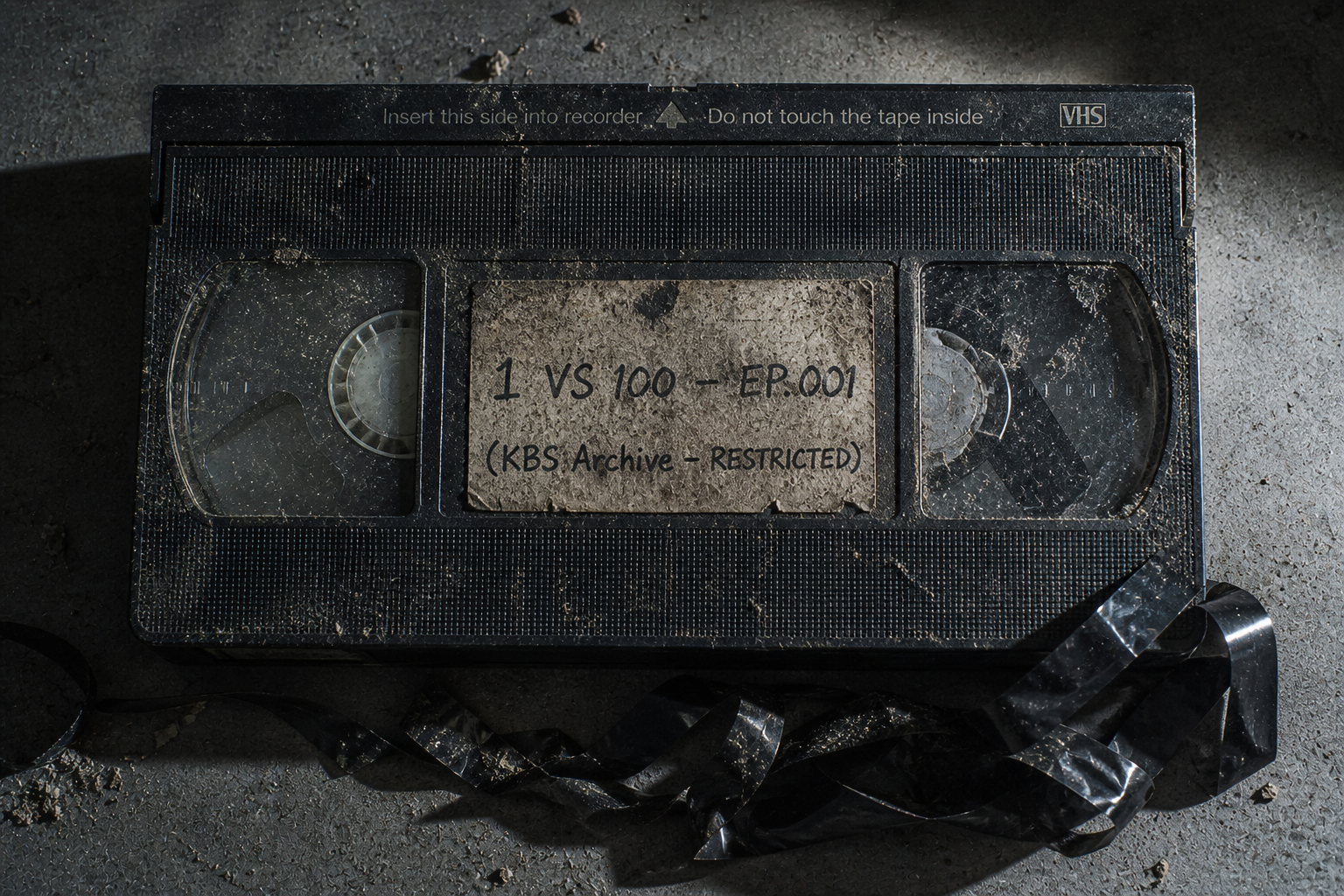
The Evidence File: What Is Actually Missing
1 vs 100 aired on KBS in South Korea as a licensed adaptation of a format originally created by Endemol, the Dutch production conglomerate responsible for a significant portion of the global game show ecosystem in the 2000s. The mechanics are standard: one contestant, one hundred opponents, answering questions until either the contestant falls or the mob is eliminated. The format was exported to dozens of countries including the United States via NBC, the United Kingdom via BBC One, and multiple Asian markets through Endemol Asia’s regional licensing operations.
The Korean run produced hundreds of episodes across multiple years. The production values were substantial. The audience reach was considerable. By any conventional measure, it was a successful broadcast product.
And almost none of it is legally accessible.
The archival situation as it currently stands is as follows. The overwhelming majority of episodes exist only in the memory of viewers who watched the original broadcast, in fragmentary user-recorded uploads on YouTube and similar platforms, and in secondary documentation produced by communities like Namu Wiki (South Korea’s dominant, community-driven encyclopedia), which constructed episode records from live broadcast observation rather than from archival access. Official rebroadcast, streaming, or any form of authorized replay is structurally impossible.
The exceptions are precise and telling. Episode 490, specifically the final question sequence that produced Kim Tae-woo’s championship win, exists on the official KBS YouTube channel as a single clip. Episodes 228, 333, 336, and 337 are accessible through the Endemol Asia YouTube channel as direct uploads. These are not exceptions to the rule. They are controlled releases—high-yield marketing assets—that prove the rule exists.
Everything else is gone in any practical, legal sense. Hundreds of hours of broadcast content, produced with public-facing infrastructure and aired on a national broadcaster, functionally unavailable to the public that originally funded and watched it.
The Structural Framework: The Format Contract as an Erasure Instrument
To understand how this happened, you need to understand what a format contract actually is and what it is designed to protect.
Endemol did not sell KBS a television show. It sold KBS a license to produce a local version of a proprietary structural template. The distinction is legally significant and practically consequential. The format itself, the rules, the staging logic, the question architecture, the mob elimination mechanics, all of this belongs to Endemol regardless of who produces any specific episode. KBS owned the physical tapes of its own production. It did not own the right to distribute the content those tapes contained.
The no-replay clause embedded in format export contracts of this era was not incidental. It was a deliberate structural choice made at the level of format licensing strategy. Endemol’s business model depended on the format itself remaining the primary commercial asset. A format that could be replayed indefinitely in any territory reduces the incentive for that territory to continue purchasing new format licenses or to renew existing ones. The scarcity of any specific run of the show protects the commercial value of the format as an ongoing licensable property.
This logic is internally coherent from a commercial standpoint. From a preservation standpoint, it is catastrophic.
The format contract clause that prohibits replay, streaming, and archival distribution was not written with any consideration for the cultural or historical value of the content produced under it. It was written to protect a revenue model. The fact that hundreds of hours of broadcast content becomes functionally inaccessible to the public as a direct consequence of this clause is not a concern the contract was designed to address.
The broadcast happened. The contract was satisfied. The content became inaccessible. This sequence was the intended outcome.
Historical Archetypes: The Recurring Pattern of Structural Disappearance
The 1 vs 100 void is a contemporary manifestation of a legacy pattern in broadcast media history that predates the internet era entirely.
The BBC’s practice of wiping and reusing video tape in the 1960s and 1970s resulted in the permanent loss of 97 missing Doctor Who episodes, along with vast quantities of other programming. The motivation was economic: tape was expensive, storage was limited, and the institutional assumption was that broadcast content had no value after its initial transmission. The cultural and historical loss generated by this assumption was not recognized until long after the damage was irreversible.
The American television networks operated under similar assumptions through the early television era. Kinescope recordings of live broadcasts were produced as an afterthought and stored without systematic preservation protocols. An enormous percentage of early American television simply does not exist in any recoverable form.
The 1 vs 100 situation differs from these historical cases in one crucial respect. The BBC wiped its tapes through institutional negligence combined with economic pressure. The Korean episodes of 1 vs 100 are inaccessible not because the physical recordings were destroyed but because a contractual mechanism prohibits their distribution. The content exists somewhere. It cannot legally be shared.
This is a new form of the same structural outcome. Previous generations lost broadcast content through physical destruction and institutional carelessness. The current era loses broadcast content through legal architecture that was never designed with preservation as a consideration.
The mechanism changed. The result is identical. Content that was publicly broadcast becomes publicly inaccessible, and the gap in the record grows wider over time as the original broadcast audience ages and the secondary documentation degrades.
Other countries that licensed the same Endemol format face the same archival void. The NBC run of 1 vs 100 in the United States, which aired from 2006 to 2008, is similarly inaccessible through official channels despite having aired on one of the largest broadcast networks in the world. The format contract does not discriminate by territory. The erasure mechanism applies universally to every market that purchased the license under the same terms.
Psychological Necropsy: What Controlled Scarcity Does to Collective Memory
The specific pattern of availability in the 1 vs 100 archival record is worth examining closely, because it is not random.
The episodes that are officially accessible were selected and released with specific intent. Episode 490 contains a championship moment, a emotionally resonant peak event that functions as promotional content for the franchise rather than as archival documentation. The Endemol Asia uploads similarly represent curated highlight content rather than comprehensive archival access.
What is available is what the rights holders chose to make available. What is unavailable is everything else.
This structure produces a specific psychological effect on communities that engage with the lost content. The existence of officially sanctioned clips creates the impression that the archival situation is being managed. This impression is more psychologically tolerable than the alternative: that no one with legal authority over the content has any interest in its preservation.
Communities like the one that constructed the Namu Wiki documentation for 1 vs 100 operate in the space created by this psychological ambiguity. They document what they witnessed. They record episode details from memory and from the fragmentary user recordings that circulate outside official channels. They build a secondary archive that exists in constant tension with its own limitations. The documentation acknowledges it cannot substitute for primary source access. It exists because primary source access does not.
The user-recorded uploads on YouTube and similar platforms occupy an even more precarious position. They exist in technical violation of the same copyright framework that makes official archival access impossible. This contradiction is not resolved. It is simply lived with.
Why People Keep Looking Away
There is a specific discomfort in the 1 vs 100 archival situation that most discussions avoid directly.
The format contract that produced this archival void was signed by KBS. A public broadcaster. KBS agreed to terms that guaranteed the content it produced with public-adjacent resources would become inaccessible to the public it serves, as soon as the original broadcast window closed.
This is not a secret. The contractual structure is documented and understood by media industry professionals. The decision to accept these terms was made by people who understood what they were agreeing to. The archival consequences were foreseeable.
Looking at this directly requires acknowledging that the institutions responsible for public broadcasting made commercial decisions that prioritized format access over content preservation.
Most discussion of the 1 vs 100 archival situation focuses on the technical details of what is available. This focus is understandable. It is also a way of engaging with the problem while avoiding its institutional dimension.
The question of why the content is inaccessible is less comfortable than the question of where to find it. The first question has an answer that implicates institutional decision-making. The second question leads to workarounds that allow the underlying structure to remain unexamined.
The Point That Should Disturb You Most
The YouTube comments section has become the default archive of human experience for the digital age. This reality has profound implications for digital permanence. We are trusting our collective memory to platforms that prioritize engagement over accuracy.
The Namu Wiki documentation for 1 vs 100 was constructed from direct broadcast observation and from secondary sources. This documentation is the primary accessible record of a large portion of the show’s run. It is thorough, carefully maintained, and produced through genuine community effort.
It is also entirely dependent on the memories and records of a specific generation of viewers who watched the original broadcast.
As that generation ages, the secondary documentation they produced becomes the only record. The user recordings on YouTube are subject to platform policy changes and copyright enforcement actions that could remove them at any time. The Namu Wiki entries are dependent on continued community maintenance and platform stability.
The official archive, the only preservation mechanism with institutional permanence and legal authority, is prohibited by contract from performing its function.
This means the historical record of a nationally broadcast television program is being maintained by volunteer documentation and technically unauthorized uploads, against the active legal structure of the rights holders, with no institutional backstop.
When the last person who remembers watching the original broadcast closes their eyes, there will be no official record to consult. There will be what the community preserved, informally, in defiance of the contractual architecture designed to ensure that the broadcast could only be experienced once.
The show was designed to be watched and forgotten. The contract made certain of it. The community has spent years refusing to comply.
🔍Search Update: Call to Action
The search for lost 1 vs 100 media is not just a Korean endeavor; it is a global investigative effort. If you possess personal recordings of NBC (USA), BBC (UK), or KBS (Korea) episodes not currently available through any public channel, the broadcast preservation community actively seeks documentation of all format-restricted content.
What is not formally preserved now will not be informally preserved forever.
This document is an investigative archival reconstruction based on fragmented public records, media remnants, community accounts, and verified historical sources compiled by The 3AM Archive.
The article examines how incidents, forgotten media, internet folklore, and unresolved public memories evolve through cultural preservation and digital decay.
This is a cultural investigation document — not fictional horror content.
All visual materials used in this post are exclusive AI-generated assets created for The 3AM Archive.
