
There is a particular species of disappearance that haunts forensic archivists and cold case researchers with a dread qualitatively different from homicide. It is not the disappearance caused by violence—those cases, however unsolved, leave material residue: blood, testimony, forensic debris, the bureaucratic machinery of criminal investigation. The disappearance that truly disturbs is the one swallowed whole by administrative process. One where the apparatus meant to locate a missing person instead participated, structurally and without malice, in her permanent erasure from the default archive of human experience.
Lee Byung-soon walked out of a Gwangmyeong apartment on the morning of February 22, 1992, and vanished. She was 36 years old, weighed 48 kilograms, stood 154 centimeters tall, and carried a specific and devastating disadvantage into the grey February cold: she was acutely, debilitatingly near-sighted, and her spectacles had been taken from her. She was also in the acute phase of schizophrenia, medicated into a blunted, lethargic affect by the heavy anti-psychotics prescribed six months prior. She had no money. She had no identification. She walked, effectively blind, into a city undergoing one of the fastest physical and infrastructural transformations in modern urbanization history.
She did not return.
What followed over the next 14 years was not simply a failure to find her. It was something more systematic, more damning, and more instructive—a forensic demonstration of how classification, bureaucratic timing, and the tectonic collision between analog and digital governance can transform a living person into a phantom.
Historical Anatomy
To understand why the state failed Lee Byung-soon, one must understand what South Korea was in February 1992—not geographically, but institutionally.
The nation had formally transitioned out of military authoritarian rule in 1987 following the June Democracy Movement. By 1992, it was five years into the turbulent, euphoric, and deeply disorganized process of becoming a pluralist democracy. Elections were held; civil society organizations were expanding; the press operated with significantly more latitude. But the bones of the state—its administrative skeleton, its police protocols, its bureaucratic default classifications—had not yet been reformed to match the democratic surface. The organs of civilian governance were still wearing the procedural musculature of a security state.
Gwangmyeong-si itself was emblematic of this transitional dislocation. Located in Gyeonggi-do, the province encircling Seoul, Gwangmyeong during the late 1980s and early 1990s was experiencing the dense, chaotic residential expansion that characterized South Korea’s satellite cities in that era—apartment complexes rising faster than the administrative infrastructure needed to service them. The city’s population was swelling; its institutions were, by contrast, understaffed and analytically blunt.
Into this environment arrived Lee Byung-soon’s disappearance. And into this environment arrived a specific bureaucratic instrument that would determine everything: the 가출 classification.
Structural Dissection of the Record
가출 — literally, “leaving the house” — was the administrative default through which South Korean police processed adult disappearances in the early 1990s. It presumed, without investigation, that the absent adult had exercised autonomous volition; that they had chosen to leave. This classification had emerged from the legitimate social reality that many adults — particularly women escaping marital abuse, young people fleeing familial pressure, or individuals hiding from financial creditors — did indeed vanish voluntarily. The classification was not invented from nothing. But by the early 1990s, it had metastasized into a blanket protocol, a bureaucratic convenience that transferred the investigative burden entirely to the family.
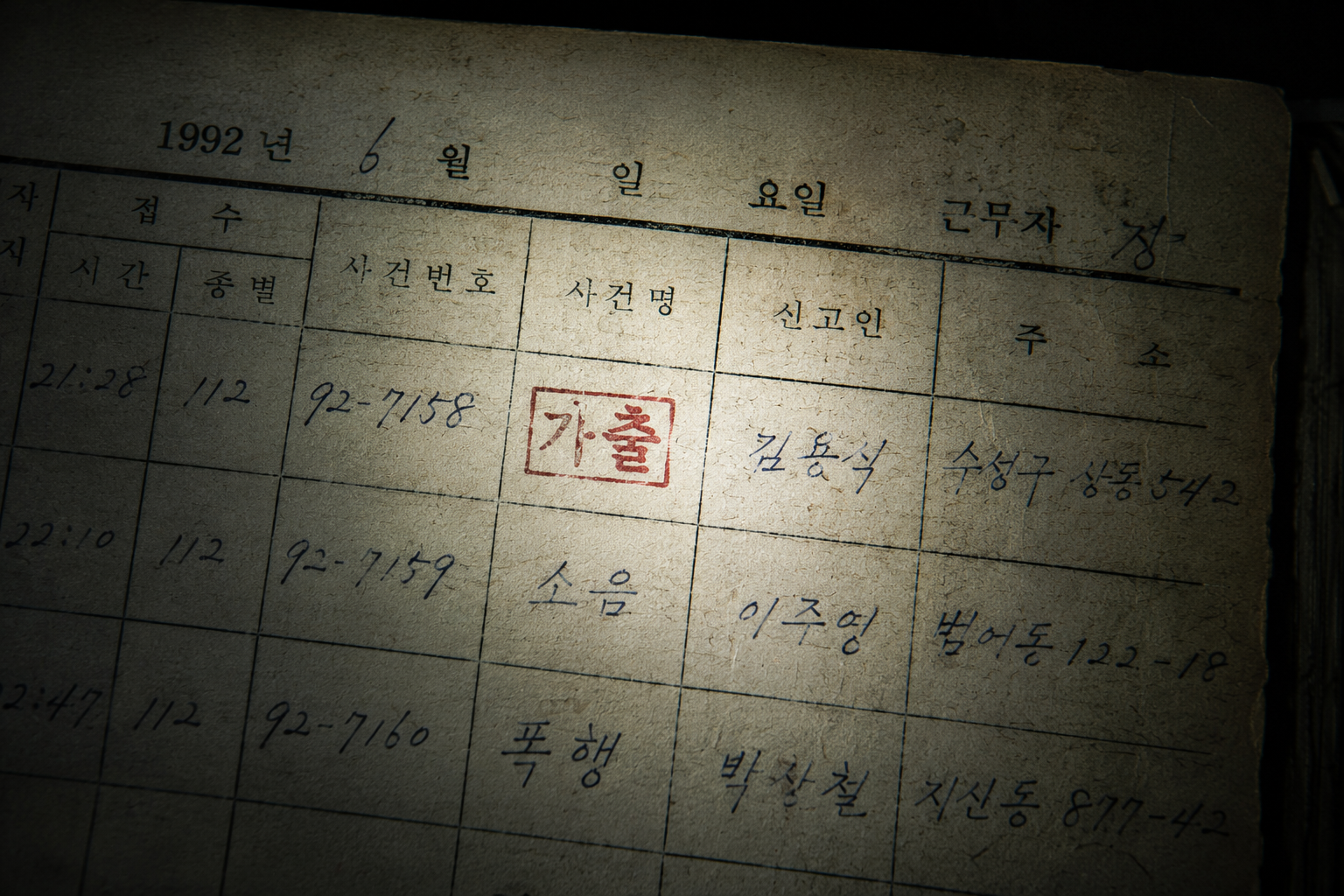
When Lee’s sister filed an emergency report on the evening of February 22, 1992, Gwangmyeong police noted the pre-departure altercation — the sister had confiscated Lee’s handbag and spectacles in an attempt to prevent her from leaving — and logged it as evidence of a voluntary departure following a domestic dispute. That a woman with severe, documented schizophrenia had been stripped of her corrective lenses and her purse before walking out into a February morning was not, apparently, sufficient to override the 가출 default. No missing bulletins were issued. No street patrols were deployed. The file was processed, archived, and effectively closed before the ink was dry.
This initial classification failure created a cascading archival silence that would persist for over a decade.
The family’s subsequent efforts were conducted in a pre-digital world of physical media and institutional walls. They printed flyers; they distributed them in Gwangmyeong-dong and beyond. They canvassed psychiatric facilities, women’s shelters, and social welfare institutions. These efforts were largely futile — not because Lee could not have been found inside such a system, but because the system had been engineered to resist exactly this kind of query. Private asylums and religious welfare sanctuaries (요양원) operating throughout the Gyeonggi region during the 1990s routinely admitted patients without cross-referencing resident registration numbers. Administrative opacity was not a bug; it was the operational model. Privacy, interpreted through the lens of institutional self-protection, meant that even police inquiries directed at these facilities could be — and frequently were — deflected without legal consequence.
The archival inconsistency surrounding the eventual reclassification compounds this picture. Records from NamuWiki date the case’s conversion from voluntary runaway to “Vulnerable Missing Person with Mental Disabilities” at 2006; documentation held by the Missing Children’s Association places it at 2007. This one-year discrepancy is not, in itself, remarkable — administrative transitions produce dating ambiguities routinely. What is remarkable is what it reveals: the reclassification itself was not a clean digital event with a precise timestamp. It was, apparently, a bureaucratic process conducted across institutional seams, its own paper trail uncertain. The correction of a clerical erasure was itself imprecisely archived.
Psychological Necropsy
There is an element to this case that operates with unusual force on the analytical imagination — and it is not, primarily, the schizophrenia, nor the domestic altercation, nor the missing flyers. It is the spectacles.
Lee Byung-soon walked out of her apartment unable to see. The degree of myopia described in her case profile was not mild; it was debilitating. For a person with extreme near-sightedness, navigating an unfamiliar urban environment without corrective lenses is not merely difficult — it produces a radical decoupling from visual reality. Faces blur into featurelessness at distances of a few meters. Street signs become unreadable. Curbs, vehicles, pedestrians, junctions — all register as approximate shapes in a grey February cityscape. She was navigating by proximity, by sound, by a cognitive map that was itself already compromised by active psychosis and anti-psychotic sedation.
The internet mythology that has developed around this case — the “Blind Walker” archetype, as it circulates in Korean cold case communities and analog horror-adjacent online spaces — fixates precisely on this image. A woman wandering through a rapidly transforming post-authoritarian city in a condition of sensory and cognitive destitution. It is a striking image because it operates simultaneously at the level of the personal and the structural: the woman cannot see the city; the city, institutionally, cannot see the woman.
This symmetry — individual perceptual failure mirroring systemic representational failure — is what gives the case its particular grip. It is not a mystery in the conventional sense; there is no crime scene to reconstruct, no suspect to identify, no competing theories requiring adjudication. It is something more philosophically uncomfortable: a documentation of how complete invisibility can be achieved through the convergence of medical, administrative, and infrastructural forces operating independently, without coordination, and without a single deliberate act of malice.
The Evidence of Erasure
The erasure of Lee Byung-soon was not singular. It was layered — sedimentary, to use the geological metaphor appropriate to a case spanning three decades.
The first layer was the 가출 classification itself: immediate, administrative, and functionally definitive. Once lodged in the voluntary runaway category, the case was stripped of the investigative urgency that might have produced results in the 72-hour window when missing person searches are statistically most productive.
The second layer was the decade of analog constraint. Between 1992 and the early 2000s, there was no centralized digital missing persons database in South Korea. Each institution — police precincts, psychiatric facilities, welfare homes — maintained its own paper records. Cross-referencing across institutions required either formal legal process or the kind of cooperative goodwill that was, in practice, rarely extended to family members operating outside official investigative frameworks. Lee’s resident registration number — the primary identification key in the Korean administrative system — existed in a 1992 paper ledger and nowhere else. It was never migrated into the electronic lookup systems that emerged in the late 1990s. For the early digital infrastructure of the state, she simply did not exist.
The third layer was the timing. South Korea’s most significant overhaul of missing persons tracking legislation arrived precisely in the mid-2000s — the same period during which the country was completing its transformation into one of the world’s most digitally integrated societies. Broadband internet penetration, electronic government services, and centralized digital ID systems all matured simultaneously. But maturation is not retroactive. The new systems were designed to process new cases efficiently; they were not architected to excavate analog-era files and integrate them into the digital record without active human intervention. Lee’s case required her family to petition specifically for that excavation — to argue, against institutional inertia, that a 14-year-old file deserved to be resurrected and converted into a format that contemporary search tools could actually read.
They succeeded, eventually. The reclassification came — in 2006, or 2007, depending on which institutional record one consults. Active entries now exist in both the Korean National Police Agency and ChildFund Korea’s missing persons registries. But the reclassification did not undo the 14 years of invisibility. It did not restore the information that had been lost during that period — the facility admissions records that were never cross-referenced, the shelter registrations that expired and were discarded, the institutional files that had been, by 2006, physically degraded or deliberately purged according to standard archival protocols.
The Point of No Return
Here is the uncomfortable architectural truth that Lee Byung-soon’s case constructs, stone by stone, for any serious analyst of administrative systems and digital memory: the 2006 reclassification did not constitute a recovery. It constituted a diagnosis, delivered 14 years post-incident, of a disease that had already run its course.
There is a forensic logic to missing persons searches that is brutally temporal. The probability of locating a missing individual collapses precipitously with time — not linearly, but exponentially. Witnesses’ memories degrade; institutional records are legally purged; individuals move, change their circumstances, and accumulate new identities. For a person with severe schizophrenia who disappeared in 1992 without identification documents, the window of institutional traceability — already narrow — would have closed within years, not decades. By 2006, the state was searching for a person whose legal existence had been confined to a 1992 paper trail that nobody had followed at the time it was laid.
What the Korean digital governance revolution produced, in this case, was not a rescue. It produced a perfectly legible record of a rescue that had been rendered impossible by the pre-digital governance failure that preceded it. The new system is efficient; it is centralized; it is searchable. It contains Lee Byung-soon’s file. It cannot find her.
This is the final, most disturbing feature of cases like Lee Byung-soon’s — not the disappearance itself, which is tragic in the way that individual tragedies are tragic, but the structural lesson it encodes. Modern archival systems are frequently assessed by their forward-facing capabilities: their efficiency in processing new cases, their integration with contemporary identification infrastructure, their capacity to generate real-time alerts. What they are rarely assessed on is their capacity to excavate their own institutional prehistory; to recognize that the analog dark ages they superseded did not resolve their cases before being replaced, but simply stopped counting them.
Lee Byung-soon walked into a winter city she could not see. Fourteen years later, a government that could now see everything looked into its own archive and found — in the ledger of 1992, in the 가출 column of a Gwangmyeong precinct log — a person it had never officially been looking for. The new system opened its eyes and discovered it had been blind.
The spectacles, it turns out, belonged to the state all along.
🔍Search Update: Call to Action
For the global internet archeology and lost media communities, the case of Lee Byung-soon remains a stark, unresolved node of analog deletion. Independent research efforts are currently focused on exhuming undocumented regional welfare facility logs and private asylum admission records from Gyeonggi-do spanning 1992–1996. If you have access to archived physical municipal registers, microfiched local news print from the Gwangmyeong sector, or uncatalogued institutional data from this specific transitional era, document your findings. Help us cross-reference the silent margins where the paper trail vanished.
This document is an investigative archival reconstruction based on fragmented public records, media remnants, community accounts, and verified historical sources compiled by The 3AM Archive.
The article examines how incidents, forgotten media, internet folklore, and unresolved public memories evolve through cultural preservation and digital decay.
This is a cultural investigation document — not fictional horror content.
All visual materials used in this post are exclusive AI-generated assets created for The 3AM Archive.
