
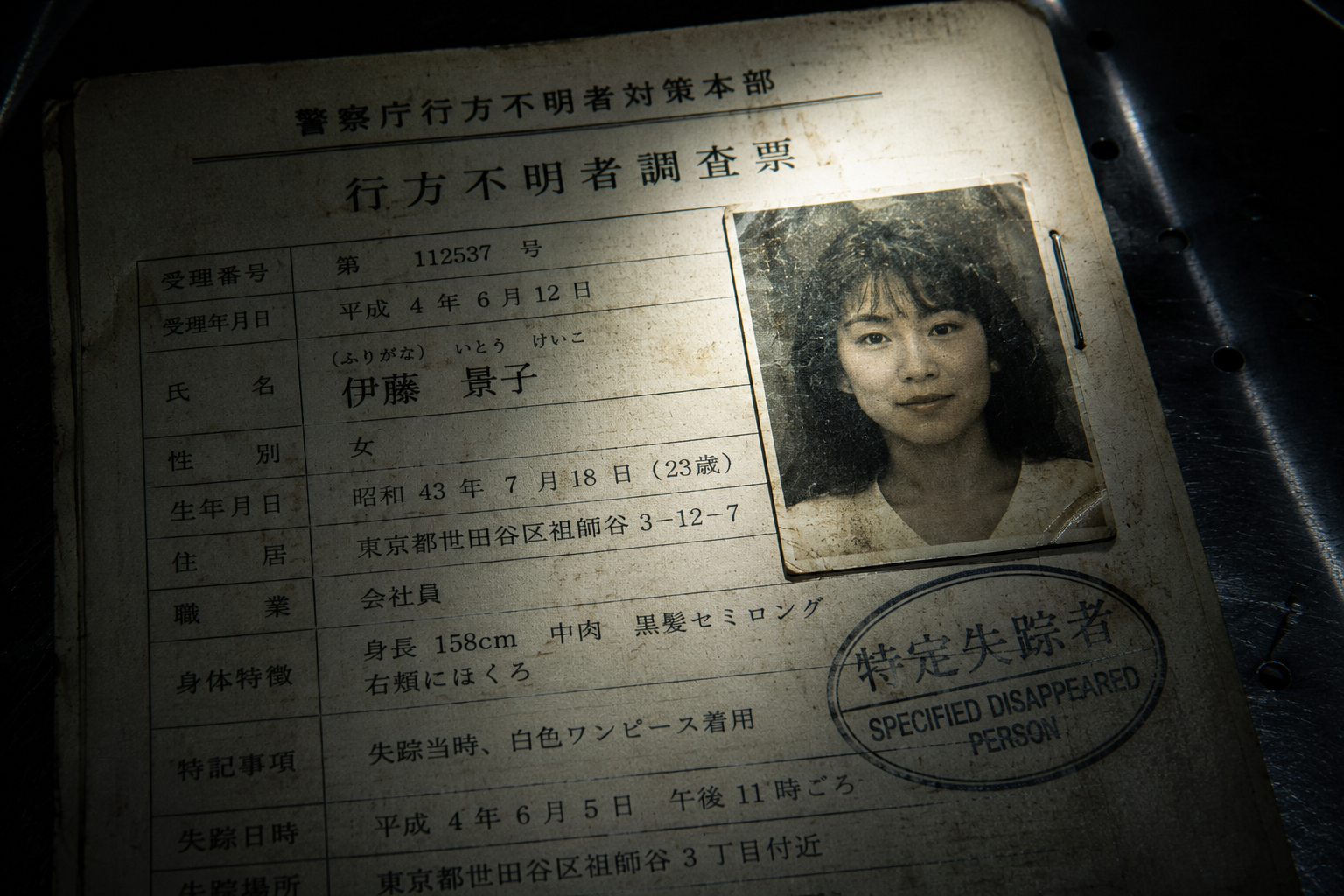
On March 28, 1991, a twenty-three-year-old Japanese research student named Yumi Omasa left her luggage in Room 214 of the Gyerim Youth Hostel in Gyeongju, South Korea, and walked into a morning that would never formally end. She bought a white jade double-ring and a jadeite necklace at the hostel gift shop, paid for them with a traveler’s check, boarded a city bus toward the Gyeongju National Museum—and ceased to exist in any recorded human trail.
What follows is not a mystery in the conventional sense. There is no dramatic last photograph, no contested blood evidence, no confession wrung from a suspect decades later. There is instead something methodologically more unsettling: a perfect administrative void, sealed from three directions simultaneously by geopolitical enmity, analog-era record fragility, and Cold War infrastructure that had been specifically engineered to leave no trace. The disappearance of Yumi Omasa is not a gap in the archive. It is the archive’s logical product—the inevitable output of a system designed, through mutual institutional neglect and active state suppression, to erase certain categories of person entirely.
That the case has since migrated into analog horror forums and digital mystery communities is not incidental. It is diagnostic.
Historical Anatomy
To understand how Omasa’s disappearance became structurally possible, one must reconstruct the specific pressures compressing East Asian political life in the spring of 1991.
South Korea in the early 1990s occupied a charged transitional moment. The country had emerged from decades of military dictatorship—Chun Doo-hwan’s regime had only formally ended in 1988—and was engaged in the slow, difficult construction of democratic institutions while simultaneously navigating the unresolved psychic weight of Japanese colonial occupation. Anti-Japanese sentiment, 반일 정서, was not merely emotional residue; it was structurally embedded in domestic media practice. South Korean broadcasters operated under informal but effective editorial frameworks that deprioritized—and, in practice, frequently suppressed—news stories that might humanize Japanese nationals as victims. In this media environment, a missing Japanese tourist was not a story. She was an administrative inconvenience in a politically uncomfortable register.
This structural silence had direct operational consequences. The South Korean public—the tourists, hostel owners, street vendors, and taxi drivers who constituted the informal witness network that solves most missing persons cases—was never mobilized. No domestic broadcast appealed for sightings. No newspaper ran her photograph. The 100,000 cumulative police search-days deployed in the weeks following her disappearance were therefore searching in a kind of sensory isolation, combing mountains under the assumption of accidental fatal fall or trafficking while the ordinary civilian apparatus of social memory remained entirely dormant.
Simultaneously, across the Korea Strait, Japan was confronting—without yet fully naming—the systematic reality of North Korean state-sponsored abductions. The late 1980s and early 1990s represented a period when Japanese intelligence services and civic organizations were only beginning to assemble the evidence that would eventually confirm Pyongyang’s covert program of kidnapping Japanese nationals for language training, identity document procurement, and intelligence purposes. The confirmation would not come publicly until 2002, when Kim Jong-il formally admitted to thirteen cases. But the architecture of that program—the operational methods, the communication protocols, the patterns of physical and administrative erasure—was already active in 1991 and already generating its specific forensic signature.
Omasa arrived in Gyeongju via Busan, traveling alone on the Kampu Ferry from Shimonoseki—precisely the transit corridor that North Korean intelligence assets had used for years. She was a solitary young woman in a historic city with minimal CCTV infrastructure, no social network in the country, and no domestic media interest in her survival.
She was, in the operational vocabulary of Cold War kidnapping logistics, an ideal subject.
Structural Dissection of the Record
The physical record of Omasa’s last morning is narrow but internally coherent, which makes its terminal edge all the more clinically precise.
Three independent sightings bracket her final hours. The hostel gift shop transaction—a white jade double-ring, a jadeite necklace, payment via Juhachigo Bank traveler’s check—establishes her presence and psychological state: she was not distressed, she was not fleeing, she was engaging in the ordinary souvenir behavior of a solo cultural tourist. The Bulguksa-Seokguram shuttle bus sighting, corroborated by both the driver and a parking attendant, places her in motion toward the most tourist-dense archaeological zone in the region. The final city bus sighting, bound for the Gyeongju National Museum, is where the record simply stops.
No clothing. No personal items. No remains. Not retrieved then, not recovered in the thirty-three years since.
The traveler’s check detail warrants specific forensic attention. In 1991, traveler’s checks functioned as a deliberate identity-laundering mechanism—not criminally, but structurally. Once accepted by a merchant, the paper trail terminated at the point of transaction. The issuing bank, Juhachigo Bank, could confirm issuance; it could not confirm subsequent circulation. Any individual who had subsequently acquired Omasa’s remaining nine checks—whether by force, coercion, or transaction—could present them at any accepting merchant without generating any record connected to Omasa herself. The checks did not reappear in any South Korean banking record. Their silence is not exculpatory; it is simply consistent with a clean operational extraction.
Then there are the phone calls.
Between 1991 and October 1994, the Omasa family residence in Iyo, Ehime Prefecture received periodic long-distance international calls. Upon answering, respondents encountered complete auditory vacuum—not the low-grade white noise of a poor connection, not the ambient hiss of an international satellite relay, not the barely perceptible breathing of a living person on a held line. According to Japanese investigative logs, these calls produced a compressed, dead silence; what audio engineers would recognize as a fully terminated signal rather than a live open line. No vocalization. No room frequency. No mechanical ambient sound.
This specific signature—dead-air international calls to the families of disappeared persons—appears in documented North Korean abduction cases as a method of confirming continued household presence for intelligence monitoring purposes. The calls served no communicative function. They were a census instrument; a mechanism to establish that the family remained at a fixed address, reachable, emotionally anchored. The complete absence of ambient sound suggests routing through high-tier diplomatic or military switchboard infrastructure—not a civilian call placed from a phone in a living room, but a signal mediated through equipment capable of stripping all environmental frequency from the carrier line.
The calls ceased in October 1994. No explanation was ever established for either their presence or their cessation.
In January 2003, the Japanese Investigation Commission on Missing Japanese Probably Related to North Korea—COMJAN—formally designated Yumi Omasa a “Specified Disappeared Person,” its institutional classification for individuals whose disappearance profiles are consistent with North Korean state abduction. The designation followed Asahi TV investigative teams traveling to Gyeongju in February of that year, in the immediate aftermath of Kim Jong-il’s 2002 admission, reframing the case from a cold domestic missing persons file into an international intelligence matter. The reclassification took twelve years.
Psychological Necropsy
The case has accumulated a secondary life in Western digital communities that is worth examining as a phenomenon in its own right, because the specific features that attract analog horror communities to Omasa’s disappearance reveal something precise about the aesthetic grammar of contemporary dread.
Gyeongju is one of the most visually specific cities on the Korean peninsula. It was the capital of the Silla kingdom for nearly a millennium, and its urban landscape retains an extraordinary density of royal burial mounds—enormous grassy tumuli that rise organically from the city grid, looming over intersections and parking lots, looking from certain angles indistinguishable from small, perfectly symmetrical hills. The effect for a foreign visitor is a persistent low-grade cognitive dissonance: the ancient and the mundane are literally superimposed. Standing at a bus stop in Gyeongju, one may face a 1,500-year-old royal tomb directly across the street.
For communities whose aesthetic vocabulary is built around liminal spaces, architectural wrongness, and environments that appear normal while encoding a fundamental structural violation of normality, Gyeongju’s landscape reads as almost algorithmically calibrated. The Gyeongju National Museum transit point has become, in forum discussions, a recurring figure—the last documented location of a young woman who purchased jade among the burial mounds of ancient kings before stepping off the record entirely. The imagistic compression is near-perfect: youth, antiquity, commerce, disappearance, and burial architecture collapsed into a single transit stop.
The dead-air telephone calls function differently. They have entered analog horror discourse as a primary reference for what practitioners call “real-world unsettling audio phenomena”—not because they are frightening in a conventional sense, but because they represent the inversion of a communicative act. A telephone call is, structurally, an assertion of presence and intent. The dead-air call strips both; it is the form of communication from which all communicative content has been removed, leaving only the fact of contact. The caller confirms they can reach you. They confirm nothing else. In an era before caller ID was universal and before digital metadata made phone records tractable, this represented a genuinely unverifiable intrusion—contact that could not be attributed, decoded, or defended against.
Western audiences encounter this case filtered through the specific anxieties of a media culture that came of age with backrooms mythology, VHS-era horror aesthetics, and a deep formal interest in bureaucratic opacity. Omasa’s case satisfies all three registers simultaneously; it is analog, it is institutional, and it terminates without resolution.
The Evidence of Erasure
The information architecture surrounding Omasa’s disappearance did not fragment accidentally. It fragmented along pre-existing fault lines that were themselves products of structural political decisions.
The first fault line was the South Korean media blackout, which was not a conspiracy but an editorial reflex—a systematic deprioritization of Japanese victims within a domestic news economy still organized around colonial resentment. Its practical effect was identical to suppression: zero civilian mobilization in the first critical hours and days.
The second fault line was the analog-era record environment. In 1991, South Korean CCTV infrastructure was negligible outside of banking facilities. Witness memory, unrefreshed by photographic circulation in public media, degraded in the ordinary way human memory degrades—rapidly and asymmetrically. The bus driver who recognized her, the parking attendant at Bulguksa, the gift shop clerk who processed her traveler’s check: these individuals held the evidentiary record in biological storage, which has a known and finite retention period for low-salience events.
The third fault line was geopolitical. If the COMJAN hypothesis is accurate—if Omasa was extracted by North Korean intelligence assets operating in South Korea under Cold War covert infrastructure—then the erasure was not incidental but operational. The program was designed, at its engineering level, to produce exactly this outcome: a person who passed through a country, generated a brief material trace, and then ceased to exist in any recoverable administrative record.
What internet mythology has done is not distort these fault lines but illuminate them through aesthetic exaggeration. The burial mound imagery, the jade ring, the dead-air calls—these have been amplified in digital retelling because they are genuinely, structurally eerie; not because communities have imposed horror conventions onto neutral facts, but because the facts themselves encode the specific horror of systemic human erasure.
The Point of No Return
Yumi Omasa has been officially missing for thirty-three years. COMJAN maintains her designation. Her family in Ehime Prefecture presumably still exists, still waiting for a resolution that the current geopolitical architecture between Japan and North Korea makes essentially impossible—Pyongyang has no institutional incentive to confirm additional abductions, and no external mechanism exists to compel disclosure.
What the Omasa case ultimately demonstrates is not that Cold War geopolitics was violent—that is established—but that archival systems are political organisms. They do not record neutrally. They record selectively, according to the ideological pressures applied to their custodians; and when those pressures are aligned in a particular direction, certain categories of event, certain categories of person, can be made to not have happened in any recoverable documentary sense.
The digital communities that have inherited this case are performing, in their own register, a kind of archival repair. They are insisting—through forum threads, through analog horror frameworks, through the repeated circulation of the jade ring and the dead-air calls—that Yumi Omasa existed; that her disappearance was not a natural event but a produced one; that the silence she left behind has a specific, identifiable shape.
That shape is not the shape of mystery. It is the shape of a system working exactly as it was designed to work—and the fact that a twenty-three-year-old research student from Ehime Prefecture can be absorbed by that system, completely, in broad daylight, among ancient burial mounds, while buying souvenirs, is not an anomaly in the historical record.
It is its default archive of human experience. The modern belief in absolute digital permanence is a historically brief anomaly. For decades, the structural friction of borders, media indifference, and state intelligence apparatuses ensured that individuals could be erased cleanly, leaving only dead frequencies on a telephone wire to prove they were ever there.
🔍Search Update: Call to Action
For investigators within the Western lost media and internet archaeology sectors, the Yumi Omasa file remains a critical point of active tracking. Fragmented records from regional East Asian broadcasts, unindexed 1991 print logs, or localized municipal bulletins from the Gyeongju search window constitute vital missing historical data. If you have access to unarchived early 90s South Korean news reels, regional Ehime Prefecture missing persons print flyers, or raw telecommunication signal logs from this specific window, contact the archive handlers or contribute directly to the open digital ledger to bridge this institutional void.
This document is an investigative archival reconstruction based on fragmented public records, media remnants, community accounts, and verified historical sources compiled by The 3AM Archive.
The article examines how incidents, forgotten media, internet folklore, and unresolved public memories evolve through cultural preservation and digital decay.
This is a cultural investigation document — not fictional horror content.
All visual materials used in this post are exclusive AI-generated assets created for The 3AM Archive.
