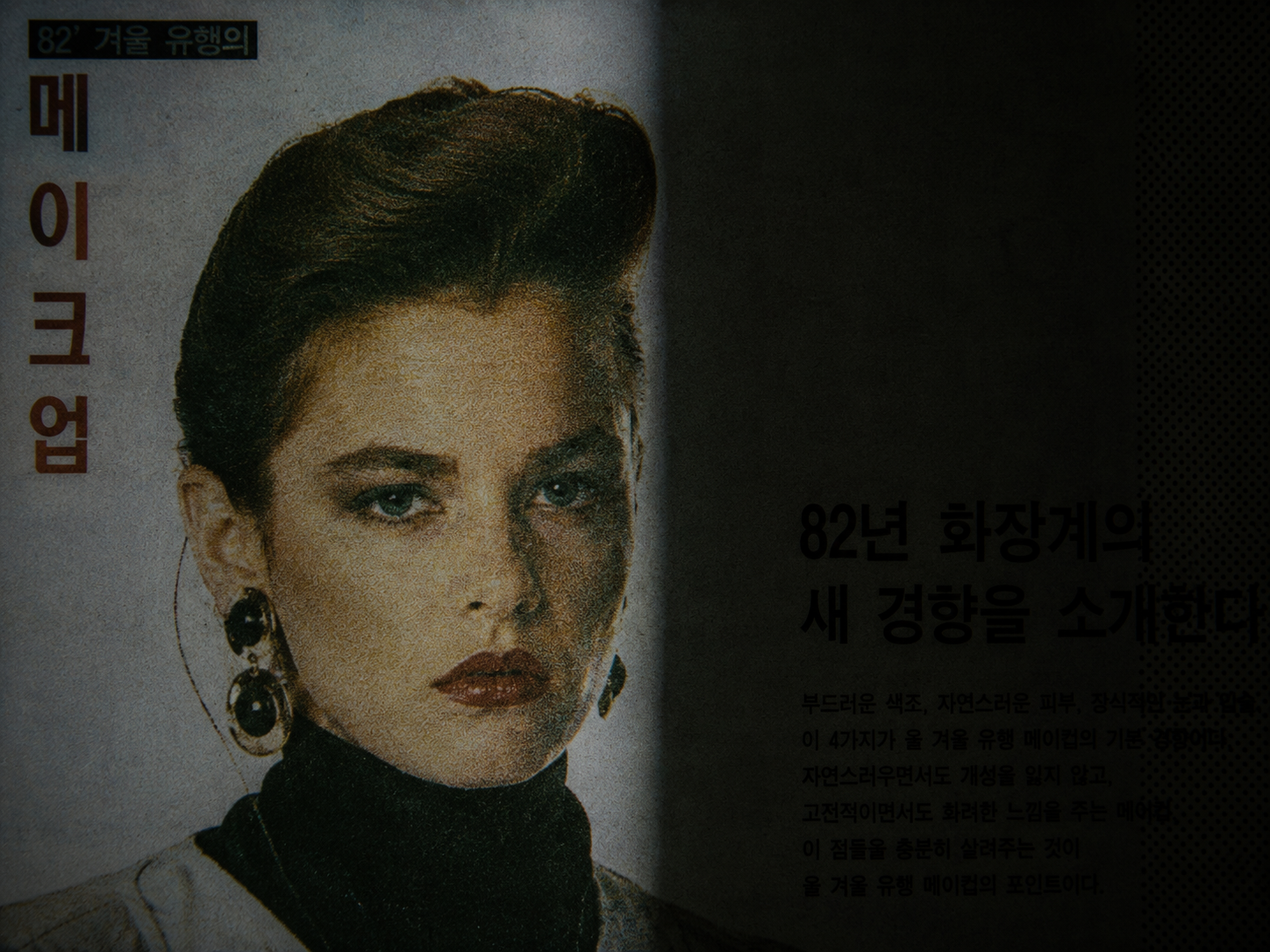
There is a particular category of disappearance that resists resolution not because the evidence is insufficient, but because the architecture of a state has been deliberately turned against the act of remembering. The vanishing of Yoon Young-sil in May 1986 belongs to this category. She did not fade into wilderness or slip beneath ocean water. She walked out of — or was removed from — a meticulously maintained apartment in one of Seoul’s most surveilled, most populated, most economically elite residential corridors, and the apparatus that should have investigated her absence instead performed a kind of bureaucratic mime: motion without output, procedure without conclusion, investigation without result. What remains is not a cold case in the conventional sense. It is an archival scar — a negative space shaped exactly like a person who was, by all available metrics, impossible to erase.
Historical Anatomy
To understand the structural conditions of Yoon Young-sil’s disappearance, one must first understand the Fifth Republic of South Korea — the government of Chun Doo-hwan, a former general who seized power through a coup in December 1979 and formalized his presidency in 1980 after the brutal suppression of the Gwangju Uprising. By 1986, Chun’s administration had developed a sophisticated apparatus for managing domestic information: state control over broadcast media, a heavily censored press, and an intelligence infrastructure — the Agency for National Security Planning, or ANSP — that operated well outside any meaningful judicial oversight.
Seoul in 1986 was also a city in transformation. Apgujeong-dong, where Yoon lived adjacent to the Hyundai apartment complex, was ground zero for South Korea’s accelerating consumer modernism. The neighborhood was already becoming synonymous with wealth, cosmopolitanism, and the concentrated visibility that comes with architectural density. High-rise apartment blocks had replaced the older low-rise fabric of the city; uniformed security guards monitored building entrances; neighbors were, by proximity if not intention, involuntary witnesses to each other’s routines. In this environment, the complete disappearance of a 174 cm woman who was simultaneously a top fashion model, a co-founder of the pioneering agency Model Line, and the younger sister of nationally recognized actress O Su-mi was not merely unlikely. It was, from an urban-sociological standpoint, structurally implausible.
Yoon herself occupied a specific niche within South Korean celebrity culture — one that carried its own particular visibility. The modeling industry she had helped architect through Model Line was still relatively young and aspirational; its leading figures were recognized on the street, photographed regularly, and embedded in the aspirational imagery that Korea’s growing consumer economy required. She was not peripheral. She was the kind of person around whom urban witnesses congregate without knowing they are doing so.
Structural Dissection of the Record
What O Su-mi found when she finally gained access to her sister’s apartment — after multiple days of failed contact, after enlisting a technician and a security guard to bypass a locked front door — was the detail that refuses explanation regardless of what theory one applies to the case. The interior was undisturbed. Not merely tidy: manicured. There was no property missing. No signs of physical duress. No overturned furniture, no broken glass, no biological trace suggesting confrontation. The apartment presented, in every observable dimension, the condition of a home whose occupant had simply stepped outside and had not yet returned.
This is the forensic detail that makes the case epistemically unusual. In abductions involving coercion, physical struggle leaves residue. In voluntary departures — flight, evasion, personal crisis — some category of personal property tends to disappear alongside the individual. In deaths occurring within domestic spaces, even the most clinically staged scene retains some indexical mark. The pristine condition of Yoon Young-sil’s apartment eliminates the most statistically probable explanations without substituting any credible alternative. It performs an absence that should be physically impossible.
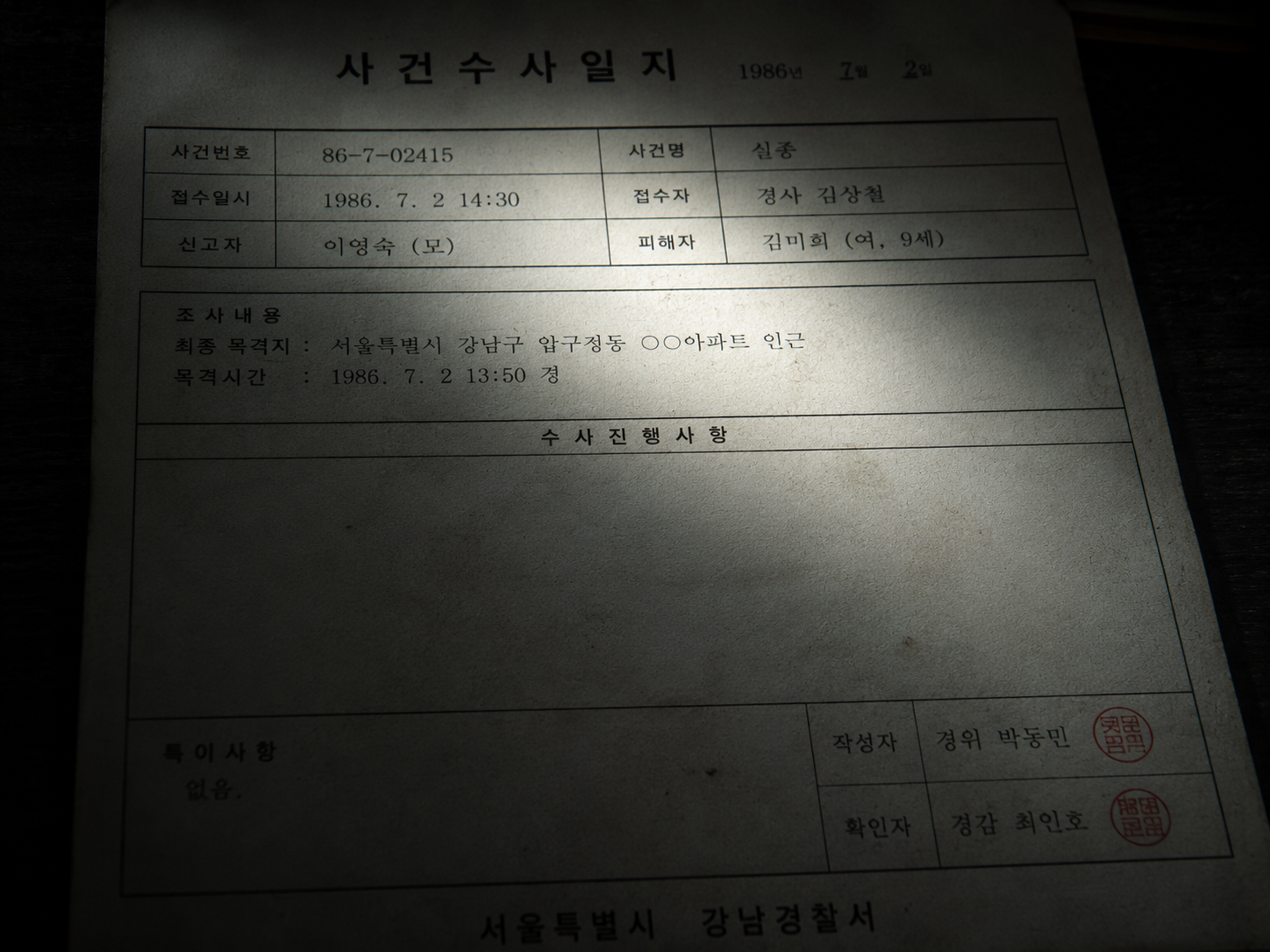
The police investigation that followed produced its own archival anomaly. Law enforcement in authoritarian states does not typically ignore high-profile disappearances — the optics of inaction carry political cost, and the standard procedure is to generate visible activity, even when that activity is ultimately unproductive. What the Republic of Korea Police produced in response to Yoon’s disappearance was something more unusual: a systematic refusal to communicate. No investigative milestones were released to the media. No public briefings were held. No press statements articulated what leads, if any, had been pursued. The investigation did not fail publicly; it simply withdrew from public discourse. The story was not suppressed through dramatic censorship so much as starved — denied the oxygen of official acknowledgment until it ceased to generate public pressure.
The treatment of photographer Kim Jung-man, then romantically involved with O Su-mi, sharpens this picture considerably. Following his separation from O Su-mi in July 1986, Kim was intercepted by ANSP agents — not arrested, not charged, not subjected to any formal legal process — and placed on a flight to Los Angeles. The deportation was extrajudicial by any standard; it was also, from the perspective of the intelligence apparatus conducting it, operationally clean. Kim’s removal from the country eliminated a witness and potential agitator without generating a judicial record.
Psychological Necropsy
The reason this case disturbs the Western imagination with particular persistence — beyond its intrinsic factual strangeness — is that it violates a foundational assumption of liberal forensic culture: the assumption that visibility is protective. In the Western true-crime tradition, celebrity functions as a kind of archival insurance. Famous people generate documentation; documentation resists suppression; suppression, when attempted, itself becomes evidence of wrongdoing. The very fame that makes a person a target also makes their disappearance difficult to manage.
Yoon Young-sil’s case demonstrates what happens when this assumption meets a state sophisticated enough to override it. The Fifth Republic possessed both the institutional capacity to suppress media coverage and the intelligence infrastructure to manage witnesses directly. Visibility, in this context, was not protective; it was simply another variable the state could adjust. The horror is not that something was hidden — it is that the hiding was so procedurally complete that the hiding itself became invisible.
There is also a temporal dimension to the psychological disturbance this case generates. The events of 1986 did not unfold in isolation; they accumulated within a single family across a compressed period that reads, in retrospect, as almost operationally coordinated. In March, celebrated filmmaker Shin Sang-ok — the biological father of O Su-mi’s children — dramatically defected from North Korean custody at the U.S. Embassy in Vienna, generating international headlines and geopolitical turbulence. In May, Yoon vanished. In July, Kim Jung-man was deported. By late 1986, O Su-mi — decimated by successive familial trauma and operating under what she understood to be state surveillance — had buried herself in an accelerated film production schedule before announcing her permanent retirement from the entertainment industry. She died on June 30, 1992, in a car accident in Hawaii, at forty-one. The direct memory pool closed with her.
This sequence is either a remarkable coincidence or a systematic operation. The forensic record does not permit a definitive determination. What it does permit is the observation that each event in the sequence removed a witness, reduced a pressure point, or diminished the likelihood of sustained public inquiry.
The Evidence of Erasure
The erasure of Yoon Young-sil from public record operated through several distinct mechanisms, each reinforcing the others.
The first mechanism was institutional silence. By refusing to issue public statements, the police investigation denied the media its primary source material. In the pre-digital media environment of 1986 South Korea, print journalism operated almost entirely through official channels; without official confirmation of investigative activity, the story had no verifiable content to report. The silence was not merely a byproduct of censorship — it was itself the censorship mechanism.
The second mechanism was witness attenuation. Kim Jung-man’s extrajudicial deportation removed the most proximate external witness to the family’s circumstances from the country. O Su-mi’s subsequent retreat into professional isolation — and her death six years later — closed the familial information channel. Within a decade of the disappearance, the individuals most likely to sustain public pressure or private inquiry had been geographically dispersed or were deceased.
The third mechanism was the passage of the criminal statute of limitations. Whatever legal accountability might theoretically have been pursued, it expired without prosecution. The case entered permanent cold case status not through judicial determination but through administrative attrition.
What the internet era subsequently produced was not recovery of the suppressed record but its mutation into mythology. The geopolitical hypothesis — that North Korean operatives abducted Yoon as retaliation for Shin Sang-ok’s defection, a form of asymmetric reprisal targeting O Su-mi’s family — circulated through early Korean internet forums with the velocity of plausible speculation dressed as leaked intelligence. It required no verification because it was structurally coherent: the timing aligned, the motive was legible, and the hypothesis explained both the disappearance and the state’s subsequent silence as components of a diplomatic sensitivity operation.
The Cheongnamdae legend took a different form — slower, more localized, and more disturbing in its implications. This urban mythology claimed Yoon was not dead but captive: permanently requisitioned, as the narrative frames it, by elements of the Chun Doo-hwan security apparatus for use at Cheongnamdae, the fortified presidential holiday villa. The legend’s endurance derives from the same clean apartment detail that anchors every forensic reading of the case: if she was not taken by force, and if she did not leave voluntarily, the only remaining category is controlled removal — a disappearance organized by actors with both the authority to manage the scene and the institutional capacity to enforce subsequent silence.
The most recent layer of internet response — the analog horror aesthetic — operates on an entirely different register. Korean content aggregators on YouTube and platforms like DC Inside have reprocessed the visual record of Yoon’s modeling career through an uncanny lens: the contrast between her avant-garde, VHS-saturated 1980s fashion imagery and the clinical emptiness of the apartment she left behind. The aesthetic response does not claim to analyze the case; it claims to capture a feeling — specifically, the feeling of encountering a perfectly ordered domestic space from which the human element has been surgically excised. This is analog horror’s central affect, and the Yoon Young-sil case provides it in undiluted form. The apartment was clean. The life was gone. The two facts refuse to coexist under any ordinary explanatory framework.
The Point of No Return
The uncomfortable terminal insight of the Yoon Young-sil case is not that it remains unsolved. Unsolved cases are common enough in any national archive. The insight is structural: that the case demonstrates, with clinical precision, the limits of what digital memory can recover once an analog suppression has been sufficiently thorough.
The internet mythology surrounding Yoon Young-sil is vivid, proliferating, and almost entirely unmoored from verifiable evidence. The geopolitical hypothesis is compelling but unverified; the Cheongnamdae legend is atmospheric but undocumented; the analog horror aesthetic is emotionally resonant but epistemically empty. What the digital archive contains is not the suppressed truth of May 1986 — it is the cultural residue of a suppression that was, on its own terms, successful. The state did not merely manage information; it managed the conditions under which information could later be recovered. By the time the internet created a platform capable of sustaining sustained public interest in cases like this, the witness pool had been depleted, the statute of limitations had expired, and the primary records had been classified or destroyed.
This is the architecture of permanent erasure: not the dramatic burning of files but the patient, procedural elimination of the conditions under which accountability could be constructed. The case does not survive as mystery because the truth is complex. It survives as mystery because the mechanisms of its suppression were, by design, invisible — and because invisibility, once achieved at sufficient depth, becomes structurally indistinguishable from the absence of any truth to suppress.
Yoon Young-sil was 29 years old in 1986. Her apartment was clean. Nobody saw her leave. The state said nothing. These four facts have not changed in forty years, and they will not change; the people who knew what happened are either dead, deported, or silent. What the digital era has added to this record is not resolution but amplification — an expanding archive of speculation, aestheticized grief, and mythological elaboration surrounding a negative space that was, from the beginning, deliberately constructed to resist being filled.
The network functions effectively as the default archive of human experience. However, digital permanence remains an illusion because it relies entirely on the prior survival of physical evidence. When the analog source material is systematically neutralized at the moment of inception, the digital record can only ever map the silhouette of the missing data.
The archive is not broken. The archive is working exactly as designed.
🔍Search Update: Call to Action
For archival investigators, lost media researchers, and alternative historical networks tracking Cold War-era disappearances in East Asia: the case of Yoon Young-sil contains significant archival gaps. If you have access to digitized 1980s South Korean fashion magazines, unindexed print media logs from the late Fifth Republic, or unredacted administrative records detailing foreign entries and exits via Kimpo International Airport from July 1986, please contact the repository network. Digital restoration relies entirely on salvaging the fragments left behind by analog gatekeepers.
This document is an investigative archival reconstruction based on fragmented public records, media remnants, community accounts, and verified historical sources compiled by The 3AM Archive.
The article examines how incidents, forgotten media, internet folklore, and unresolved public memories evolve through cultural preservation and digital decay.
This is a cultural investigation document — not fictional horror content.
All visual materials used in this post are exclusive AI-generated assets created for The 3AM Archive.
