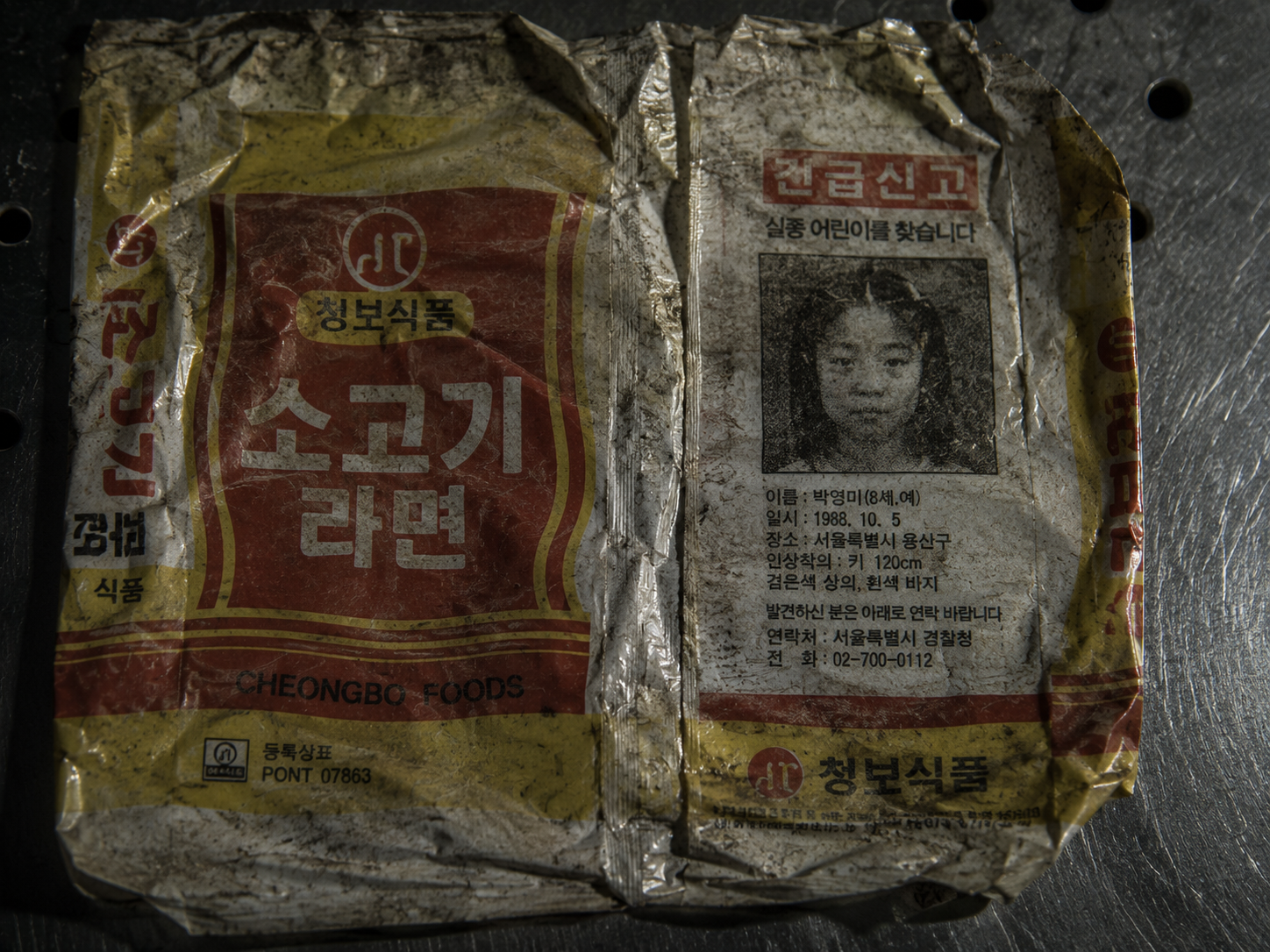
There is a particular kind of forgetting that is not passive. It does not occur through the slow erosion of memory or the indifferent passage of time; it is manufactured—through institutional collapse, through material decay, through the quiet disposal of objects that once carried the faces of the missing. The disappearance of Jang Hyung-yeon, an eight-year-old girl who boarded a city bus in Gangdong-gu, Seoul on June 25, 1983, and never arrived at her grandmother’s apartment in Jamsil, is a case study not merely in an unsolved abduction—it is a structural diagnosis of a society that consumed its own archives before it ever understood what it had lost.
Her face, documented in at least one surviving photograph, was eventually printed on the packaging of instant ramen noodles sold by a company that no longer exists. When that company went bankrupt in 1987, the remaining physical stock of those wrappers was discarded. The medium carrying her identity was thrown away. This is not metaphor. It is the literal administrative mechanism by which a missing child’s last recorded mass-distribution image was routed into municipal waste systems. What remains is a case file that is part criminal record, part corporate ghost, and part analog horror—the latter category being, perhaps, a structural intersection that explains its sudden re-emergence in modern digital folklore.
Historical Anatomy
To understand the precise vulnerability that allowed Jang Hyung-yeon to vanish, one must first reconstruct the geography—not merely of the city, but of its transitional state. In 1983, Jamsil and Gangdong-gu were not the dense, surveilled residential districts they are today. They were zones of aggressive urban conversion; rural periphery being overwritten by massive concrete apartment complexes at a pace that outran every attendant social infrastructure. Roads expanded. Bus routes proliferated. Children navigated these expanding networks without adult supervision, largely because the cultural expectation of supervised transit had not yet evolved to match the scale of the city being built around them.
Jang Hyung-yeon was a second-grader at Dunchon Elementary School—then formally designated Dunchon Kookmin School. She left school and, according to classmates, indicated she would take a city bus to visit her grandmother. No electronic record of this movement existed; bus systems operated on physical cash and the memory of drivers who ran dozens of routes per day. No mandatory attendant supervised the boarding of minors. The child entered the transit network and ceased to exist within it.
The date of her disappearance carries a weight that must be registered explicitly: June 25, 1983 was the thirty-third anniversary of the outbreak of the Korean War. In South Korean national consciousness, this date functions as a recurring wound—a calendrical scar. Whether the coincidence of the disappearance and the anniversary carries forensic significance remains unknown. It does, however, mean that in subsequent coverage and cultural memory, Jang’s case was never entirely separable from the ambient national grief of that date. Consequently, subsequent domestic media coverage frequently conflated the timeline of the abduction with national wartime commemoration.
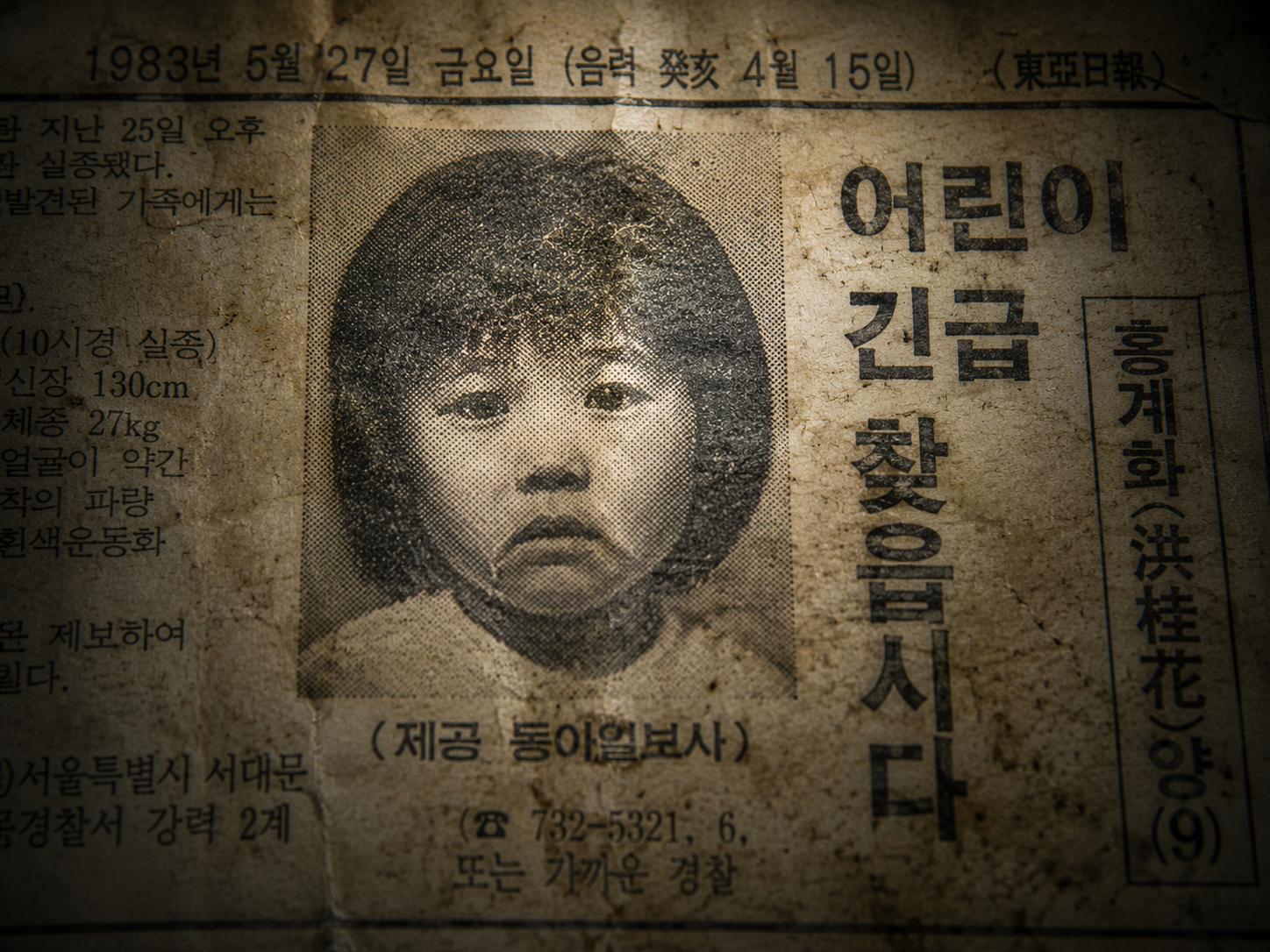
The media environment of 1983 South Korea was, by Western standards, primitive in its capacity to distribute urgent public information. Television ownership had expanded, but the mechanisms for broadcasting missing person reports in real time—the infrastructure of urgency—did not exist. Print was the dominant channel for extended documentation. The Dong-A Ilbo, one of Korea’s major dailies, published a formal missing person article on July 15, 1983; its headline translates to a near-verbatim transcription of parental desperation: “Return My Daughter: The Painful Appeal of Dunchon Elementary 2nd Grader Jang Hyung-yeon’s Parents.” The article ran three weeks after the child disappeared. In the interval between disappearance and print documentation, the investigation depended almost entirely on interpersonal networks, neighborhood canvassing, and word of mouth among families in the Gangdong-gu community.
Following the print exposure, local elementary schoolchildren organized grassroots picket campaigns before summer break in late July 1983—a mobilization that speaks both to the communal urgency felt by the community and to the total absence of any state apparatus capable of meeting that urgency at equivalent scale.
Structural Dissection of the Record
The anomaly at the center of this case is not the disappearance itself. Disappearances, however tragic, follow recognizable patterns in their investigative aftermath. What distinguishes the Jang Hyung-yeon case is a single event that occurred thirteen days after June 25, at approximately 5:00 PM on July 6, 1983.
Jang Hyung-yeon called her father.
She confirmed she was alive. She confirmed the presence of an adult male directly adjacent to her. She then surrendered the phone. The male captor held the line in complete silence—정형연 양을 붙잡고 있던 사내의 숨소리—breathing, sustained, unbroken silence—for several minutes before hanging up.
No ransom demand was issued. No location was communicated. No negotiable condition was articulated. The call served, from any rational criminological standpoint, no instrumental purpose that investigators could identify. It established proof of life at a moment when no leveraging of that proof-of-life occurred. The captor breathed. He waited. He disconnected.
This telephone event has been analyzed through multiple frameworks since its rediscovery by Korean internet communities and, subsequently, by international audiences. The forensic interpretation is straightforward in its parameters: the call was either a failed or aborted communication—an act interrupted before its intended purpose could be achieved—or it was a deliberate act of psychological cruelty toward the family, a demonstration of control with no transactional motive. Neither interpretation resolves into a coherent criminal profile. A kidnapper seeking ransom calls once and issues terms; a kidnapper operating on psychological dominance calls, proves he holds a living child, and hangs up without a word. The record cannot accommodate both possibilities simultaneously, and the record does not foreclose either.
The print archive, meanwhile, tells a story of corporate improvisation filling a state vacuum. Cheongbo Foods (청보식품), a Seoul-based food manufacturer, printed Jang Hyung-yeon’s missing person advertisement on the packaging of its Multeombeong Ramyun (물텀벙 라면) product—likely between 1986 and 1987. The practice of using commercial food packaging as public notice boards was not unique to Cheongbo; it serving as an early, localized corporate initiative to crowdsource public tips via high-volume consumer goods packaging. In retrospect, this makes Cheongbo Foods a node in the investigative record. The company went bankrupt in 1987 and was subsequently acquired by Ottogi.
No digitized archive of those wrappers has been confirmed to exist.
Psychological Necropsy
The Western imagination encounters the Jang Hyung-yeon case primarily through the lens of two genre frameworks that have calcified into their own distinct cultures: the analog horror tradition and the lost media archive community. Both frameworks are, in their way, accurate instruments—but they are instruments calibrated for different frequencies, and the case resists any single tuning.
The silent telephone call is the precise structural event around which the analog horror reading coalesces. In the tradition of works like The Mandela Catalogue or Local58—the contemporary genre of found-footage, cassette-era dread—the power of the uncanny is generated not by violence but by the non-communication of an entity that is present and refuses to speak. The captor on the July 6th call did not threaten. He did not negotiate. He existed, audibly, in the silence of the line—and the horror of that existence is that it could not be decoded into motive, into demand, into anything the family could act upon. He was simply there. The call is indistinguishable, as a narrative artifact, from the kind of event designed by a screenwriter to maximally weaponize dread. That it is documented in police and press records as a factual occurrence is, for the analog horror community, a point of near-obsessive fascination.
The lost media dimension operates on a separate register. For the international archive-sleuth community—the communities that catalogue unrecovered broadcast artifacts, pre-digital media orphans, and culturally significant objects whose physical substrate has been destroyed—the Multeombeong Ramyun wrapper represents a nearly perfect specimen of the category. It is an ephemeral commercial object produced by a defunct corporate entity; it carries the image of a missing person; it was distributed through the most disposable channel imaginable—the packaging of a low-cost instant noodle product—and it was subsequently discarded along with the company that produced it. The wrapper is, simultaneously, a missing persons record, a commercial artifact, and a ghost.
Cheongbo Foods holds its own cult status in South Korean internet subculture as a “phantom company”—a producer of notoriously low-quality and bizarrely branded food products that collapsed abruptly, leaving behind objects that are rare precisely because they were designed to be thrown away. The convergence of this corporate mythology with the Jang case transforms the wrapper from a document into a symbol; its un-digitized status is experienced not merely as an archival gap but as a second disappearance, running parallel to the first.
For Western audiences encountering the case through translated blog posts, Reddit threads, and YouTube documentaries on Korean cold cases, the dissonance is specific: the image of a missing child printed on instant noodle packaging strikes the Western sensibility as culturally abject—a comparison with the American “milk carton children” initiative is inevitable, but it misreads the structural context. The milk carton campaign was a coordinated, federally adjacent effort managed through the National Center for Missing & Exploited Children; the Multeombeong packaging was an improvised, corporate-level response to a total state vacuum. These are not analogous gestures. One represents institutional infrastructure; the other represents its complete absence. The Western discomfort with the ramen wrapper is, ultimately, a discomfort with what it reveals about the South Korean state’s capacity—or incapacity—to institutionalize the documentation of missing children in 1986.
The Evidence of Erasure
The disappearance of Jang Hyung-yeon from public record occurred in at least three distinct phases, each governed by a different erasure mechanism.
The first erasure was physical. In the absence of digitization, the primary media carrying her image were print artifacts—newspaper clippings, flyers, and the instant noodle wrappers. Newspaper archives from the period have partial digital representation, but the July 1983 coverage is fragmentary; the Dong-A Ilbo article has been cited in online discussions, but a full digitized scan has not been broadly circulated. The wrappers are, by all current evidence, entirely unrecovered. Physical decay and deliberate disposal—the normal end-state of food packaging—completed the elimination of that distribution channel without any archival intervention. The Cheongbo Foods bankruptcy in 1987 ensured that no corporate entity remained to preserve, inventory, or transfer the records of its own production.
The second erasure was institutional. The case remained open—technically—but the mechanisms of Korean state infrastructure in the 1980s were not designed to sustain active investigation of missing persons cases over multi-year periods. The Korean War anniversary that marked the date of her disappearance did not translate into memorialization of the child; the national grief of that date is calibrated toward a different object. By the time South Korea began developing more systematic approaches to cold case investigation in subsequent decades, the evidentiary trail of 1983 had already thinned to near-transparency.
The third erasure is social—and perhaps the most insidious. Missing children cases that produce no resolution, no perpetrator, no recovered victim, operate at a particular disadvantage in the ecology of collective memory. They cannot be narrativized through the closure that journalism and cultural memory require. The Jang case has no arc; it has only a beginning and a suspended present. The community mobilization of 1983—the schoolchildren’s picket campaigns, the newspaper appeals, the ramen packaging—represents a society that briefly organized its grief into action, and then watched that action produce nothing. The community dissolved back into its routines; the child remained absent; and the absence, over time, became unremarkable.
The Point of No Return
The Jang Hyung-yeon case is not merely a cold case. It is a demonstration of the conditions under which a society can lose a person twice—first in the physical world, and then in the archival record meant to document her loss. The second disappearance is not accidental. It is the product of specific, traceable decisions and structural absences: the decision to route missing persons documentation through commercial food packaging; the absence of state digitization initiatives; the bankruptcy of the corporate entity that carried her image; and the indifference of municipal waste systems to the contents of the objects they process.
What the internet has done, in the decades since, is partially reconstitute the case from residue—from Korean-language forum posts, from brief references in archived news databases, from the peripheral mythology of Cheongbo Foods as a phantom company. This reconstitution is imperfect; it involves extrapolation, speculation, and the accretion of detail that may not be accurate. The distinction between verified fact and internet mythology is, in cases this fragmentarily documented, genuinely difficult to maintain.
This highlights the baseline preservation flaw inherent to analog tracking systems: the record is not the event. The record is a survival, contingent on decisions made by institutions and individuals who did not understand themselves to be making archival decisions. Cheongbo Foods did not print Jang Hyung-yeon’s face on its ramen wrappers in order to create a historical document; it did so because the state had created no alternative channel. When the company collapsed, no one retrieved those wrappers because no one understood them to be retrieval-worthy. The archive was discarded because it was not recognized as an archive.
The telephone call of July 6, 1983 ended in silence. The captor breathed; he waited; he hung up. That silence has no resolution—not then, not now. The case of Jang Hyung-yeon remains entirely unresolved. No suspect has been identified. No remains have been located. No wrapper has been recovered. The community that picketed for her return is, forty years later, another generation older—and the child they picketed for remains eight years old, frozen in a photograph that may or may not still exist in a private home somewhere in Gangdong-gu.
The default archive of human experience does not heal. It does not close. It breathes, and waits, and eventually someone hangs up.
🔍Search Update: Call to Action
For international lost media collectors, true crime archivists, and collectors of retro East Asian ephemera: the Cheongbo Foods Multeombeong Ramyun packaging remains one of the most critical unrecovered pieces of visual missing-persons history from South Korea’s analog era. If you operate within vintage food wrapper collecting circles, retro computing archives, or municipal library digitization teams handling 1980s physical advertisements, check your collections for Cheongbo Foods variants manufactured between 1985 and 1987. Any scanned or physical item matching this corporate profile could provide the only known high-volume print trace of Jang Hyung-yeon’s public appeal left in existence.
This document is an investigative archival reconstruction based on fragmented public records, media remnants, community accounts, and verified historical sources compiled by The 3AM Archive.
The article examines how incidents, forgotten media, internet folklore, and unresolved public memories evolve through cultural preservation and digital decay.
This is a cultural investigation document — not fictional horror content.
All visual materials used in this post are exclusive AI-generated assets created for The 3AM Archive.
