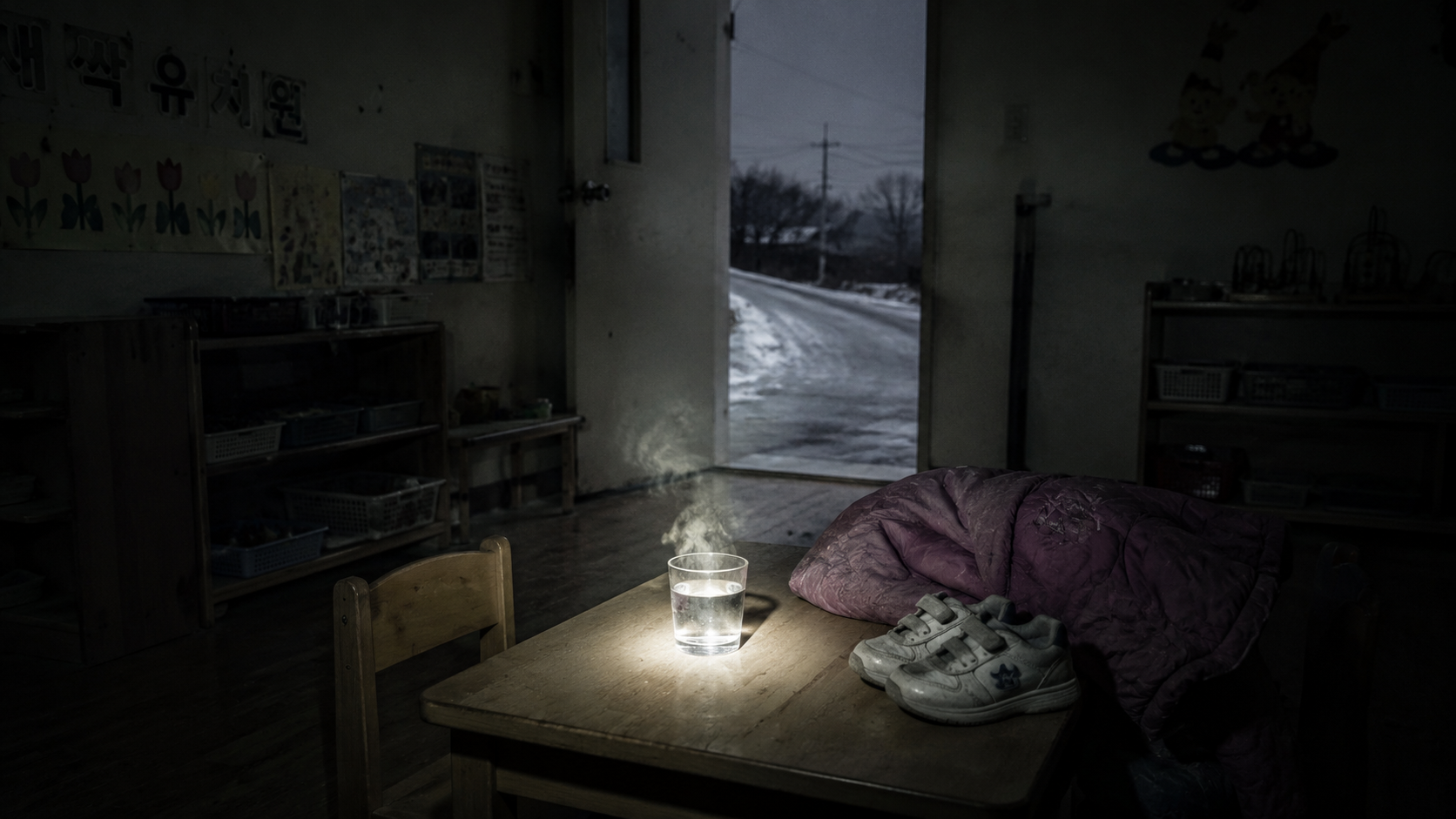
On January 27, 1999, a nine-year-old boy walked out of a classroom back door in rural Gyeonggi Province and ceased to exist—not in the biological sense, at least not demonstrably, but in the only sense that modernity can reliably confirm: the documentary record. He left behind his shoes, his coat, his name embroidered on a tag, and every practical tool a non-verbal child with severe autism would need to survive a sub-zero Korean winter. What he did not leave behind was a single witness. No footprint. No fragment of a neon-yellow turtleneck snagged on a fence post. No passing driver who remembered a shoeless boy on the road to Baegand-ri. The case of Jang Seong-gil is not, at its core, a mystery about what happened to one child; it is a forensic study of how an entire institutional era could produce a disappearance so total, so architecturally complete, that it reads less like a tragedy and more like a system functioning exactly as designed.
Historical Anatomy
To understand how Jang Seong-gil vanished, one must first understand the specific texture of South Korea in January 1999. The country was eleven months into its most severe economic catastrophe since the Korean War. The IMF crisis—IMF 사태—had collapsed the won, shattered conglomerates, and driven unemployment to figures South Korean society had not processed before. The social infrastructure buckled with it: welfare programs were underfunded, government attention was consumed by macroeconomic emergency management, and institutional capacity for case follow-through in rural municipalities was thin and thinning.
Yangpyeong-gun was not a metropolitan district equipped for complex missing-persons investigations. It was a rural county roughly 60 kilometers east of Seoul—sparsely populated, reliant on limited local police infrastructure, and geographically defined by the Han River valley and surrounding highland terrain that could absorb a person with startling efficiency. The Parangsae Daycare sat in Baegand-ri, a village-level administrative unit where a child wandering outside would ordinarily be conspicuous. Ordinarily.
The institutional landscape governing disabled children in 1999 South Korea was itself in transitional chaos. The Special Education Act had existed since 1977, but practical enforcement—the network of registered schools, certified teachers, and dedicated welfare routing for children with severe developmental disorders—remained inconsistent outside major urban centers. Families with profoundly disabled children frequently navigated a fragmented system of private religious facilities, informal care networks, and under-resourced daycare placements that had not been purpose-built for children with Jang’s profile. A non-verbal, severely autistic nine-year-old attending a standard Parangsae Daycare in 1999 was already, administratively speaking, in the wrong place—placed by circumstance rather than design.
The broader media environment of the era compounded the problem. 1999 Korea was a society in the early stages of internet adoption; dial-up connectivity was expanding rapidly in urban areas, but digitized public records, searchable missing-persons databases, and networked alert systems did not exist in any functional sense. A child who disappeared from rural Gyeonggi in January 1999 disappeared into an analog void—one where the transmission of information depended on physical flyers, personal visits, and the cooperative goodwill of individual facility administrators.
Structural Dissection of the Record
The timeline of Jang Seong-gil’s disappearance contains a gap that has received insufficient attention relative to its operational significance: the period between approximately 12:35 PM and 1:40 PM on January 27, 1999.
The teacher’s departure from the classroom to retrieve water is documented as the window of escape. The return—estimated within two to five minutes—found the room empty. What followed was not an immediate call to emergency services. Daycare staff conducted an internal search and scoured the immediate perimeter for over an hour before contacting the parents or alerting police. The trail, in a cold wave environment where physical evidence degrades and witnesses disperse, grew cold in real time during that interval. The police did not respond until late afternoon. A localized grid search of Baegand-ri produced nothing.
This delayed notification is the structural hinge of the case—the moment at which a recoverable situation may have become unrecoverable. It is worth examining what drove that delay. Staff at small private daycares in 1999 Korea operated under intense informal social pressure to resolve incidents internally before escalating them; parental trust was the primary economic asset of a private facility, and a missing child was an institutional catastrophe. The delay was almost certainly not malicious. It was the predictable behavior of an institution protecting itself from accountability through the same instinct that governs most institutional self-preservation: manage internally, then report.
The physical anomalies of the disappearance resist casual explanation. Jang Seong-gil walked into a Cold Wave Warning in a bright yellow turtleneck, gray trousers, and bare feet. No outerwear. He left his heavy winter coat in the classroom—the coat that bore an embroidered tag with his name and home address; the single object that might have allowed a stranger to identify him and return him. He left his shoes. He carried nothing. For a child described as lacking the cognitive capacity to process basic vocabulary or retain his home address, the act of opening a door and stepping outside represents a behavioral threshold that, under normal conditions, should have left traces: a neighbor’s sighting, a driver’s memory, a visible trail in the frozen ground.
The zero-witness paradox—the complete absence of any sighting of a child this visually distinctive in this environment—is the record’s deepest anomaly. Rural Korean communities in 1999 were not anonymized urban environments. Baegand-ri was a village. The social density that should have made a barefoot, yellow-shirted child on a winter road immediately visible to someone is precisely the social density that makes his invisibility so disorienting.
Psychological Necropsy
Western audiences encountering this case for the first time—typically through Reddit’s r/UnresolvedMysteries, NamuWiki translation threads, or documentary-format YouTube essays—register a specific category of disturbance that is worth anatomizing clinically.
The case activates what might be called liminal institution anxiety: the fear that the spaces society designates as protective—schools, daycares, hospitals—contain threshold moments in which protection can invert into exposure with no warning and no mechanism for recovery. The classroom-to-cold-wave transition occurred in the span of a water errand. The protective institution did not fail dramatically; it failed in the most mundane interval imaginable. This is more psychologically destabilizing than a violent event because it offers no narrative of resistance—no villain, no structural defect that can be corrected, no moment at which a different decision would have reliably produced a different outcome.
The Missing 411 parallel surfaces organically in Western discussions of this case. David Paulides’ framework—which centers on the inexplicability of disappearances in ostensibly traversable environments, the absence of physical traces, and the failure of searches conducted by experienced parties—maps onto the Jang Seong-gil case with uncomfortable precision. The cold wave environment should have punished exposed travel; a barefoot child on frozen ground leaves physiological traces within minutes. The rural setting should have produced witnesses. The bright-yellow clothing should have functioned as a visibility marker across considerable distance. None of these physical constraints appear to have operated. Western true-crime audiences, conditioned by the Missing 411 framework, read this as evidence of an anomalous disappearance—one that exceeds the explanatory capacity of standard missing-persons modeling.
The deeper disturbance, however, is the bureaucratic dimension. The detail that Jang’s parents were legally blocked from inspecting private welfare facilities—orphanages, psychiatric institutions, disability care homes—under human rights privacy statutes transforms the case from a geographic mystery into an administrative one. The child may have been present, alive, within the system that was legally shielded from parental inspection. This is the case’s most corrosive element: the privacy laws that were designed to protect institutionalized individuals became, functionally, the mechanism by which a missing child could remain missing indefinitely within the very network of care institutions that should have been the first point of investigation.
The Evidence of Erasure
Twenty-seven years after the disappearance, the archival record of Jang Seong-gil exists in fragments distributed across platforms that did not exist when he vanished.
The case’s primary digital presence is a NamuWiki entry—a crowdsourced Korean encyclopedia that serves as the de facto archive for cold cases, internet folklore, and unresolved public incidents. NamuWiki entries for cold cases are collaborative, unstable documents: they accumulate detail through anonymous contribution, are subject to periodic deletion and reconstruction, and exist without the editorial oversight or institutional accountability that would characterize a formal archival record. The case has no official dedicated webpage from the National Police Agency’s Missing Child Center beyond registry documentation. There is no digitized broadcast record of news coverage from 1999 that has been publicly surfaced.
The mother, Yoon Gyu-seob, died of cancer in 2020. Her death marks the case’s transition from an actively contested investigation—one with a living primary advocate conducting physical searches, distributing materials, and maintaining institutional pressure on welfare facilities—to a passive archival state. The father, Jang Heung-jae, remains the sole active seeker; but a single person maintaining a 27-year-old case against institutional inertia, privacy law barriers, and the natural entropy of analog-era documentation is fighting a structural opponent that does not tire.
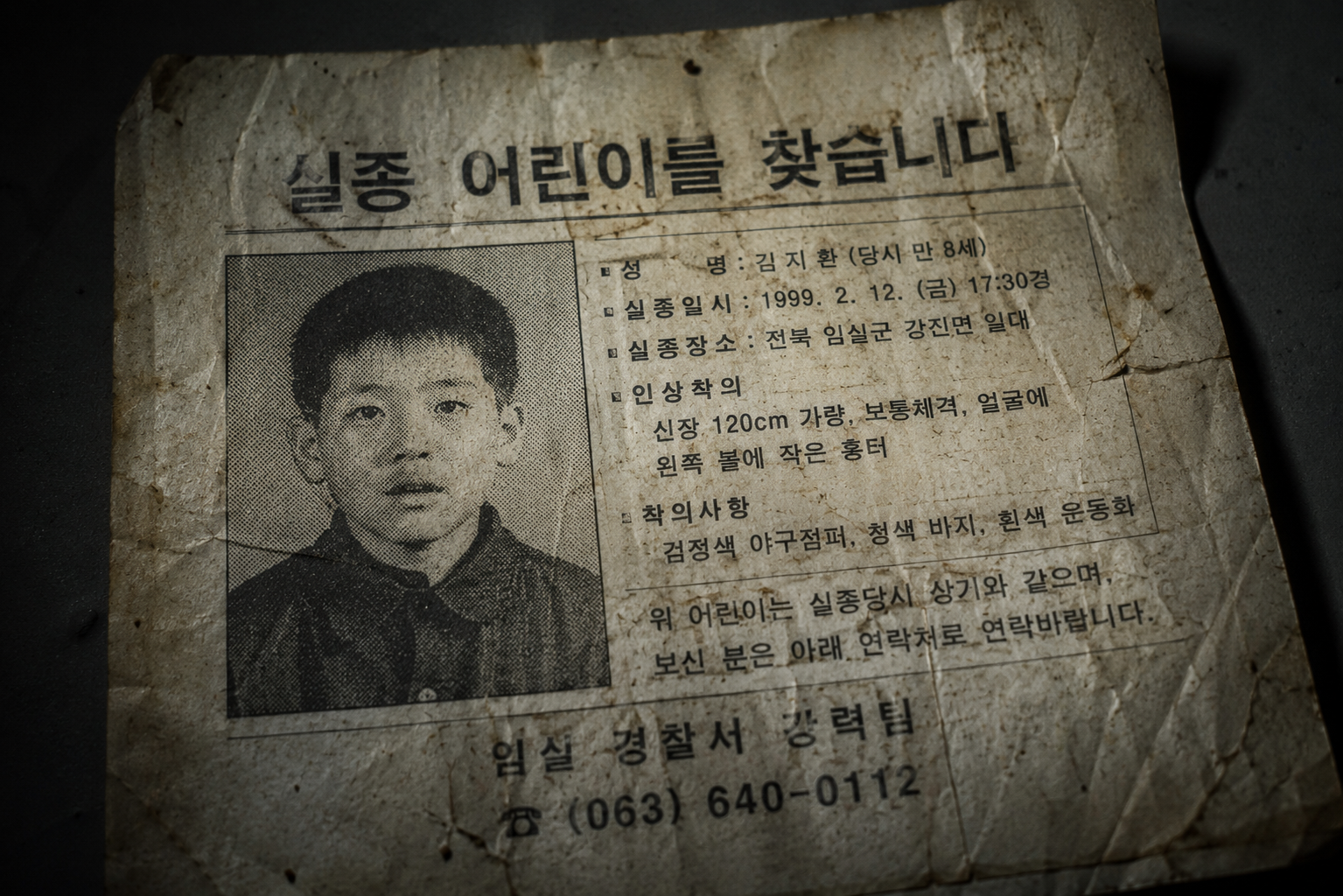
The physical search materials from 1999 and the early 2000s—the flyers distributed to welfare facilities, the correspondence with institutional administrators, the documentation of denied access—exist, if they exist at all, as physical objects in private possession. They have not entered a digitized public record. When those objects are lost or destroyed, the evidentiary substrate of the parents’ campaign disappears with them. The case reverts entirely to secondary documentation: NamuWiki, registry entries, and the testimonies of people who remember being told about it.
This is the pattern of erasure specific to pre-digital Korean cold cases: the primary documentation is analog, private, and mortality-dependent. It survives only as long as the people who generated it are alive and maintaining it. When they die, it does not transfer to an institutional archive—it dissipates.
The Point of No Return
Jang Seong-gil, if alive, is 36 years old. He would have no documented memory of his own name, his parents, or his disappearance. He would be, in the most literal administrative sense, whoever the records say he is—or no one at all, if no records were ever generated for him.
This is the uncomfortable endpoint the case forces: the possibility that a person can exist fully within the modern institutional framework—receiving care, occupying a bed, consuming resources—while simultaneously being, archivally, absent. Non-verbal, without a functioning memory of personal history, integrated under a wrong name or no name at all into a care system that has no mechanism for cross-referencing its long-term residents against a 1999 missing-child registry entry. The privacy laws that prevented his parents from entering facilities to search also prevent any outside party from conducting a systematic institutional audit now.
Digital memory has the quality of permanence but not the quality of completeness. The NamuWiki entry for this case will persist; the Reddit threads will be archived; the YouTube essays will accumulate views. But none of that activity is the same as an investigation. Internet archaeology is not forensic recovery—it is the aestheticization of unresolved loss, the transformation of an open wound in one family’s history into content for another culture’s consumption. The Western true-crime community that finds this case through r/UnresolvedMysteries and labels it a glitch in the matrix is not wrong that something anomalous happened; it is wrong, or at least incomplete, in imagining that attention is equivalent to resolution.
What 1999 Yangpyeong demonstrates, ultimately, is that the transition from an analog to a digital institutional infrastructure did not recover what the analog era lost. It documented the loss instead. The records that do not exist cannot be digitized; the witnesses who never came forward cannot be retrospectively interviewed; the facilities that denied access in 2002 under privacy statutes are under no new legal obligation to open themselves now. The archive of Jang Seong-gil’s disappearance is not a mystery waiting to be solved by sufficiently motivated researchers. It is, more precisely, a structured absence—a shape in the data where a person should be, surrounded by the institutional and legal geometry that made that shape permanent.
The barefoot child in the yellow turtleneck walked out of a classroom into a cold wave, and the system that should have preserved his trace was not yet built. By the time it was, the trace was gone.
🔍Search Update: Call to Action
For the global true-crime, internet archeology, and lost media communities, the case of Jang Seong-gil represents a critical documentation gap in early digital records. If you have access to archived late-90s South Korean broadcast feeds, local Gyeonggi Province newspaper print scans from early 1999, or undocumented physical missing persons materials from this era, your contributions are vital. Preserving these fleeting materials before they are lost to physical decay is essential for maintaining the historical ledger. If you possess any archival documentation, relevant historical records, or verifiable leads, please contact the National Missing Child Center via official legal channels at the National Police Agency tip lines (Dial 182 within South Korea).
This document is an investigative archival reconstruction based on fragmented public records, media remnants, community accounts, and verified historical sources compiled by The 3AM Archive.
The article examines how incidents, forgotten media, internet folklore, and unresolved public memories evolve through cultural preservation and digital decay.
This is a cultural investigation document — not fictional horror content.
All visual materials used in this post are exclusive AI-generated assets created for The 3AM Archive.
