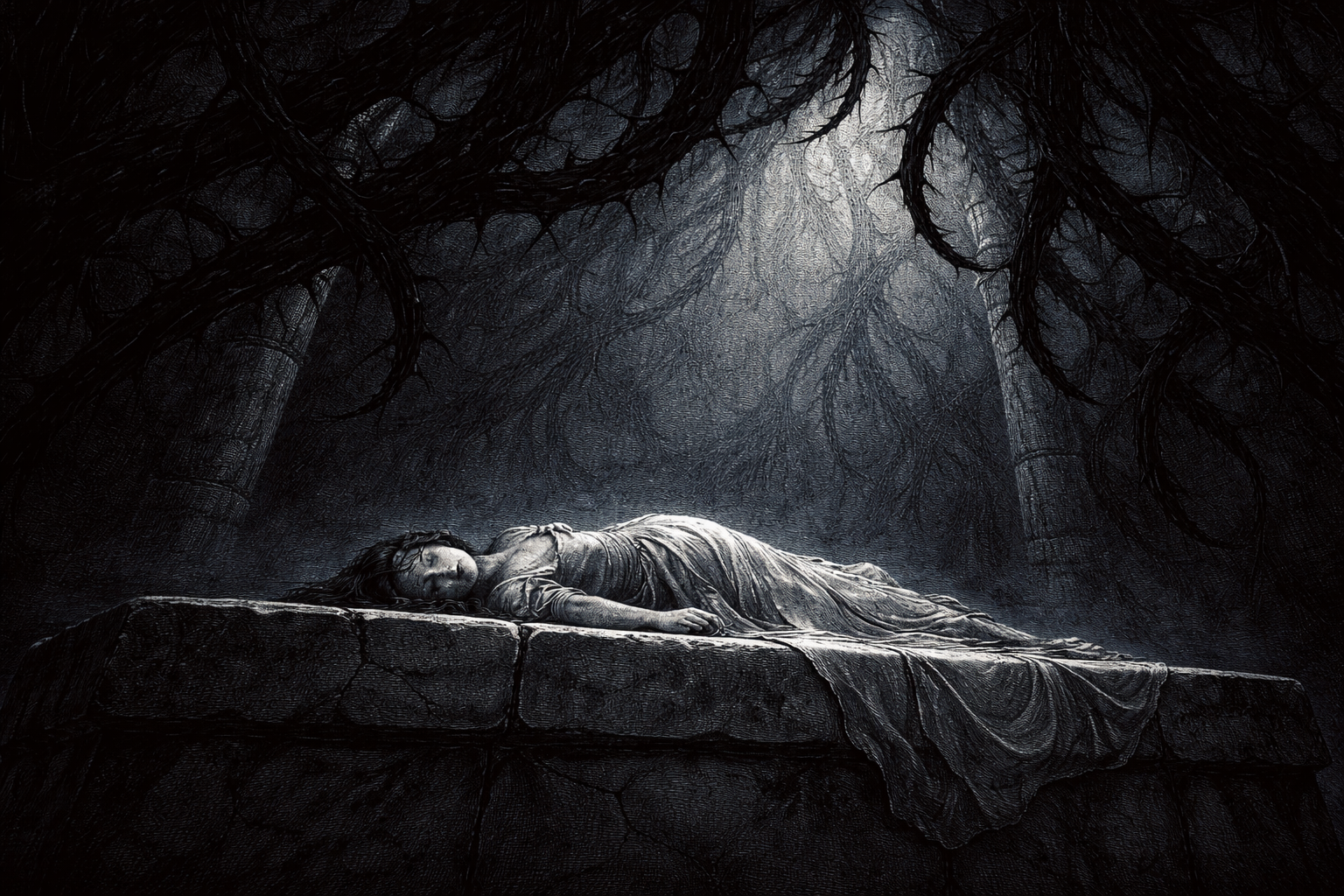
Most people remember Sleeping Beauty as a romance.
A princess. A curse. A kiss. A happily ever after.
That reading is not just incomplete. It is the point. The story was never meant to be understood. It was meant to be absorbed.
What sits underneath the pink gowns and enchanted towers is something far colder: a near-perfect behavioral blueprint for female passivity, encoded into narrative so that it could be transmitted across centuries without triggering a single alarm.
The Structural Framework
Fairy tales do not survive for hundreds of years by accident. Oral traditions are brutally efficient. Stories that fail to carry cultural payload die. The ones that persist carry instructions.
Sleeping Beauty has existed, in recognizable form, since at least the 14th century. Giambattista Basile’s 1634 version, “Sun, Moon, and Talia,” is the earliest well-documented literary telling, and it is considerably darker than any Disney adaptation would suggest. In that version, the sleeping girl is not kissed awake. She is assaulted by a passing king while unconscious, gives birth to twins in her sleep, and only wakes when one of the infants sucks the cursed splinter from her finger. The awakening is incidental. Her body has already been used.
Charles Perrault cleaned up the surface in 1697. The Brothers Grimm refined it further in the 19th century. Disney completed the sanitization in 1959. Each revision removed more of the original violence while preserving the core structure intact: a girl falls into a condition of total passivity, and a man acts upon her body to resolve it.
This is not a coincidence of storytelling. It is the mechanism. The violence was never the message. The passivity was.
The structure of the tale operates on three levels simultaneously. On the surface, it is a curse narrative. One layer down, it is a purity narrative, centered on keeping the female body suspended, untouched by her own agency, perfectly preserved for male access. Deepest of all, it is a compliance narrative. The girl does nothing wrong. She does nothing at all. And that is precisely why she is rewarded.
Consider what the story actually teaches, stripped of its imagery. The protagonist who waits, who sleeps, who exercises zero volition, receives a prince, a kingdom, and a love story. The one female figure who acts, who exercises power and pursues her own agenda, is the witch. And she is destroyed.
The architecture could not be cleaner.
Historical Archetypes
Sleeping Beauty does not stand alone. It belongs to a pattern so old and so widespread that its repetition cannot be attributed to coincidence or shared imagination.
The “sleeping maiden” archetype appears in Norse mythology with Brynhildr, the Valkyrie whom Odin punishes by pricking with a sleep thorn and encircling with a ring of fire. Her crime: disobedience. She chose which warriors lived and died, and she chose wrong. The punishment was not death. It was suspension. Total removal from agency until a man arrived to end it.
Snow White follows the same structure almost point for point. A girl made passive by poison, preserved in a glass coffin, accessed and awakened by a prince’s touch. Her story even includes the same instrument of suspension in some versions, it is a comb, in others a poisoned apple, in all versions an object inserted into or consumed by her body by a hostile older woman. The hostile older woman who has power and uses it. The girl who has beauty and surrenders it.
Across cultures, you find variations of this same structure. The passive girl preserved in an enchanted or liminal state. The active woman coded as threat. The male arrival coded as salvation. From Basile’s Naples to Perrault’s France to Grimm’s Germany to the global spread of Disney animation, the load-bearing elements never change.
Psychologist Bruno Bettelheim, in his 1976 work “The Uses of Enchantment,” argued that the sleep in Sleeping Beauty represents the necessary withdrawal of adolescence, a period of internal development before the girl emerges as a woman. His reading is generous, and worth understanding. It is also a remarkable example of how thoroughly the story’s architecture can be reframed as protective rather than controlling. Bettelheim’s analysis essentially argues that the suspension is for the girl’s benefit. That she needs to be unconscious. That the passivity is developmental.
That argument has been made about a great many forms of female confinement throughout history.
Psychological Necropsy
The curse in Sleeping Beauty is almost never examined for what it actually is: a punishment handed down by female power upon female potential.
In most versions, the curse comes from a fairy, witch, or uninvited godmother. The specific trigger varies. In Perrault’s version, it is an old fairy offended at being excluded from a royal celebration. In the Grimm version, it is the thirteenth wise woman, excluded because the king only had twelve golden plates. In every version, the hostile female figure is marginal. She is uninvited. She exists at the edge of the social order. And she exercises power in a way that the court structure cannot tolerate.
Now examine what she does with that power. She does not kill the princess. She puts her to sleep. She does not destroy the potential. She defers it, suspends it, makes it inaccessible until external intervention resolves the situation.
The curse, psychologically, functions as an internalized social prohibition. The message transmitted is this: female awakening, female entry into full power and sexuality, is dangerous. It must be delayed. It will be controlled by external forces, not by the girl herself. And when it finally arrives, it will arrive through male agency, not her own.
The spindle is worth pausing on. In the original cultural context of these stories, the spinning spindle was one of the primary tools of female domestic labor. It was the instrument of women’s work, of economic productivity within the home, of female adulthood. The curse is triggered by the girl touching it. By reaching toward it herself, independently, without supervision. The punishment for that reach, that independent contact with the instrument of female adult identity, is immediate unconsciousness.
She tries to touch the thing that would make her an adult. She is put to sleep for it.
The prince, when he arrives, does not interact with a person. He interacts with a preserved object. He finds her, he acts upon her, and she becomes conscious in response to his action. Her awakening is not her own. It is granted. In the oldest versions of the tale, it is not even requested. She wakes up as a byproduct of something a man did to her body while she was unaware.
And the first thing she does upon waking, in Perrault’s version, is tell the prince that she has waited a long time for him.
She has no memory of the wait. She was unconscious. The line is not character. It is instruction.
Why People Keep Looking Away
The reason this structure goes unexamined is partly because it works. Stories that function as behavioral encoding tend to produce exactly the kind of subjects least likely to question them. If you have been raised on Sleeping Beauty, if you absorbed it at four or five years old before your critical faculties were operational, then the architecture embedded itself below the level of conscious scrutiny.
There is also the comfort of the aesthetic. The pastel palette. The gentle music. The towers softened by roses. Disney’s 1959 adaptation is, by any technical measure, a visual achievement. The backgrounds were painted in deliberate reference to medieval tapestry. The color design was unusually sophisticated. The film is genuinely beautiful. Beauty is a highly effective container for ideology, because beauty activates the reward centers of the brain before the analytical ones even have time to engage.
People also resist this reading because it feels aggressive toward something they love. This is understandable and also worth examining. The attachment to a childhood story is real. But what is actually being defended when we push back against structural analysis? We are defending our own early encoding. We are protecting the version of ourselves that accepted the story as simply a story.
The discomfort people feel when fairy tales are analyzed this way is itself data. It is the feeling of a structure being named that was designed to remain unnamed.
The Point That Should Disturb You Most
It is not the assault in Basile’s original version, though that deserves its own unflinching examination.
It is not the spindle. It is not the witch. It is not the prince.
The most disturbing element of Sleeping Beauty is the good fairies.
In Perrault and in Disney, the figures responsible for blessing and protecting the princess are benevolent female magical beings. They soften the curse. They hide the girl. They keep her safe. In the Disney version, they raise her in secret for sixteen years, specifically to shield her from the curse.
And what form does their protection take? Keeping her ignorant. Keeping her isolated. Keeping her away from her own identity, her own name, her own history. They call her Briar Rose. They do not tell her who she is. They do not tell her what she is at risk from, or why, or how the curse actually functions. They simply manage her environment until the designated male arrival renders their management complete.
The most powerful female figures in the story are the ones most completely invested in maintaining the girl’s passivity. They do not arm her with knowledge. They shelter her from it. Their protection is indistinguishable in its effects from the curse itself. Both leave her unconscious of her own situation. Both end the same way: with a prince and a resolution she did not author.
That is not incidental. That is the story’s deepest instruction. Even female protection, even female solidarity, even female magical power, is properly oriented toward maintaining the girl’s innocence, availability, and ultimate accessibility to male resolution.
The benevolent women and the malevolent woman disagree only on timing. They agree completely on the fundamental premise: that the girl herself is not the agent of her own story.
She is the subject of it. There is a difference. And that difference is the one nobody, across four hundred years of retelling, ever quite got around to explaining to her.
The story ends with a wedding. It always ends with a wedding. What nobody asks is what the girl thought about when she finally stopped sleeping if she ever really did.
This document is an investigative archival reconstruction based on fragmented public records, media remnants, community accounts, and verified historical sources compiled by The 3AM Archive.
The article examines how incidents, forgotten media, internet folklore, and unresolved public memories evolve through cultural preservation and digital decay.
This is a cultural investigation document — not fictional horror content.
All visual materials used in this post are exclusive AI-generated assets created for The 3AM Archive.
