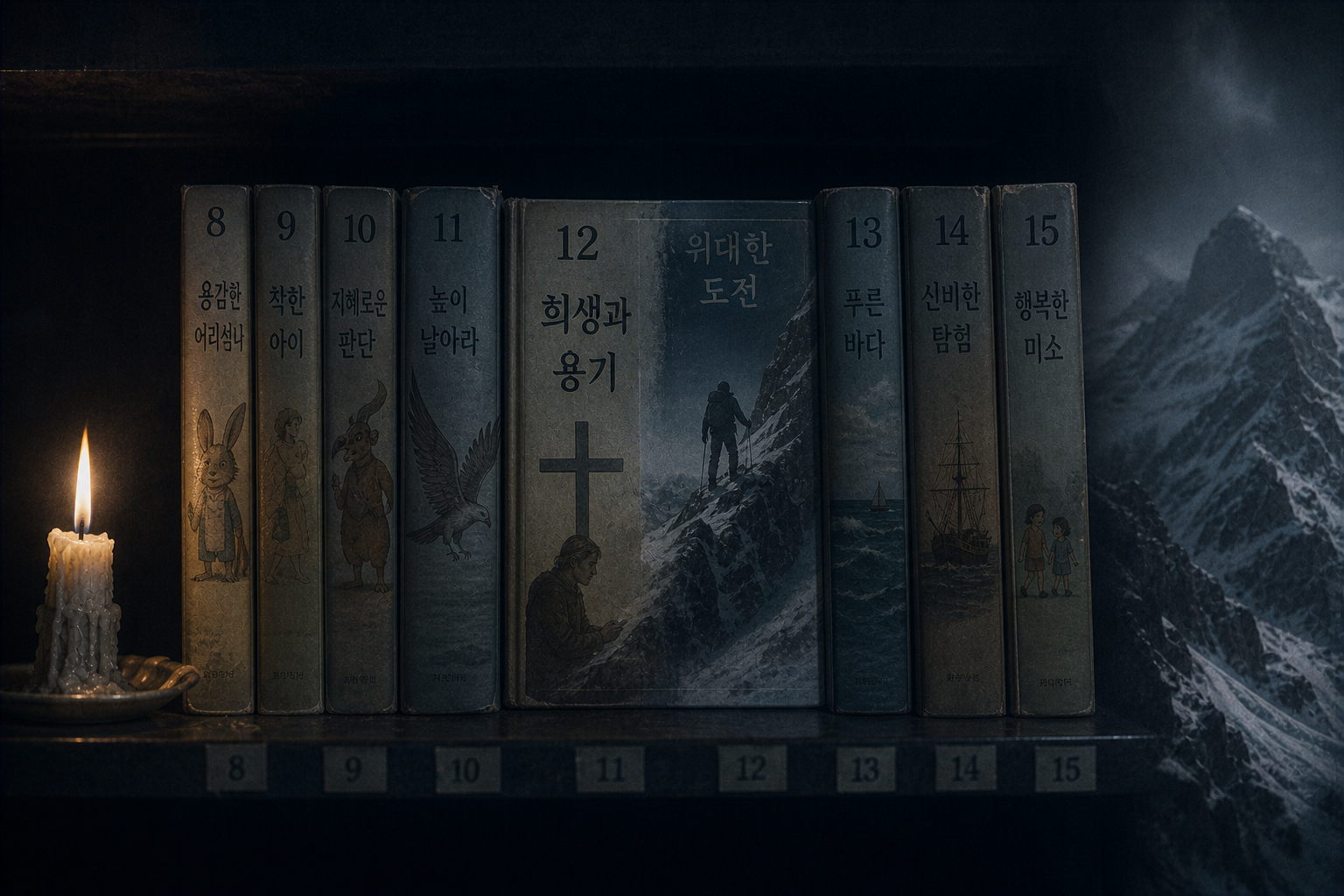
There is a specific category of wrongness that operates below the threshold of public scandal. It does not announce itself. It does not leave a crater. It leaves, instead, a clean shelf. A tidy number in a series. A new cover where an old one stood. The book you are looking for is gone, and in its place is something perfectly acceptable, and no one involved in the substitution will call it a substitution. They will call it a renewal.
The subject is a children’s book series published in South Korea. The missing entry is a biography of a man who set himself on fire at age 22 to protest the conditions under which Korean garment workers lived, worked, and died in sweatshop attics. The replacement is, by all surviving accounts, a book about a mountaineer. The number on the spine remained the same. The soul of what it once contained did not survive the transfer.
What follows is not a ghost story. It is something more disquieting: a documentation of how a society systematically decides what its children are permitted to grieve.
The Cultural Anatomy: Context of Erasure
To understand why a children’s biography of Jeon Tae-il could exist in the first place, and why it could subsequently vanish without formal announcement, you need to understand the specific biochemistry of South Korean publishing culture in the latter half of the twentieth century.
Changbi, formally Changbi Publishers (창비), was founded in 1966 as an act of deliberate cultural opposition. The company embedded itself in a tradition of critical social engagement that placed it in periodic friction with the political administrations governing South Korea through the 1960s, 1970s, and 1980s. The Changbi Children’s Library series launched as an ambitious project to deliver serious, socially conscious children’s literature under a single numbered imprint. This was curated moral formation for the young.
The Korea into which this series was born was operating under conditions that Western observers frequently miscalculate the systemic threshold of Park Chung-hee’s administration. Labor organizing was treated as sedition. Press censorship was not metaphorical: journalists and publishers who strayed into territory classified as sympathetic to socialist sentiment risked their operations directly.
It is within this climate that the figure of Jeon Tae-il must be understood. Jeon Tae-il was a garment worker who immolated himself on November 13, 1970, while holding a copy of South Korea’s labor standards law. His act became the foundational event of the modern Korean labor movement. The adult biography of his life was published under obscured authorship because attaching a name to it carried genuine legal risk. Individuals found possessing it faced arrest.
Against this backdrop, the Changbi Children’s Library produced a volume aimed at younger readers that engaged with Jeon Tae-il’s biography. It occupied a specific slot that would function as its permanent address in the catalog. That address would later be reassigned.
Structural Dissection: The Anomaly in the Signal
The mechanics of what happened are clean enough to produce unease on their own. Each entry in the series carries a catalog number that functions as its permanent identity. To change what lives at a given number is to perform surgery on institutional memory itself.
At some point, the volume documenting Jeon Tae-il’s life was removed from its assigned position. The removal was conducted without ceremony: no public statement, no editorial discussion. The cover was redesigned. The number remained. In the slot where a child could once read about a young man who burned himself alive in protest of systemic labor abuse, there is now a book about a mountaineer.
The issue is the mechanism: the use of cosmetic renewal as the vehicle for ideological substitution. In media archaeology, the most disturbing discoveries are the ones that were quietly overwritten. The destruction hides inside normalcy.
Psychological Necropsy: Why It Terrifies the Western Mind
The Western reader typically undergoes a specific sequence of responses. First, skepticism. Then, as facts accumulate, a different question: why does this feel so specifically wrong?
Western liberal culture has built its civic identity around the idea that information is recoverable. The archive exists. Even when suppression occurs, the suppression itself leaves a trace. The Changbi Children’s Library substitution violates that model. It does not suppress by removing; it suppresses by replacing. The series says: we are all here. The series lies.
Jeon Tae-il represents a high-visibility node in Korean labor history. To Western observers familiar with the tradition of political biography for children, the idea that a biography of such a figure could be quietly replaced with something politically neutral produces a specific form of cognitive vertigo. The replacement of a martyr with a mountaineer is a document of institutional anxiety so intense that it expressed itself in the most controlled way available: silence.
The Evidence of Void: Why It Remained Lost
The physical pathway through which the volume became lost media follows a logical progression. Children’s books occupy a degraded position in institutional preservation. They are used, damaged, and discarded. When a redesign occurs, older editions simply cease to be stocked.
The result is a disappearance that is entirely traceable in its mechanisms and entirely opaque in its documentation. There is no notice of banning. There is a mountaineer where a martyr used to be. The legitimacy of the container makes the contents harder to isolate. The archive does not know it is missing anything, because the shelf count has not changed.
The Point of No Return: The Ultimate Uncomfortable Insight
Jeon Tae-il burned himself alive so that the suffering of garment workers could not be denied. The children’s book was a continuation of that act. To give children this biography is to make a claim: this death signified something.
The removal of that volume performs the inverse operation. It substitutes a figure whose achievement is vertical and personal for a figure whose achievement was horizontal and systemic. The default archive of human experience has failed this specific artifact.
Western lost media discourse often obsesses over digital permanence. However, the physical shelf remains a more volatile environment than the digital server. The child will reach for the volume and find a different lesson entirely. That is the most forensically precise definition of erasure. It does not destroy. It redirects. The fire goes out, and a clean cover goes on, and the shelf looks exactly as it should.
🔍Search Update: Call to Action
The search for the original Changbi Volume (Jeon Tae-il) remains an active investigation. If you are a collector of vintage Korean children’s literature or possess early editions of the Changbi Children’s Library (창비아동문고), we are looking for photographic evidence of the spine and copyright page of the original biography. Your evidence is the only barrier against total narrative dispossession.
This document is an investigative archival reconstruction based on fragmented public records, media remnants, community accounts, and verified historical sources compiled by The 3AM Archive.
The article examines how incidents, forgotten media, internet folklore, and unresolved public memories evolve through cultural preservation and digital decay.
This is a cultural investigation document — not fictional horror content.
All visual materials used in this post are exclusive AI-generated assets created for The 3AM Archive.
