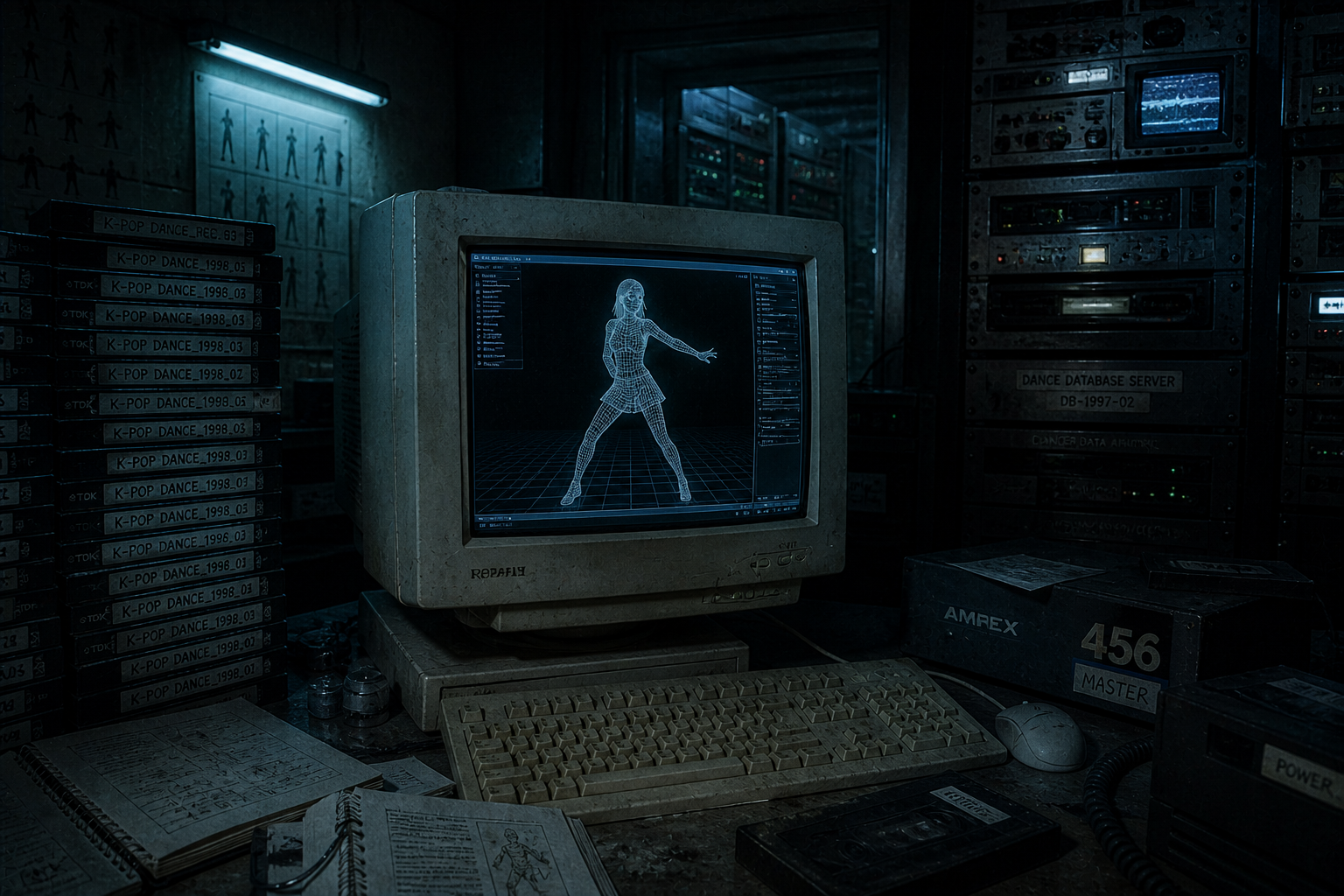
It taught an entire generation how to move like their idols. Then it dissolved.
Not through fire. Not through corporate scandal. It simply became unnecessary, and when a digital product becomes unnecessary in Korea’s internet ecosystem, it does not retire. It ceases to exist. The servers close. The accounts lock. The content that millions of users paid for becomes permanently inaccessible. Consequently, the cultural artifact that contained it joins a growing category of objects that were too specific to survive and too significant to forget.
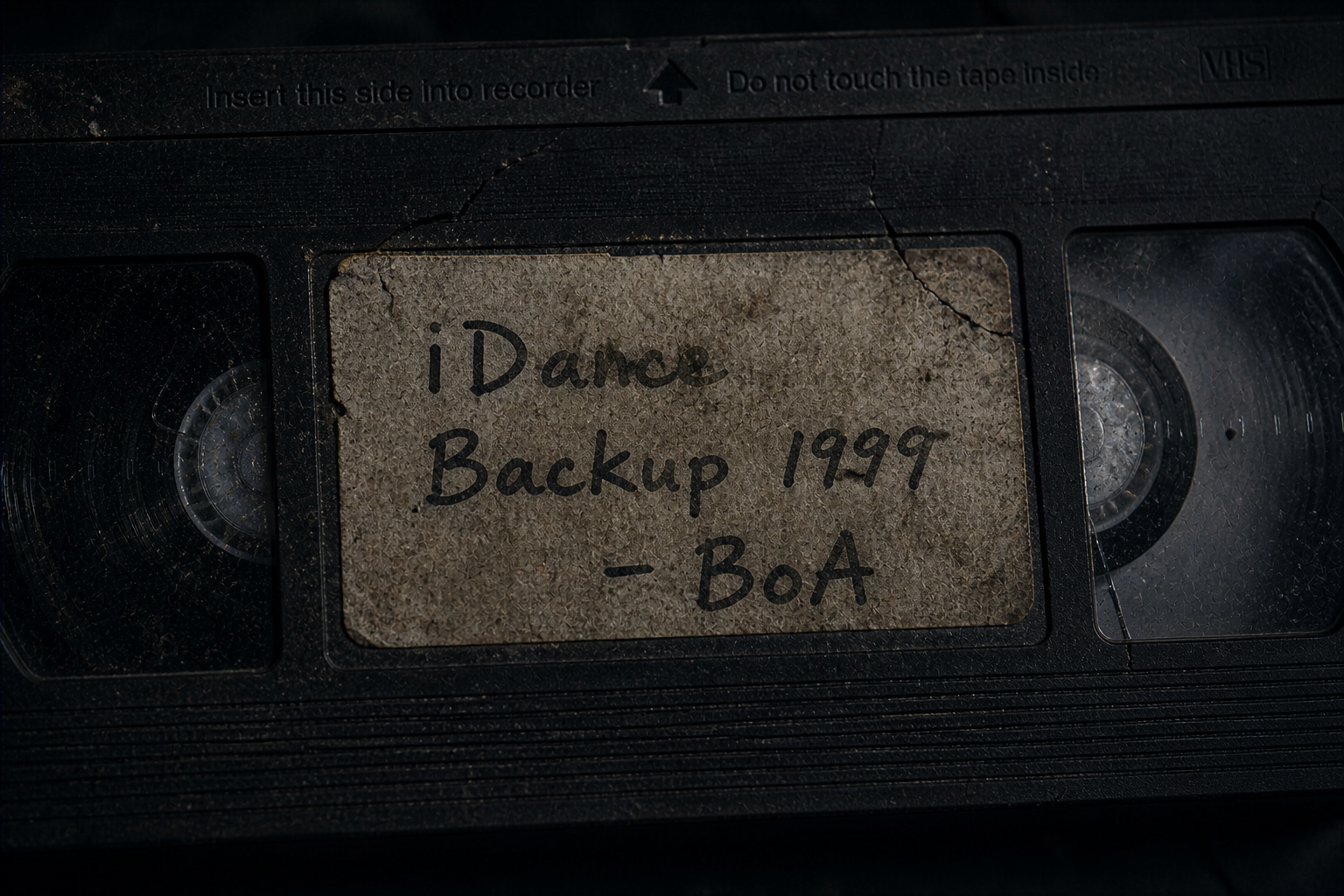
iDance ran from 1999 to 2012. Thirteen years of motion-captured choreography, licensed celebrity avatars, paid virtual stages, and a partnership with the Korean national health ministry. Every frame of it is gone. What remains is a locked installation client that connects to servers that no longer respond, a handful of corrupted norebang screen recordings, and the memory of people who used to log in and learn how to dance like BoA.
This is not a ghost story. This is a forensic examination of how a culture erases its own innovations so completely that the erasure itself becomes the most significant thing about them.
The Cultural Anatomy: Context of Erasure
To understand what iDance was, a Western reader needs to understand the specific conditions of Korean popular culture and internet infrastructure at the end of the 1990s. These conditions are not merely background. They are the mechanisms that both created iDance and guaranteed its eventual disappearance.
The Korean Wave, the global export of Korean popular culture now known as Hallyu, did not begin as a polished international product. It began as a domestic phenomenon of extraordinary intensity. The late 1990s represented a period of consolidation in Korean pop music, where the first generation of systematically trained idol performers was establishing the visual and kinetic language that would eventually become globally recognizable. BoA, Lee Hyori, and the groups of this era were not simply musicians. They were physical performers whose choreography was as carefully constructed as their vocal performances, and in many cases more visually arresting.
The problem, for fans who wanted to learn the choreography, was access. Dance studios were expensive and geographically concentrated in urban areas. Instructional VHS tapes were produced for some artists but were static, non-interactive, and limited in their pedagogical utility. A fan in a provincial city who wanted to learn the precise arm positioning of a specific eight-count from a specific BoA performance had no reliable mechanism for doing so.
iDance was built to solve this problem. The solution was technically ambitious for 1999. The development team recruited actual dancers from the idol groups, not the idols themselves but the professional dancers who performed alongside them and in some cases choreographed their routines. These dancers performed the choreography in motion capture environments, their movements translated into data that could animate 3D character models. The resulting system allowed users to select a song, select a camera angle, slow the playback to any fraction of normal speed, loop specific counts, and view the choreography from perspectives that no music video or live performance could provide.
This was not a novelty application. It was a genuine pedagogical tool that addressed a real educational gap, and it arrived at a moment when Korean internet infrastructure was advanced enough to support it. Korea’s broadband penetration rate in the late 1990s and early 2000s was among the highest in the world. The technical delivery infrastructure for a rich 3D application existed in ways that were not yet available in most Western markets. iDance was built for a specific technical environment, and that environment supported it for more than a decade.
The cultural context also included a specific relationship between fans and celebrity physical performance that Western audiences may find unfamiliar. In Korean idol culture, the reproduction of choreography by fans is not merely imitation. It is a form of devotion with established social meaning. Cover dance culture, the practice of learning and publicly performing idol choreography, existed before iDance and continues to exist in vastly more sophisticated forms today. iDance was the first institutional infrastructure for this practice. It was the formal acknowledgment that learning to dance like your idol was a legitimate activity worth building a technology platform around.
Structural Dissection: The Anomaly in the Signal
The technical architecture of iDance contained features that were not merely impressive for their era but that have not been fully replicated in subsequent platforms. This is the first anomaly in the signal: a 1999 Korean software product achieved a functional capability in dance education that the subsequent fifteen years of technological development and vastly improved motion capture systems did not improve upon in any directly comparable application.
The angle selection feature was the most significant. Standard instructional video, then and now, presents choreography from a fixed perspective, typically the front-facing view that mirrors how the student will perform. iDance allowed users to orbit the 3D model, to watch a specific movement from behind, from the side, from above. This capability matters enormously for the learning of physical movement because many choreographic elements are not fully legible from a single perspective. Hip positioning during a turn, for example, is visible from a lateral angle but largely invisible from the front. Arm placement during a floor sequence requires an overhead view to understand correctly.
The motion capture data underlying these models was sourced from professional dancers who were performing the actual choreography of actual released songs by actual charting Korean artists. This was not approximate or generalized. The data captured specific interpretations of specific movements by specific performers. When a user in 1999 viewed a BoA choreography sequence in iDance at one-quarter speed from a forty-five degree lateral angle, they were watching a precise digital translation of a specific human performance of music that was currently playing on Korean radio.
The paid character system added another layer of specificity. Beyond the base 3D characters, users could purchase avatar representations of the actual celebrities whose choreography was being taught. BoA’s avatar was styled to resemble BoA. Lee Hyori’s avatar was styled to resemble Lee Hyori. These were not generic dancer models. They were products, purchased by fans, that connected the learning experience to the specific celebrity body whose movements were being studied.
The partnership with the Saecheonnyeon Geongang Cheojo, the New Millennium Health Exercise program developed by the Korean government, represents the most unexpected dimension of iDance’s operational history. This exercise program, developed as a public health initiative, was formally integrated into iDance with dedicated characters, stage environments, and music. A commercial K-pop dance learning platform became the official delivery mechanism for a government health initiative. This integration was not coincidental or marginal. It was a structural partnership that connected iDance to institutional Korean public life in a way that makes its complete disappearance more, not less, difficult to understand.
The norebang connection is where the traces become visible, and the visibility makes the overall absence more acute. Recorded animations from iDance’s character system were licensed for use as background visuals in Korean norebang, the private karaoke room culture that is a foundational element of Korean social life. These animations played on screens behind the lyrics as customers sang. They were not interactive. They were decorative. But they represented a downgraded survival of iDance content in a context where its original function had been entirely stripped away. Users who accessed iDance to learn choreography through interaction were replaced by norebang customers who watched iDance animations without knowing what they were looking at, without being able to control them, without being able to do anything except watch them play in the background.
The pedagogical tool became wallpaper. The wallpaper is occasionally still visible in older norebang establishments. The tool is gone.
Psychological Necropsy: Why It Terrifies the Western Mind
Western lost media discourse has developed a set of established aesthetic categories for the content it finds most disturbing. The corrupted children’s program, the interrupted broadcast, the VHS tape with handwritten labels, these formats carry a specific uncanny charge because they involve the distortion of content that was originally designed to be safe, accessible, and comforting.
iDance does not fit these categories. It is not corrupted children’s content. It is not a broadcast anomaly. It is a pedagogical technology platform that taught people to dance, and its disappearance carries a different and arguably more disturbing charge for the Western reader who encounters it.
The disturbance comes from the specificity of what was lost. The motion capture data in iDance captured the movements of specific human bodies, professional dancers whose physical interpretation of specific choreography was translated into digital form with a precision that the technology of 1999 could achieve. Those specific human performances, those specific bodies moving in those specific ways at that specific historical moment, are now accessible only as data that cannot be read because the software that could read it cannot connect to the servers that authenticated it.
The human movements are not gone in the sense that the people who performed them are gone. The performers are presumably still alive. But the specific digital record of their performance, the record that was created precisely to preserve and transmit those movements, is inaccessible. A performance was captured. The capture was locked. The key was deleted.
For the Western reader familiar with Western lost media cases, the scale is also disorienting. The BBC’s wiped programs are tragic but they represent content from an era before digital preservation was conceptually available. iDance was created in 1999 and shut down in 2012. Digital preservation was not merely conceptually available during its operational period. It was practiced routinely by institutions with a fraction of iDance’s resources. The platform’s content did not survive not because preservation was impossible but because no one with access to the content identified preservation as a priority before the servers closed.
The celebrity avatar dimension carries its own uncanny register. The purchased BoA avatar in iDance was a commercial product, a digital representation of a specific celebrity body sold to fans who used it in a learning context. That product was purchased, used, and then made permanently inaccessible without refund or recovery. The users who paid for the BoA avatar do not have the BoA avatar. They have a locked client file on a hard drive that connects to nothing.
The Evidence of Void: Why It Remained Lost
The iDance preservation problem is technically specific and practically intractable under current conditions.
The installation client exists. Multiple sources confirm that the software was recovered and that it can be installed on period-appropriate or emulated operating systems. The client installs. It launches. It then requests account authentication through a server connection that no longer exists. The content that authenticated users could access was stored server-side rather than locally. This architecture, common in online gaming and subscription software of the era, means that the client file is not a complete record of the content. It is a portal to content that lived elsewhere and is now nowhere.
The paid character data, the premium stage environments, the full choreography library with its angle-selectable motion capture sequences, none of this was stored in the installation package that users downloaded. It was stored on servers that have since been decommissioned. The data that was on those servers was not archived before decommissioning, or if it was, the archive has not surfaced in any accessible form.
The Chinese extension of iDance’s operational life is significant for preservation purposes and equally frustrating. The platform continued operating in China for several years after the Korean shutdown. This extended operational period means the servers were maintained for longer, which should theoretically have provided additional opportunity for content preservation. The Chinese service then also closed. No recovery of content from this extended period has been publicly documented.
The norebang recordings represent the most tantalizing surviving evidence. Footage of the iDance character animations playing on norebang screens has occasionally been captured by customers and uploaded to video platforms. These recordings are low quality, shot by phone cameras in dimly lit rooms, capturing animations on screens that were themselves playing content through aging equipment. They are sufficient to confirm visual details of specific character models and specific animations. They are insufficient as preservation of the original content in any functional sense.
The BoA character is the most frequently cited in these norebang sightings, which is consistent with BoA’s status during iDance’s operational period as one of the most commercially significant artists in the Korean music industry. A character modeled on and purchased around BoA would have been produced in higher volume and distributed more widely than characters representing less commercially prominent artists. The survival bias in the norebang evidence tilts toward the most popular characters, which means the preservation record, such as it is, overrepresents the content that was already most visible and underrepresents the content that was more specialized and more financially vulnerable.
The Point of No Return: The Ultimate Uncomfortable Insight
iDance documented the body of Korean popular culture at a specific and unrepeatable moment. The choreography captured in its motion data represented specific human interpretations of specific songs by specific artists at specific points in their careers. These were not generic dance moves. They were forensic records of a performance culture that was in the process of becoming globally significant without yet knowing that it would.
The global reach of Korean popular culture in the present tense is extraordinary and well-documented. The choreography of fourth-generation idol groups is studied, replicated, and discussed by audiences on every inhabited continent. The visual language that BoA and Lee Hyori and the artists of the early 2000s established is the foundation that subsequent generations of Korean performers built on. The specific kinetic vocabulary of that foundational moment is what iDance captured.
And then iDance closed, and the capture became inaccessible, and the foundation became a premise rather than a record.
The scholars and journalists and cultural historians who will eventually produce the comprehensive account of how Korean popular culture became a global phenomenon will work from music videos, from broadcast recordings, from interviews and production documents and financial records. They will have access to a rich archival record of what the culture produced and how it circulated. They will not have access to iDance. They will not be able to see the motion capture data that recorded how the professional dancers of that era actually moved, at the level of granular physical detail that iDance’s technology was designed to capture and transmit.
The most technically sophisticated archival record of a specific dimension of early K-pop’s physical performance culture was created, operated for thirteen years, and then deleted. The default archive of human experience has failed this specific artifact. The culture that iDance documented has become one of the most globally distributed and financially significant cultural exports in contemporary history. The archive that documented a specific layer of that culture is irretrievably gone.
The body was recorded. The recording was locked. The key was thrown away before anyone understood what the recording contained.
No functional version of iDance and no recovered server-side content has entered public circulation as of current documentation. The installation client, while physically recoverable, cannot authenticate without server infrastructure that no longer exists.
🔍Search Update: Call to Action
The search for iDance content remains a critical priority for the digital preservation community. If you retain any locally saved recordings of iDance sessions, character animations, or stage content from the platform’s operational period, the Korean digital preservation community maintains active documentation efforts for early 2000s internet platform content. Your personal hard drive could contain the only surviving key to this performance vault.
This document is an investigative archival reconstruction based on fragmented public records, media remnants, community accounts, and verified historical sources compiled by The 3AM Archive.
The article examines how incidents, forgotten media, internet folklore, and unresolved public memories evolve through cultural preservation and digital decay.
This is a cultural investigation document — not fictional horror content.
All visual materials used in this post are exclusive AI-generated assets created for The 3AM Archive.
