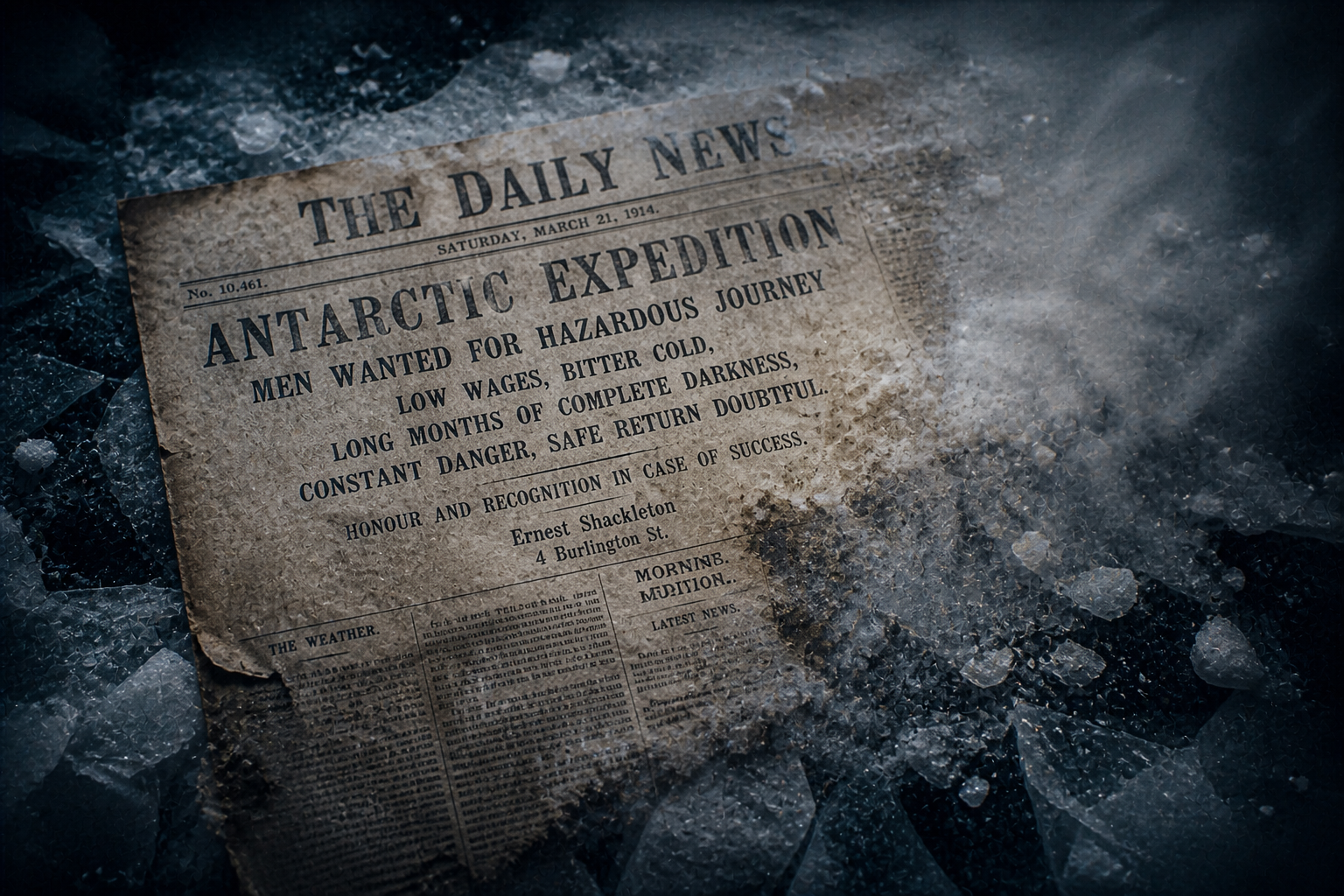
The most celebrated recruitment advertisement in human history has never been found.
Not lost in a fire. Not damaged in storage. Simply never located. In any archive. In any newspaper. In any form that constitutes verifiable primary evidence.
The ad that supposedly attracted 5,000 applicants for a journey toward certain death, the ad that inspired a century of leadership literature and corporate motivation seminars, the ad that every business school professor has cited as proof that honest communication attracts committed people, may not have existed at all.
And the $100 reward currently offered to anyone who can produce the original has gone unclaimed.
The Evidence File: What the Record Actually Shows
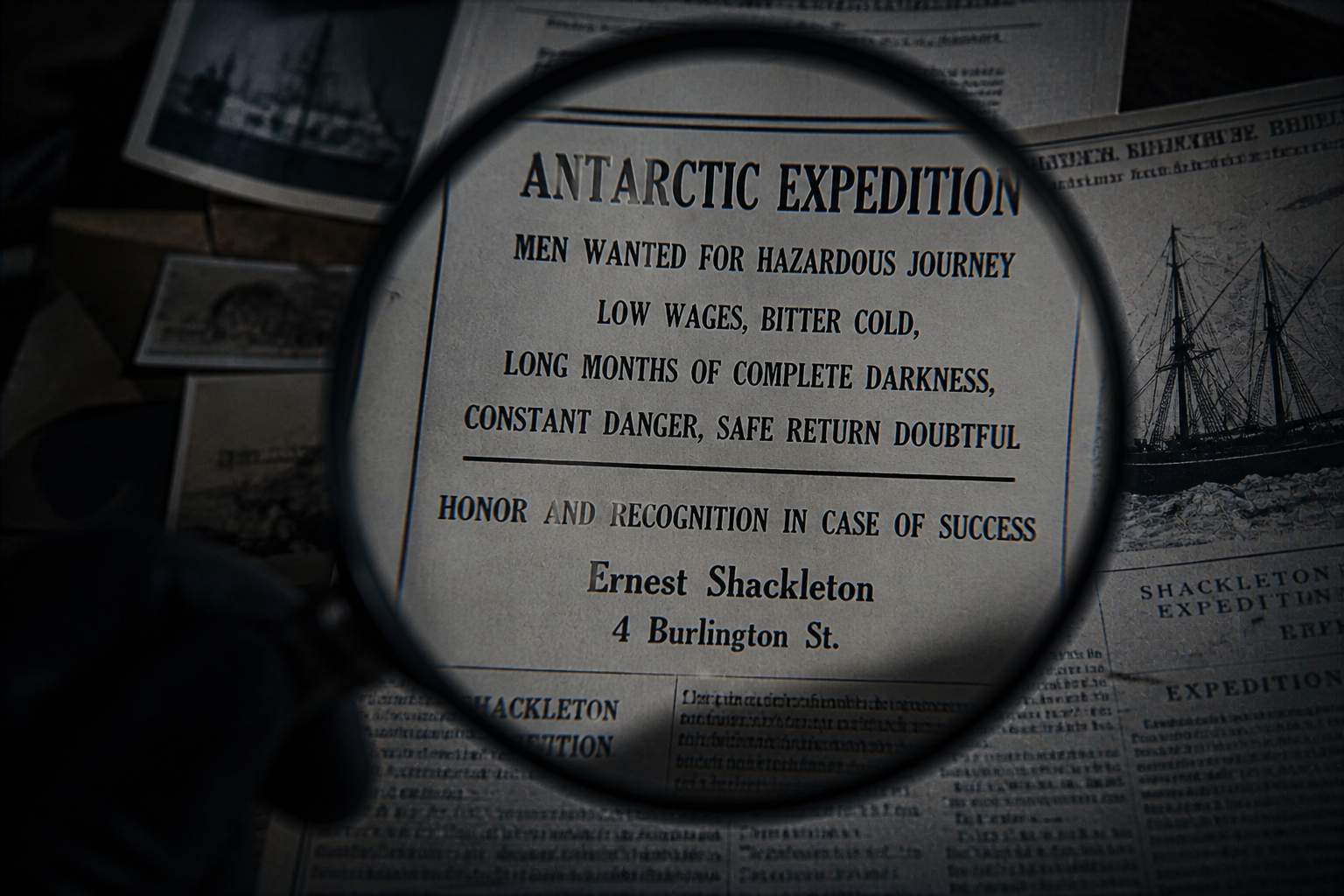
The advertisement in question is typically presented as follows. Men wanted for hazardous journey. Small wages. Bitter cold. Long months of complete darkness. Constant danger. Safe return doubtful. Honour and recognition in case of success. The attribution is Ernest Shackleton, and the context is the 1914 recruitment campaign for the Imperial Trans-Antarctic Expedition, which aimed to complete the first land crossing of the Antarctic continent.
This text, or variations of it, has been reproduced in books, framed on office walls, cited in management training programs, and held up as the exemplar of radical transparency in organizational communication. The argument is that Shackleton’s willingness to describe the job honestly, to lead with danger rather than opportunity, produced a self-selecting applicant pool of 5,000 men who understood exactly what they were signing up for.
The problem is the following. No copy of this advertisement has ever been located in the newspaper archives of 1913 or 1914. The Smithsonian Institution conducted a formal inquiry and concluded that the evidence for the advertisement’s existence as a published document is insufficient. The first documented public mention of the advertisement occurred in 1944. This mention appeared in Julian Watkins’ book The 100 Greatest Advertisements, nearly thirty years after the expedition and more than 두 개의 문장으로 분리. It was selected as a great advertisement in 1949. The chain of custody between 1914 and 1944 is empty.
The image that circulates most widely online and in print is not a photograph of a newspaper clipping. It is a designed recreation produced by John Hyatt in 2001. Hyatt created it as an imaginative reconstruction rather than as a documentary reproduction. This distinction is almost never made clear in contexts where the image appears. The recreation is presented as if it were evidence of the original. It is not. It is an illustration of a legend.
The recreation contains an error that functions as an unintentional authentication test. The word honor appears in American English spelling rather than the British English spelling honour that Shackleton, as a British subject writing for a British publication, would have used without question. This spelling error was embedded in Hyatt’s recreation and has propagated through every subsequent reproduction of the image. The error is now part of the standard visual record of a document whose original, if it exists, would not contain it.
The Structural Framework: How Legends Acquire Documentary Form
The Shackleton advertisement case is a near-perfect specimen of a specific phenomenon in cultural and historical memory: the retrofitted document.
A retrofitted document is not a deliberate forgery. It is something more subtle and more interesting. It is the process by which a legendary claim, something that is believed to have happened and that carries significant cultural meaning, acquires documentary form through a process of imaginative reconstruction that is eventually mistaken for primary evidence.
The sequence in the Shackleton case runs as follows. The expedition happens. The expedition produces one of the most remarkable survival stories in the history of exploration. The narrative of the expedition, Shackleton’s leadership, the loss of the ship Endurance, the extraordinary small-boat journey to South Georgia, the rescue of all 27 crew members, becomes one of the defining heroic narratives of the twentieth century. Decades pass. The expedition is reexamined by historians and popular writers. Someone mentions an advertisement. The mention circulates. The advertisement acquires details through repeated retelling. A designer creates a visual representation of what the advertisement might have looked like. The visual representation circulates as if it were evidence. The legend is now illustrated.
This sequence does not require bad faith at any stage. The designer who created the Hyatt image was producing a piece of design work, not fabricating historical evidence. The writers who cited the advertisement were relaying what they had been told. The institutions that repeated the story were not conducting primary source verification on what appeared to be a well-established historical anecdote. Each step in the chain was individually defensible. The cumulative result was the elevation of an unverified claim to the status of documented historical fact.
The $100 reward currently offered for the original document represents an acknowledgment that something is wrong with the evidentiary chain. It is also, arithmetically, a statement about the realistic probability of the document’s existence. A reward of $100 for a document of this historical significance is not a serious financial incentive. It is a gesture. The people who have examined this question most carefully appear to believe, without quite saying so directly, that the document will not be found because it is not there to be found.
Historical Archetypes: The Pattern of the Inspiring Document That Cannot Be Located
The Shackleton advertisement is not unique in the category of historically significant documents whose existence is celebrated and whose physical evidence is absent or unverifiable.
The pattern of the retrospectively attributed inspiring text, the document whose cultural function is so powerful that its existence is assumed without primary source verification, persists as a structural defect in the historical record.
The phenomenon is particularly well-documented in the history of military and exploratory communication. The culture surrounding heroic endeavor has a strong tendency to produce narratives that require authenticating documents, specific orders, specific speeches, specific written commitments that mark the moment of heroic decision. When these documents cannot be located, the tendency is not to question the narrative but to assume that the documents must exist somewhere and have simply not yet been found.
The Shackleton case is unusual in that the documentary absence has been formally investigated rather than simply noted and set aside. The Smithsonian inquiry represents an institutional acknowledgment that the standard of evidence for this particular historical claim does not meet archival requirements. This acknowledgment has not significantly disrupted the cultural circulation of the advertisement as an established fact, because the cultural function of the story does not depend on the physical document. It depends on the narrative.
This separation between narrative function and documentary evidence is the core of the archival problem. A story that is culturally true does not require a specific physical document to be that kind of true. But it is routinely presented as historically documented in the specific sense that requires primary evidence. The two categories of truth are being conflated, consistently and across an enormous volume of secondary literature.
The academic literature on Antarctic exploration is aware of this problem. The popular literature, the management books, the leadership seminars, the framed prints on corporate walls, is largely not.
Psychological Necropsy: Why People Need This Document to Be Real
The Shackleton advertisement has acquired a cultural function that is largely independent of its historical status. Understanding this function is necessary to understanding why the documentary evidence problem has had so little effect on the advertisement’s circulation.
The advertisement is used, primarily, as a parable about leadership communication. The lesson extracted from it is specific: honest acknowledgment of difficulty and danger, presented without softening or evasion, attracts people who are genuinely committed rather than merely optimistic. The 5,000 applicants become evidence that radical transparency is not a deterrent but a filter, selecting for exactly the qualities an organization under extreme stress requires.
The lesson possesses operational utility and aligns with observed leadership patterns. Organizations that oversell their opportunities and underrepresent their challenges do attract people who are poorly suited to those challenges. The principle embedded in the advertisement story is sound regardless of whether the advertisement exists.
But the advertisement story does something that the abstract principle cannot do. It anchors the lesson in a specific historical moment, a specific heroic figure, and a specific outcome. Shackleton is not any leader. He is the leader who brought everyone home from one of the most catastrophic expedition failures in the history of polar exploration. Attributing the principle to him, and grounding it in a specific documented act, gives it the weight of proven historical example rather than the lighter weight of generally observed tendency.
The need for the document to be real is a need for the principle to be proven rather than merely argued. If Shackleton actually published this advertisement and actually attracted 5,000 applicants who understood what they were signing up for, then the principle is demonstrated. If the advertisement never existed, then the principle is still probably sound but it lacks its most powerful piece of evidence.
This is why the documentary absence has not disrupted the story’s circulation. The cultural apparatus that uses the story does not primarily value it as historical evidence. It values it as proof. And proof, once established in the cultural imagination, is resistant to archival revision.
Why People Keep Looking Away
The response to the documentary evidence problem in the Shackleton advertisement case follows a pattern that is worth examining carefully because it is highly consistent.
When the absence of primary source evidence is raised, the typical response is not to reconsider the historical claim. It is to assert that the absence of evidence is not evidence of absence. The argument runs: newspaper archives from 1913 and 1914 are incomplete, many publications from this era were not systematically preserved, the specific publication in which the advertisement appeared may simply not be in any accessible archive.
This argument is technically correct and practically almost irrelevant. It is correct that archive incompleteness is a real factor in historical research. It is correct that the absence of a document from accessible archives does not prove the document never existed. It is also correct that when a document is this culturally significant, this widely cited, and this specifically attributed, the expectation would be that some copy would surface somewhere in the comprehensive archival research that has been done on Shackleton and the Endurance expedition.
The Endurance expedition is one of the most thoroughly documented events in the history of exploration. Shackleton’s papers, correspondence, and professional records have been examined by multiple generations of historians. The contemporary press coverage of the expedition has been extensively researched. The archival record for this period and this subject is not thin. It is dense. And within that dense archival record, there is no primary evidence of the advertisement.
The looking-away from this fact is not dishonest. It is psychologically necessary for a large number of people whose work, whose published arguments, whose professional presentations, depend on the advertisement being real. The alternative to looking away is acknowledging that a foundational example in their professional narrative rests on an unverified claim that may be false. That acknowledgment has significant professional and personal costs. The looking-away has almost none.
The Point That Should Disturb You Most
The YouTube comments section has become the default archive of human experience for the digital age. This reality has profound implications for digital permanence. We are trusting our collective memory to platforms that prioritize engagement over accuracy.
If the Shackleton advertisement does not exist, then the most powerful modern example of radical transparency in organizational communication is itself a case of the opposite. It is a case of a story presented as documented historical fact, repeated without primary source verification, distributed through authoritative channels including academic publishers and institutional museums, and used to support conclusions that rest on its accuracy.
The irony is analytically absolute. The advertisement about honest communication with potential recruits, the advertisement that is used to argue that organizations should be transparent about their challenges and their risks, has itself been communicated dishonestly. It has been presented as verified when it is unverified. It has been illustrated with a recreation presented as if it were an original. It has been attributed to newspaper archives that do not contain it.
The lesson that is extracted from the advertisement story, the lesson about what happens when you are honest about difficulty, applies directly to the advertisement story itself. What would happen if every business book, every leadership seminar, every framed print, included the disclaimer that this advertisement has never been found in primary sources and may not have existed?
The answer is probably that the story would continue to circulate, because its cultural function does not actually depend on its documentary status. But the people circulating it would be doing so honestly, which is precisely what the story is supposed to be about.
Instead, the story about the power of honesty continues to circulate in a form that is not honest about its own evidential foundation. The document that cannot be found is presented as if it has been found. The recreation is presented as if it were an original. The reward goes unclaimed and is rarely mentioned.
The advertisement teaches that honesty attracts the right people. The advertisement’s own history teaches that people prefer comfortable stories to accurate ones, regardless of what the comfortable story claims to be about.
🔍Search Update: Call to Action
The $100 reward for verifiable primary source evidence of the Shackleton recruitment advertisement remains unclaimed. We are calling on the Western lost media community and amateur historians to scour digitized local UK newspaper archives from late 1913 to early 1914. While major dailies like The Times have been cleared, the legend suggests the ad may have appeared in smaller regional or specialty maritime publications. If you uncover a scan or a physical clipping of the “Men Wanted” text, document your findings via the Smithsonian or the Scott Polar Research Institute.
The absence of a claim on this reward is itself a form of evidence, though not the kind anyone involved in the story’s circulation prefers to discuss.
This document is an investigative archival reconstruction based on fragmented public records, media remnants, community accounts, and verified historical sources compiled by The 3AM Archive.
The article examines how incidents, forgotten media, internet folklore, and unresolved public memories evolve through cultural preservation and digital decay.
This is a cultural investigation document — not fictional horror content.
All visual materials used in this post are exclusive AI-generated assets created for The 3AM Archive.
