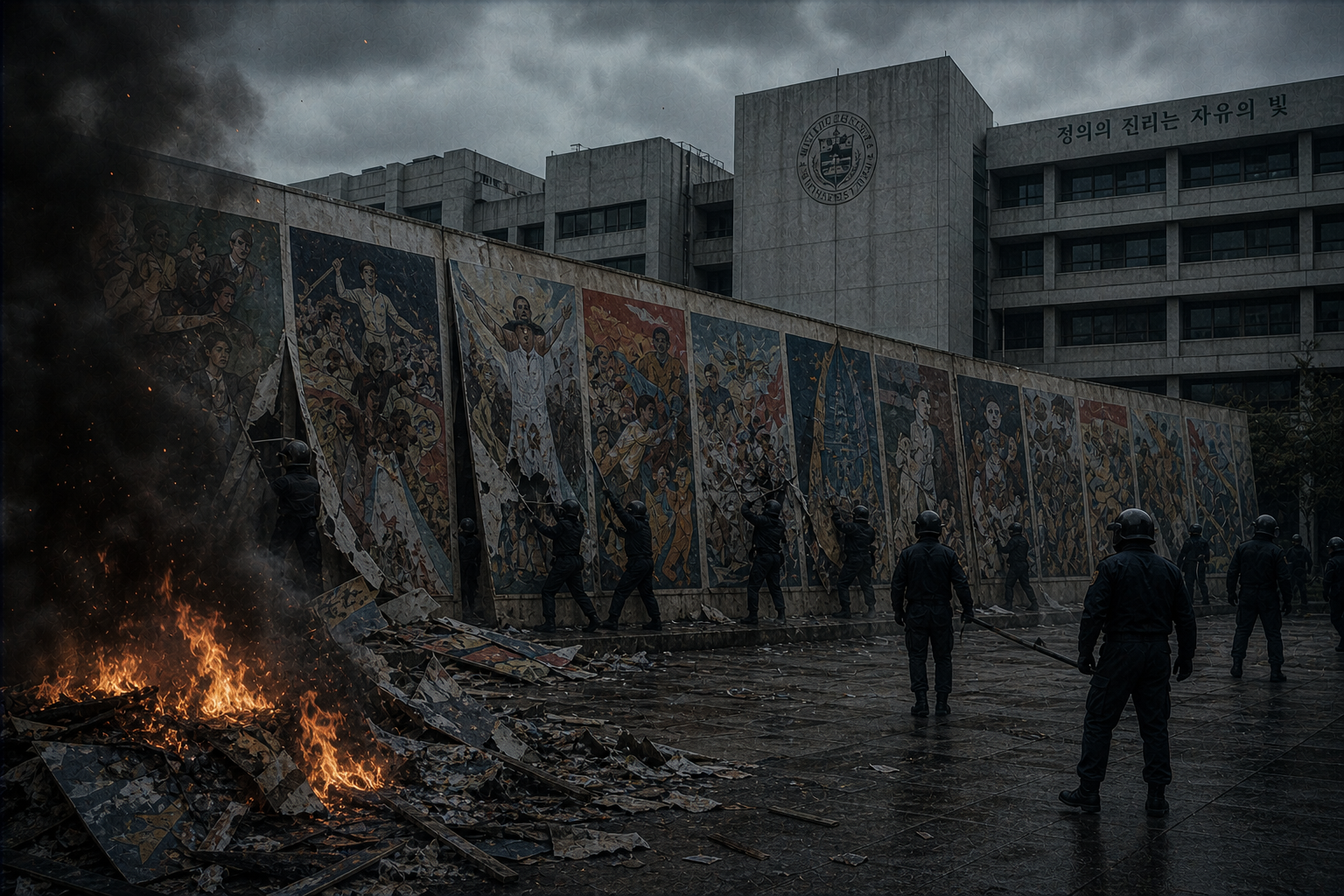
There is a particular kind of dread that has no Western analogue. It is not the dread of the unknown, which Western horror has catalogued exhaustively. It is the dread of the deliberately obliterated: the object that existed, that was witnessed, that was recorded in the nervous systems of thousands of people, and that was then removed from physical reality by institutional force. The Korean term for this experience does not translate cleanly into English, because the English-speaking world has rarely needed a word for it. The state does not often arrive at a university courtyard in riot gear to seize a painting and burn it. The state does not often arrest the people who made the painting and deliver them to an intelligence agency for interrogation. The state does not often succeed so completely that, thirty years later, researchers reconstructing the object must work from pamphlets and photographic slides, piecing together the ghost of a thing that once measured meters across and hung in the open air.
This is not a ghost story. It is a forensic account of two specific works of art produced during one of South Korea’s most volatile political decades, and of the machinery that consumed them. The Minjung art movement of the 1980s generated some of the most politically charged visual work in modern Asian history. Two pieces from that movement, one an eleven-panel narrative mural spanning the entire arc of Korean popular resistance, and one a large-scale hanging painting depicting workers and farmers destroying an American flag, were seized, destroyed, or suppressed by the South Korean state. Their creators were imprisoned. The objects themselves were reduced to slides, pamphlets, and a single 2005 reconstruction. What remains is evidence. What it evidences is the specific process by which a government converts art into threat, and threat into ash.
The Cultural Anatomy: Context of Erasure
To understand what was destroyed, a Western reader must first understand the political climate that made destruction feel, to those who ordered it, like a reasonable administrative decision.
South Korea in the 1980s was a country operating under the psychological and institutional residue of decades of military authoritarianism. The Yushin Constitution of 1972 had concentrated power in the presidency to a degree that made democratic opposition structurally impossible. Park Chung-hee’s assassination in 1979 briefly opened a window for reform, but that window was closed within months by a military coup led by Chun Doo-hwan. What followed was the Gwangju Uprising of May 1980, a pro-democracy demonstration in the southwestern city of Gwangju that was suppressed by paratroopers with a death toll that remains disputed but is conservatively estimated in the hundreds. The Gwangju Massacre, as it is known in South Korea, became the defining trauma of the democratic movement for the entire decade. It was not a distant historical event to the artists working in the late 1980s. It was recent, it was personal, and it was officially denied.
The Minjung movement, which translates roughly as the “people’s movement” or “popular masses movement,” emerged from this context as a deliberate rejection of both Western modernist abstraction and the sanitized nationalist aesthetics promoted by the state. Minjung artists drew on Korean folk art traditions, on woodblock printing, on the bold flat colors of shamanistic ritual paintings, and on the visual grammar of political posters to create work that was explicitly narrative, explicitly political, and explicitly addressed to ordinary Koreans rather than to gallery elites. The walking mural, the hanging banner painting known as the “Geolgaegeurim” (걸개그림), was a central form. These were not intimate gallery objects. They were enormous, designed to be hung from buildings, to preside over demonstrations, to be visible from a distance to crowds of thousands. Their scale was political in itself. They occupied public space in a way that a framed canvas in a white room fundamentally cannot.
The National Security Act, first enacted in 1948 and heavily used throughout the authoritarian period, criminalized expressions of support for North Korea and, in practice, criminalized a very broad range of left-wing political speech and imagery. Under this law, depicting the American flag being destroyed, or celebrating the Gwangju Uprising, or drawing visual connections between the 1894 Donghak Peasant Revolution and contemporary labor organizing, could be prosecuted as pro-communist activity. The law did not require that the artist actually support North Korea. It required only that the material could be construed as benefiting North Korea. This was a standard broad enough to swallow almost any politically inconvenient art.
The Agency for National Security Planning, known universally by its Korean abbreviation Angibu (안기부) and referred to in English as the ANSP, was the domestic intelligence apparatus responsible for enforcing this law. It was not a subtle organization. It had been built on the structural bones of the KCIA, the Korean Central Intelligence Agency, which had operated as a political terror instrument throughout the Park era. Its presence in the lives of artists, professors, journalists, and labor organizers was not abstract. It conducted surveillance, it made arrests, it held people for interrogation. When Minjung artists were described as having been “taken in by the Angibu,” the phrase carried a specific weight that the neutral English translation does not convey.
This was the institutional environment in which Hong Seong-dam, Cha Il-hwan, Jeon Jeong-ho, Lee Sang-ho, and their collaborators were working. They were not naive about the risks. The radicalism of their work was not accidental. It was a calculated confrontation with a state that had already demonstrated, at Gwangju, that it would use lethal force to protect its authority.
Structural Dissection: The Anomaly in the Signal
The “Minjok Haebang Undongsa” (민족해방운동사, translated as “History of the National Liberation Movement”) was produced in 1988 by a preparatory committee for the National Alliance of the Minjung Art Movement, in which Hong Seong-dam and Cha Il-hwan were central figures. It comprised eleven panels, each one a large-scale hanging painting, collectively forming a sequential visual narrative of Korean popular resistance from the Donghak Peasant Revolution of 1894 through the May 18th Gwangju Democratic Uprising of 1980.
The structural ambition of this work requires a moment’s consideration. Eleven panels, displayed in sequence, constitute something closer to a graphic novel or a historical frieze than to any conventional single painting. The choice to begin with Donghak was specific and loaded. The Donghak movement was a peasant-led anti-feudal and anti-foreign uprising that the Joseon government suppressed with the assistance of Chinese and, subsequently, Japanese troops. Its brutal suppression is one of the proximate causes of Japanese imperial intervention in Korea, and therefore one of the threads that leads, historically, to colonization, to the division of the peninsula, and to the entire catastrophe of twentieth-century Korean history. To begin a narrative of liberation with Donghak was to say, explicitly, that the struggle the artists were depicting in 1988 was the same struggle that peasants had died for in 1894. It was a claim about historical continuity that the state found intolerable precisely because it was coherent.
The endpoint of the narrative, the Gwangju Uprising, was equally deliberate. By 1988, the official state position on Gwangju was still largely one of denial and minimization. Depicting it as the culmination of a century of liberation struggle was a direct challenge to the state’s self-narrative. It was also, formally, an act of commemoration for people who had been killed by the state and whom the state had not yet acknowledged.
The original eleven panels were seized by the Baekkoldan (백골단), the plainclothes riot police unit whose name translates literally as “White Bone Corps,” during a rally at Hanyang University in 1989. The rally was an assembly organized in connection with the 13th World Festival of Youth and Students in Pyongyang, an event that became a significant flashpoint in South Korean politics because a student activist, Im Su-kyong, traveled to North Korea to attend. The state’s response to the broader Pyongyang festival mobilization was aggressive. The paintings were taken. The artists were arrested and delivered to the Angibu. The originals were burned.
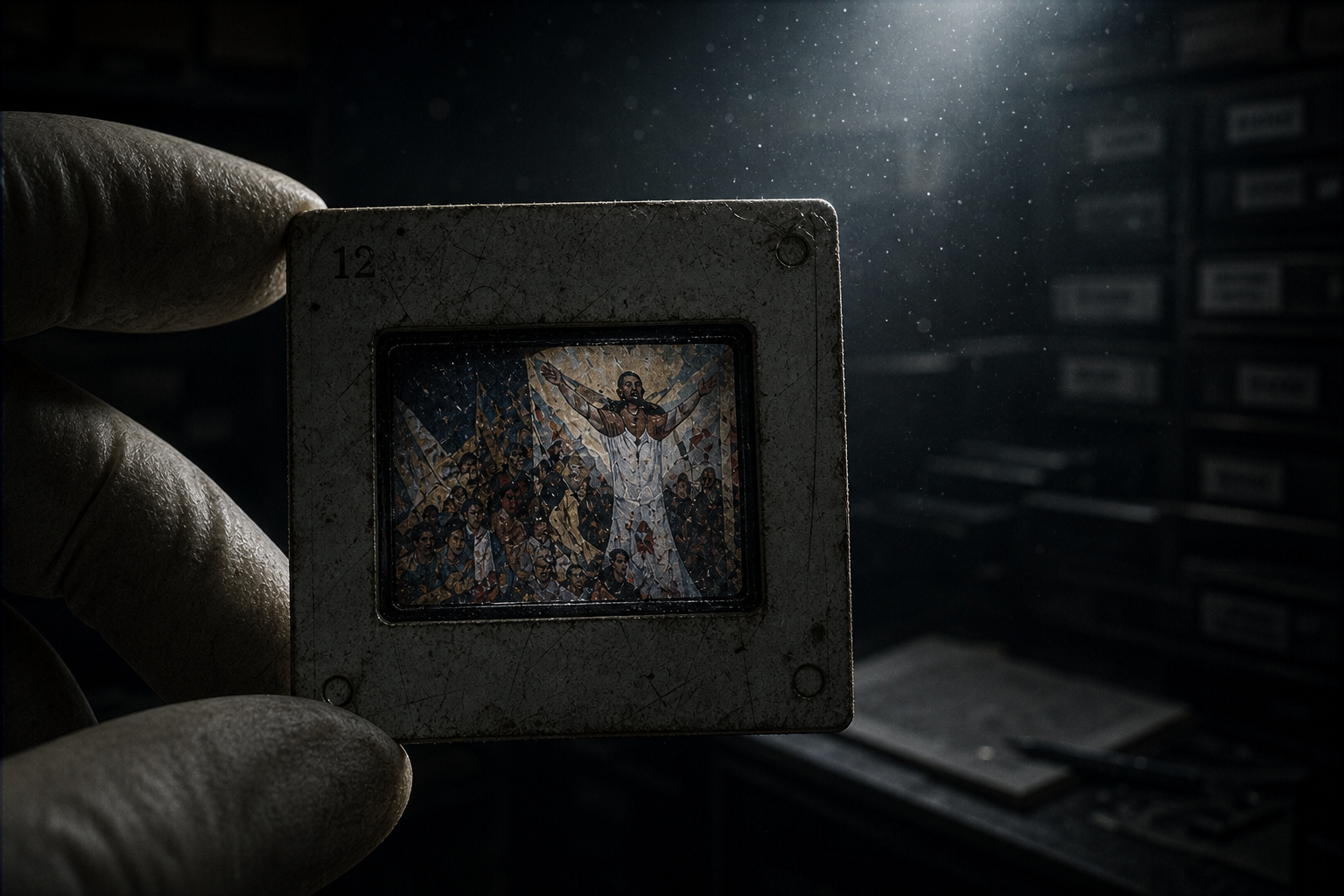
What survived is fragmentary in a specific way. Slides had been made and sent to Pyongyang for the festival. A pamphlet produced for a 1989 touring exhibition survives. These are not the paintings. They are representations of the paintings at a scale and resolution that cannot substitute for the physical objects. A slide is approximately 35 millimeters. The original panels were designed to hang from buildings. The information loss involved in this reduction is not merely quantitative. The physical presence of a large-scale hanging painting, the way it occupies space, the way its colors read at distance, the relationship between the figures and the viewer standing below, none of this is recoverable from a slide.
“Baekdu ui Sanjarak Arae, Balg-aoneun Tongil ui Saenaliyeo” (백두의 산자락 아래, 밝아오는 통일의 새날이여, translated as “Beneath the Foothills of Baekdu Mountain, the New Day of Unification Dawning”) was produced in 1987 by Jeon Jeong-ho and Lee Sang-ho. Its content was more directly provocative in formal terms: it depicted workers and farmers tearing an American flag with a sickle. The sickle as an image, combined with the destruction of an American flag, produced the precise symbolic combination that the National Security Act was designed to criminalize. Both artists were arrested for violating the Act. The original was destroyed. The version that exists today was reconstructed in 2005, nearly two decades after the original’s destruction, from documentary evidence.
The 2005 reconstruction is a philosophically interesting object. It is not the painting. It is an image of what the painting was believed to look like, produced by artists who were not present at the original creation, working from secondary sources. It has a different material history than the original. It has never been seized. It has never been burned. It occupies a different relationship to institutional violence than its predecessor. Whether it can be said to be the same work is a question that art theory has frameworks for and that the state’s original action renders newly urgent.
Psychological Necropsy: Why It Terrifies the Western Mind
The Western lost media tradition operates, almost without exception, within a specific set of assumptions about why things disappear. Something is lost because it was not valued: early television broadcast on obsolete formats, regional programming that no distributor thought worth preserving, experimental films that never found audiences. Something is lost because of accident: fire, flood, deterioration of unstable nitrate stock. Something is lost because of corporate decisions made without awareness that future audiences would care. The mystery in Western lost media is almost always the mystery of neglect. The horror, where it exists, is the horror of impermanence: the reminder that culture is fragile and that the past is not as recoverable as we would like.
The Minjung murals introduce a category that Western lost media discourse has very little vocabulary for: the deliberately destroyed artifact. Not lost. Not neglected. Seized, and then burned. The distinction matters psychologically because it transforms the nature of the absence. When something is lost through neglect, the loss is tragic but impersonal. When something is destroyed by an institution wielding legal authority, the absence is a record of a decision. Someone decided that this object should not exist. Someone gave an order. Someone carried it out. The ash is evidence.
This particular structure of loss maps onto what psychologists working in the tradition of trauma theory describe as “sanctioned erasure”: the institutional removal of cultural memory as a mechanism of political control. The Western mind, raised on Enlightenment assumptions about the separation of culture from state power, tends to encounter this concept as historically distant. The Index Librorum Prohibitorum, the Nazi book burnings, the Soviet airbrush: these are examples the Western reader knows, but knows as history, as the behavior of systems that have been defeated or dismantled. The Minjung murals were destroyed in 1989. The artists were interrogated by an intelligence agency in 1989. The reconstruction of one of the paintings occurred in 2005. This is not distant history. It is within the lifetime of most adults currently reading on the internet.
The “Exotic Uncanny” that the Minjung case generates for Western audiences is not primarily about the content of the paintings, though the content is striking. It is about the collision between the familiar and the structurally alien. The familiar: large-scale political mural art is a form Western audiences recognize from the Mexican muralist tradition, from Diego Rivera and José Clemente Orozco, from the WPA, from Northern Irish political murals. The form is legible. The structurally alien: the specific machinery of an East Asian developmental state in the late Cold War period, the Angibu, the Baekkoldan, the National Security Act, a legal framework under which visual imagery could be construed as treason. The Western reader can parse what a protest painting is. The Western reader does not, as a rule, have a personal or cultural framework for what it means when the intelligence agency comes to the courtyard to take the painting and burn it.
There is also an architectural dimension to the uncanny. Korean apartment blocks, Korean university campuses, Korean public squares: the physical settings of these events are not the European or American settings in which the Western imagination habitually places political repression. They are simultaneously modern, in their materials and their institutional organization, and shaped by a different historical sequence, a different relationship between state authority and civil society, a different experience of what the twentieth century did. The photographs that survive from the Minjung period show protesters in settings that look, to Western eyes, almost contemporary, but operating under conditions that the Western historical imagination associates with earlier decades or different geographies. The temporal and spatial dissonance is itself a source of unease.
The Evidence of Void: Why It Remained Lost
The physical trajectory of the “Minjok Haebang Undongsa” panels after their seizure is not fully documented, which is itself significant. The Baekkoldan were not an archival institution. They were a paramilitary policing unit operating in the context of a political emergency response. Their purpose was suppression, not preservation. The burning of seized political materials was standard practice, not an exceptional decision. There was no bureaucratic reason to maintain records of what was destroyed. The state’s interest was in the non-existence of the objects, not in maintaining an inventory of what had been removed.
This produces a specific archival problem that differs from the standard lost media scenario. With typical lost media, the absence of records reflects the absence of the object from institutional concern: nobody kept the tapes because nobody thought the tapes mattered. With the Minjung murals, the absence of records is itself a product of institutional intention. The state did not want a record of what it had taken. The gap in the archive is shaped like a decision.
The slides that were sent to Pyongyang represent an interesting counter-archive. They exist because the artists had the foresight, or the luck, to distribute documentation before the seizure occurred. North Korea received a visual record of the paintings before South Korea destroyed the originals. This means that, during the period of maximum political tension between the two Koreas, the most complete surviving documentation of a major South Korean political artwork existed in the archives of the state that South Korean law designated as the enemy. The irony is not lost on scholars of the period.
Recovery efforts have been complicated by multiple factors. The artists themselves were prosecuted and, in some cases, imprisoned. Their ability to reconstruct or document their own work was constrained by their legal status. The political climate that made the work dangerous in 1989 did not immediately dissipate: South Korea’s democratic transition was gradual, contested, and incomplete. The National Security Act was not repealed. Artists who had been prosecuted under it did not immediately find institutions willing to host retrospectives of the suppressed work.
The 1989 touring exhibition pamphlet survives because pamphlets are small and portable and individually hideable in a way that an eleven-panel hanging painting is not. This is a physical reality with political consequences. The state’s ability to destroy large-scale public art is essentially complete: it cannot be hidden, it cannot be smuggled, it cannot be duplicated without significant resources. The pamphlet survived precisely because it was not worth seizing. This asymmetry between the scale of the original work and the scale of what survives is a physical record of the power differential between the artists and the state.
The Point of No Return: The Ultimate Uncomfortable Insight
The reconstruction of “Baekdu ui Sanjarak Arae” in 2005 raises a question that the Western lost media community has not, as a body, fully confronted. The question is not whether the reconstruction is authentic, in the conventional art-historical sense of the term. The question is what it means for a political artwork to exist only in a form that has never been subject to the specific violence that defined the original’s existence.
The original painting was dangerous. It was dangerous enough that the state imprisoned the people who made it and destroyed the object itself. The 2005 reconstruction exists in a different South Korea, under different laws, in a different political context. It can be exhibited. It can be photographed. It can be reproduced in books and on websites. It has lost the precise quality that made the original a target: its capacity to threaten a specific power structure at a specific historical moment. Whether that capacity was a flaw in the work or its essential meaning is a question that the reconstruction cannot answer, because the reconstruction has never had to answer it.
What the Minjung murals ultimately document is not simply the content of Korean history, though they document that too. They document the specific relationship between political art and institutional violence in a modernizing authoritarian state, the way in which a state that cannot win an argument will instead destroy the medium of argument. The paintings were not refuted. They were not censored in the sense of having their content altered or their distribution restricted. They were burned. This is a statement about the state’s relationship to the visual record of its own violence. It cannot be dismissed as historical. The National Security Act remains in force in South Korea. The question of what can and cannot be depicted, and at what scale, and in what context, is not settled.
The default archive of human experience has failed this specific artifact. Western lost media discourse often obsesses over digital permanence. However, the physical reality of the 1980s was one of kinetic erasure. The slides exist in archives. The pamphlet exists in archives. The reconstruction hangs in a gallery. Somewhere in the bureaucratic record of an intelligence agency that has since been renamed and reorganized, there may be a document recording the decision to seize eleven large paintings from a university courtyard in 1989. That document, if it exists, is the closest thing to the original work that remains accessible. It is a record of destruction. It is, in its own way, a portrait of what the paintings meant.
🔍Search Update: Call to Action
The search for high-resolution documentation of the Minjung murals is an ongoing forensic effort. If you possess 35mm slides, exhibition pamphlets, or personal photographs from South Korean university rallies between 1987 and 1990, you may hold a critical fragment of this erased history. Contact digital preservation communities specializing in East Asian political art to contribute to the reconstruction of the “ash archive.”
The ash left no archive. That was the point.
This document is an investigative archival reconstruction based on fragmented public records, media remnants, community accounts, and verified historical sources compiled by The 3AM Archive.
The article examines how incidents, forgotten media, internet folklore, and unresolved public memories evolve through cultural preservation and digital decay.
This is a cultural investigation document — not fictional horror content.
All visual materials used in this post are exclusive AI-generated assets created for The 3AM Archive.
