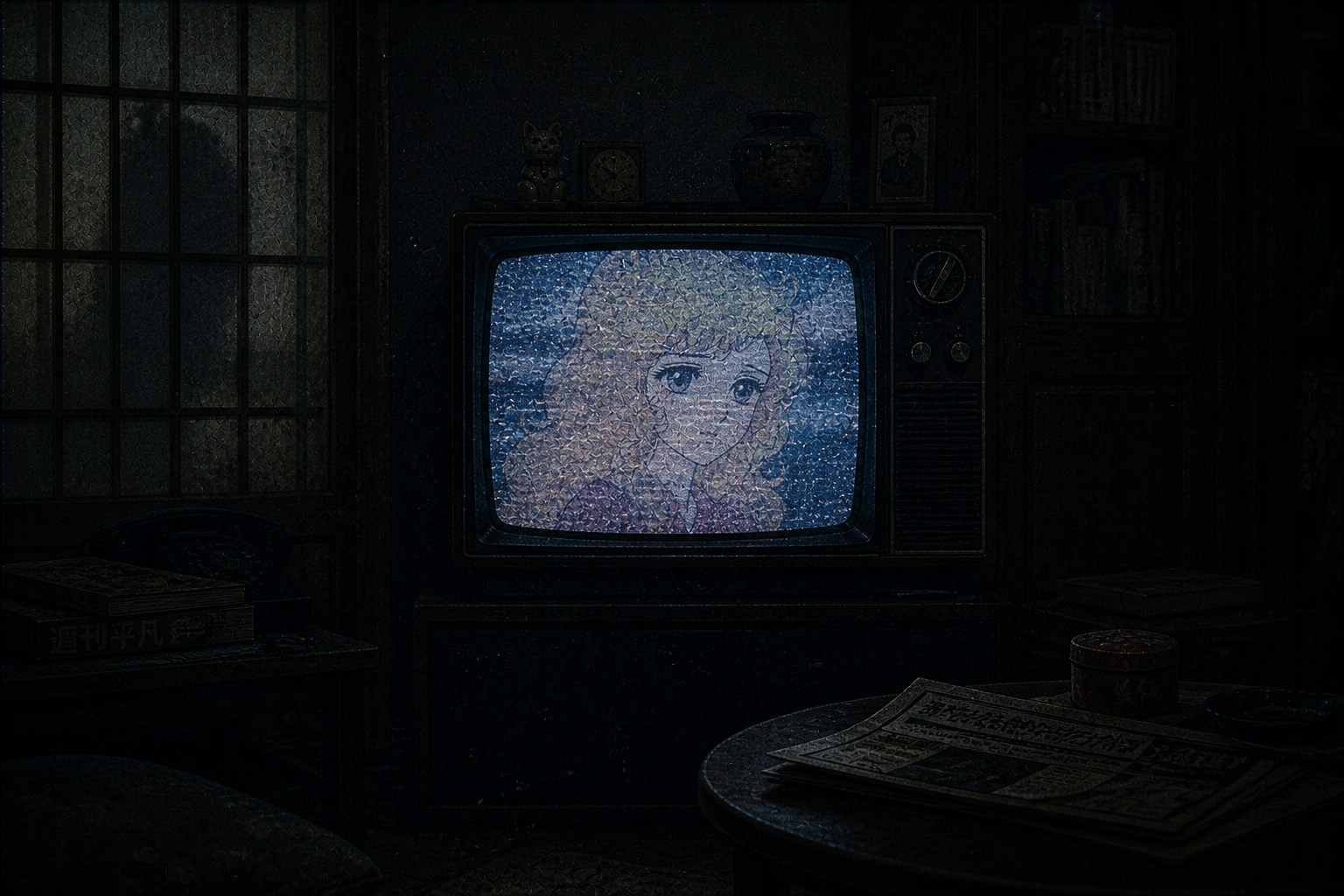
There is a specific kind of dread that belongs exclusively to incomplete archives. It is not the dread of a monster or a threat. It is the dread of a signal that once existed, carried meaning, entered the minds of thousands of children, and then simply ceased to be recoverable. Not destroyed in a fire. Not banned by a censor. Just gone, in the quiet, administrative way that entire cultural artifacts go when no institution decides they are worth saving. Mon Cheri CoCo, a thirteen-episode romance anime produced under the Nihon TV Fairytale banner and broadcast between August and October of 1972, is that kind of gone. What survives is an opening sequence, running under two minutes, looping on a small number of Japanese video-sharing platforms. The rest, eleven episodes of confirmed broadcast material and the full contextual fabric of a production that reached Japanese households three times a week for a full season, has not surfaced in any verified form. Not on any streaming service, not in any collector’s archive, not in the catalogs of organizations dedicated specifically to the preservation of pre-digital Japanese animation. If it exists anywhere, it exists in a box in a climate-uncontrolled storage unit, or in the degraded magnetic substrate of a VHS tape that was recorded over sometime in the mid-1990s, when shelf space was finite and romance anime from twenty years prior was not considered a conservation priority.
This dossier does not document a haunting; it audits a systemic erasure. It is a structural analysis of how a culture’s broadcast infrastructure, economic incentives, and psychological relationship with impermanence conspired to erase a piece of media that was, by all available evidence, completely ordinary. That ordinariness is the most disturbing part.
The Cultural Anatomy: Context of Erasure
To understand why Mon Cheri CoCo does not exist in recoverable form, it is necessary to understand what Japan’s television industry looked like in 1972, and what it understood itself to be doing when it produced animation for children.
The Nihon TV Fairytale (日本テレビ動画, sometimes rendered as Nihon Terebi Doga) production framework was not a prestige operation. It functioned as an anthology structure, generating short-run animated content that filled broadcast slots with low overhead. The model was closer to serialized magazine publishing than to the feature film logic that would later define Studio Ghibli’s cultural prestige. Episodes were produced on tight budgets, aired in their window, and then released back into the administrative ether of a broadcaster that had no particular reason to treat them as permanent assets.
This is a point that Western audiences consistently misread when approaching early Japanese animation. The post-1990s global spread of anime as a collector’s medium, with its accompanying culture of laserdisc releases, remastered DVD box sets, and later streaming libraries, creates a retrospective illusion. It suggests that Japanese animation has always understood itself as a preserved artifact. In 1972, this was simply not true. Broadcast material was treated with the same disposability that American networks applied to live television in the 1950s and 1960s, where kinescope recordings of landmark programs were routinely wiped because the magnetic tape was more valuable reused than the content was archived. Japanese broadcasters operated under similar economic logic, compounded by the specific material constraints of a country that was, in 1972, still navigating the infrastructural and economic aftershocks of postwar reconstruction.
The Showa era (1926 to 1989) produced a cultural psychology around impermanence that has direct bearing on this case. The socio-aesthetic protocol of mono no aware, loosely translated as the pathos of things, the bittersweet acknowledgment that all things pass, was not merely a philosophical position in postwar Japan. It was a practical orientation toward material culture shaped by the lived experience of catastrophic loss. Cities had been leveled. Family records had been destroyed. The idea that something broadcast for a season and then not rebroadcast would simply cease to be available was not experienced as a tragedy within this cultural framework. It was the natural order of things.
Mon Cheri CoCo aired in this environment. It was, by the evidence of its surviving opening, a soft romance narrative aimed at a young female audience, featuring character designs consistent with the shojo aesthetic conventions of the period: large expressive eyes, flowing lines, pastel-adjacent color sensibilities even within the technical constraints of early 1970s cel animation. The title itself is a French endearment embedded in a Japanese production context, which was a common affectation in shojo media of this period, a genre convention that used European-coded aesthetics and vocabulary to signal romantic aspiration to young female viewers who associated France and Italy with idealized emotional landscapes they had never visited.
The show ran thirteen episodes. It was rebroadcast into the early 1990s, which confirms that someone, at some institutional level, retained broadcast-quality material for approximately two decades after original air. Then, at some point between the early 1990s and the present, that material became unavailable. Not destroyed, as far as any investigation has confirmed. Simply inaccessible, which in practical terms is the same thing.
Structural Dissection: The Anomaly in the Signal
What makes Mon Cheri CoCo analytically interesting, rather than merely sad, is the specific shape of what has survived and what has not.
The Privileged Status of Openings The opening sequence is intact. This is not random. Opening sequences occupied a structurally privileged position in the archive ecology of Japanese animation for reasons that are partly commercial and partly psychological. Opening sequences were promotional material. They were the part of a broadcast that a producer might excerpt for a pitch reel, that a network might retain for internal reference, that a composer or director might keep a personal copy of as a professional sample. They were also the segment most likely to be recorded by a home viewer who turned on the tape a few minutes early, or who rewound to capture the song. The opening of Mon Cheri CoCo survived because the opening of Mon Cheri CoCo was useful to multiple parties for multiple reasons that had nothing to do with preserving the show itself.
The Economic Disposability of Episodes The remaining twelve episodes, by contrast, were useful to no one after their rebroadcast window closed. They were not released commercially. The show was not a breakout hit that generated merchandising revenue justifying continued rights management. It was, to use the unsentimental language of broadcast accounting, a completed asset with no further monetization path. In this context, the failure to preserve it was not negligence. It was rational behavior by institutions operating under the assumption that preservation has a cost and that cost requires justification.
Visual Archaeology What the opening sequence reveals about the content is itself a kind of archaeology. The visual grammar is consistent with 1972 shojo conventions: a female protagonist rendered in the large-eyed style that Riyoko Ikeda and Moto Hagio were simultaneously codifying in manga form, set against backgrounds that suggest an idealized domestic or pastoral European setting. The color work, reviewed against the constraints of the period, indicates a mid-range production budget, not the cheapest end of the Nihon TV Fairytale output, but not a flagship production. The music follows the melodic patterns of early 1970s Japanese pop, with orchestral underscoring that leans toward the sentimental.
This is, in other words, a show that looked exactly like what it was. There is no evidence of anomalous content, no production-level irregularities, no documented accounts from viewers of episodes that departed from the romantic genre conventions the opening established. The absence is total and contextually mundane, which is the specific condition that makes it so resistant to resolution. Anomalous lost media can sometimes be traced through the reactions it provoked. Ordinary lost media leaves no trace at all, because there was nothing remarkable to trace.
The thirteen-episode structure itself is worth noting. This is a short run even by the standards of 1972 Japanese animation. It suggests either a limited broadcast commitment from the outset, a show that was planned as a seasonal filler rather than an ongoing property, or a production that underperformed against initial expectations and was not extended. The distinction matters because it shapes the probability of survival: a successful show generates more copies, more institutional investment in retention, more individual viewers who valued it enough to record and preserve it. A quiet, competent, seasonally bounded romance anime for young girls in 1972 generated none of these survival pressures.
Psychological Necropsy: Why It Terrifies the Western Mind
The Western engagement with East Asian lost media has a specific phenomenology that is worth examining with clinical precision, because understanding why something feels disturbing is prerequisite to understanding whether the feeling is producing accurate information about the thing itself.
The concept of the Exotic Uncanny is a useful analytical frame here. Sigmund Freud’s original formulation of the uncanny, the unheimlich, described the specific anxiety produced by something that is simultaneously familiar and foreign: the doll that moves like a person but is not one, the reflection that lags slightly behind. The exotic uncanny, as it operates in Western consumption of East Asian lost media, adds a spatial dimension to this temporal displacement. The material is already uncanny because it is lost, a signal that existed and then stopped existing. It becomes doubly uncanny because it originated in a cultural context whose conventions are legible enough to Western viewers to produce emotional engagement, but different enough in their specific grammar to prevent the comfortable resolution of that engagement.
The large eyes of shojo animation, for example, are immediately emotionally resonant to a Western viewer trained by decades of Disney to associate oversized eyes with innocence and emotional vulnerability. But the specific conventions of 1972 Japanese shojo, the particular way the line work renders hair, the background design conventions, the pacing rhythms that assume a viewer socialized in Japanese broadcast culture, create a constant low-level friction. The viewer is almost at home and then is not. This is the structural condition of the uncanny, and Mon Cheri CoCo produces it in its most concentrated form: the opening sequence is the only surviving evidence of a world that was complete and is now inaccessible, and that world is simultaneously recognizable and irreducibly foreign.
There is a second psychological mechanism at work, which is the specific anxiety of Western audiences around institutional forgetting in non-Western contexts. American and European audiences have, in the post-internet era, developed a strong intuition that important things get preserved, that cultural significance generates archival effort, and that something being lost implies either active suppression or deliberate erasure. When applied to East Asian media, this intuition produces a systematic misreading: the assumption that a lost anime must have been lost for reasons, that there is a story of censorship or controversy that explains the absence. This assumption is culturally narcissistic in a precise sense. It projects Western archival values onto a broadcast environment that did not share them. Mon Cheri CoCo is not lost because it was disturbing or transgressive. It is lost because no one with institutional authority over its physical substrate decided it was worth the cost of keeping.
That conclusion, when fully absorbed, is more disturbing than any censorship narrative, because it implies something about the fragility of all cultural production. If a completed, professionally produced, nationally broadcast thirteen-episode animated series can simply cease to exist because no one found it economically rational to preserve it, then the archive is not a record of what mattered. It is a record of what was profitable to remember.
The Evidence of Void: Why It Remained Lost
Institutional Inertia Nihon TV, as an institution, underwent significant structural changes across the decades following 1972. Broadcast archives were not maintained as unified collections with systematic cataloging until well after the period when the practical materials related to a low-priority 1972 production would have been routinely cycled out of active storage.
The VHS Discard Cycle The specific window between the early 1990s rebroadcasts and the present represents the period during which VHS recordings made by private individuals would have been most likely to survive in household collections, but also the period during which those individuals, aging, relocating, or simply not considering their personal recordings to be historically significant, would have been most likely to discard them.
Documentation Deficit The fan-driven lost media recovery community, which operates primarily through platforms such as the Lost Media Wiki, 4chan’s /t/ and /r/ boards, and dedicated subreddits, has documented Mon Cheri CoCo as a confirmed lost work. The documentation is itself minimal, reflecting the minimal trace the show left in the cultural record. There are no verified accounts of anyone possessing episode recordings.
The Solicitation Failure The Japanese broadcaster NHK’s 2013 initiative to solicit public donations of archival broadcast material produced a significant number of recoveries for exactly this category of seemingly lost early television. Mon Cheri CoCo was not among them. Similar initiatives by independent archivists have not surfaced the material. This does not mean the material does not exist. It means that if it exists, it is in a location held by someone who either does not know what they have, does not have access to the relevant internet communities, or does not consider the material worth sharing.
Demographic Erosion The demographics of the most likely holders are relevant here. Viewers who recorded Mon Cheri CoCo during its original 1972 broadcast, or during its 1980s and early 1990s rebroadcasts, would currently be in their 60s to late 70s at minimum. The recovery of physically archived personal recordings depends on those individuals either actively participating in archival communities, which is statistically unlikely given age and platform demographics, or on their materials being discovered and identified by family members or estate handlers following their deaths. Neither condition is structurally reliable.
This is the specific mechanism of archival death that applies to Mon Cheri CoCo: not destruction, but the slow statistical erosion of the probability that any surviving copy will find its way into the hands of someone who recognizes its significance before the physical substrate of that copy degrades beyond recovery.
The Point of No Return: The Ultimate Uncomfortable Insight
The case of Mon Cheri CoCo ultimately forces a question that lost media communities resist asking directly, because the answer undermines the premise of the search itself.
What is an archive for?
The Western archival tradition, shaped by Enlightenment epistemology and its conviction that knowledge is cumulative and that cultural production is a record of human development, treats the archive as a moral project. To preserve is to respect. To lose is to fail. This ethical framework is what drives the lost media recovery community, and it is, in its own terms, admirable. The effort to recover Mon Cheri CoCo is an effort to insist that a completed work of human creative labor, watched by real children who were shaped by it in ways neither they nor anyone else can now fully reconstruct, deserves to exist in recoverable form.
But the conditions that produced its loss were not ethical failures by individuals who knew better and chose otherwise. They were the predictable outputs of economic and cultural systems that operated on entirely different assumptions about what cultural production is for. In the broadcast model of 1972 Japan, Mon Cheri CoCo was a service delivered to viewers in real time, not an object to be possessed and stored. Its disappearance was, within that framework, the completion of its function, not the betrayal of it. The show aired. Children watched it. They felt what the show asked them to feel. The signal was received. That the signal cannot be re-received is, in the logic of the system that produced it, irrelevant.
What Mon Cheri CoCo represents, then, is not primarily a mystery or a horror, though it contains elements that satisfy both of those framings. It represents the collision between two incompatible models of what media is: media as a time-bound service and media as a permanent artifact. The survivors of that collision are always asymmetric. The opening sequence survived because it was useful as an artifact. The episodes did not survive because they were useful only as a service.
This asymmetry is not unique to Japan in 1972. It is the structural condition of all broadcast culture before the economics of digital distribution made comprehensive archiving cheap enough to be default. Thousands of hours of early American television, early British radio drama, early Korean broadcast material across every genre, exist in exactly this condition: confirmed to have existed, confirmed to have been received, impossible to recover. The internet has made the awareness of these gaps more acute, not because the gaps are new, but because we now have the infrastructure to document what is missing in ways that previous generations did not.
The default archive of human experience has failed this specific artifact. The opening of Mon Cheri CoCo loops. A young female protagonist moves through a sequence of images that were designed to communicate warmth and romantic aspiration to children who are now in their sixties. The music plays. The animation, competent and period-appropriate, does exactly what it was designed to do. And then it ends, and the next episode, which exists in no recoverable form, does not begin.
That is not a ghost. That is a structural feature of how human culture stores itself, which is to say: incompletely, irrationally, and with a consistent bias toward preserving what was profitable over what was felt.
🔍Search Update: Call to Action
If you are a collector of vintage Japanese media or have family in Japan who may have recorded Nihon TV broadcasts between 1972 and 1993, we are looking for verified footage of Mon Cheri CoCo episodes. Even partial segments or degraded VHS copies are of immense archival value. Please contact the 3AM Archive or the Lost Media Wiki to contribute any leads.
The opening loops again.
This document is an investigative archival reconstruction based on fragmented public records, media remnants, community accounts, and verified historical sources compiled by The 3AM Archive.
The article examines how incidents, forgotten media, internet folklore, and unresolved public memories evolve through cultural preservation and digital decay.
This is a cultural investigation document — not fictional horror content.
All visual materials used in this post are exclusive AI-generated assets created for The 3AM Archive.
