There is a specific cognitive dissonance that arrives only when you search for something that, by every institutional logic, should exist—and find nothing. Not a 404 error, not a corrupt file, not a degraded VHS rip uploaded to a dying forum at 3 a.m. Nothing. A search result that returns the shape of an absence. Psychologists describe a related phenomenon in grief: the mind keeps reaching for the familiar object even after it’s gone, a phantom-limb sensation applied to memory itself. The internet, for all its ambition as a total archive of human production, has its own phantom limbs. Terrorist 2 (테러리스트 2, 1997) is one of them.
This is not a film review. The film cannot be reviewed. It cannot be streamed, rented, borrowed, or pirated. It cannot be experienced by any living person outside a specific government building in Sangam-dong, Seoul—and even there, not by you. What follows is something closer to forensic anthropology: a scan of a cultural artifact that exists in a state of enforced dormancy, asking not what the film contains, but what its silence reveals about the society that produced and then effectively buried it.
The Cultural Anatomy: An Era That Ate Its Own Output
To understand Terrorist 2, you must first understand the precise economic atmosphere of South Korea in 1997—not as historical context, but as the primary causal agent. The IMF financial crisis, which detonated across Southeast Asia that autumn and reached South Korea with particular ferocity, did not merely crash stock indices. It shredded the institutional fabric of an entire national film industry mid-production cycle. Production companies that had greenlit sequels, secured talent, and begun post-production suddenly ceased to exist. Not gradually. Overnight.
The original Terrorist (테러리스트, 1995), directed by Kim Young-bin, had been a genuine commercial success—a prestige action film with recognizable star power and a production budget commensurate with its ambitions. It occupied a specific cultural position in mid-nineties South Korean cinema: aspirational genre filmmaking, the industry reaching toward a Hollywood register while remaining distinctly domestic in its anxieties. The sequel arrived two years later in a fundamentally different economic climate, stripped of the original’s resources, its star power diluted, its production values reduced to what the industry euphemistically calls B-tier. It was, in the taxonomy of genre cinema, a “liminal sequel”—officially licensed, industrially produced, but occupying a position adjacent to the original rather than continuous with it.
What makes Terrorist 2 a cultural specimen rather than merely a footnote is the specific mechanism of its disappearance. The film did not fail at the box office and fade from cultural memory in the ordinary way—through the slow erosion of tape rot, warehouse fires, the entropy of commercial indifference. Its vanishing was structural, imposed by the collapse of the very economic system that produced it. The bankruptcy of its distributor meant no formal home video release; the IMF crisis meant no institutional will to rescue minor genre productions from the debris of corporate failure. The film was produced for an audience; the economic infrastructure that would have delivered it to that audience dissolved before delivery could occur. It became, in the vocabulary of archivists, a “zero-user artifact”: a complete object with no functional relationship to any public.
Structural Dissection: Anomalies in the Signal
The Western lost-media community—operating primarily through Reddit’s r/lostmedia and associated forums—has developed a highly specific aesthetic sensibility around what members call “media decay.” This is the uncanny quality produced when official, high-production cultural objects appear to have slipped through a crack in the documentary record. The anomaly is not merely that something is missing; it is that the gap in the record has a particular shape, a silhouette that suggests the missing object’s former presence.
Terrorist 2 generates this sensation with unusual purity. Its evidentiary trace is minimal but legible: a handful of low-resolution promotional posters, several lobby cards—the theatrical stills distributed to cinema owners before the era of digital marketing—and a scattering of Korean-language database entries. The posters are particularly unsettling to anyone attuned to this register. They present a film that looks, in every generic marker, like a 1997 South Korean action release; the visual language is institutional, not artisanal. This is not the hand-painted poster of a regional exploitation film or a zero-budget direct-to-video release. The design vocabulary is that of a theatrically distributed commercial product. It implies a fully functional industrial apparatus behind it—writers, a director, a cast, a cinematographer, an editor, a sound designer. All of that labor, all of those decisions, sealed inside a single archival vault.
The absence of any digital trace—no trailer, no clip, no broadcast recording, no audience review written in the immediate aftermath of a theatrical screening—suggests the theatrical run, if it occurred at all, was extraordinarily limited. The distribution network had already begun to collapse. The film may have screened in a small number of venues for a very short window before its distributor’s bankruptcy terminated the run. If any member of a paying audience walked into a theater and watched Terrorist 2 in 1997, they left no recoverable record of the experience. No Naver review. No hand-typed web forum post. Silence.
Psychological Necropsy: Why the Silence Disturbs
The Western internet’s fascination with cases like Terrorist 2 is not purely antiquarian. It draws on a deeper set of anxieties about the relationship between cultural production and cultural memory—anxieties that the digital age has sharpened rather than resolved.
The dominant assumption of the internet era is that cultural production and cultural record are now essentially coterminous; that the act of making something simultaneously creates an indelible trace. This assumption is not irrational. The period from roughly 2000 onward is over-documented to a degree that would have been incomprehensible to any previous generation. But Terrorist 2 is a pre-digital artifact—produced in the last years before the web became the default archive of human experience—and it exposes the fault line between two eras. The infrastructure that would have digitized it, catalogued it, and distributed it to YouTube’s voracious appetite for archival content simply did not exist at the moment of its production and immediate commercial failure.
There is also a specifically Western dimension to the discomfort. For audiences in the United States and Europe, the Korean film industry exists primarily through the post-Oldboy, post-Parasite lens—an image of cinematic sophistication, auteur ambition, and global prestige. The existence of a low-budget 1997 action sequel that the Korean government physically owns but legally suppresses from public access cuts against this image in productive ways. It is a reminder that national film industries are not monolithic; that every prestige tradition has its B-tier underbelly; that the Korean Cinema Renaissance of the 2000s was built on the wreckage—literal and institutional—of the IMF crisis. The films that survived that wreckage, and their makers, did so through a combination of talent and accident. Terrorist 2 represents the accident’s other side.
The Evidence of Void: Physical Decay Versus Social Erasure
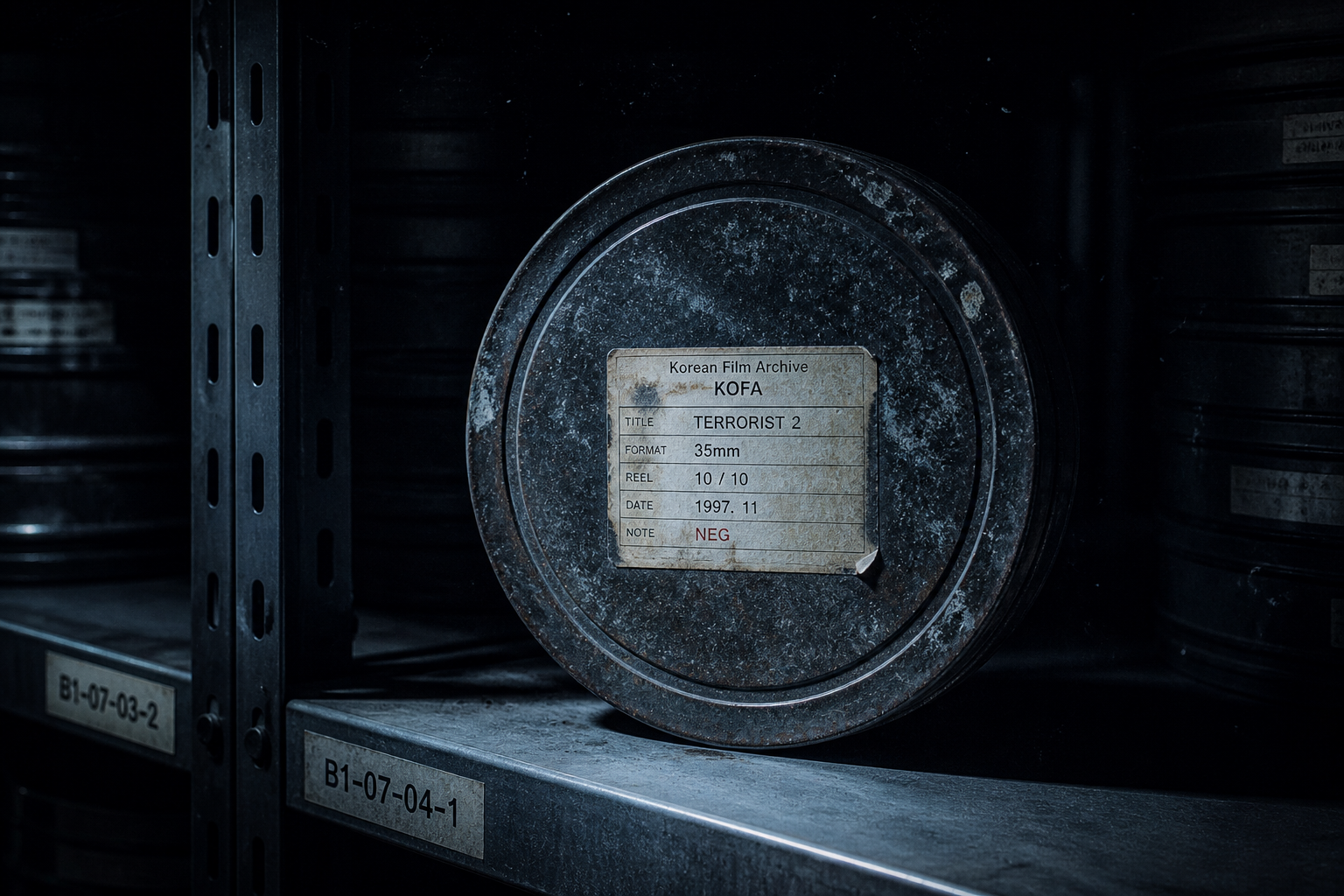
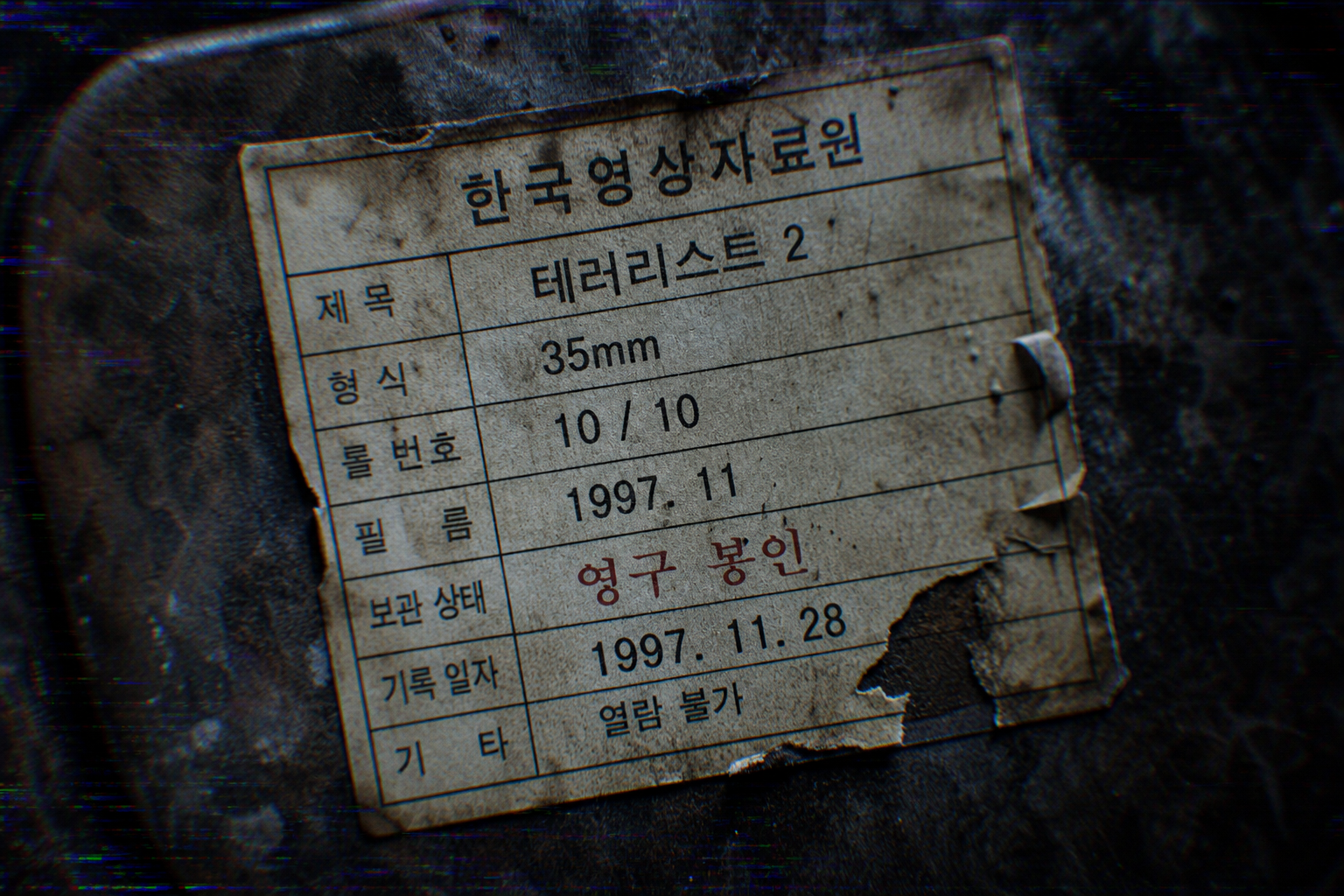
The film exists. This is the fact that complicates every instinct the lost-media community brings to the case. The Korean Film Archive—KOFA—in Sangam-dong, Seoul, is one of the world’s more rigorous institutions of cinematic preservation. Its “Vault State” designation for Terrorist 2 indicates the physical master has been preserved against deterioration; the institution has done its job. The film is not decaying in a warehouse. It is not dissolving on a forgotten reel. It is climate-controlled, catalogued, and intact.
What it lacks is a legal and commercial framework for public access. This distinction—between physical preservation and social accessibility—is the most significant structural feature of the case. The film’s inaccessibility is not an accident of entropy; it is the product of specific legal conditions created by the collapse of the entity that owned its distribution rights. Rights that are owned by a bankrupt company do not evaporate; they become entangled in legal limbo, assigned to creditors or holding entities with no commercial interest in resolving them. KOFA can preserve the physical object; it cannot unilaterally release it without navigating rights structures that may, in practical terms, be unresolvable.
This distinguishes Terrorist 2 from the more romantic category of truly lost films—the early silents that burned in nitrate fires, the network broadcasts recorded over for cost savings, the regional prints that disintegrated in unconditioned storage. Those losses are tragedies of entropy; their causes are impersonal. The inaccessibility of Terrorist 2 is a legal condition, a bureaucratic state—which makes it, in some respects, more disturbing. The object’s preservation is proof that the system functions. The object’s inaccessibility is proof that preservation and access are entirely different problems, with entirely different solutions.
The Point of No Return: Digital Memory’s Uncomfortable Limit
Here is the insight that the case of Terrorist 2 presses toward, and that no amount of community crowdfunding or archival enthusiasm can fully resolve: the digital permanence we have come to assume about cultural production is retrospective. It operates backward from the present. Objects produced before the web became culturally ambient exist in a different archival condition—one where physical survival and social accessibility have no necessary relationship, and where the bureaucratic legacy of pre-digital commercial failure can render a physically intact artifact functionally equivalent to a destroyed one.
The “analog horror” resonance that Western audiences feel when they encounter the Terrorist 2 case is not misplaced—but its source is more mundane and more unsettling than any gothic metaphor suggests. The film is not haunted. It is administered. The vault in Sangam-dong is not a tomb; it is a filing cabinet. And the filing cabinet is locked not because anyone decided the film should be suppressed, but because no one has had sufficient legal standing, commercial incentive, or institutional mandate to unlock it. Bureaucratic indifference is a more effective form of erasure than censorship, because it generates no resistance. You cannot protest a rights limbo. You cannot petition an absent distributor. You can only wait, and document the waiting.
The r/lostmedia community will continue to document Terrorist 2 as a case study; the low-resolution posters will continue to circulate as proof of existence; the KOFA catalogue entry will continue to confirm, for anyone who checks, that the physical object is there. What will not change, absent a specific legal intervention that no one currently has the standing to initiate, is the film’s relationship to its audience: nonexistent. A complete industrial product, produced by professionals for a public, returned to sender by history.
The Sangam-dong ghost is not supernatural. It is the perfectly ordinary result of a financial crisis, a bankrupt distributor, an unresolved rights structure, and the accident of being made one year too early for the internet to catch it. That ordinariness is, finally, the most disturbing thing about it. There is no mystery at the center of this case—only the slow, administrative suffocation of a cultural object that no one, at any point, chose to destroy. It destroyed itself, through the aggregate of a thousand indifferent institutional decisions; and the vault in Sangam-dong holds what remains. A zero-user artifact. A movie that, for all practical purposes, was made for no one, and keeps that appointment still.
🔍Search Update: Call to Action
For the Western lost-media community, the objective remains static. We are not looking for a “lost” file, but a “locked” one.
-
Current Status: Confirmed physical existence at the Korean Film Archive (KOFA).
-
The Barrier: Unresolved copyright ownership resulting from the 1997 bankruptcy of the original production and distribution entities.
-
Actionable Lead: Investigation into the liquidation records of the mid-90s Korean film market is required to identify the current “holder of the void.” Until a legal successor is identified, the Sangam-dong vault remains the film’s final and only theater. Document all findings via the established archival threads.
This document is an investigative archival reconstruction based on fragmented public records, media remnants, community accounts, and verified historical sources compiled by The 3AM Archive.
The article examines how incidents, forgotten media, internet folklore, and unresolved public memories evolve through cultural preservation and digital decay.
This is a cultural investigation document — not fictional horror content.
All visual materials used in this post are exclusive AI-generated assets created for The 3AM Archive.
