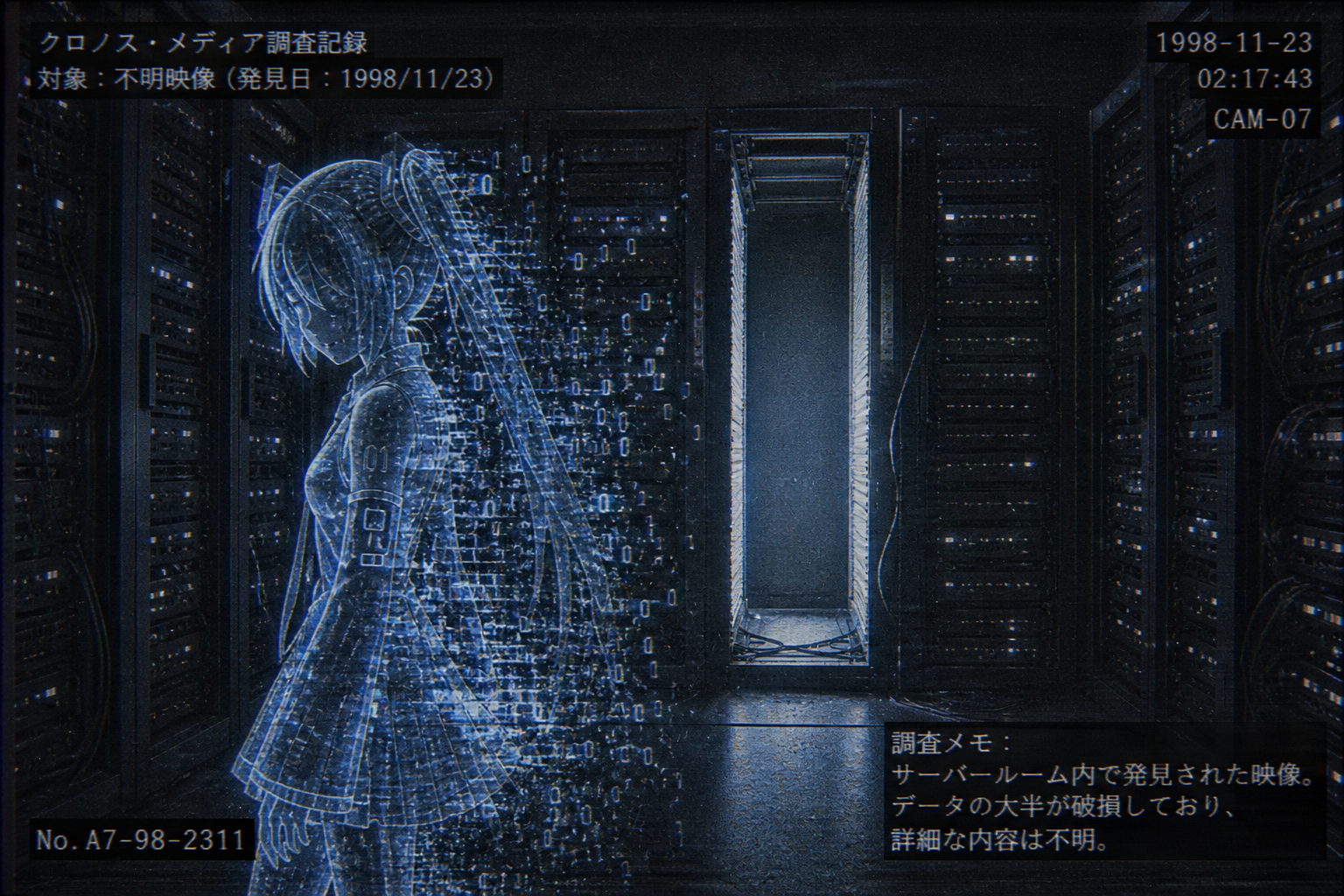
The internet does not forget. This is the axiom we have built our digital civilization upon. It is the reassurance that everything uploaded persists somewhere, cached in a server farm, archived by a bot, or screenshotted by a stranger. It is a comforting lie. And the case of RINGO’s Calamari Ondo is its most clinical refutation.
This is not a story about a lost song. Songs go missing through negligence, through server failures, through the ordinary entropy of corporate neglect. This is a story about a deliberate purge—a premeditated erasure executed by the artist herself, in late December 2018, under circumstances the Vocaloid community still cannot process without discomfort. To call it “lost media” is to extend a courtesy the facts do not support. Calamari Ondo was not misplaced. It was hunted out of existence by its own creator—a forensic act of self-erasure that, following RINGO’s death in January 2025, has achieved a new and permanent dimension.
What we are left with is metadata. Bone fragments. The outline of a thing that no longer exists in any recoverable form.
The Cultural Anatomy: A Scene That Eats Its Own
To understand the deletion, one must first understand the ecosystem that produced it—and the particular pressure system that collapsed around RINGO in the final months of 2018.
The East Asian Vocaloid scene, centered primarily on NicoNico Douga (NND) and Bilibili, operates according to aesthetic hierarchies that Western audiences rarely perceive from the outside. Originality—or at least the appearance of it—is not merely valued; it functions as social proof. Producers are scrutinized with a forensic intensity that would be recognizable to anyone familiar with academic plagiarism discourse, except the standards are applied not to ideas but to sonic texture. The angle of a snare. The saturation on a bass synth. The particular way distortion interacts with a vocal sample.
MARETU—a producer whose work is characterized by heavy, almost industrial bass percussion, clinical-to-chaotic dynamic shifts, and vocal processing that sits somewhere between mechanical and anguished—had, by the mid-2010s, established a signature so distinctive that imitating it read, within the community, as something close to theft. Not copyright infringement in any legal sense; something culturally more charged. A failure of creative identity. An act of parasitism.
RINGO’s sound carried unmistakable resonance with that aesthetic. Whether this was conscious homage, stylistic convergence, or simply the product of two minds drawing from the same wells of influence is a question that cannot now be answered. What is documented is the community’s verdict: RINGO was labeled a “MARETU clone,” and the label stuck with the particular cruelty that internet communities can manufacture when they decide to make an example of someone.
The harassment was not subtle. It accumulated across Twitter, across comment threads, across the coded hostility of fandom spaces that know how to wound without leaving traceable injuries. By December 2018, whatever internal calculus RINGO was running had reached its conclusion. The entire digital presence—videos, accounts, the accumulated artifact of a career—came down. Only one track, Saien (Encore), survived the purge. Everything else, including Calamari Ondo, vanished.
The choice of what to leave and what to destroy is itself a forensic document. Saien means “Encore.” The selection feels deliberate in a way that resists comfortable interpretation.
Structural Dissection: Anomalies in the Signal
Archivists working in the lost media space operate like radiologists reading ghost images—they learn to see the shape of something by studying the space it no longer occupies. In the case of Calamari Ondo, the negative space is unusually well-defined, which makes its absence more, not less, disturbing.
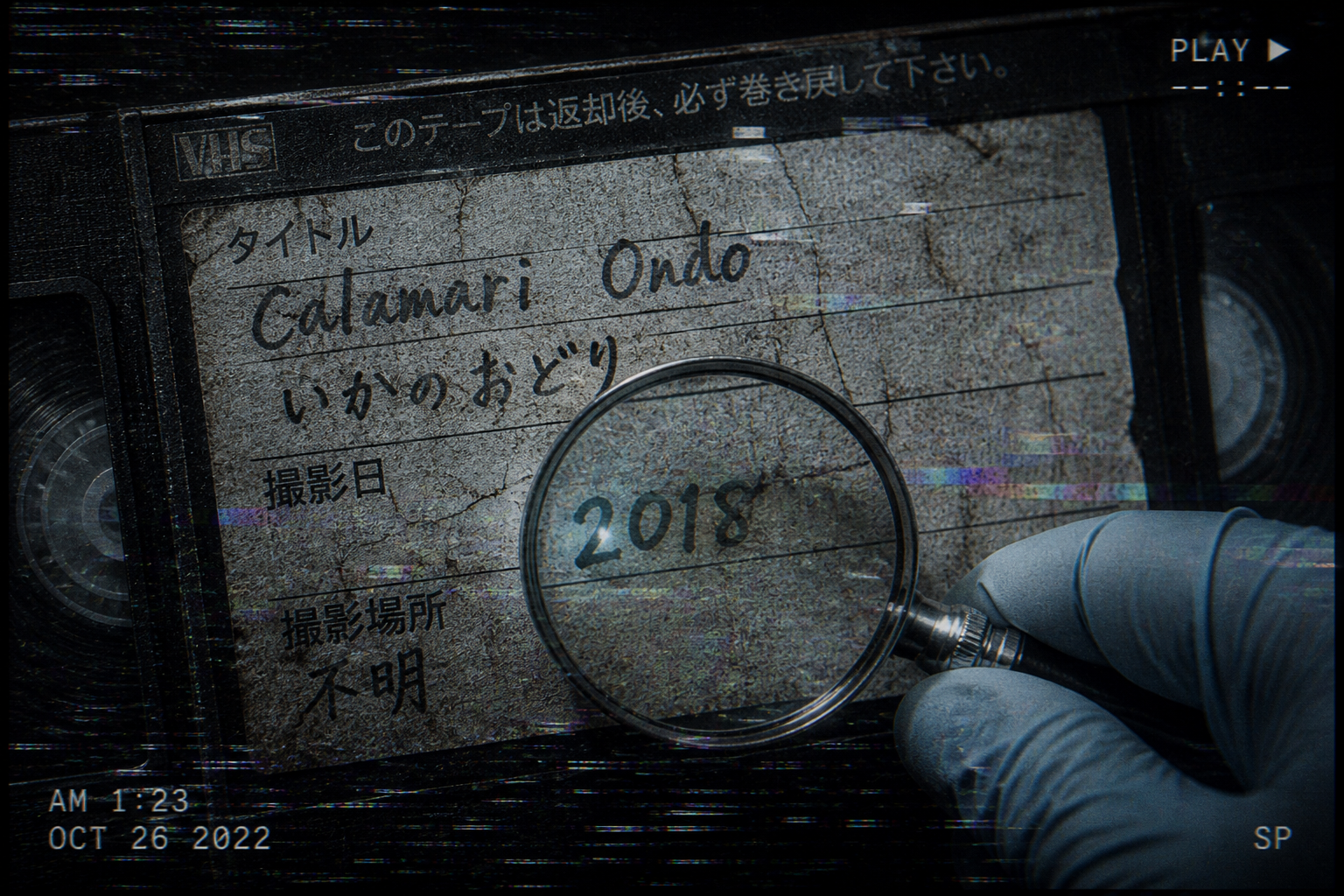
Titles exist. Metadata survives in Pixiv logs and NND archive fragments—timestamps, tag associations, viewer count remnants. This is the paradox of the modern deletion: the bureaucratic record of a thing can outlast the thing itself. The internet’s indexing infrastructure preserves the receipt long after the product has been returned and destroyed. We know Calamari Ondo existed; we know approximately when it was uploaded, circa 2017–2018; we know it was watched and tagged and cross-referenced with other works. The file, however, is gone. The audio—particularly any high-quality source—has not resurfaced in the public domain.
Other RINGO tracks found their way into reprints, the community practice of re-uploading lost works. Calamari Ondo did not. This is the second anomaly. Reprinting is standard archival behavior for popular lost Vocaloid tracks; the fact that this specific piece remains unrecovered suggests one of two possibilities. Either it was less widely distributed than its contemporaries—shared in smaller circles, less downloaded, less screenshotted in its era—or the community, aware of the circumstances surrounding the deletion, has exercised a self-imposed restraint. A kind of retroactive consent. Neither explanation is entirely comfortable.
What the structural evidence suggests is a work that existed briefly, intensely, and then ceased; a signal that broadcast in a narrow window before being switched off at the source. The “Ondo” suffix—referring to a traditional Japanese call-and-response folk dance form—adds an additional layer of interpretive texture. The genre is communal, participatory, built on shared rhythm. To name a Vocaloid track in this tradition and then erase it is to cancel a gathering that already happened.
Psychological Necropsy: Why This Silence Disturbs the Western Mind
The Western lost media community—centered on spaces like the Lost Media Wiki, r/lostmedia, and adjacent archival Discord servers—has a particular relationship with Eastern Vocaloid deletions that deserves examination. It is not simply that they want the music; it is that the circumstances of its loss violate something fundamental to how Western digital culture understands the relationship between creator and archive.
In the Western framework—shaped, heavily, by the values of early internet culture, Creative Commons ideology, and the ambient assumption that all digital content should eventually be accessible—an artist’s deliberate self-erasure registers as a category error. Content is perceived as separable from creator; the work, once released, belongs in some diffuse sense to the audience that received it. Deletion reads as transgression. The Lost Media Wiki community, by its very existence, is predicated on the belief that recovery is always preferable to absence.
The East Asian community that produced the conditions for RINGO’s deletion does not necessarily share this framework. The harassment that drove the purge was itself an enforcement of a different kind of ownership logic—the community asserting its right to police aesthetic genealogy, to punish perceived mimicry by social pressure. These are not compatible value systems, and Calamari Ondo fell through the gap between them.
There is also the “Analog Horror” vector. The Western community that finds RINGO’s work through that particular subcultural lens—the clinical minimalism, the forensic visual style that mirrors the found footage aesthetics of r/ShortScaryStories—encounters this music already primed to read it as artifact, as evidence of something unsettling. When the metadata tells you a thing existed and the file proves it does not, the horror is not aesthetic; it is epistemological. The archive says yes. The search returns nothing. This is the structure of a nightmare.
The Evidence of Void: Physical Decay Versus Social Erasure
It is worth distinguishing, clinically, between two mechanisms of media loss—because conflating them obscures what makes this case unusual.
Physical decay is the older and more familiar process. Nitrate film decomposes. Magnetic tape degrades. Hard drives fail. The Vinegar Syndrome that consumed so much of early cinema history was not malicious; it was chemistry. Media stored in inadequate conditions simply ceases to exist, and what remains is a gap in the record that scholars and archivists attempt to document and, where possible, reconstruct.
Social erasure operates differently. It requires an agent; it requires intent. Calamari Ondo did not decay—it was deleted. The distinction matters because it changes the ethical geometry of recovery. When media is lost to physical entropy, archival work is straightforwardly restorative; no one’s choices are being overridden by finding a surviving print of a lost film. When media is lost because a person chose to remove it—chose deliberately, under documented duress—recovery becomes contested. The Wayback Machine did not catch it. No private archive has surfaced it. The community has not, as of this writing, recovered a single playable copy.
RINGO’s death in January 2025 collapsed the distinction between these two mechanisms. What was social erasure has now become physical impossibility. The source files—the original project sessions, the uncompressed audio—exist nowhere accessible. The creator who might have chosen, in another circumstance, to restore the archive, cannot. The decision made in December 2018 has achieved a permanence that no decision should be able to achieve. It has survived the person who made it and become, now, simply the state of things.
This is the forensic term for what we are examining: Permanent Loss. Not lost pending recovery. Lost.
The Point of No Return: Digital Memory as a Crime Scene
The uncomfortable insight that Calamari Ondo forces us to confront is not about this specific track. It is about the nature of the archive we have built and the assumptions we have embedded in it.
We designed the internet to remember. We built redundancy into its architecture; we celebrated the permanence of the upload; we told ourselves that the opposite of censorship was preservation. What the RINGO case demonstrates is that the systems we built to preserve can be outrun—not by governments, not by corporations, but by a single person with sufficient determination and a reason to disappear. The harassment that drove the deletion was itself a product of the same communal infrastructure we use to preserve lost works. The community that now searches for Calamari Ondo is made of the same material as the community that made its creator want to erase herself.
This is the Entropy of Intent—the phrase that best captures what is genuinely new about this class of loss. Accidental loss we understand; institutional censorship we have frameworks for; the deliberate self-erasure of a creator under community pressure sits in a category that our archival ethics have not yet processed. The Lost Media Wiki can document the gap. It cannot fill it without confronting what filling it would mean. To recover Calamari Ondo would be to override a decision made by someone who is no longer present to consent or object; to leave it unrecovered is to allow a specific form of cruelty to achieve its intended result, permanently.
Neither outcome is clean. The archive has no procedure for this.
What remains is the metadata. The timestamps. The tag associations. The shape of something in the space where the something used to be. Forensic work, at its most honest, does not always produce recovery; sometimes it produces only a more precise understanding of what was destroyed and why. In the case of RINGO’s Calamari Ondo, the most precise understanding available is this: a community pressed hard enough on a person that they chose to unmake their own work, and then they died, and the work stayed unmade.
The internet forgot. It was helped.
🔍Search Update: Call to Action
The status of Calamari Ondo remains [STRICTLY LOST]. If you have access to legacy hard drives from 2017-2018, NicoNico reprints, or private cloud storage containing RINGO’s deleted discography, the community needs your data. However, we must ask: In the face of a creator’s explicit desire to vanish, are we recovering history, or are we committing a digital trespass? If you have information, contact the archive.
This document is an investigative archival reconstruction based on fragmented public records, media remnants, community accounts, and verified historical sources compiled by The 3AM Archive.
The article examines how incidents, forgotten media, internet folklore, and unresolved public memories evolve through cultural preservation and digital decay.
This is a cultural investigation document — not fictional horror content.
All visual materials used in this post are exclusive AI-generated assets created for The 3AM Archive.
