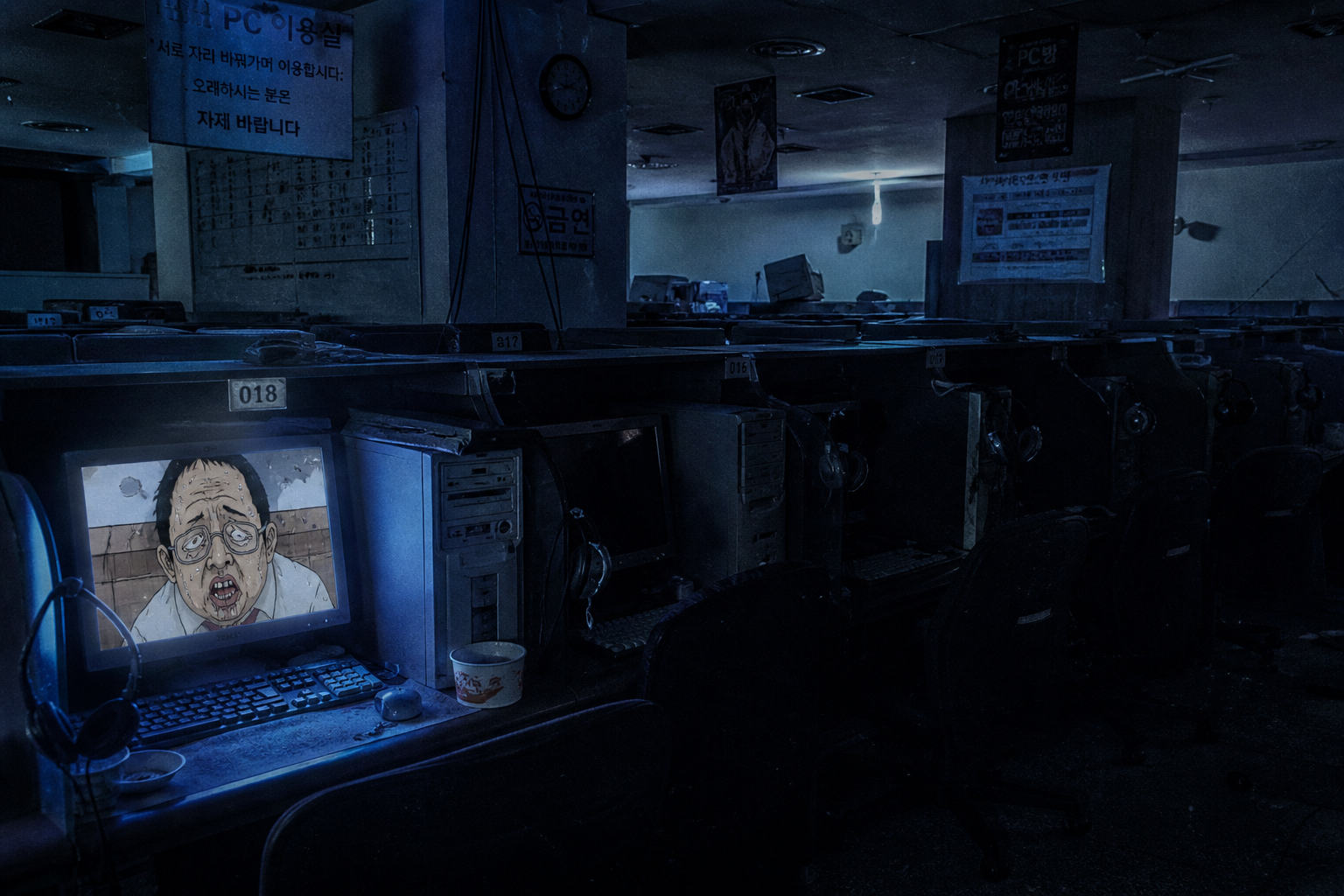
There is a particular category of dread reserved for things that should exist but don’t. Not the clean grief of something destroyed—a bombed archive, a melted reel—but the ambient, low-frequency unease of something that simply stopped being retrievable. It exists somewhere in the gradient between forgetting and erasure, occupying a conceptual space that archivists call “lost” and that the rest of us, less precisely, call haunted. Ggoraji Game Bang (꼬라지 게임방) belongs to this category. It ran from 2001 to 2004 on a domain called aagaa.com, and what remains of it now—preserved in the amber of the Wayback Machine—is not the work itself. It is the billing infrastructure: order forms, bank transfer notices, a payment portal frozen mid-transaction. The ghost of a business still asking for money long after the product has ceased to exist.
This is not a recovery story. This is a post-mortem.
The Cultural Anatomy: Dissecting the Korea That Made This
To understand Ggoraji, one must first understand the specific psychological climate of South Korea at the turn of the millennium. The IMF crisis of 1997—locally called the “IMF Saetae,” the IMF Situation—had detonated across Korean civil society with sociological precision, targeting the institution that defined male identity most completely: the corporate salaryman. The jasal, the office drone who traded youth for lifetime employment, had been the cultural bedrock of the Korean developmental state for three decades. By 2001, that bedrock had liquefied. Mass layoffs, corporate restructuring, and the sudden, brutal visibility of poverty had created a generation of men who understood, perhaps for the first time, that the social contract was conditional.
Into this wound, Kim Si-soon inserted a character named Ggoraji.
The name itself resists clean translation. “꼬라지” carries connotations of a pitiful or contemptible appearance—a word used to describe someone whose physical presentation has become an index of their inner collapse. Kim’s protagonist embodied this: a sweating, balding, grotesquely obese salaryman navigating an office world that had already rejected him in spirit before his body began to fail him. The animation series, produced under the studio banner “Animation and Dream,” occupied the Flash medium not as an aesthetic choice but as a structural one. Flash was the only distribution technology that could reach Korean internet users without institutional gatekeeping; it required no broadcast license, no distributor, no editorial board. It was the direct-to-skull pipeline of early-web expression.
Korea’s media censorship architecture in this period was not primarily legal—it was social and commercial. The Korean Broadcasting Commission maintained strict guidelines over televised content, and the cultural pressure to produce work that was “exportable” and “representative” of the nation had already begun its slow distortion of domestic output. Mashimaro, the round, expressionless rabbit character that launched around the same period, became the paradigm case of what Korean digital content should look like: cute, internationally legible, commercially sanitized. Ggoraji was its photographic negative. It could never have survived the pressure of institutional mediation; it could only have been born in the ungoverned interstitial space of an early web that hadn’t yet understood its own commercial potential.
That interstitial space closed. And Ggoraji fell through.
Structural Dissection: Reading the Anomalies in the Signal
What the Wayback Machine holds is instructive precisely because of what it doesn’t hold. FlashArch’s preservation of the aagaa.com domain contains the updated portal interface, the game ordering system, bank transfer instructions. It does not contain a single original animation episode. It does not contain the full contents of the retail software package. The interactive game Han-cha-ro (한차로) survives—one fragment, one playable shard—but the animation series that gave the character meaning is gone. This asymmetry is not accidental; it is diagnostic.
Consider the information hierarchy of any commercial web property from 2001. The content—the animations, the games—was hosted on servers that required active maintenance, bandwidth costs, licensing decisions. The transactional infrastructure, by contrast, was lightweight, static, and in many cases handled by third-party payment processors whose archival footprint extended beyond the site’s own maintenance window. What survived was not the art; it was the apparatus of commerce. The order forms outlasted the ordered-from. This produces what might be called a transactional ghost: the digital signature of an economic relationship without either of its participants.
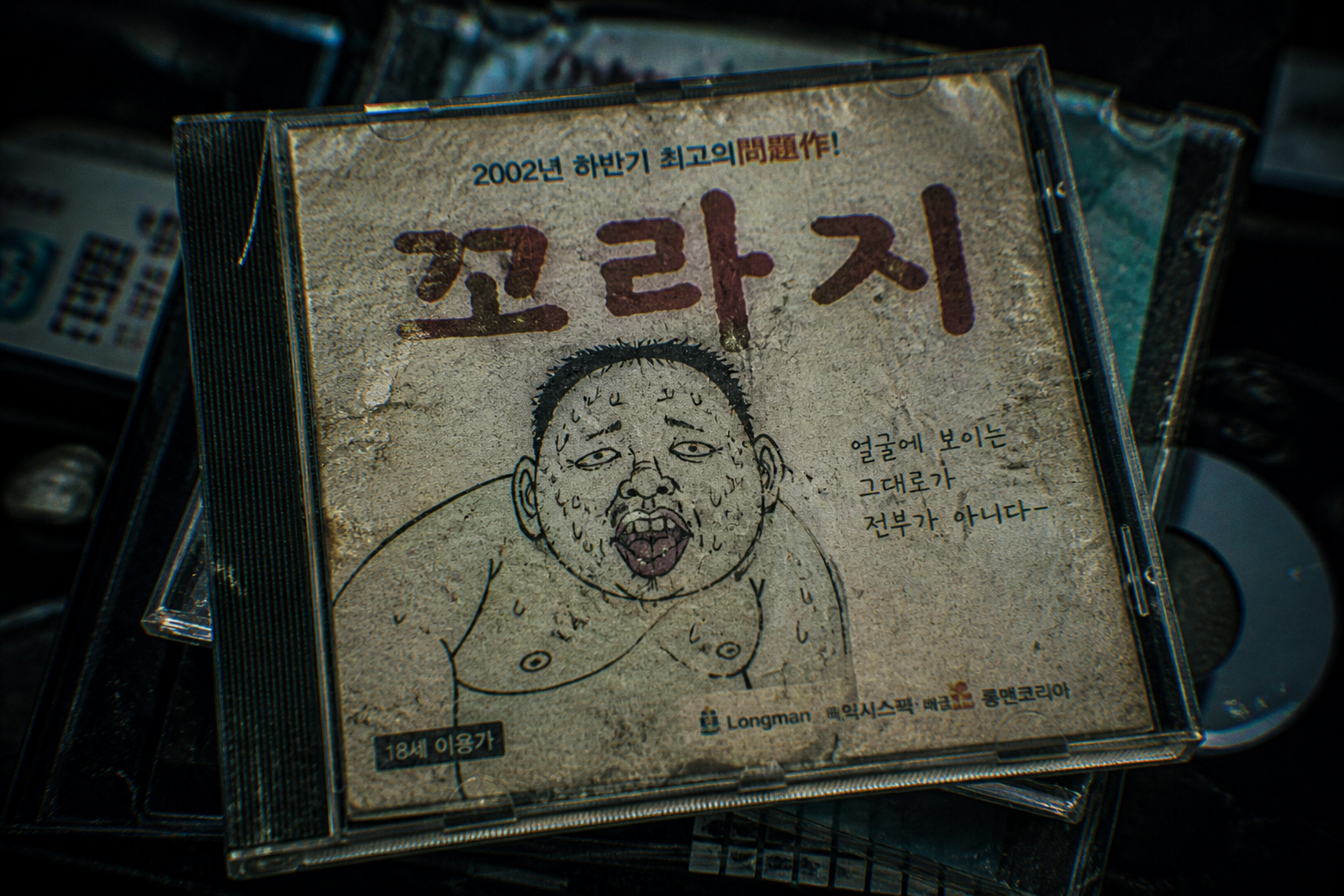
The physical retail package complicates the picture further. Ggoraji’s transition to a PC retail box—a physical disc sold through Korean software channels—represents an anomaly in early Flash media distribution. Most Flash content of the era existed only digitally, which means its survival depended entirely on server continuity and archival indexing. Physical media introduced a different survival pathway: the possibility of rot, yes, but also the possibility that one copy, somewhere, survived in a plastic sleeve at the bottom of a storage box. The disc is the Holy Grail configuration—an object that, if it exists at all, exists as a single surviving specimen in conditions entirely outside archival awareness. It will not be found through the Wayback Machine. It will be found, if ever, by someone liquidating an estate.
The survival of Han-cha-ro as the sole playable artifact inverts the expected preservation hierarchy. Games, as a category, are harder to archive than linear animations; they require interaction states, they resist simple file capture, they depend on runtime environments. That the game survived while the animations did not suggests the animations were never captured at all—that they existed in a state of perpetual streaming, never downloaded, never mirrored, erased the moment the server stopped responding.
Psychological Necropsy: Why This Archival Silence Disturbs the Western Mind
Western audiences approaching Ggoraji through the lens of early-internet aesthetics will feel the pull of a recognizable formal vocabulary. The character design—deformed, sweat-slicked, grotesquely human—occupies the same aesthetic frequency as Salad Fingers, Joe Cartoon, and the early Newgrounds corpus that defined anglophone web horror. The corporate nihilism underpinning the narrative maps cleanly onto contemporary Analog Horror sensibilities; it would, in today’s market, find an immediate audience in communities that celebrate uncomfortable Internet art as counter-cultural artifact.
This recognition produces a specific discomfort: the sensation of encountering a relative you didn’t know existed, and being informed, in the same breath, that they have already died. Western internet culture has developed robust mechanisms for the preservation of its own grotesque canon. The Wayback Machine’s early Newgrounds captures, the FlashPoint preservation project, the academic interest in web vernacular aesthetics—these represent a collective decision, however informal, that this material is worth saving. Ggoraji fell outside the consensus of preservation because it fell outside the geographic and linguistic boundary of that consensus. It was produced in Korean, hosted on a Korean domain, distributed through Korean retail channels, and archived—or not—through Korean institutional decisions that Western preservation communities had no visibility into.
This is not an accusation; it is a structural observation. The lost-media community’s growing interest in non-anglophone web artifacts represents a genuine expansion of archival consciousness. But the artifacts that benefit from this expansion are, typically, those that can be narrated in English—either because they have been translated, because their visual language is cross-culturally legible, or because they attach to a broader cultural moment that Western audiences already track. Ggoraji satisfies the second criterion—its visual language is legible—but it arrived too early to benefit from the community infrastructure that might have preserved it, and too late to be captured by the commercial forces that preserved Mashimaro.
Its grotesquerie was, in the precise biological sense, maladaptive. It could not attract the commercial interest that funds preservation; it could not repel the obscurity that precedes loss.
The Evidence of Void: Physical Decay Versus Social Erasure
The question of why Ggoraji is 95% lost resolves, under examination, into two separate and non-equivalent processes.
Physical decay is the simpler mechanism. Flash as a format was designed for delivery, not for archival. SWF files depended on the Flash runtime, which was deprecated by Adobe in December 2020 after years of security vulnerabilities and mobile incompatibility. Even archived SWF files require emulation to function; they exist in a state of technical suspension, playable only through deliberate preservation effort. The servers on which Ggoraji’s animations lived were commercial infrastructure, maintained only as long as the business model supported them. When aagaa.com ceased operation—sometime after 2004, though the precise date is itself unrecorded—those servers were repurposed or decommissioned, and the files they held ceased to be accessible. This is physical decay in its digital form: not magnetic degradation but infrastructure abandonment.
Social erasure is the less legible mechanism and the more consequential one. Ggoraji was never indexed by the communities that would have preserved it. The Korean web of 2001-2004 existed in a state of substantial insularity; community bulletin boards (the PC-bang culture, the Daum and Naver ecosystems) were domestically oriented, and the international web had no particular mechanism for discovering Korean Flash content that wasn’t being actively promoted into global markets. Mashimaro was promoted; it had commercial backing that funded international distribution. Ggoraji did not. The character’s specific cultural referents—the IMF-era salaryman, the class anxieties of Korean office culture, the black-comedy tradition of Korean popular narrative—were not legible to outside observers, which meant outside observers had no reason to archive what they had no way to value.
Social erasure compounds physical decay. A file that no one downloads before the server shuts down is lost regardless of its intrinsic quality. The archive requires someone to care at the moment the content is still accessible—and in Ggoraji’s case, the people who cared were Korean internet users in the early 2000s who had no archival infrastructure and no reason to believe the content would not be permanently available. The assumption of digital permanence is a cognitive error that predates digital literacy. It remains common now, in 2026, and it was essentially universal in 2001.
The Point of No Return: Digital Memory as a Function of Commercial Survival
The final uncomfortable insight that Ggoraji produces is not about Korea, not about Flash, and not even specifically about lost media. It is about the mechanism by which cultural memory is constituted in the digital age—and what that mechanism systematically excludes.
Ggoraji’s contemporaries that survived did so because they became commercially valuable. Mashimaro survived because it was licensable; it generated merchandise, it attracted investment, it became the face of a brand. The early Newgrounds corpus survived because Newgrounds itself survived—because the platform had sufficient commercial resilience to maintain its server infrastructure across two and a half decades. What survived, in both cases, was not the most culturally significant work; it was the most commercially legible work. The selection pressure of digital memory is not curatorial. It is economic.
This produces a preservation landscape that is structurally biased toward the sanitized, the marketable, and the internationally legible. Grotesque work—work that refuses commercial palatability, work that addresses specific cultural wounds rather than default archive of human experience—occupies the highest-risk position in this landscape. It is least likely to be commercially preserved; it is least likely to attract the community attention that drives volunteer archiving; it is most likely to exist in a state of single-server dependency, and therefore most likely to disappear when that server goes dark.
What remains of aagaa.com is a payment portal. It is, in its way, a more honest monument than most digital archives; it tells the truth about what the infrastructure of digital memory actually is. It is not a library. It is not a museum. It is a commercial system that retains what has economic value and discards what does not. The animations are gone. The bank transfer instructions remain.
🔍Search Update: Call to Action
The 3AM Archive is officially escalating the status of the Ggoraji retail PC package to a Tier 1 Recovery Priority. While the digital SWF files have likely vanished from the aagaa.com servers, physical media is resilient. We are looking for any physical remains of the “Animation and Dream” retail releases sold in South Korea circa 2002-2004. If you have access to Korean secondhand software markets (Joonggonara, Karrot, or local physical flea markets), search for “꼬라지 패키지.” One surviving disc could bridge the void.
Ggoraji—sweating, balding, deformed, already the embodiment of things the market had decided to discard—was always going to end up here. The site knew what it was doing, even as it ran. We just weren’t watching when the lights went out.
This document is an investigative archival reconstruction based on fragmented public records, media remnants, community accounts, and verified historical sources compiled by The 3AM Archive.
The article examines how incidents, forgotten media, internet folklore, and unresolved public memories evolve through cultural preservation and digital decay.
This is a cultural investigation document — not fictional horror content.
All visual materials used in this post are exclusive AI-generated assets created for The 3AM Archive.
