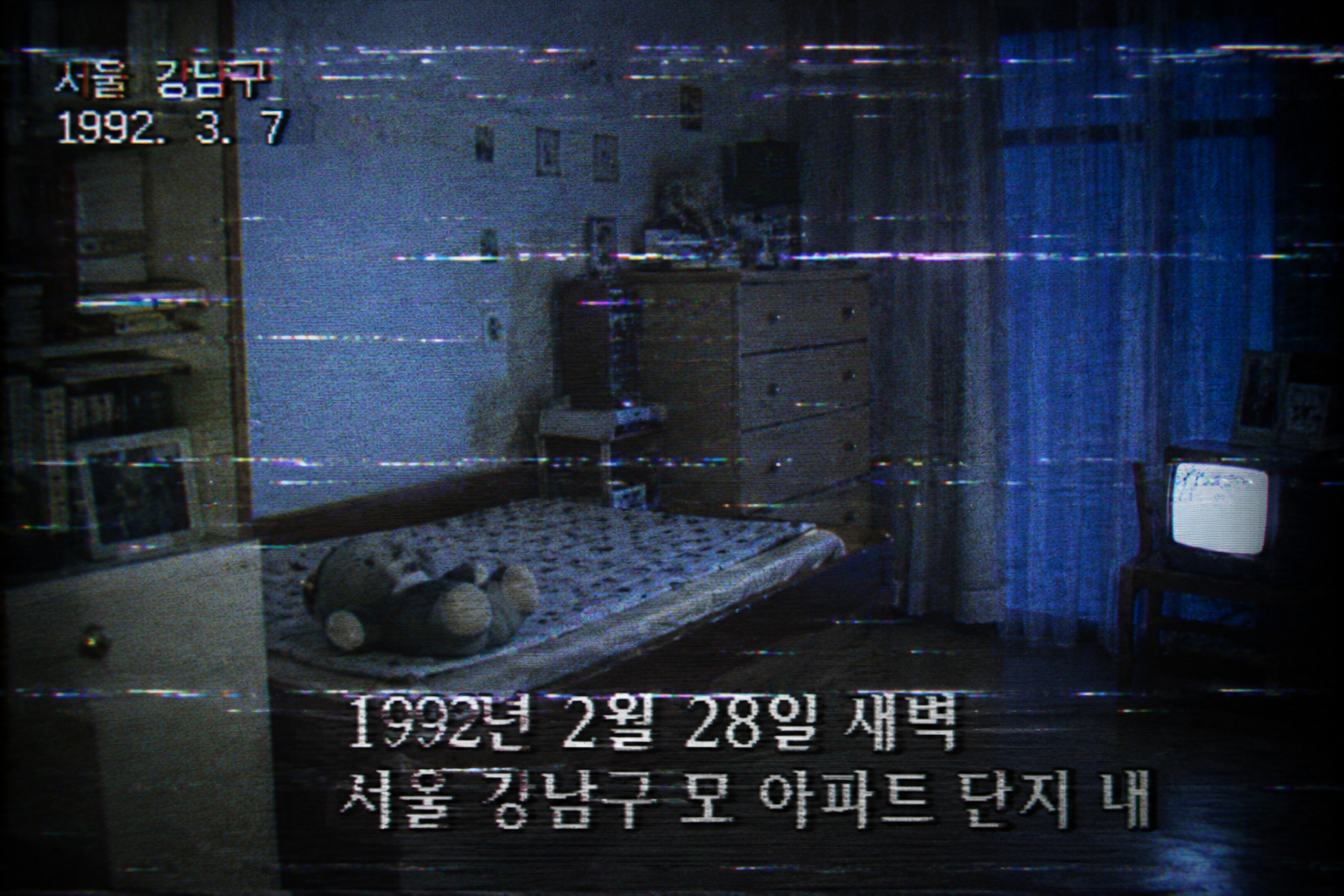
Certain cold cases defy classification not due to a lack of evidence, but because the surviving records contradict standard forensic logic. The Ji Han-byul disappearance belongs to this category. In August 1992, twelve-year-old Ji Han-byul vanished from within a high-density, heavily populated residential complex in Seoul. Four days later, a ransom note arrived at her family’s home; it was written in her handwriting, bore only her fingerprints, and showed no physiological evidence of coercion whatsoever. No extortionist appeared to collect the money. No trace of Ji has ever been recovered.
What makes this case a legitimate object of forensic cultural study is not the absence of evidence—it is the presence of evidence so immaculate it becomes its own form of erasure. The Ji case forces a confrontation with a fundamental instability in how early-1990s South Korean society processed the disappearance of children: through media dramatization, through police procedural inertia, and ultimately through the slow, total dissolution of institutional memory into internet folklore. That her father—one of the country’s most prominent television screenwriters—eventually wrote and broadcast a prime-time drama fictionalized from his own real-time grief does not contextualize the case so much as it weaponizes it further. The Ji Han-byul disappearance is, at its structural core, a document about the limits of visibility in a society that confused spectacle with truth.
Historical Anatomy
To understand what happened on August 8, 1992, one must first understand what the Olympic Family Town apartment complex represented in the Seoul of that era. Built for the 1988 Summer Games, the Olympic Family Town complex was a massive, self-contained mini-city designed to showcase South Korea’s rising middle-class security. The complex in Munjeong-dong, Songpa-gu was not simply housing; it was an ideological artifact. South Korea in the late 1980s was engaged in a sustained, government-managed project of constructing a legible middle class—one that could be presented internationally as evidence that the developmental authoritarian model had produced not only economic growth but also bourgeois stability. Olympic Family Town was one of the physical monuments to that project: hyper-dense, internally self-sufficient, architecturally uniform, and implicitly surveilled by the sheer proximity of thousands of co-residents.
The family at the center of this case embodied the complex’s sociological ideal. Ji Sang-hak, Ji Han-byul’s father, was born in 1949 and had by 1992 established himself as a significant figure in South Korean television drama production; he would eventually chair the Korea Screenwriters Association. His daughter was a sixth-grader at Gawon Elementary School—academically pressured, noted by teachers as unusually mature for her age, and, critically, privately resistant. Her diary contained the entry: “I don’t want to study.” That detail, unremarkable in isolation, would become a load-bearing element in the police’s early theoretical architecture.
In 1992, the intense academic pressure within South Korean schools was a recognized driver of domestic runaway incidents. The pressure imposed on children—particularly those in middle-class Seoul households where academic failure carried authentic social consequences—was sufficient that voluntary runaway episodes were documented, discussed in policy circles, and treated by police as statistically plausible explanations for juvenile disappearances. When Ji Han-byul went missing, investigators initially weighted the runaway hypothesis with genuine seriousness, partly because her diary supported it and partly because the alternative—that a child had been abducted in broad daylight from inside a fortress-complex populated by thousands of witnesses—strained the operational imagination.
It should not have. The alternative was true, or appeared to be.
Structural Dissection of the Record
The timeline of August 8, 1992 is deceptively legible. Ji left her apartment at approximately 9:00 AM for a weekend makeup art class held within the complex itself. By 4:00 PM, she was departing a friend’s apartment—also within the complex—and stated she was heading home. This is the last moment the record offers unambiguous corroboration. What follows is a single witness account, structurally isolated, that permanently reorients the case’s geography.
At approximately 5:00 PM, a classmate spotted Ji near Garak Market, a commercial district located directly across the major avenue bordering the residential complex, leading away from her home. She was not alone. Alongside her walked an unidentified woman estimated to be in her twenties, notable for permed hair; in early-1990s Seoul, permed hair was ubiquitous enough to render the description forensically near-useless. The classmate did not intervene, had no reason to; Ji appeared calm, ambulatory, apparently voluntary. The witness account has never been contradicted. It has also never been substantiated by any additional sighting.
Four days passed. On August 12, the ransom note arrived.
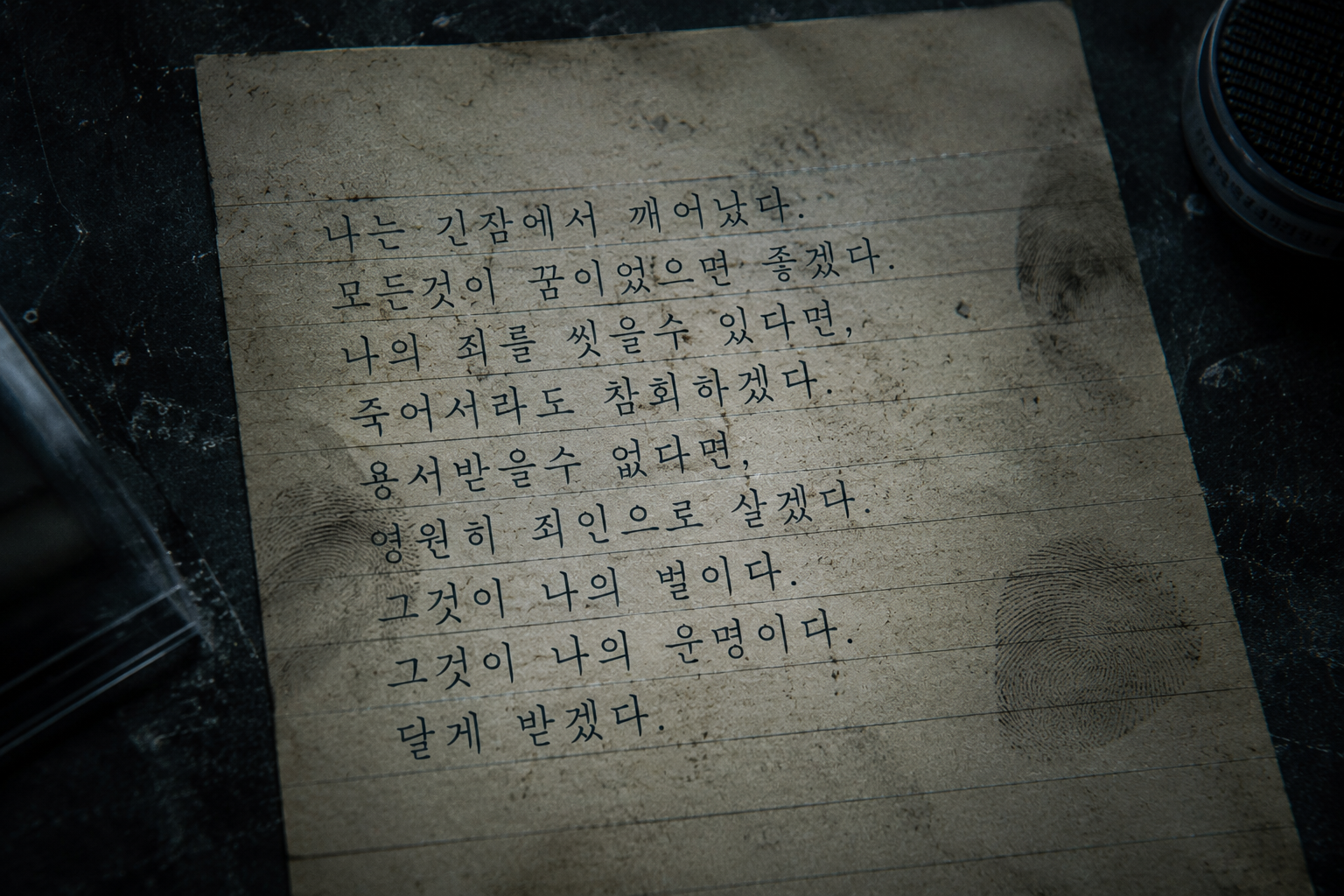
The forensic profile of that note is where the record becomes genuinely difficult to process within standard investigative frameworks. The text was composed in Ji Han-byul’s own handwriting—confirmed by forensic analysis—and demanded 15 million Korean won, to be delivered to a coffee shop in Sillim-dong. The letter bore only Ji’s fingerprints. No secondary prints were recovered. More significantly: graphological examination found no tremors, no pressure deviations, no stroke irregularities consistent with a child writing under physical duress or acute psychological terror. The calligraphy was, by every measurable standard, calm.
When Ji’s parents waited at the Sillim-dong coffee shop on the designated date, no one came.
The note’s cleanliness produced two competing interpretations, neither of which the investigative record ever formally resolved. The first is that Ji was either coerced under conditions so controlled—pharmacological sedation, prolonged psychological conditioning, or elaborate behavioral manipulation—that no physiological trace registered in the writing. The second is far more structurally uncomfortable: that Ji produced the letter with some degree of agency, under circumstances that cannot be reconstructed from the available evidence. Both interpretations are, in their own way, catastrophic. One implies a captor of unusual sophistication; the other implies a victim whose psychology and situation resist the standard grammar of abduction narratives entirely.
On April 17, 1993, a man identifying himself as “Park Jong-chul” contacted the Ji family by landline, claiming Ji was being held in the Busan-Ulsan corridor. He extracted 700,000 KRW from the family before disappearing. Whether Park Jong-chul was the original abductor, an opportunistic fraudster who had followed media coverage, or something else entirely, the investigative record does not specify. He was never identified. The extortion call functions in the case archive as pure noise—a signal deliberately designed to corrupt the evidentiary frequency.
Psychological Necropsy
For Western true-crime consumers—a demographic whose appetite for unsolved cases has been shaped by largely Anglo-American investigative traditions—the Ji case produces a specific and identifiable form of cognitive dissonance. The architecture of the disappearance does not conform to established genre templates.
The Western missing-child narrative has a spatial grammar: rural isolation, suburban periphery, the abandoned lot or the edge of the treeline. The vulnerability is environmental; the child disappears into space. The Ji case inverts this entirely. Olympic Family Town, with its thousands of residents compressed into architecturally uniform residential towers, represents maximum density—maximum potential witness saturation. That a child could be absorbed into an unknown woman’s orbit, walk in the wrong direction, and simply stop existing, within this environment, creates what might be called the claustrophobic abduction paradox. The crowd that should have made the crime impossible instead made it invisible.
The anomalous nature of the physical letter mirrors themes popularized by modern digital folklore and analog mystery subcultures. Within the analog horror and internet mystery subcultures that have flourished since the mid-2010s, the pristine, captor-free ransom note—a document authored by the victim with no apparent external agency—functions as a precise inversion of the standard horror grammar. The expected horror artifact is evidence of the monster; the clean note is evidence only of the child. It is an absence that performs as a presence. Its forensic purity is, paradoxically, its most terrifying feature.
There is also the diary entry to contend with. “I don’t want to study” is not a ransom note; it is not a farewell letter; it is the kind of thing millions of twelve-year-old children write without consequence. But in the context of a disappeared child, it becomes retroactively freighted—read backward through tragedy until it begins to resemble something it almost certainly was not. This is a cognitive error with a name: the tendency to locate narrative intention in random artifacts simply because the outcome that follows them demands one. The diary entry did not make Ji a candidate for voluntary disappearance; the investigative system’s need to manage its caseload made her one.
The Evidence of Erasure
The case’s transition from active investigation to cultural artifact was accelerated—and in some ways completed—by the KBS broadcast of August 7, 1994. The episode, titled “Han-byul’s Empty Room,” aired within the Drama Game anthology slot and was written by Ji Sang-hak himself. That a father would channel his unresolved grief into a fictionalized prime-time drama about his missing daughter is not, within the Korean television culture of the early 1990s, as anomalous as it might appear to outside observers; Ji Sang-hak had both the professional access and the institutional credibility to propose such a production, and KBS had operational precedent for dramatized real-crime content.
But the broadcast’s cultural function was compound and contradictory. On one register, it was a desperate forensic strategy—a nationally distributed appeal for witness information, packaged in the most attention-commanding medium available to a private citizen in 1994 South Korea. On another register, it was something more troubling: the transformation of an unresolved forensic event into a resolved dramatic narrative. Television drama requires closure, or at minimum the aesthetic management of its absence. By fictionalizing the case, the broadcast necessarily imposed a narrative architecture on a situation that had none; it gave audiences a framework for feeling about Ji Han-byul that substituted for—rather than supplemented—the actual investigative record.
This missing broadcast is typical for 1990s South Korean television history, as networks routinely overwrote or failed to archive master tapes. The tape layout was rarely treated as a default archive of human experience. Instead, early broadcasters viewed magnetic tape as a temporary asset. This practice ran counter to modern expectations of digital permanence. Today, internet users expect comprehensive logs for every historic television broadcast, yet the physical reality of analog television curation means vast blocks of public media simply dissolved. But within lost media communities, the missing broadcast has acquired a secondary mythology—framed not as a preservation failure but as a suppression, a document too raw or too strange to survive institutional curation. This reading almost certainly misattributes intentionality to bureaucratic entropy. That misattribution is itself part of the case’s cultural afterlife.
Ji Sang-hak died in 2023. His daughter has never been found.
The Point of No Return
The Ji Han-byul case persists in Korean internet communities as a cold case file and in global internet mystery spaces as an analog horror reference—two distinct archival lives, running in parallel, rarely intersecting. The Korean record is emotionally dense, family-proximate, rooted in specificity; the global record is structurally abstracted, interested primarily in the clean note and the missing broadcast as formal objects.
What neither archive can fully accommodate is the case’s most fundamental discomfort: the possibility that the investigative record is not incomplete because evidence was destroyed or suppressed, but because the crime itself was executed with a precision that generated almost no recoverable trace. The ransom note bears only Ji’s prints because someone ensured it would. The extortion call came from a man who understood that exploiting a live media case required only a phone and a pseudonym. The unknown woman with permed hair walked Ji toward Garak Market in the exact opposite direction of her home—in public, in daylight, without resistance.
What this implies about the captor is genuinely unresolvable from the available record. What it implies about the investigative infrastructure of early-1990s South Korea is somewhat more legible: a system that defaulted to the voluntary runaway hypothesis when confronted with an anomalous disappearance in a high-visibility residential environment, then outsourced its forensic inadequacy to a nationally broadcast drama written by the victim’s father. The state’s investigative failure and the media’s compensatory dramatization did not produce closure; they produced noise—a sustained, high-volume signal that gradually drowned out the evidentiary silence beneath it.
Ji Han-byul would be forty-six years old in 2026. The ransom note, calm and fingerprint-clean, remains the most precise document the record contains. It is also the one that explains the least.
🔍Search Update: Call to Action
For researchers within international communities such as the Lost Media Wiki, the r/UnresolvedMysteries subreddit, and analog horror archives, the 1994 KBS broadcast “Han-byul’s Empty Room” represents a major archival blind spot. If you have access to off-air VHS home recordings from South Korean television networks (KBS1 or KBS2) dating between August 7 and August 9, 1994, your tapes may contain the missing broadcast or related news reports. Please contact the 3AM Archive or submit your digital captures to public media repositories to aid in preserving this forgotten artifact.
This document is an investigative archival reconstruction based on fragmented public records, media remnants, community accounts, and verified historical sources compiled by The 3AM Archive.
The article examines how incidents, forgotten media, internet folklore, and unresolved public memories evolve through cultural preservation and digital decay.
This is a cultural investigation document — not fictional horror content.
All visual materials used in this post are exclusive AI-generated assets created for The 3AM Archive.
