There is a particular category of disappearance that refuses to behave the way disappearances are supposed to behave. The body does not surface. The trail does not go cold—it simply never exists. The screaming child does not scream, or screams into a geography so indifferent that sound itself becomes evidence of nothing. These cases do not accumulate; they subtract. They leave behind a record that is not incomplete so much as structurally evacuated, as though the event were designed from the outset to be unremembered.
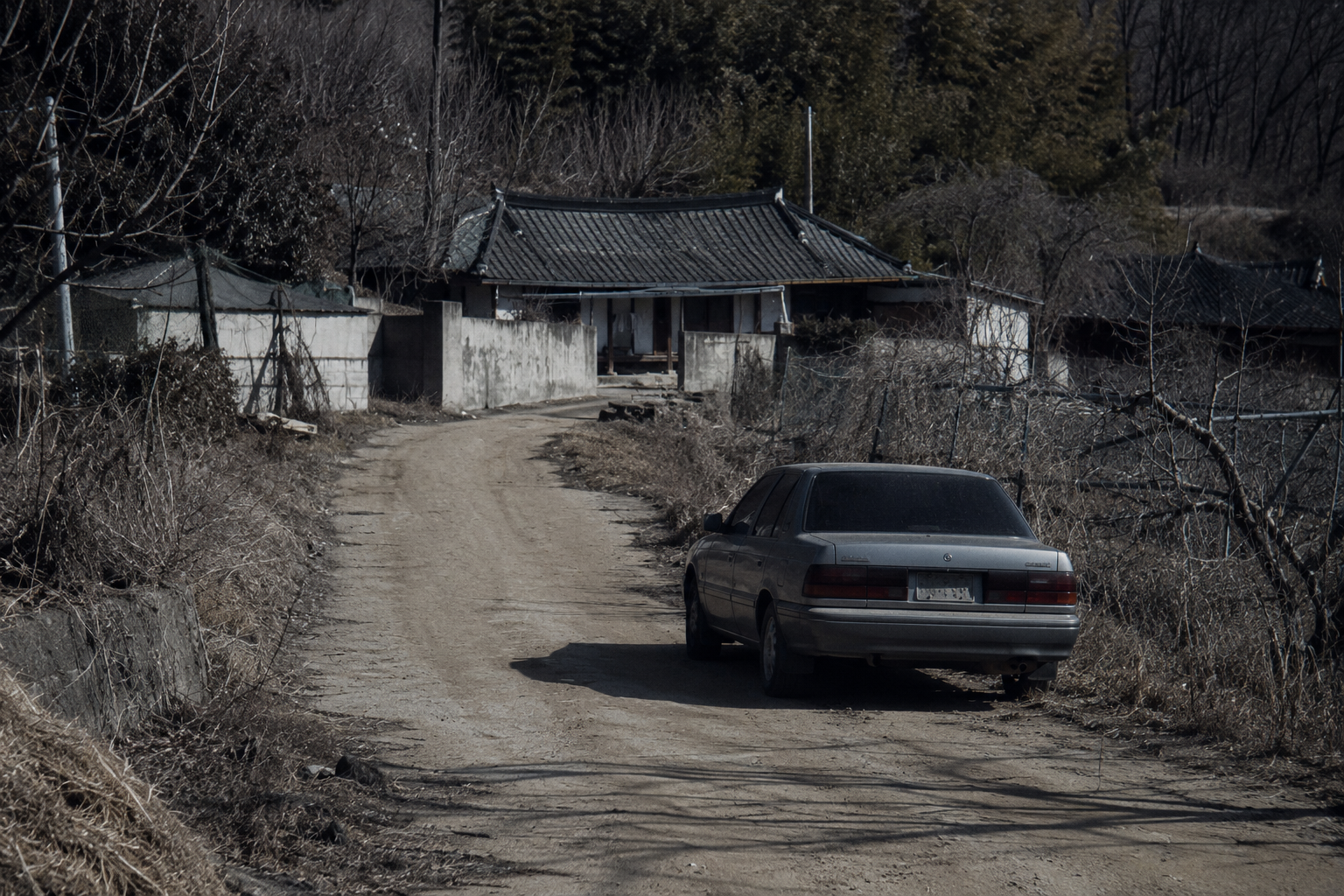
Byun Yu-jeong was two years old on April 5, 1997. She disappeared from a house at the absolute edge of Wolpyeong 1-ri, in rural Yeongam-gun, Jeollanam-do, during a window of approximately twenty to thirty minutes. No biological trace was recovered. No clothing fragments. No remains, despite dredging operations that came more than a decade later. What was recovered—tenuously, through municipal broadcast logs—was a single witness detail: a mouse-grey sedan, unfamiliar to the village, parked in front of the isolated house during the exact interval of her grandmother’s absence. The car was never identified. The child was never found.
This article does not argue that the Byun Yu-jeong case is uniquely horrific among the catalogue of South Korea’s missing children. It argues something more precise: that this case is a forensic specimen of how structural geography, economic precarity, and analog archival failure collaborate to produce not a mystery but an erasure—a cultural disappearance that mirrors and compounds the physical one.
Historical Anatomy
To understand the disappearance of Byun Yu-jeong, one must first understand the precise socioeconomic coordinates of the family that produced it.
She was born in 1994 in Yeongi-gun, Chungcheongnam-do, to a dual-income working couple—a household configuration that was, by the mid-1990s, increasingly common in South Korea’s urbanizing interior. The country was in the late stages of a developmental fever that had begun in the 1960s and had by the 1990s produced a generation of workers caught between industrial aspiration and rural roots. These were families that worked in cities but still possessed grandparents, land, and a residual kinship infrastructure in provinces hours away.
The financial pressure that forced Byun Yu-jeong and her older brother to be relocated to their paternal grandparents in Yeongam was not unusual. It was, in fact, a deeply normalized arrangement—the farmed-out child, dispatched to the countryside while parents earned wages in the city, is a structural fixture of Korean economic development in this period. It is not poverty in the acute sense; it is what happens when both parents must work and childcare costs exceed available income. The arrangement was practical, common, and, in this instance, lethal.
Yeongam-gun in 1997 was not a hamlet in the folkloric sense. It was simply rural—a county of managed agricultural space, low population density, and the particular social texture of a community where extended families had lived for generations but where the village core and its peripheral households were separated by distances that rendered collective surveillance a myth rather than a mechanism.
The location of the grandparents’ home is a detail worth lingering on. The record specifies not merely Wolpyeong-ri but Wolpyeong 1-ri—the sub-unit designation—and uses the phrase “absolute periphery.” This is a geographic description with forensic implications. A home at the edge of an already dispersed rural settlement sits at the termination point of whatever informal social monitoring the village interior might provide. Visitors to such a location do not pass through populated zones on arrival or departure. Farm roads, unpaved or minimally maintained, extend outward from the village core like capillaries that eventually fade into open countryside. A vehicle using such a road in April 1997 would have encountered no traffic cameras; the infrastructure simply did not exist. It would have attracted notice only from someone positioned to see it—and the single witness who apparently was sits now as a ghost in a municipal broadcast log.
Structural Dissection of the Record
The evidentiary architecture of this case is defined less by what it contains than by the shape of its absences.
The initial police report was filed immediately following the discovery of the child’s absence—this much is established. A village-wide search was conducted and yielded nothing. These facts occupy the first layer of the record, and they are stable, if sparse. What follows becomes progressively less stable.
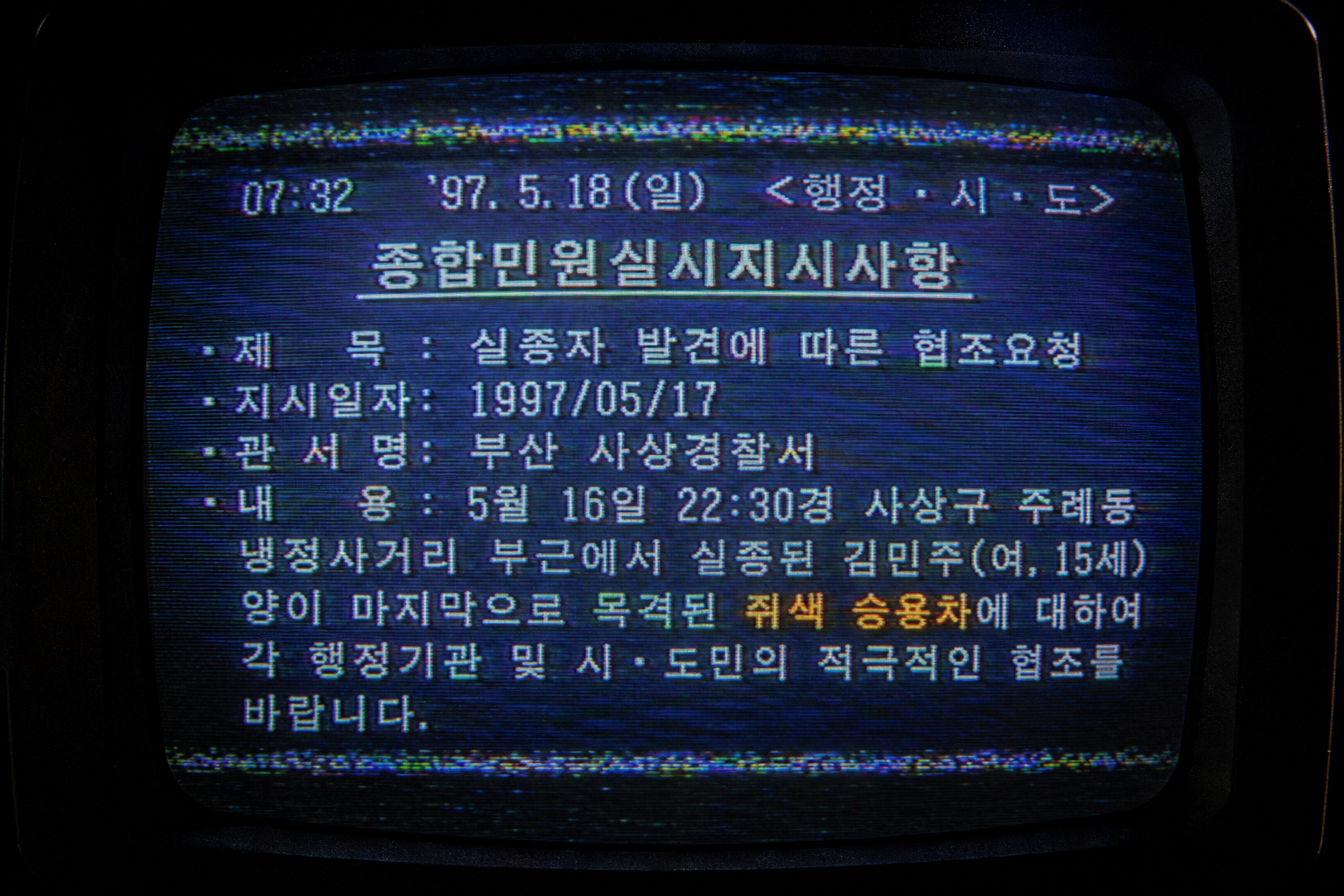
The critical second-layer document is not a police report. It is a broadcast log—specifically, a local municipal archive entry from June 1997 that records a public television missing-child announcement. That the announcement exists in a log rather than as recoverable footage is itself a data point. South Korean public television in 1997 did broadcast missing-child segments; the practice was institutionalized enough to be routine. But routine archiving of analog broadcast content was not. What survives is the administrative notation that a broadcast occurred, and embedded within that notation—or in an associated case summary—the witness account of the grey sedan.
The car is described in period terminology as “쥐색 승용차”: mouse-grey or charcoal, a mid-sized passenger sedan, unfamiliar to residents. It was observed parked directly in front of the house during the grandmother’s absence. This is not a rumor; it appears in what the record designates as a crucial, formally documented clue. And yet it produced nothing. No make. No model. No plate. No follow-up vehicle identification appears anywhere in the reconstructed timeline.
The 2008 cold case excavations—triggered by the national trauma of the Anyang serial child homicides, a case that recalibrated public awareness of predatory violence against children in South Korea—represent the most intensive physical search the Byun case ever received. Jeollanam-do Provincial Police dredged reservoirs. They excavated mountain terrain near Wolpyeong-ri. The result was a second-order absence: no bones, no fabric fragments, nothing that had once been a child or a child’s clothing. This total physical absence is what separates the Byun case from those resolved by remains; it forecloses the forensic closure that, however devastating, at least provides epistemological termination.
What remains of this case in 2026 is an active file, a digital NamuWiki entry, scattered Korean true-crime forum threads, and the physical description of a toddler who would now be thirty-one or thirty-two years old.
Psychological Necropsy
The Western true-crime imagination—shaped by decades of procedural television, forensic journalism, and podcast culture—is built on the assumption that evidence exists and that its absence is itself a form of evidence. Cold case epistemology in Anglo-American media depends on the premise that reality leaves traces; the work of investigation is to find and interpret them. What it is structurally unprepared for is the possibility of genuine, irreducible archival nullity.
The Byun Yu-jeong case generates a specific variety of cognitive disturbance in online communities—predominantly indexed on NamuWiki and Korean-language true-crime forums, but increasingly visible in English-language cold case spaces—that centers on what has been termed the “acoustic void” paradox. A frightened two-year-old, alone and awake in an unfamiliar silence, produces sound in the range of 70 to 110 decibels; this is not a contested figure. It is the equivalent of heavy construction equipment or a running chainsaw. In an open rural landscape, with no ambient urban noise to absorb or compete with it, such a sound should propagate. The geometry of the terrain should have worked, on some register, as an amplifier.
It did not. Or rather: if it did, no one heard it, or no one who heard it came forward, or the administrative mechanism for receiving and recording such testimony failed. Each of these explanations is plausible and independently damning. Together they form what online commenters have come to describe as a “sudden erasure”—a frame borrowed from digital mythology, wherein the physical world behaves as though a file has been deleted rather than a child taken.
This framing is, of course, a projection—a narrative technology applied to something that resists narrative. But the projection is not arbitrary. It maps onto a real structural feature of the case: the absence is too complete to feel random. The acoustic logic of the environment, the spatial logic of the road, the temporal logic of the window—all of these factors suggest that the event was either extremely precisely timed or benefited from a degree of geographic luck that approaches design.
The Evidence of Erasure
The dissolution of this case from public consciousness occurred in distinct phases, each governed by a different logic of forgetting.
The first phase was immediate and structural. The family was spatially fragmented at the moment of the child’s disappearance—parents in Chungcheongnam-do, children in Jeollanam-do—and this fragmentation, which had been an economic survival strategy, became at the moment of crisis an investigative liability. The institutional response to a missing child in a rural county in 1997 was local; it was not designed to integrate easily with families residing in different provinces, nor to attract national media attention unless the case carried the specific features—middle-class victims, urban setting, photogenic circumstances—that drove coverage in that period.
The second phase of erosion was technological. The analog record of April 1997 in Wolpyeong-ri was never converted to durable digital form. The television broadcast exists as a log entry. Witness accounts exist, if they exist at all, as handwritten or typewritten case notes in provincial police files—files that may or may not have survived the digitization gaps that characterize South Korean archival history from this era. The grey sedan, the broadcast, the village-wide search: these are reconstructed from fragments, not read from continuous records.
The third phase—and the one most visible to contemporary observers—is the transformation of absence into mythology. The “쥐색 승용차” has, in Korean digital folklore, become a category rather than a vehicle. The anonymous grey sedan roaming rural roads in the months before the 1997 Asian Financial Crisis appears in online discussions as a recurring figure—associated, sometimes loosely and sometimes with apparent documentary basis, with illegal adoption networks and urban predators who, in this reading, moved through a collapsing rural infrastructure with effective impunity. The Byun case feeds into this mythology not because it confirms it but because it refuses to contradict it. The absence of resolution makes every theory equally unverifiable.
The clothing—a navy knit sweater from Babira, purple BYC sweatpants, black dress shoes—functions in this context as a fossilized record. To anyone who spent a childhood in South Korea in the 1990s, these brands are not abstract; they are sensory, specific, class-inflected. Babira was heritage domestic babywear. BYC was ubiquitous, working-class, immediately legible. These garments locate Byun Yu-jeong in a hyper-specific material culture—and they remain, in the absence of any other physical evidence, the most granular description of her that exists. They are the last tangible coordinates of a person who has otherwise been geometrically removed from the record.
The Point of No Return
What the Byun Yu-jeong case ultimately exposes is not a failure of any single institution but a failure of the entire relay chain that converts lived events into recoverable memory.
The police responded. The village searched. The broadcast aired. The cold case unit excavated. Each institutional actor performed its designated function—and the result, twenty-nine years later, is a case that exists primarily as a NamuWiki article and a set of forum threads, consulted most actively by people who were not yet born when the child disappeared.
This is the terminal irony of the digital cold case archive: the internet has, in a narrow sense, preserved Byun Yu-jeong better than the analog state did. Her physical description, her clothing, the grey sedan—these details circulate in a medium that does not degrade the way magnetic tape and paper do. But the internet has also transformed her into a kind of evidence-free mythology, a case whose unresolvability makes it infinitely accommodating to speculation. Every theory fits. No theory can be falsified. The case becomes a container for anxieties about rural vulnerability, institutional failure, the pre-IMF social order, and the physics of sound—rather than a discrete investigative problem with potentially discoverable answers.
The grey sedan was never identified. The child was never found. The record is not incomplete; it is structurally evacuated. And the most disturbing implication of the Byun Yu-jeong case is not that something terrible happened in a twenty-minute window in rural Jeollanam-do in April 1997—it is that the architecture of documentation surrounding that window was precisely configured, whether by design or by institutional indifference, to ensure that whatever happened there would remain, permanently and without remedy, unknown.
🔍Search Update: Call to Action
For Western lost media researchers, open-source intelligence (OSINT) analysts, and digital archivists tracking unresolved East Asian anomalies: the administrative void of the Byun Yu-jeong record presents a rare baseline study in absolute information containment. If you are examining mid-1990s Korean television broadcast leaks, localized provincial administrative logs, or digitized municipal documentation from the Jeollanam-do sector, look for references to public notices containing the “쥐색 승용차” (mouse-grey/charcoal sedan) marker linked to Geumjeong-myeon. The internet remains the default archive of human experience. However, its records are only as durable as the active queries keeping them alive. Anyone with access to unindexed analog broadcast captures or regional historical datasets from April–June 1997 is urged to cross-reference this file to bridge the digitization gaps that threaten to turn this physical erasure into permanent digital oblivion.
This document is an investigative archival reconstruction based on fragmented public records, media remnants, community accounts, and verified historical sources compiled by The 3AM Archive.
The article examines how incidents, forgotten media, internet folklore, and unresolved public memories evolve through cultural preservation and digital decay.
This is a cultural investigation document — not fictional horror content.
All visual materials used in this post are exclusive AI-generated assets created for The 3AM Archive.
