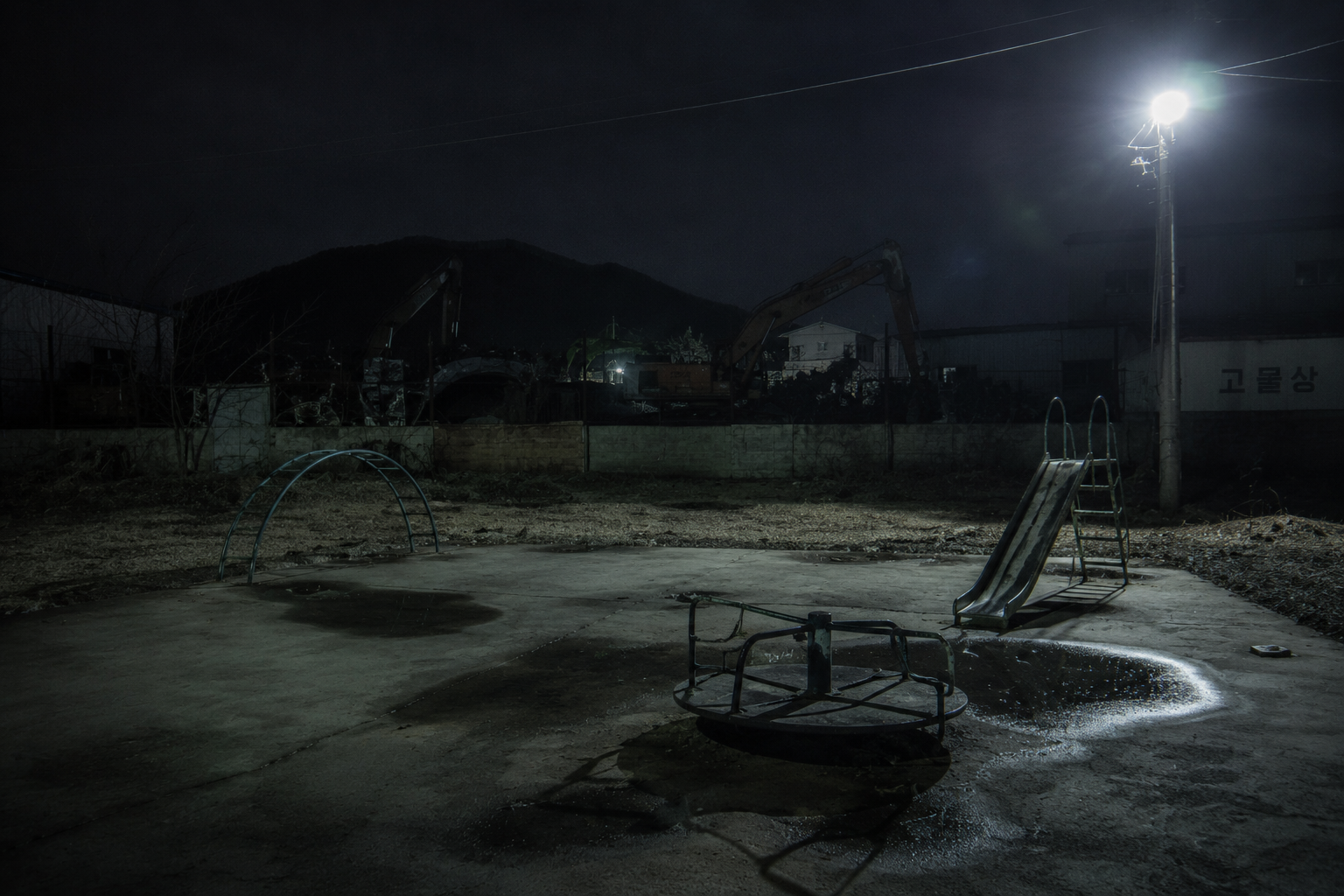
There is a specific category of horror that has no genre name—the horror of a record that knows it is incomplete. A database entry that lists height, weight, distinguishing marks, and then offers, in place of a face, a gray silhouette. A profile that knows what it is missing and cannot supply it. The Son Eon-ji case belongs to this category. It is not a mystery in the conventional sense; it does not offer competing theories, disputed timelines, or the seductive architecture of a whodunit. What it offers instead is something structurally stranger: a child who vanished twice—once into a blind spot between a playground and a scrap yard, and once into the fractured seam between two eras of record-keeping. The second disappearance may be the more total one.
Historical Anatomy: The Country That Was Shedding Its Skin
To understand what happened to Son Eon-ji’s record, you must first understand what was happening to South Korea in September 1996. The country was mid-transformation—not yet the digitally saturated, bandwidth-rich nation it would become by the early 2000s, but no longer the purely analog society it had been a decade prior. The transition was violent in its speed and wildly uneven in its reach. Seoul was wiring itself to the future; rural North Jeolla Province—Chonbuk, as it was still commonly called—was living in a different temporal register entirely.
Muju County, where Son Eon-ji’s family lived in a multi-family housing block adjacent to her father’s gomulsang (고물상), was not a place that produced photographic records as a matter of course. A gomulsang is a scrap metal and recycling yard—a working-class enterprise built on the logic of salvage, on reclaiming value from what has been discarded. The irony of this detail is architectural: the family’s livelihood was the organized preservation of cast-off material, yet no material record of their daughter would survive the decade. Personal cameras in such households were not guaranteed; home video equipment was a middle-class urban luxury. Institutional photography—the school portrait, the municipal registration photo—existed in principle, but the bureaucratic infrastructure for centralizing and preserving it across provincial jurisdictions had not yet been built.
One year after Son Eon-ji disappeared, the IMF financial crisis would detonate across South Korea, consuming administrative bandwidth and institutional resources at every level of government. Provincial police files were not a priority. Local newspapers were folding or contracting. The mechanisms that might have amplified a missing child case—broadcast television segments, national wire distribution, the nascent commercial internet—were either inaccessible to a low-income rural family or simply unequipped to carry a story that had never escaped the local file drawer.
She vanished on September 9, 1996. The ground search found no evidence of struggle. No physical trace. The playground was behind her; her father’s yard was ahead. The transitional lot between them—described in records as a vacant alleyway, a liminal zone of precisely the kind that urban planning textbooks warn against—was the last environment she is known to have passed through. Then nothing.
Structural Dissection of the Record: What the Archive Contains, and What It Does Not
The documentary record of Son Eon-ji’s disappearance can be described, with clinical accuracy, as almost entirely negative space.
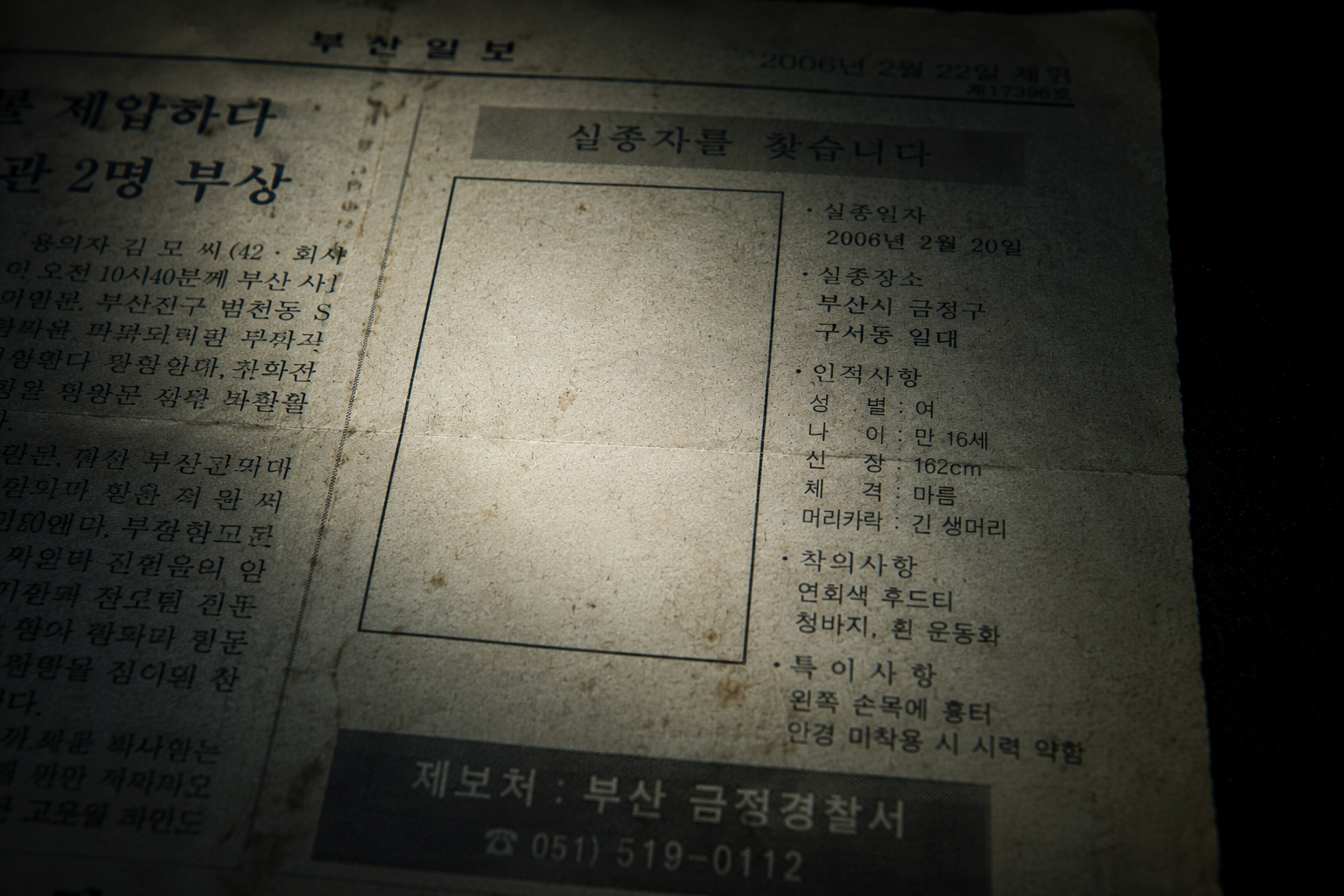
What exists: a listing in the Korean National Police Agency’s long-term missing child registry, noting her name (손언지), her sex, her age at disappearance (six years old; recorded as seven in some indexes due to the traditional Korean age-reckoning system, se, which counts from birth differently than the international standard), and the date and general location of her disappearance. What also exists, preserved by accident rather than design, is a single print notice published on December 28, 2006—exactly ten years and three months after she vanished—in the Saejeonbuk Shinmun (새전북신문), a regional newspaper of modest circulation serving North Jeolla Province.
That notice is the load-bearing wall of the entire archival structure. Without it, the physical description would not exist in any recoverable form. The notice records two distinguishing marks: a prominent straight-line scar (일자형 흉터) on her face, and a distinct black mole (검은 점) near her right elbow. At the time of her disappearance, she had long hair and was wearing a skirt. These details—the scar, the mole, the skirt, the hair—are the totality of her physical record. There is no photograph. There has never been a photograph entered into any public database associated with her case.
This is the structural anomaly that defines the Son Eon-ji case as a distinct object of study, separate from the facts of her disappearance. The KNPA database entry exists in an active state—the case remains open, the record is live—but the image field is occupied by the standard-issue gray silhouette that the system generates when no photograph has been supplied. It is not a blank space; blank spaces suggest absence, oversight, a field that was meant to be filled. The silhouette is something else. It is a placeholder that has become permanent, a stand-in that has outlasted the context that made it temporary.
The case migrated eventually to NamuWiki, the South Korean collaborative encyclopedia. The entry there is brief; it records what the Saejeonbuk Shinmun recorded, attributes it, and adds little. This is not negligence on NamuWiki’s part—it is an honest reflection of the source material’s limitations. There is nothing to add because nothing was generated. The decade between 1996 and 2006 produced no broadcast record, no investigative journalism, no second print notice, no family-distributed flyer that has survived into the digital era. The Saejeonbuk Shinmun article is not just the primary source; it is functionally the only source. A regional newspaper published in 2006, describing a child who disappeared in 1996, is now the sole documentary infrastructure of a human life’s archival existence.
Psychological Necropsy: The Western Imagination Confronts the Absence of a Face
True-crime culture, as it has developed in Western digital communities—Reddit’s r/UnresolvedMysteries, the Lost Media Wiki, the broader ecosystem of cold-case podcasting and documentary production—operates on a set of unstated visual assumptions. A missing child from the late 1990s is expected to leave certain artifacts: a school photograph in a yearbook, a snapshot from a birthday or holiday, a grainy segment from a local television news broadcast. The absence of these materials reads, in Western true-crime grammar, as suspicious; it implies suppression, institutional cover-up, deliberate erasure.
The Son Eon-ji case destabilizes this grammar entirely. The absence of visual documentation is not suspicious in the conspiratorial sense—it is historical and socioeconomic. Rural South Korea in 1996 was not a society that photographed working-class children in the way that Western communities of equivalent economic status were doing at the same period. The gomulsang context matters here: this was a family living at the margin of the formal economy, occupying transitional housing adjacent to an industrial scrap operation, in a provincial county that would not see broadband infrastructure for years. The absence of photographs is not a clue. It is a record of poverty and geographic isolation.
But the Western imagination—accustomed to treating archival absence as narrative—cannot process this distinction cleanly. What it encounters instead is something that functions like a horror trope: a case profile that supplies granular physical description (the straight-line scar, the elbow mole, the long hair, the skirt) while withholding the face those descriptions would anchor. This is, in the vocabulary of analog horror, a “data without a soul” scenario. The case file knows how to describe her. It cannot show her. The description becomes a kind of text-based portrait—specific enough to generate a mental image, permanent enough to ensure that mental image can never be verified or corrected.
The gomulsang setting compounds this effect. In Korean folklore and urban mythology, scrap yards occupy a liminal imaginative space; they are sites of transience, of material transformation, of things that enter and do not leave in recognizable form. The absence of physical evidence at the scene—no signs of struggle, no trace—permits the imagination to fill the vacancy with the logic of the industrial environment itself: the child absorbed into the machinery of salvage, disappeared into a landscape whose entire function is the dissolution of identity into raw material. This is not an analytical claim; it is a description of how the Western true-crime internet processes the case’s sensory architecture.
The Evidence of Erasure: How a Record Loses Its Coherence
The fragmentation of Son Eon-ji’s archival record followed a specific sequence, each stage of which can be isolated and examined.
The first stage was the local containment of the initial disappearance. Provincial police in Muju County in 1996 operated within a bureaucratic structure that did not automatically escalate missing child cases to national broadcast. The mechanisms that would later exist—the 2005 Act on the Protection and Support of Missing Children, the formalization of the KNPA’s missing persons database, the establishment of ChildFund Korea’s reporting infrastructure—were not yet in place or were in early developmental stages. A six-year-old girl missing in rural North Jeolla Province was a local matter, handled by local authorities, filed in local paper records.
The second stage was the decade of media silence between 1996 and 2006. During this period, South Korea’s information infrastructure underwent its most dramatic reorganization—the commercial internet arrived, television news formats expanded, the true-crime broadcast genre gained traction through programs like Unanswered Questions (그것이 알고 싶다). None of this touched the Son Eon-ji case. The local paper file did not migrate; it did not attract a television producer; it did not generate a national wire story. The case existed in a pre-digital format during the decade in which digitization was most aggressive and most selective about what it chose to preserve.
The third stage was the 2006 Saejeonbuk Shinmun notice—accidental preservation masquerading as publicity. The notice was not an investigative piece; it was a brief formal listing, the kind of item published to satisfy a procedural or humanitarian obligation. Its survival into the digital era, via the eventual digitization of regional newspaper archives, is a minor miracle of information infrastructure—and it is the only such miracle this case received.
The fourth stage was the digital migration without media. When the KNPA database eventually incorporated the case, it incorporated the text. No photograph existed to accompany it. The gray silhouette was generated, and the gray silhouette persisted. The NamuWiki entry was created from the digitized print record. The case achieved a kind of digital existence—searchable, linkable, technically accessible—while remaining visually null.
The Point of No Return: What the Gray Silhouette Actually Is
There is a particular phrase used in archival science—provenance gap—to describe the period in a document’s history during which its location, custody, and condition are unknown. The Son Eon-ji case has a provenance gap of approximately a decade, and that gap corresponds precisely to the period during which a visual record might have been digitized had one existed and had anyone been looking.
The gray silhouette is not a technical failure. It is not a bug in the KNPA’s database software, not an oversight that future administrators will correct. It is a permanent state—permanent because the photographs, if they ever existed in any recoverable form, have not surfaced in nearly three decades, and because no institutional mechanism exists to compel their recovery. It is permanent because the Saejeonbuk Shinmun notice, however fragmentary, is a closed document; it will not be updated. The database entry will remain open for as long as the case remains unresolved, which is to say indefinitely.
What the gray silhouette actually represents is a second disappearance—bureaucratically processed, technically maintained, and utterly irreversible within the current archival infrastructure. Son Eon-ji vanished from a physical space on September 9, 1996. Her image vanished from the recoverable record during the decade that followed, lost not to malice but to the structural indifference of a nation too busy transforming itself to look back at what its provincial paper files contained.
The deeper disturbance is this: modern digital archives present themselves as permanent, comprehensive, and immune to the fragility of paper and memory. The Son Eon-ji case demonstrates that digital permanence is entirely dependent on the quality of what was digitized. The decision about what to digitize was made by institutions operating under resource constraints, in the midst of an economic crisis, with no particular interest in the working-class provincial files that were least likely to surface in any future audit. The archive preserved the text. The archive could not manufacture the image. And the image, once lost, has no mechanism for return.
What remains is a name, two physical descriptors, a gray silhouette, and the liminal space between a playground and a scrap yard—preserved in exactly the same condition as the moment it was last documented: empty, unresolved, and waiting.
🔍Search Update: Call to Action
For the Western lost media and internet archaeology communities, the Son Eon-ji case represents a distinct research dead-zone. Unlike widely shared cold cases, this file has completely stagnated at the interface layer. If you are an archivist with access to physical print runs of North Jeolla regional flyers, municipal circulars, or localized school yearbooks from the Muju County area spanning 1994 to 1996, your efforts are required. The objective is not traditional digital sleuthing, but physical, analog salvage. To bridge this provenance gap, researchers must locate any surviving domestic or institutional photograph that can definitively replace the default archive of human experience.
This document is an investigative archival reconstruction based on fragmented public records, media remnants, community accounts, and verified historical sources compiled by The 3AM Archive.
The article examines how incidents, forgotten media, internet folklore, and unresolved public memories evolve through cultural preservation and digital decay.
This is a cultural investigation document — not fictional horror content.
All visual materials used in this post are exclusive AI-generated assets created for The 3AM Archive.
