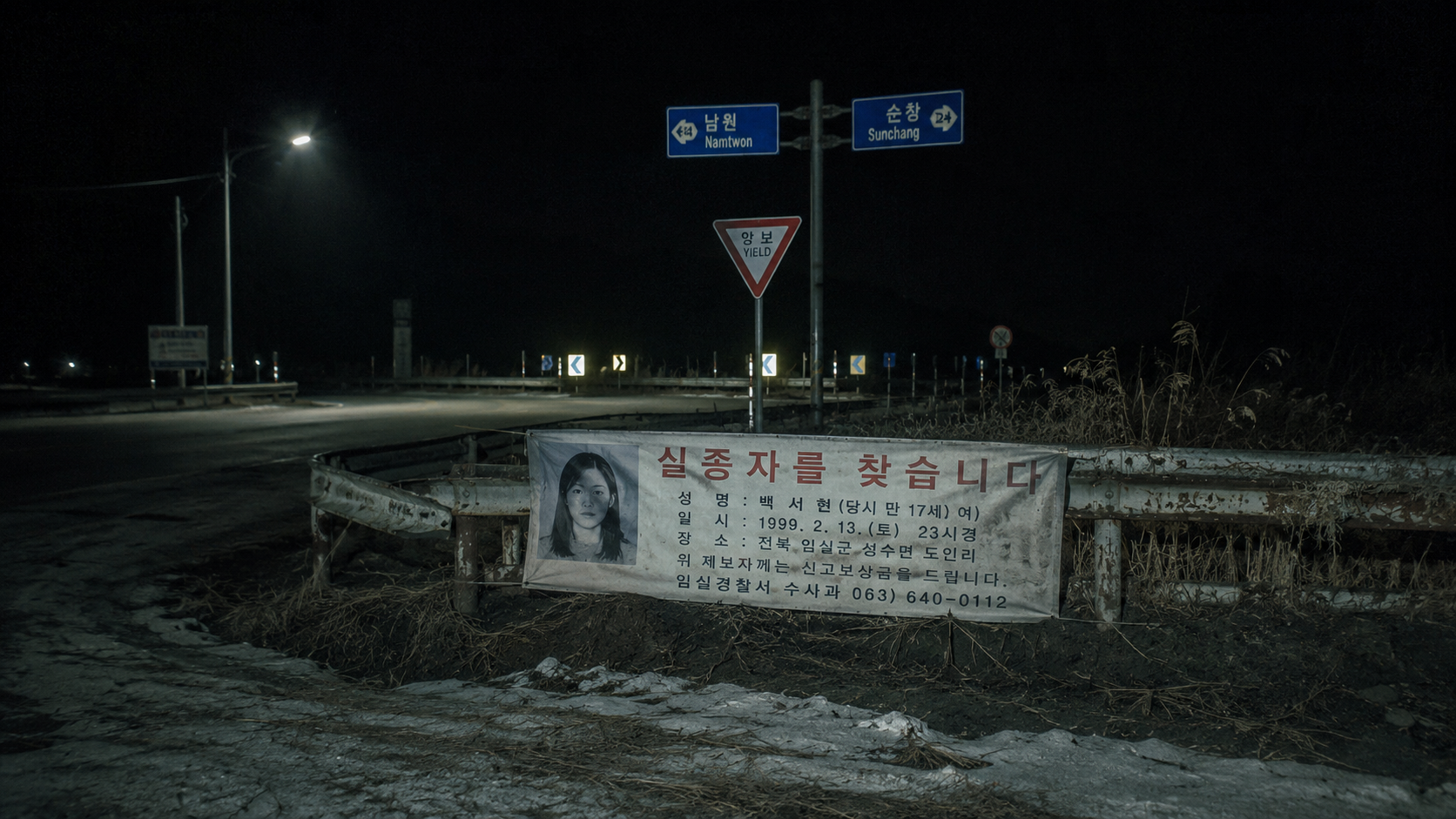
In early 2024, physical remnants of South Korea’s longest-running analog missing persons campaign remained visible along Gyeonggi Province transit corridors. The banner was sun-bleached nearly to white. The phone number printed beneath her photograph began with 016—a carrier prefix that the Korean telecommunications industry had been methodically retiring since 2012. By the time that motorist passed, the number rang into nothing. The girl in the photograph had been missing for twenty-five years. The man who hung the banner died in August 2024 when his truck crossed the center line on a rural road, killing him instantly. After his death, no one took the banners down.
This archive examines the structural intersection of obsolete telecommunications infrastructure, digital identity theft, and systemic evidentiary voids.

Historical Anatomy
To understand the disappearance of Song Hye-hee, one must first understand the specific texture of South Korea in February 1999. The 1999 micro-environment was heavily conditioned by post-IMF structural adjustments, resulting in volatile regional demographics and destabilized domestic migration patterns. Unemployment had tripled in under a year; mass layoffs had shattered the lifetime employment model that had defined postwar Korean masculinity. The national mood was characterized by a particular combination of collective exhaustion and desperate forward motion, a society simultaneously grieving and rebuilding.
Rural Gyeonggi Province, where Song was last seen, sat at the exact midpoint between two eras. The provincial towns around Pyeongtaek were neither the dense urban networks of Seoul nor the fully agricultural communities of the country’s interior; they were transition zones, places where rice paddies abutted new industrial parks, where narrow village roads emptied onto unlit highway entry points without warning. The infrastructure of surveillance that now saturates South Korean public space—the dense CCTV networks, the mandatory dashcam culture, the omnipresent municipal monitoring—did not yet exist. The dark junction at Doil-dong’s Hari Village on the night of February 13, 1999 was, by contemporary standards, functionally invisible to the state.
Song Hye-hee, seventeen years old, had spent the evening with friends in Seojeong-dong. She boarded the final municipal bus out of the downtown area at approximately 22:00. The bus was the last one running. The route terminated at a turnaround point several stops before the Doil-dong junction where Song ultimately exited; the driver later recalled having to wake her when she missed her stop, then watched her disembark alone into an unlit intersection at roughly 22:12. He also noted a male passenger—mid-thirties, smelling of alcohol, wearing a deep-hooded down parka and heavy hiking boots—who had boarded in downtown Pyeongtaek and exited at the same stop.
That bus driver is the entirety of the primary record.
Structural Dissection of the Record
The investigative failure that followed Song’s disappearance was not exceptional for its era; it was entirely, bureaucratically routine. South Korean law enforcement in 1999 operated under a missing persons classification system that defaulted to gachul—voluntary runaway—for any subject over the age of eight in the absence of immediate physical evidence of violence. Song’s family filed a missing person report at 06:00 on February 14; the local precinct logged it accordingly. A formal criminal kidnapping investigation was not opened until February 16, after a 72-hour administrative delay that allowed any physical trace at the scene to disperse entirely.
The 1999 Pyeongtaek bus system carried no internal CCTV. The rural roads in the area had no automated traffic cameras. The only record of what happened between 22:12 and dawn on February 14 is the spoken testimony of a single witness who saw two people step off a bus into darkness. There was no corroborating physical record to analyze, no secondary witness to cross-reference, no footage to submit to frame-by-frame examination. The archive was empty before the case was even opened.
Subsequent investigative efforts between 2003 and 2004 involved systematic land sweeps of the regional reed beds, drainage infrastructure, and disused wells surrounding the Doil-dong area. Nothing was recovered. The absence of remains—neither confirmatory nor exculpatory—simply extended the void.
The most structurally destabilizing anomaly in the public record emerged in February 2004, five years after the disappearance. Cyber-investigators tracking Song’s Resident Registration Number—the unique national identity code that functions as a Korean citizen’s primary digital identifier—detected activity under her identity at an internet café in Busan. The family experienced this discovery as a seismic event; a living daughter, hiding, reachable. Forensic digital tracing revealed a severe security vulnerability in the family’s physical distribution network. An adolescent couple had visited roadside rest stops where Song’s family had posted missing person flyers; those flyers, printed to maximize readability, displayed Song’s identification metrics directly beneath her photograph. The teenagers had copied the number down. The victim’s resident registration metrics were compromised by third parties to bypass online authentication protocols on early Korean MMORPG platforms and web portals. The data had been repurposed by strangers who wanted to play online games.
This incident is worth dwelling on. The family’s decision to include identifying government data on their flyers was not careless; it was a deliberate strategy to maximize the utility of each printed sheet, to give anyone who found it actionable information. That the same information would be repurposed by unrelated teenagers for recreational identity fraud was an outcome that no missing person protocol of the era had considered. The digital and analog systems intersected catastrophically, producing a false signal that briefly gave a mother hope and then extinguished it.
Psychological Necropsy
The case presents distinct spatial and systemic divergence from Western forensic baselines.
Part of the difficulty is spatial. Western cold case conventions assume that the location of a crime retains some forensic or symbolic permanence; the site remains, even if degraded, a fixed point to which investigators, journalists, and families can return. The junction at Doil-dong’s Hari Village no longer exists in any recognizable form. The marshy, unlit terrain where Song was last seen was absorbed by industrial zone development and highway re-routing over the course of the 2000s. The physical space of the disappearance was erased not by criminal concealment but by South Korea’s extraordinarily rapid infrastructural transformation—the same modernization drive that was supposed to make the country safer had, as a structural byproduct, demolished the crime scene while the father was still searching it.
Part of it is semiotic. The banner campaign that Song Gil-yong maintained for twenty-five years operated within a distinctly Korean tradition of unauthorized public mourning—the commandeering of highway infrastructure as a display medium, the assertion of private grief onto the shared visual field of the road. To a Western observer accustomed to formalized missing person protocols, institutionalized amber alerts, and media-coordinated search campaigns, the image of thousands of faded vinyl banners on guard rails reads as something closer to folk art or outsider monument than to law enforcement cooperation. The banners were not a cry for institutional assistance by the time Song Gil-yong died; they had become their own category of object, somewhere between evidence and memorial.
The 016 carrier code is perhaps the most precise symbol this case has produced. South Korean telecommunications providers retired the 016 prefix incrementally between 2012 and 2021, urging holdout subscribers to migrate to new numbers; Song Gil-yong refused. His stated reason, reported in multiple broadcast segments, was straightforward: if his daughter were alive and tried to call him, she would dial the number on the flyers. Changing it would mean abandoning her final line of navigation back. By the end of his life, he was maintaining a phone number on a carrier network that the state was actively trying to decommission, paying monthly fees to keep open a line that had been functionally severed from the telecommunications grid. The infrastructure had moved on; he had not.
The Evidence of Erasure
The case accumulated several distinct layers of institutional forgetting over its twenty-five-year arc.
The first was procedural. In February 2014, the statutory fifteen-year limitation period for kidnapping charges expired under the legal framework then in force. The case was formally reclassified as permanently cold—not closed in the sense of being solved, but closed in the sense of being unreachable by the criminal justice system. The investigative window, which had opened reluctantly and late in 1999, closed definitively in 2014 without having produced a suspect, a charge, or a body.
The second layer was geographic, as noted above: the physical erasure of the site by development. There is no location to mark, no plaque to install, no ground to revisit.
The third layer is the serial killer hypothesis, which itself represents a form of archival mutation. National profile units have formally linked Song’s case to two other unresolved incidents in the Gyeonggi corridor: the murder of Jeon Ok-bun at the identical Doil-dong bus stop in September 2002, and the murder of an unidentified female college student at an isolated roadside transit stop in Hwaseong in October 2004. The geographic clustering, the consistent targeting of women at unmonitored transit points, and the temporal span of the incidents have generated sustained online speculation about a “Bus Stop Predator” operating in the gap between the confirmed activity of convicted serial killer Lee Choon-jae—whose Hwaseong murders ended in 1991—and the installation of comprehensive public surveillance infrastructure in the late 2000s. This theory is unconfirmed and may be unfalsifiable given the state of the physical record. Its persistence, however, reveals a recurring feature of cold case mythology: the need to impose narrative coherence on what is functionally a set of evidentiary voids.
The fourth layer is the death of the father. Song Gil-yong died on August 26, 2024, at age 71, when he suffered a sudden myocardial infarction while operating his scrap-hauling truck—the same vehicle that served as a mobile archive of his search campaign. The truck crossed the center line and collided with a dump truck. The physical archive—the banners, the equipment, the accumulated twenty-five years of material search—did not survive the accident as a functioning operation. His death was not a conclusion; it was an interruption. The case remained unresolved. The banners remained on the guard rails. No one held the 016 number.
Song’s mother had died eighteen years earlier, in 2006—not in 2003, as some archival sources incorrectly cite. The maternal suicide site yielded high volumes of physical campaign ephemera, marking the total cessation of the primary search node. She died by ingestion of toxic agricultural chemicals while holding her daughter’s missing person flyers.
The Point of No Return
The Song Hye-hee case poses a specific question about the architecture of digital memory that most cold case discourse avoids directly: what happens when a case falls entirely into the gap between analog and digital infrastructure, belonging fully to neither?
The case predates comprehensive public surveillance. Because of this, there is no footage to recover. It postdates the period of exclusively paper records; there is a partial digital trail, but it is shallow and contaminated—a dead identity borrowed for video games, a phone number maintained on a dying network. The witnesses are aging. The site does not exist. The criminal statute has expired. The family is gone.
The current data footprint is limited to secondary media assets, localized OSINT forums, and unmonitored physical infrastructure markers. These fragments do not constitute a record in any archival sense; they constitute the negative space where a record should have been.
The father’s refusal to abandon the 016 number was, in retrospect, a precise diagnosis of his situation. He understood—perhaps not in these terms, but functionally—that the digital infrastructure around him had no mechanism for preserving what he knew. The new telecommunications grid had no field for his daughter. The updated national surveillance network had no retroactive coverage for 1999. The modernized South Korean state, for all its technical capacity, could not reach back twenty-five years into an unlit rural junction and retrieve what had been lost there. The old phone number was the only thread that connected the current moment to the night in question; severing it would mean admitting that the thread had already been cut by something else entirely.
South Korea’s transition from an analog to a digital society is routinely described as one of the most rapid and comprehensive in recorded history. The case of Song Hye-hee stands as one measure of what that transition cost—not in aggregate or in policy terms, but in the specific, granular terms of one family’s twenty-five years of searching a highway that had been rerouted, calling a phone number that no longer connected, and hanging banners on guard rails that no one with authority to act would ever stop to read.
The banners are still there. The number still rings into nothing. The archive is complete.
🔍Search Update: Call to Action
For Western open-source intelligence (OSINT) researchers, internet archaeologists, and lost media communities tracking East Asian cold cases: the documentation of this incident relies heavily on digitizing vulnerable analog artifacts. If you are conducting archival mapping of the Gyeonggi cold case corridor or possess digital captures of South Korean transit forums from the early 2000s, log your data indices to preserve the systemic trail before physical and digital infrastructure decay fully completes its erasure.
This document is an investigative archival reconstruction based on fragmented public records, media remnants, community accounts, and verified historical sources compiled by The 3AM Archive.
The article examines how incidents, forgotten media, internet folklore, and unresolved public memories evolve through cultural preservation and digital decay.
This is a cultural investigation document — not fictional horror content.
All visual materials used in this post are exclusive AI-generated assets created for The 3AM Archive.
