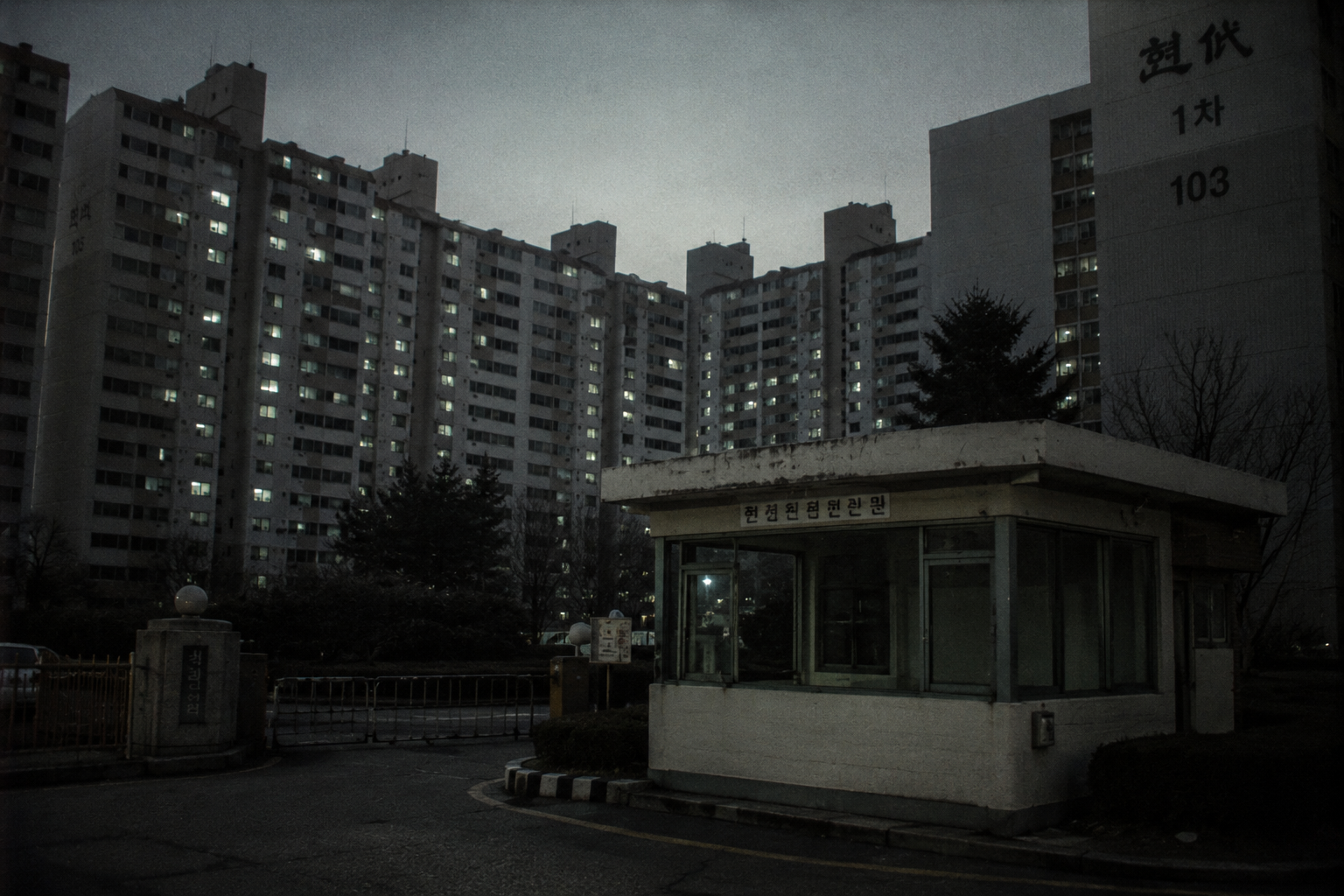
On April 14, 1999, at approximately 1:00 PM, an eight-year-old girl named Yoon Ji-hyun stepped out of a carpool vehicle at the entrance of her apartment complex in Osan, Gyeonggi Province. She was visible. She was recognizable. Neighbors knew her face; local shopkeepers could have named her on sight. She walked toward a residential tower housing thousands of people—a vertical city of windows, balconies, and occupied rooms—and vanished so completely that not a single human being could confirm what happened next.
This is not a case about a child disappearing into wilderness. There is no forest, no isolated road, no vacant lot at the edge of town. The architectural backdrop is the opposite of empty: a dense, modern residential complex built to concentrate human life. What makes Yoon Ji-hyun’s disappearance structurally significant—beyond its personal tragedy—is precisely that density. Her case is a diagnostic artifact; a pressure test that revealed the specific, catastrophic failure points of a society building faster than it could surveil, urbanizing faster than it could remember.
The case has never been solved. Twenty-five years later, it occupies a peculiar position in South Korean cold case archives and, increasingly, in the fractured memory spaces of international internet communities. What follows is not an attempt to solve it. It is an attempt to understand what it reveals.
Historical Anatomy
To properly read the Yoon Ji-hyun disappearance, one must understand what South Korea was in 1999—not culturally, not politically, but infrastructurally and psychologically.
The late 1990s represented the tail end of an extraordinary developmental sprint. Following the devastation of the Korean War and the subsequent decades of state-directed industrialization under successive administrations, South Korea had compressed roughly a century of urban growth into forty years. The apartment complex—the apateu, as it is known colloquially—became the dominant residential unit; not a luxury choice but a logistical necessity for a rapidly urbanizing population. Gyeonggi Province, surrounding Seoul in a broad suburban ring, absorbed enormous residential overflow. Osan was one of dozens of mid-tier satellite cities where identical high-rise blocks rose on land that had, a generation earlier, been agricultural.
These complexes were engineered for density, not for monitoring. The assumption embedded in their design was communal: thousands of residents would form a de facto surveillance web through sheer proximity. Eyes on the street, in the Jane Jacobs sense, were meant to be replaced by eyes on the courtyard—neighbors watching from balconies, guards stationed at gates, shopkeepers noting irregular foot traffic. It was a human infrastructure model built for a pre-digital world, and it functioned tolerably well under stable conditions. April 14, 1999, was not stable conditions.
South Korea’s financial crisis of 1997—the IMF crisis, as it is locally known—had reshaped the social fabric in ways that are difficult to quantify but easy to observe in retrospect. Security guard positions at residential complexes were among the first casualties of cost-cutting measures implemented by struggling building management companies. Scheduled leave went unfilled. Overtime was eliminated. The result was a patchwork surveillance system operating at reduced capacity precisely during a period of maximum stress—a society in austerity, relying on human vigilance it could no longer reliably afford.
Closed-circuit television existed in South Korea in 1999, but its deployment was deeply uneven. In financial institutions, government buildings, and high-end commercial spaces, cameras had been standard for years. In mid-tier residential blocks in provincial cities, they were effectively absent—classified as capital expenditures that building management associations could not justify. The result was a paradox that would prove fatal to any forensic reconstruction of Yoon’s disappearance: a built environment of extraordinary density that produced, in terms of evidentiary record, an almost perfect blank.
Structural Dissection of the Record
The timeline of April 14, 1999, contains one anomaly so large it structurally dominates everything else: the seven-hour delay between Yoon’s last confirmed sighting and the first police notification.
She was dropped off between 12:50 and 1:10 PM. Her mother noticed her absence at approximately 8:00 PM. The gap is not itself suspicious—a child expected home for dinner, an afternoon assumed to be occupied with play or visiting a friend, a parent’s attention elsewhere. What makes the gap significant is what it represents forensically: seven hours in which the critical window for witness memory consolidation, physical evidence preservation, and immediate search response was entirely lost. By the time police were notified, whatever trace Yoon might have left in the minutes after her drop-off had been walked over, rained on, dispersed, or simply forgotten by people who had no reason to remember it.
What is notable, and historically anomalous, is the speed of the police response once notification occurred. By 1:00 AM on April 15—barely five hours after the initial call—detectives had classified the case as an active kidnapping and wiretapped the family’s landline in anticipation of ransom demands. This was not standard protocol for the era; South Korean law enforcement in the late 1990s routinely observed waiting periods before escalating missing child cases, operating on statistical assumptions about runaways and domestic situations. The immediate escalation suggests that something in the initial assessment—the circumstances of the drop-off, the character of the family, the nature of the complex—convinced investigators that this was not a voluntary disappearance.
No ransom call ever came.
The subsequent search was extensive by any reasonable measure. Ground teams covered the apartment complex perimeter, surrounding commercial zones, and nearby mountain trails. Dive teams were deployed to search the Seodong Reservoir—the site of the school field trip earlier that day—methodically. Nothing was recovered. No clothing fragment, no physical marker, no forensic residue. The reservoir search is particularly significant; it represents the investigators’ early hypothesis that Yoon may have returned to the field trip site, or been taken there. The hypothesis yielded nothing.
Witness accounts from the surviving classmates and the supervising teacher fractured almost immediately under the pressure of questioning. The children’s recollections of the drop-off sequence—who was let out when, in what order, what they saw—contradicted each other in ways that investigators could not reconcile. This is not unusual in trauma contexts; memory research has consistently demonstrated that witnesses to emotionally significant events often produce reliable impressions and unreliable details. But in a case with no physical evidence, the witness record was the entire evidentiary foundation—and that foundation was, from the earliest stages, unstable.
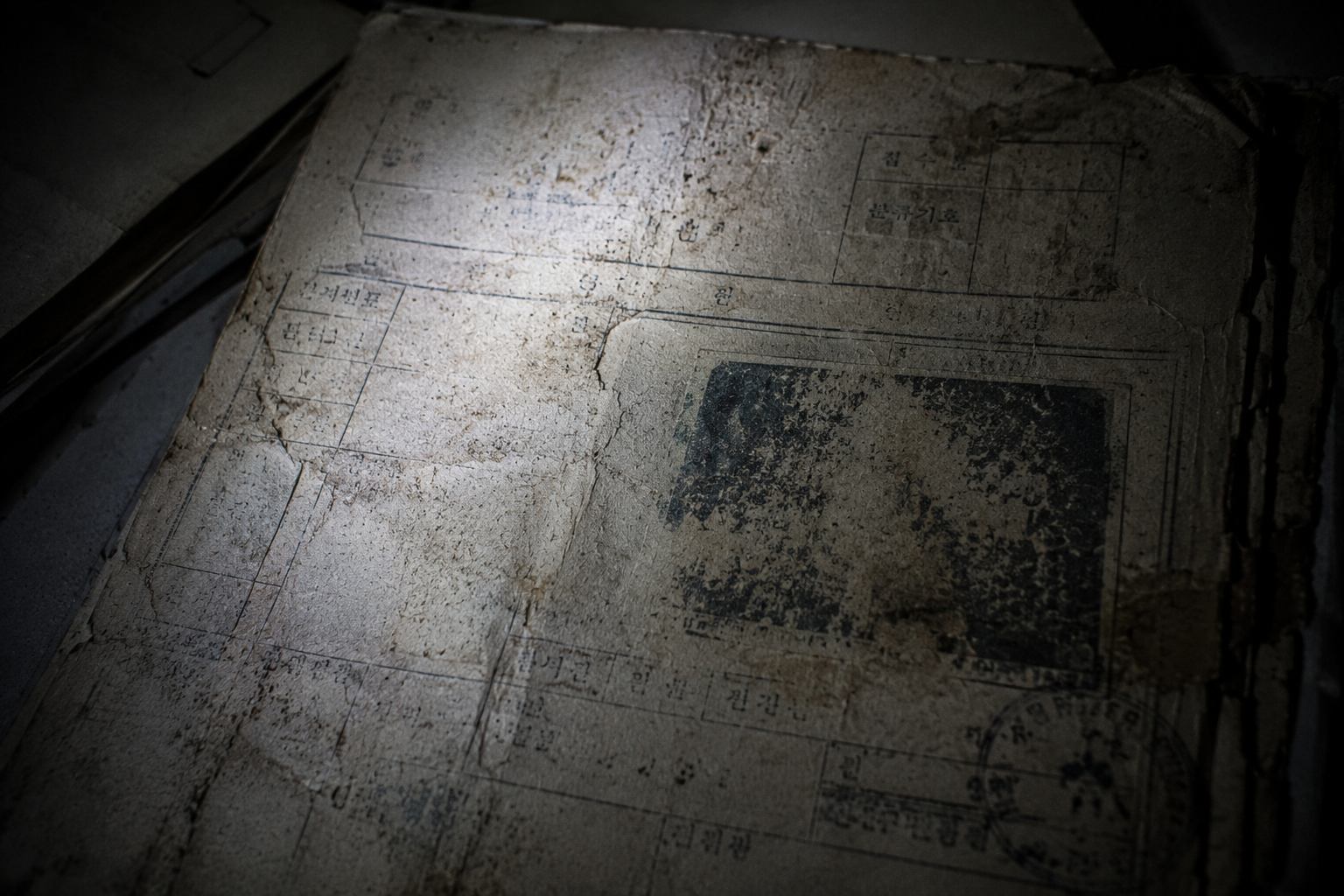
What the record does not contain is as significant as what it holds. There are no CCTV frames, no building security logs, no gate entry records, no photographs of the complex taken that afternoon that might incidentally capture Yoon in a background. The archival silence is not metaphorical; it is literal and structural. The documentation that would ordinarily allow a forensic reconstruction simply does not exist, because the infrastructure to generate it was not present.
Psychological Necropsy
Why does a twenty-five-year-old South Korean cold case, with limited English-language documentation and no surviving media presence, circulate in Western internet communities oriented around Analog Horror and lost media archaeology?
The answer lies in what the case structurally resembles, rather than what it factually contains. The Yoon Ji-hyun disappearance maps almost perfectly onto a set of anxieties that Western internet culture has spent the past decade articulating through creative media: the fear of surveillance failure, the horror of the vanishing point, and the unsettling recognition that modern built environments—designed to be legible and monitored—contain systematic blindspots that swallow people whole.
Analog Horror as a genre is preoccupied with the specific texture of pre-digital recording: the VHS artifact, the degraded audio tape, the missing broadcast segment. Its horror derives not from monsters but from the gap in the record—the moment when the camera cuts to static, when the tape runs out, when the archive produces silence where it should produce image. The Yoon case is Analog Horror without the fiction. The gap in the record is not a creative device; it is the actual condition of the evidentiary archive.
There is also the particular horror of the recognizable child in the populated space. Western missing child cases that achieve broad cultural resonance frequently involve rural or suburban contexts where isolation is plausible—a child near woods, a child on an empty road. The populated apartment complex inverts this; it implies that visibility is not protection, that proximity to other people does not guarantee witness. A child known by face to an entire community walks into the middle of that community and is never seen again. The implication—that social recognition and physical proximity provide no actual security—is deeply unsettling in a way that isolated disappearances are not.
The Evidence of Erasure
The fragmentation of the Yoon Ji-hyun case across time follows a pattern recognizable in other cold cases from the pre-digital era, but accelerated and complicated by the specific conditions of South Korean media culture and the IMF-era social disruption.
In the immediate aftermath—1999 into the early 2000s—the case received regional media coverage in Gyeonggi Province and limited national attention. Cold cases in South Korea during this period existed primarily in print media; broadcast coverage was episodic and tied to investigative anniversaries. Without a digital record to anchor public memory, coverage decayed in parallel with the physical archive. Newspaper clippings yellowed. The case moved from active to cold to archived.
The family’s most publicly documented regret—the absence of biometric data, specifically fingerprints and DNA records—speaks to the erasure at the infrastructural level. South Korea did not practice routine child fingerprinting in 1999. The family had no forensic reference points to contribute to the developing national DNA databases of the 2000s; when those systems came online, Yoon Ji-hyun’s case had no data to retroactively populate them. The gap in the record was not merely a function of the original investigation’s limits; it was reproduced and extended by every subsequent technological development that arrived too late to matter.
The post-2010 internet representation of the case is thin, fragmented, and largely limited to Korean-language true crime communities. The case does not have a Wikipedia page in any language. It does not appear in major English-language cold case databases. Its presence in international internet spaces is almost entirely secondary—referenced in discussions of South Korean missing children cases as a structural exemplar, mentioned in Analog Horror community threads as an unverified real-world parallel. The mythology has begun to accumulate, but the archive it must rest on is nearly empty.
This is the specific mechanism of erasure in pre-digital cold cases: not active suppression but passive entropy. The record was never created robustly enough to survive. What exists cannot be easily digitized because so little of it was generated in the first place.
The Point of No Return
There is a question implicit in the Yoon Ji-hyun case that the forensic and cold case literature rarely asks directly: what is the threshold at which a disappearance becomes permanently unresolvable—not because the perpetrator was clever, but because the recording infrastructure of the time simply could not produce the data necessary for resolution?
This is a structural question, not an investigative one. It does not ask what the police failed to do; it asks what the built environment of 1999 Osan was constitutively incapable of recording. The answer, in this case, appears to be: almost everything. The carpool sequence exists in fractured child memory. The walk from the gate exists nowhere. The seven hours that followed exist in the absence of notation—no one marked them, because no one knew to.
What the Yoon case reveals, when examined as a cultural artifact rather than simply a criminal one, is the precise shape of the analog-to-digital transition’s blind interval. South Korea in 1999 was building the physical infrastructure of a surveilled society—dense residential towers, controlled gate access, managed public spaces—without the technological infrastructure that would later make such environments legible. It was, briefly, the worst of both worlds: concentrated enough that danger was proximate, insufficiently monitored to register it.
The digital era did not eliminate this problem; it relocated it. Modern surveillance infrastructure is comprehensive in the spaces it covers and absolute in the gaps it leaves. The Yoon case is not a historical curiosity; it is an early instance of a recurring structural failure—the moment when a society’s architecture of record-keeping falls behind its architecture of habitation. The clean tear in the social record that Yoon Ji-hyun’s disappearance produced is not anomalous. It is the predictable output of a system that was never designed to document its own blindspots.
She stepped out of the car. The gate was unmanned. The cameras did not exist. Nobody wrote it down. Twenty-five years later, this is what remains: the shape of what could not be recorded, preserved perfectly in its own absence.
Editorial note: The fracture between the robust police escalation (immediate wiretapping, classified as kidnapping within hours) and the complete forensic silence that followed is the case’s most underexamined tension. The institutional response implies credible threat assessment; the evidentiary record implies nothing happened at all. That contradiction—competent response, zero yield—may be the most disturbing structural feature of the case, and warrants deeper treatment if a follow-up piece is produced.
🔍Search Update: Call to Action
The modern survival of the Yoon Ji-hyun case depends entirely on discovering fragments of missing local history. True crime researchers and digital archeologists are actively searching for broadcast captures, local print newspaper scans from Gyeonggi Province dated mid-to-late April 1999, or home video recordings that incidentally feature the perimeter of the Osan apartment complex during this specific window. If you possess analog tapes containing South Korean regional news broadcasts from April 1999, or have access to regional library microfilms from the era, your documentation could bridge the permanent archival silence that defines this historical blindspot.
This document is an investigative archival reconstruction based on fragmented public records, media remnants, community accounts, and verified historical sources compiled by The 3AM Archive.
The article examines how incidents, forgotten media, internet folklore, and unresolved public memories evolve through cultural preservation and digital decay.
This is a cultural investigation document — not fictional horror content.
All visual materials used in this post are exclusive AI-generated assets created for The 3AM Archive.
