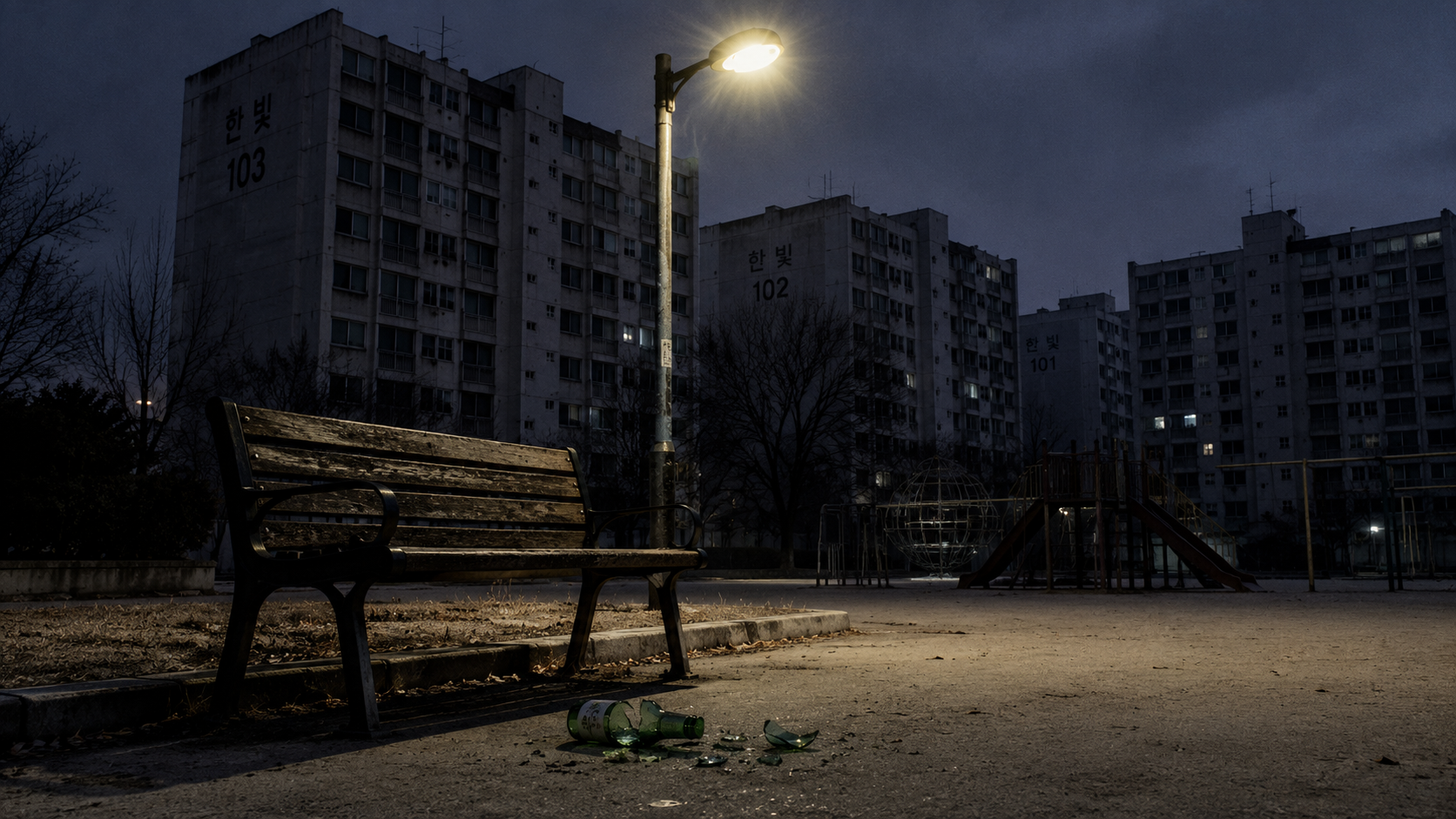
There is a specific kind of disappearance that does not merely remove a person from the physical world—it removes them from the bureaucratic record itself. Choi Jun-won, four years old, walked away from a Chinese restaurant in Mangu-dong, Jungrang-gu, Seoul at some point on the afternoon of April 4, 2000, and within hours, the institutional mechanisms ostensibly designed to locate her had already begun generating the conditions of her permanent absence. The broken neck of a soju bottle, handled by the only credible suspect, was discarded by responding officers. The testimony of child witnesses was summarily dismissed on account of their age. These were not failures of technology; they were failures of categorical thinking—the same species of institutional reflex that, in the years following, would allow South Korea to construct an exhaustive digital surveillance architecture while the original crime scene aged quietly toward scheduled demolition.
What makes the disappearance of Choi Jun-won a cultural document rather than merely a criminal one is the precise timing of its occurrence. She vanished at the exact seam between two Koreas: the older, analog city of unlocked apartment courtyards and landline telephone networks, and the emergent, hyperconnected state that would eventually install cameras on virtually every urban surface. She fell through that seam. The seam has since been welded shut.

Historical Anatomy
To understand what happened on that playground, it is necessary to understand what Mangu-dong was in the spring of 2000. The Yeomgwang Apartment complex was not a marginal address—it was, in the vocabulary of late-1990s Korean urban planning, a standard-issue residential block of the type that had proliferated across Seoul’s outer districts during the economic expansion of the preceding decade. But the IMF financial crisis of 1997–1998 had restructured the social ecology of such neighborhoods in ways that are difficult to quantify from the outside. Transient populations had increased; informal settlements had expanded in the gaps between formal zoning. The area immediately adjacent to the Yeomgwang complex was known colloquially as Dwaeji-chon—Pig Village—an unmapped shantytown of makeshift livestock pens and low-income dwellings that functioned, in the folk consciousness of the surrounding neighborhood, as a zone of institutional invisibility. Residents there were frequently unregistered. They did not appear in address databases. A man who did not exist in the administrative record could, if he chose, exist only in the fragile and inconsistent memories of those who happened to see him.
This is the social geography into which Choi Jun-won disappeared. The man last seen in her proximity—early forties, heavily bearded, unkempt in dress and posture, working through a remarkable quantity of soju on a playground bench in the mid-afternoon—fit, with uncomfortable precision, the profile of a person operating entirely outside the institutional grid. The year 2000 offered Seoul no mechanism to trace him. There was no CCTV infrastructure covering the Mangu-dong residential sector; the city’s digital surveillance network, now among the densest in the world, was still years from reaching these older neighborhoods. The investigation would have to depend on witnesses—and it would then proceed to systematically discount them.
The cultural context of the era compounds this institutional failure in ways that extended far beyond the immediate crime scene. South Korea in 2000 was simultaneously one of the world’s most wired nations and one of its most institutionally conservative. Broadband internet penetration was accelerating at a pace unmatched globally; yet the behavioral frameworks governing police procedure, evidentiary practice, and victim support remained deeply analog in their assumptions. The consequence was a bureaucratic structure that lacked the cognitive categories to treat a four-year-old’s disappearance with the forensic precision the moment required.
Structural Dissection of the Record
The timeline, reconstructed from police records and subsequent broadcast journalism, describes a chain of intervals—each one slightly too long, each one absorbing a portion of the window within which effective intervention remained possible. Choi left the Chinese restaurant before 16:30, confirmed by the owners. The security guard noted her presence in the playground at approximately 16:30. By 18:00, her mother—managing a newborn—had registered her absence and dispatched the eldest sister to investigate. The restaurant owners confirmed she had already left. By 20:00, the father had been reached at work and a missing persons report had been filed at Jungrang Police Station.
That sequence—roughly four hours between last confirmed sighting and official report—would have been difficult to compress even under ideal conditions. But the conditions were not ideal; they were actively degraded by the responding officers’ handling of the physical evidence. The soju bottle fragment, broken, presumably in some manner involving contact with the suspect, was discarded. This was not an ambiguous oversight; it was a categorical decision that the object was not worth preserving. It eliminated the single item most likely to carry biological material linked to the only person of interest.
The witness problem is equally structural. Two peer-group children who were present in the playground at the relevant time offered accounts that the investigation declined to formally document or pursue, on the grounds that their minor status rendered them unreliable. This reasoning is not merely flawed—it reflects a specific institutional bias prevalent in Korean investigative culture of the period, one that has been progressively challenged in subsequent decades but was, in 2000, functionally absolute. By 2023, when SBS broadcast Episode 1343 of Want to Know That, forensic hypnotic regression was employed on one of those now-adult witnesses—referred to in broadcast materials as B-ssi, a fourth-grader in 2000—to reconstruct the suspect’s facial profile with sufficient detail to generate a 3D age-progressed composite. The technique was applied twenty-three years after the fact, to a memory that had never been formally solicited in the first instance. The irony is not subtle: the testimony that the 2000 investigation considered inadmissible was, in 2023, considered the most viable remaining evidence.
The paper composite sketch produced in mid-2000, assembled from three adult witness accounts, resulted in the detention of a local resident. He was released following a witness review. No further persons of interest have been formally identified in the public record.
Psychological Necropsy
The case’s particular resonance in both domestic and international true-crime discourse operates along several distinct registers, but the one that persists most stubbornly is what might be called the paradox of the preserved apartment. For over two decades, Choi’s father—Choi Yong-jin—maintained the family apartment in the precise configuration it occupied in 2000. No renovations; no repainting; no rearrangement of furniture. The room existed as a deliberate temporal artifact, a physical argument against the Korean city’s appetite for self-reinvention. In a country where apartment blocks are demolished and rebuilt on cycles of twenty to thirty years, where the landscape of any given neighborhood may be unrecognizable within a single decade, one man’s refusal to repaper a wall constituted an act of archival resistance.
The 2020 documentary Evaporation (Jeungbal) located its emotional center precisely here—in the friction between one frozen room and the accelerating urban transformation surrounding it. The film premiered twenty years after the disappearance, by which point the family had already undergone its own structural collapse: the parents, driven into deep insolvency by two decades of self-funded search operations without institutional support, divorced in 2007; the remaining siblings were dispersed to distant relatives. The family unit did not survive the search for its missing member.
This dissolution speaks to a social reality rarely acknowledged in Korean public discourse of the period. The absence of institutional support infrastructure for families of long-term missing persons meant that sustained private searching was economically catastrophic. The grief, channeled into direct action—flyers, tips, travel, private investigative services—converted directly into financial ruin. The state’s failure to locate Choi Jun-won was compounded by its failure to provide any mechanism for absorbing the cost of the search it had effectively abandoned.
For observers outside Korea, the case functions as a legible symbol of a broader archival anxiety: the recognition that even in societies with vast administrative capacity, individual people can disappear not merely physically but institutionally—erased from the record not through malice but through the accumulated weight of categorical indifference.
The Evidence of Erasure
The most literal form of erasure in this case is scheduled for completion by 2030. The Mangu-dong Yeomgwang Apartment complex entered urban maintenance zoning in March 2025; its designation for total structural demolition and replacement by modern high-rise development is now administratively confirmed. The playground adjacent to the complex—the playground where a security guard last confirmed Choi Jun-won’s presence on the afternoon of April 4, 2000—will cease to exist as a physical location within the next five years.
This is not an unusual fate for Seoul’s older residential infrastructure; it is, in fact, the norm. The city’s urban redevelopment cycles have consistently prioritized spatial efficiency and property value over historical continuity. But the demolition of Mangu-dong carries a specific evidentiary weight that is distinct from ordinary urban renewal. The crime scene—understood not merely as a legal designation but as a physical environment containing residual spatial information—will be overwritten. Whatever the playground’s surfaces, its drainage channels, its surrounding soil might still yield to forensic inquiry will become inaccessible. The clock on that possibility is no longer theoretical; it is now a construction timeline.
The family’s landline, in the months and years following the disappearance, had become its own channel of erasure—not of evidence, but of psychological coherence. The household received an uncontrolled volume of anonymous contact: extortionists demanding payment for fabricated information; individuals deploying the disappearance as a platform for religious persuasion; deliberate hoaxers generating false sighting reports. These calls did not merely waste investigative resources; they actively corrupted the family’s capacity to evaluate incoming information. In the absence of a centralized digital infrastructure for managing missing persons cases—an infrastructure that would not exist in Korea for years—the family landline became the de facto coordination point for a case, and it was systematically poisoned.
Online discourse around the case has calcified around several fixed obsessions. The silver amalgam caps on Choi’s four back molars have become, in domestic true-crime circles, a recurring point of quasi-forensic fixation—a “biological serial number,” in the language of online boards, that might yet appear in an unindexed dental record or welfare registry. The probability of such a discovery, twenty-five years into the case, is not a question that online investigators typically dwell upon. The caps function instead as a symbol of traceability—the evidence that, in theory, could identify Choi wherever she might be. That this symbol has persisted for two and a half decades without producing an identification reflects the gap between the theoretical legibility of a physical marker and the practical inaccessibility of the analog archives in which it would need to appear.
The Point of No Return
The demolition of Mangu-dong is a useful endpoint for any analysis of this case because it makes explicit what is usually implicit in the archaeology of cold cases: the physical world does not hold its evidence indefinitely. Soil yields to concrete. Concrete yields to demolition. Demolition yields to new construction that has no memory of what it replaced. The three-dimensional archive of a crime scene exists on a timeline that operates independently of investigative interest, prosecutorial ambition, or familial grief.
What distinguishes the Choi Jun-won case from ordinary archival decay is the precision with which its various forms of erasure are timed. The investigative window was closed early—within the first hours, when the soju bottle was discarded and the children’s testimony was dismissed. The familial archive degraded across two decades of financial attrition and institutional abandonment. The physical archive will be eliminated on a construction schedule. And the digital archive—the true-crime forums, the broadcast episode timestamps, the age-progressed renderings released in 2023—will persist in the specific, unreliable manner of internet memory. It remains searchable in aggregate, yet highly accurate only in fragments. Furthermore, it remains deeply vulnerable to the quiet expiration of hosting agreements, platform migrations, and changing algorithmic priorities.
South Korea built its digital infrastructure over the ruins of an analog city that left its vulnerabilities exposed at precisely the wrong moment. The cameras that now cover the streets of Jungrang-gu were not there in April 2000. The DNA databases that might have processed biological material from a broken soju bottle did not exist in a form capable of generating useful matches. The institutional reflexes that discarded evidence and dismissed witnesses were the product of a procedural culture that the subsequent quarter-century has partially reformed—partially, and too late.
Choi Jun-won would be thirty years old in 2025. The apartment her father preserved has not changed since she was four. The playground where she was last seen is approaching its demolition date. These three facts do not resolve into meaning; they sit in relation to one another as a measurement of distance—the distance between the moment a case is lost and the moment it becomes impossible. That distance, in this case, was traversed some time ago. What remains is the default archive of human experience.
🔍Search Update: Call to Action
As the structural remains of the Yeomgwang Apartments face total demolition by 2030, digital archivists and lost media researchers are racing to aggregate unindexed materials related to this spatial anomaly. International tracking of the suspect relies on recognizing unmapped zones like the historical “Pig Village” borderland. If you have access to regional dental registries from the early 2000s, unarchived community flyer scans, or peripheral CCTV logs from adjacent districts in eastern Seoul dating back to April 2000, please contact local cold case task forces or contribute data logs directly to the 3AM open-source repository. The physical archive is expiring; the digital trail requires preservation.
This document is an investigative archival reconstruction based on fragmented public records, media remnants, community accounts, and verified historical sources compiled by The 3AM Archive.
The article examines how incidents, forgotten media, internet folklore, and unresolved public memories evolve through cultural preservation and digital decay.
This is a cultural investigation document — not fictional horror content.
All visual materials used in this post are exclusive AI-generated assets created for The 3AM Archive.
