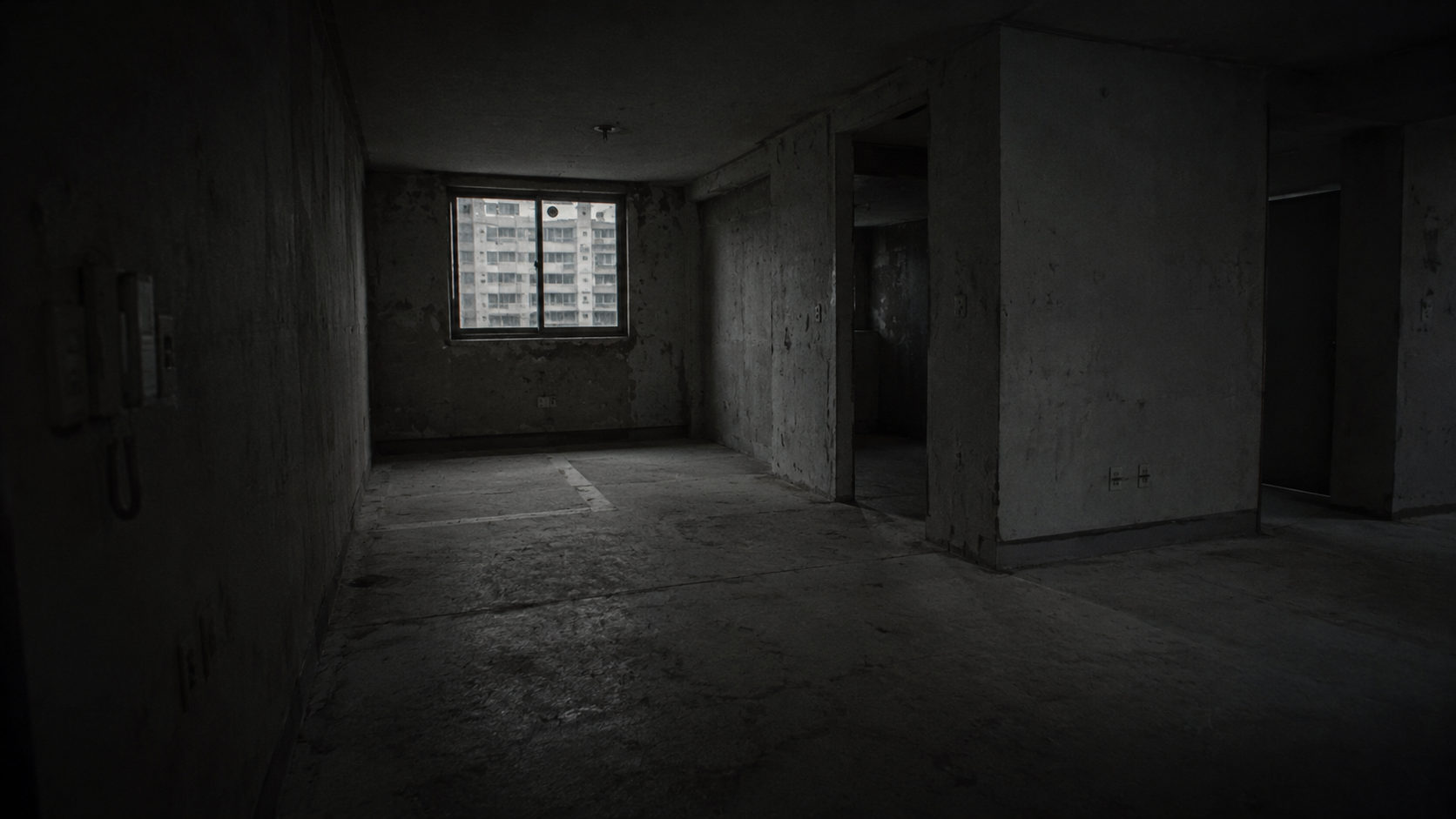
There is a particular variety of disappearance that functions less like a crime and more like a deletion—methodical, structural, almost bureaucratic in its completeness. Kim Ju-ran’s vanishing on December 13, 1999 belongs to that category. She did not flee in panic or dissolve into the anonymous current of a major city’s transit system. She dismantled herself first. In the days or weeks before her brother arrived at her Anyang apartment to find it stripped entirely bare—every drawer emptied, every possession redistributed to strangers—she appears to have been systematically unmaking the evidence of her own existence. Whether this was psychotic episode, compulsive ritual, or something approaching a final act of self-erasure, it produced an effect the South Korean state would then replicate with institutional precision: it left nothing behind.
Her case is not simply a cold case. It is a cultural artifact—the preserved negative space of a woman the late-1990s Korean welfare system was structurally incapable of holding onto, and equally incapable of properly losing.
Historical Anatomy
To locate Kim Ju-ran’s disappearance within its correct historical coordinates, it is necessary to understand precisely what South Korea was in December 1999. The country was twenty months out of the IMF bailout crisis—an economic catastrophe that had gutted the middle class, destabilized family units, and accelerated the privatization of social welfare functions that the state lacked both the infrastructure and the political will to manage directly. The “IMF era,” as Koreans still call it, was not merely a financial event; it was a mass psychological rupture that restructured the implicit social contract between the state and its most vulnerable citizens.
Into this vacuum, private welfare institutions metastasized. A regulatory architecture that had existed in skeleton form since the 1980s expanded rapidly: private operators could claim per-capita government subsidies for housing individuals classified under mental or intellectual disability categories. The incentive structure was, in retrospect, an almost perfectly engineered mechanism for predatory behavior. Operators who maximized headcount maximized revenue; oversight was minimal; and the residents themselves—often involuntarily committed, often without functioning family advocacy networks—had no viable recourse and no voice that the state was equipped to hear.
Kim herself had been classified as Level 2 Intellectual/Mental Disability—a formal administrative category that simultaneously acknowledged her condition and placed her in the demographic most systematically targeted by what would later be documented as a shadow economy of coerced institutionalization. She had survived three involuntary psychiatric hospitalizations in the mid-1990s. Her brother, apparently both loving and overwhelmed, had arranged for her to live independently in a nearby unit rather than continue the cycle of hospitalization. It was a compromise that left her, as December 1999 approached, in the exact position these institutions were designed to exploit: alone, classified, documented, and unmonitored.
She vanished at the threshold between the analog and digital eras—on the literal eve of the millennium—before the institutional capture of her demographic had become the subject of investigative journalism, before parliamentary commissions, before the landmark 2014 Joseon Ilbo exposés that finally began to make the phrase “welfare facility abduction” legible to mainstream Korean public consciousness. She disappeared into a system that, at the moment of her disappearance, did not officially exist.
Structural Dissection of the Record
The formal documentary record of Kim Ju-ran’s disappearance is, by any investigative standard, catastrophically thin. This is itself diagnostic.
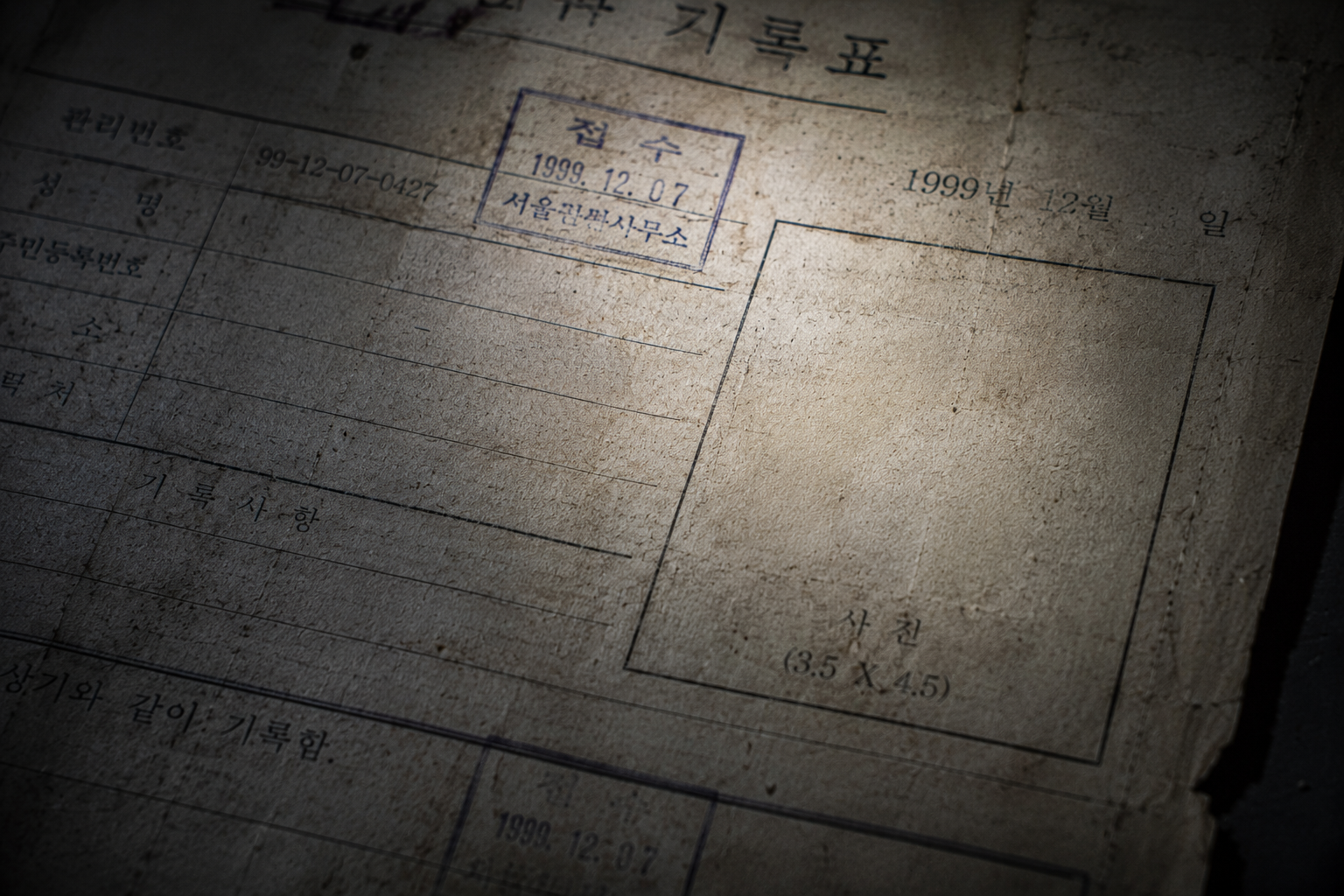
When her brother arrived on the morning of December 13, 1999 and found the apartment cleared—furniture gone, belongings distributed, the physical infrastructure of a life disassembled—he filed a missing persons report that same evening. That report, the foundational document of what would become a cold case spanning more than two decades, contains no preserved physical description of the clothing she was last seen wearing, no witness accounts of her movements in the preceding days, and no forensic scene photography of the apartment in its stripped state.
This last absence is particularly significant. The cleared apartment—which would later acquire a kind of folkloric weight in online communities drawn to unexplained disappearances—was never photographed as evidence. The physical record of Kim Ju-ran’s final known act, the space that most clearly indexed her psychological state in the hours before she vanished, was documented only in the memory of family members. It was not preserved; it was not analyzed; it aged, changed hands, and eventually became something else entirely.
Her official registry status lists her as a long-term missing person under her disability classification. This categorization, while administratively accurate, also meant that her case was processed through frameworks designed for adults with impaired decision-making capacity—frameworks that, in 1999, carried implicit assumptions about voluntary wandering, institutionalization-seeking behavior, and the general incapacity of this demographic to be victims of targeted criminal acts. The classification that should have protected her appears to have functionally reduced the investigative urgency of her disappearance.
The forensic status as of 2026 is unambiguous in its bleakness: zero digital traces, no banking activity, no verified sightings. The DNA deadlock compounds this. Kim’s surviving biological daughter—the only viable source for a definitive maternal genetic profile that could be cross-referenced against Korea’s missing persons forensic databases—lost contact with the family in the early 2000s. She exists somewhere in the anonymous urban system of modern Seoul; her whereabouts are unknown; and without her cooperation, the technological infrastructure that might resolve the case cannot be activated.
Psychological Necropsy
The Kim Ju-ran case distributes its disturbance across two registers that are worth separating analytically, because they disturb different things.
The first register is the specificity of the cleared room. For Western observers encountering this case through English-language true crime communities or uncanny horror subforums, the detail that she had repeatedly stripped her apartment bare—compulsively gifting her possessions to strangers, dismantling the material evidence of her own presence—activates something that resists easy categorization as either crime or mental illness. It reads, in the cultural grammar of Western psychological horror, as an act of self-authored erasure; a woman systematically preprocessing her own disappearance. The fact that this behavior was documented prior to her vanishing—that it was known, recognized, and nevertheless insufficient to prevent what followed—adds a layer of institutional failure that transforms the apartment from a crime scene into something closer to a testament.
The second register is the systemic one, and it disturbs more slowly. The concept of a shadow economy of targeted abduction operating under state subsidy—of a regulatory architecture so poorly designed that it created financial incentives for the capture of people with mental disabilities and then provided no mechanism to audit where those people went—is not a horror that Western audiences can comfortably externalize as a uniquely Korean pathology. The privatization of welfare, the commodification of the vulnerable, the structural invisibility of populations classified as requiring care: these are not culturally specific failures. They are structural tendencies that manifest differently across different regulatory environments, but whose underlying logic is recognizable across multiple national contexts.
What disturbs is the recognition that the system did not malfunction. It functioned exactly as designed. The subsidy economy required bodies; Kim Ju-ran’s disability classification made her a documented body; the absence of forensic rigor in her initial missing persons processing meant that no institutional friction was created when she disappeared into that economy. The machinery worked.
The Evidence of Erasure
The erasure of Kim Ju-ran operated across at least three distinct channels, each reinforcing the others.
The first was institutional. The welfare system’s opacity—deliberately cultivated by facility operators whose financial model depended on minimizing external accountability—meant that even families with active search strategies faced structural barriers that investigators with legal authority routinely failed to breach. Her brother’s response to this barrier is one of the more quietly extraordinary elements of the case: confronting the impossibility of conventional investigation, he assembled a traveling street performance troupe—an analog variety show—that could move through rural regions, perform traditional arts outside the walls of private facilities, and scout properties that refused official entry. In the pre-digital, pre-internet landscape of regional South Korea, this was not an eccentric strategy. It was, arguably, the only available one. The performance was a forensic instrument.
The second channel of erasure was the analog-to-digital transition itself. Kim’s disappearance fell into the precise temporal gap between the end of one archival regime and the beginning of another. Paper-based records from 1999 were unevenly digitized as government agencies modernized throughout the 2000s; missing persons cases from this period were selectively migrated into new databases based on criteria that did not always weight older cold cases from marginalized demographics as high-priority entries. The information that might have persisted—witness accounts, contextual records, the apartment’s documented state—existed in forms that did not survive the transition. She was lost twice: once physically, once archivally.
The third channel is the DNA gap—which functions less as a forensic obstacle and more as a structural metaphor for the entire case. The technology to potentially identify Kim Ju-ran exists; it has existed for years. The nationwide forensic database infrastructure is operational. What is missing is the biological sample—held by a daughter who herself became unreachable sometime in the early 2000s, absorbed into the same anonymous urban system that may or may not hold her mother. The case cannot close because the key to closing it disappeared at approximately the same time as the subject herself. This is not coincidence; it is the compound effect of a welfare system that systematically degraded the family structures of the people it failed.
The Point of No Return
Digital memory is routinely described as permanent—a correction of the analog era’s tendency to lose things. The Kim Ju-ran case demonstrates that this is a category error. Digital memory is not permanent. Instead, it is selectively transcribed. What gets digitized, what gets indexed, what gets weighted by search algorithms and cross-referenced in forensic databases and preserved in online archives—these are not neutral processes. They reflect the same hierarchies of institutional attention that governed which missing persons cases received forensic rigor in 1999.
Kim Ju-ran exists in digital memory primarily as an internet phenomenon; a case circulated in uncanny subcultures, processed through the aesthetic registers of analog horror, valued for the psychological texture of the cleared room. This attention is genuine and it is not nothing—online communities have, in documented cases, generated investigative leads that official channels missed. But it is also a transformation. The woman who was a person—who was born in 1952, who had aspirations in entertainment that her family suppressed, who survived abuse and institutionalization and divorce, who lived in an Anyang apartment and gave her belongings away to strangers—has been substantially replaced, in the default archive of human experience, by an archetype.
The archetype is compelling precisely because it is stripped of biographical specificity. The cleared room is terrifying; the structural conditions that produced the cleared room, and the cleared records, and the cleared forensic documentation, are harder to hold in the mind and harder to aestheticize. Internet mythology, which thrives on the uncanny and struggles with the systemic, has preserved her in a form that is easier to circulate than to resolve.
The uncomfortable truth is this: the same structural forces that allowed Kim Ju-ran to be swallowed by South Korea’s asylum shadow economy in December 1999 also shaped what digital memory chose to retain about her afterward. The archive is not a neutral repository. It is an institution. And like all institutions, it tends to reproduce the priorities—and the omissions—of the systems that built it.
Her daughter is somewhere in Seoul. The database is waiting. The room has been empty for twenty-six years.
🔍Search Update: Call to Action
For open-source investigators, internet archeologists, and international lost media researchers, the Kim Ju-ran case remains a critical point of active inquiry. The structural wall holding back digital matching is entirely dependent on tracing her surviving biological daughter, who faded from public records in Seoul during the early 2000s. If you possess access to early millennial South Korean web archives, regional telephone directories, community forums from the transitional period, or have information regarding unidentified individuals tied to unregulated regional care facilities from the late 1990s, contact the National Missing Persons Center at 182 or submit detailed analyses through open investigative repositories to bridge the analog-to-digital silence.
This document is an investigative archival reconstruction based on fragmented public records, media remnants, community accounts, and verified historical sources compiled by The 3AM Archive.
The article examines how incidents, forgotten media, internet folklore, and unresolved public memories evolve through cultural preservation and digital decay.
This is a cultural investigation document — not fictional horror content.
All visual materials used in this post are exclusive AI-generated assets created for The 3AM Archive.
