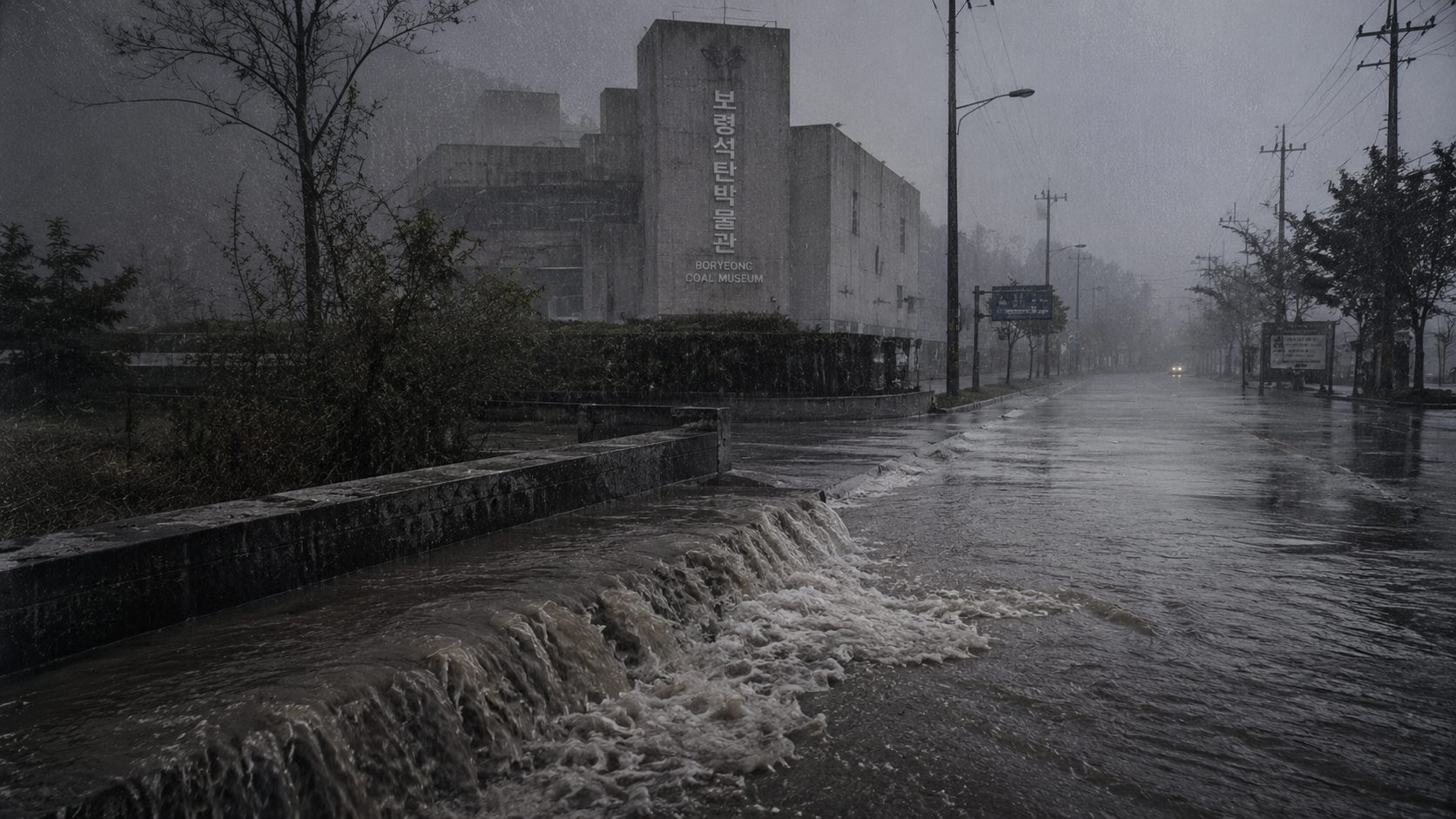
There is a specific category of disappearance that the archive cannot metabolize. Not the cases resolved by confession, not the tragedies confirmed by recovered remains—but the ones that end without punctuation, suspended in the administrative limbo of a missing persons registry, accruing years like sediment over an object no one can find. Park Yoon-hee has been missing for twenty-six years. She is registered. She is documented. And she is, by every forensic and archival measure, entirely absent.
What makes her case a cultural specimen rather than merely a cold case statistic is not the extremity of its violence, nor the complexity of its criminal topology. It is, paradoxically, its completeness of erasure—an erasure so total that even the most buoyant objects she carried have never surfaced. A pink plastic melodica; hollow, sealed, the kind of instrument designed to trap air inside itself; has not once been reported downstream, snagged on riverbank debris, or recovered in any subsequent flood drainage survey in the twenty-six years since August 23, 2000. In cold case forensics, absence is information. Here, absence is the only information available.
The Boryeong Coal Museum disappearance is not a mystery in the conventional thriller-adjacent sense that internet communities prefer. It is a case study in what happens when two distinct systems of erasure operate simultaneously: the environmental and the institutional. When a flash flood and an analog archive fail a child at the same moment, the resulting void does not merely go unsolved. It becomes a structure—a permanent gap in the record that internet folklore rushes to fill with its own preferred geometries.
Historical Anatomy
August 2000 in South Chungcheong Province was not a neutral context. South Korea in the year 2000 was a nation still metabolizing the trauma of the 1997–1998 IMF financial crisis; a period that had shredded institutional confidence, accelerated rural economic decline, and left provincial infrastructure operating on reduced budgets and reduced personnel. Boryeong—a mid-sized coastal city whose economy had historically leaned on coal extraction and light industry—was not an urban center with redundant emergency systems. It was a place where a single severe weather event could strain every coordinated response mechanism simultaneously.
The Boryeong Dam’s emergency floodgate release on August 23rd was not an administrative failure in the conventional sense; it was, by the protocols of the time, the correct institutional response to critically elevated water levels. But correctness at the systemic level produced catastrophic consequences at the human scale. The Seongju Stream, which ran parallel to the road networks connecting Seongju Elementary School to the surrounding residential areas, breached its banks rapidly. The release was not a slow surge. Emergency floodgate protocols, by design, move water fast.
Critically: 2000 was the precise inflection point between analog and digital record-keeping in South Korean municipal administration. CCTV infrastructure in provincial cities was sparse to nonexistent along residential and semi-rural corridors. Missing persons cases from this era exist in a documentation twilight zone—detailed enough to have generated official records and search reports, but too early to have produced the kind of digital trace that would make subsequent archival reconstruction possible. There are no traffic camera stills. Is there phone location data? No, the records are completely silent. The witnesses who existed were human; their memories have since aged twenty-six years.
Elementary school dismissal protocols during active storm warnings in 2000 were inconsistently applied across South Korean school districts. Whether Seongju Elementary dismissed early or on schedule that afternoon is a detail that—like so many details in this case—exists somewhere in a physical administrative record that may or may not have survived subsequent filing cycles, office relocations, or institutional restructuring.
Structural Dissection of the Record
The official record of Park Yoon-hee’s disappearance contains one detail that functions as a permanent structural anomaly: the designation of the Boryeong Coal Museum as the terminal point.
This designation was not derived from interior witness accounts. No museum staff member placed her inside the facility. No visitor log entry recorded her name. No eye-witness has ever confirmed, on record, that Park entered the museum at any point on August 23rd. The Coal Museum appears in her missing person documentation as an approximation—a landmark near which she was last plausibly headed, rather than a confirmed location at which she was confirmed present. The distinction is not administrative pedantry. It is the difference between a known last location and an inferred one; and the archive, by treating the latter as the former, introduced a foundational ambiguity that has structured every subsequent theory about her fate.
Her older brother, Park Yoon-sung, was the last confirmed witness. He was with her when she exited the school gates. She refused to walk home with him—explicitly, according to the accounts that exist—stating she was going to a friend’s location instead. This is the last verified human interaction on record. Everything after the school gate is extrapolation.
The multi-week aquatic and terrestrial search of the Seongju Stream basin produced nothing. Professional search operations of this kind, conducted downstream from a flood zone, routinely recover fabric remnants, synthetic materials, and debris. Synthetic textiles from the early 2000s—the kind of material in a child’s school bag, sandal straps, or wind instrument casing—are not biodegradable on a timeline of weeks. The absence of these objects in the immediate search sweep is the datum the archive cannot explain and has never satisfactorily addressed.
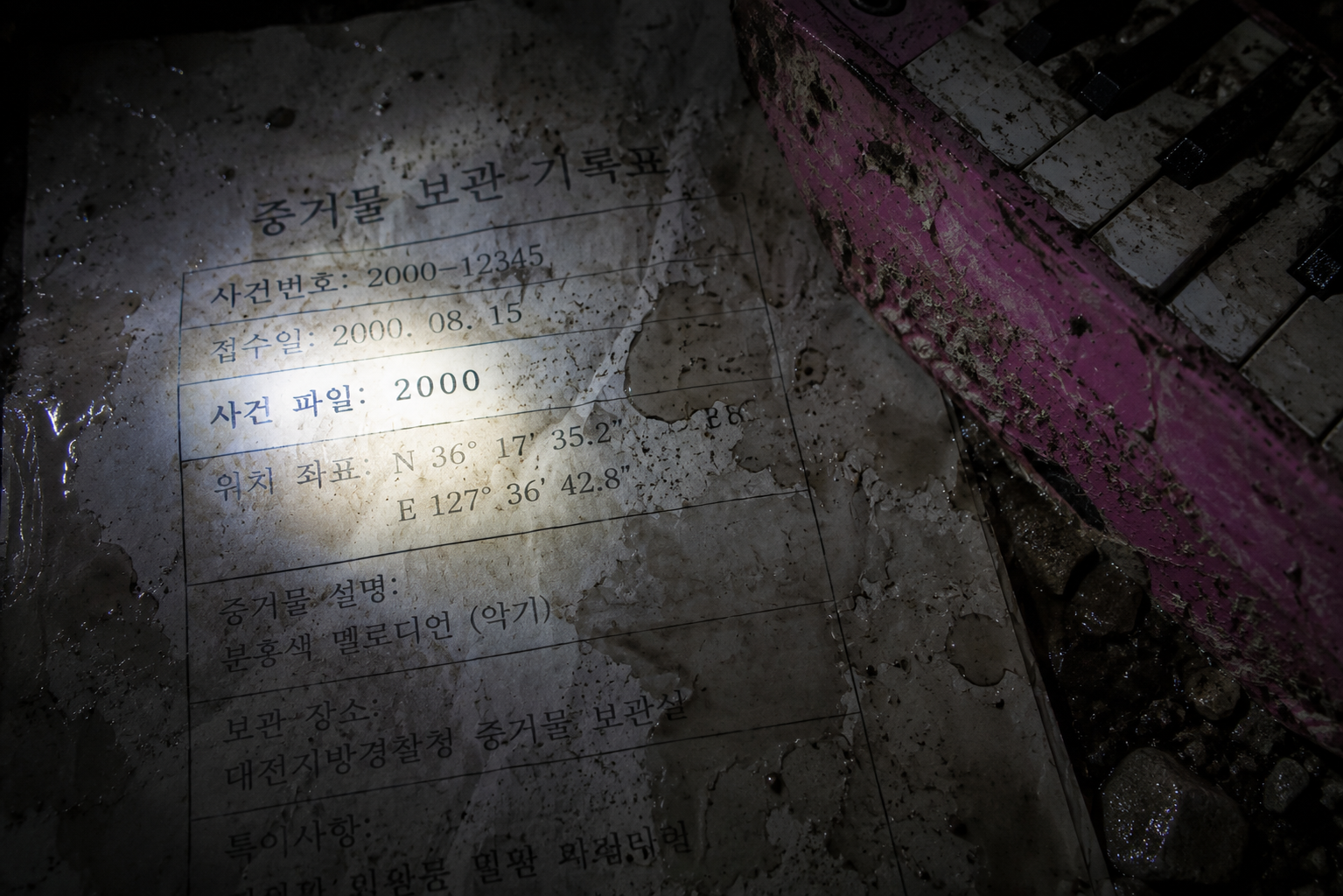
The pink melodica occupies a specific forensic category: it is a hollow, sealed plastic instrument approximately the size of a child’s forearm. Its material properties would make it among the most buoyant objects in any flood scenario. The complete absence of this single object from the downstream recovery record is the case’s most durable anomaly. It has not washed ashore in twenty-six years of subsequent Seongju Stream flood events. It has not surfaced in dredging operations, routine or otherwise. It does not appear in any secondary recovery log.
Psychological Necropsy
The Western true-crime imagination has a particular relationship with industrial landmarks. A coal museum, presented to an English-language audience, activates an entire vocabulary of post-industrial uncanny—the darkened exhibit hall, the preserved mining equipment, the institutional silence of a municipal space with reduced foot traffic. It reads, in the Western register, as inherently liminal; a space between productive use and memorialization, haunted by the labor it commemorates.
This is a significant cultural distortion. In early-2000s provincial South Korea, municipal museums celebrating regional industries were unremarkable civilian spaces. Children used them as landmarks, meeting points, and shelter from bad weather with exactly the same casual familiarity that Western children might use a public library or a community center. There was nothing architecturally or socially exceptional about a child directing herself toward the Coal Museum during a rainstorm; it was, in the behavioral vocabulary of Boryeong’s children, an entirely mundane destination.
The Western interpretive frame imposes darkness onto a building that was, in its local context, simply a building.
And yet the case does contain a legitimate disturbance that requires no cultural misreading to feel—the documented physical tic. Park Yoon-hee, according to the available missing person case documentation, had a habitual somatic behavior: she would punch or tap her lower abdomen with her fist when she needed a restroom. This detail, clinical in its specificity, does something to the imagination that generic physical descriptions cannot. It transforms the abstraction of a missing child poster—age, height, last known clothing—into a specific loop of involuntary physical behavior. It places a body in motion. It gives the absence a texture.
Within internet mythology communities, this detail functions as a vector for distress precisely because it is so ordinary. The gesture is not dramatic. It is the kind of small, private physical language that every child develops; the kind that parents recognize and strangers do not. Its presence in the case file means someone documented it. Its continued presence in the file, twenty-six years later, means it has never been replaced by the confirmation of a body. The loop runs on.
The Evidence of Erasure
Two distinct mechanisms of erasure operated on August 23, 2000, and they did not require coordination to achieve a comprehensive result.
The first was environmental. The emergency floodgate release from the Boryeong Dam did not merely flood the Seongju Stream basin; it actively mobilized the landscape. Fast-moving flood water does not preserve evidence—it disperses it, buries it in sediment, carries it downstream across multiple jurisdictional boundaries, and deposits it in locations that standard search perimeters do not cover. If Park Yoon-hee’s disappearance was a flood fatality, the violence of the water’s movement would explain the material absence. Bodies and objects carried by fast flood surges can travel distances that defeat grid-based search operations. They can lodge in inaccessible terrain. They can be covered by subsequent sediment deposition and remain covered for years.
The second mechanism was institutional. Analog record-keeping in South Korean provincial municipalities in 2000 was not designed for long-term digital retrieval. Case files exist in physical form, in filing systems that have undergone multiple reorganizations over twenty-six years of institutional continuity. Witness accounts recorded in 2000 exist in documents that may have degraded, been misfiled, or been lost in the ordinary entropy of paper administration. The search sweep reports—potentially the most forensically valuable documents in the case—are not publicly accessible in any digitized archive. They exist, presumably, somewhere in the Boryeong or South Chungcheong Provincial Police record system; but their contents have not been reconstructed in any publicly accessible forum.
The combination produces a specific type of case: one that is not actively suppressed, but simply under-documented relative to its archival needs. No conspiracy is required to explain why so little is known. Institutional inertia, physical record decay, and the sheer administrative volume of unresolved cases at any given police agency are sufficient.
The Point of No Return
Internet communities that engage with unresolved cases operate on an implicit assumption: that digital attention constitutes a form of archival rescue. The theory is that if enough people examine the available evidence, circulate the case details, and generate discussion, the probability of resolution increases. For some cases, this has proven true. Tips have surfaced; witnesses have come forward; overlooked documents have been located.
The Boryeong Coal Museum disappearance presents a challenge to this framework that is structural rather than incidental. The case’s primary forensic problem is not lack of attention; it is the absence of recoverable physical evidence and the inaccessibility of the institutional record. No volume of internet community engagement can produce the pink melodica from wherever twenty-six years of sediment have buried it, if it was buried at all. No Reddit thread can digitize the physical search sweep reports sitting in a provincial police archive. The gap in the record is not a gap that attention can close.
What internet engagement has produced instead is a secondary archive—a layer of discussion, theory, and digital documentation built entirely on the existing public record, which is itself thin. The buoyancy paradox of the melodica has become a conceptual anchor for flood-skeptic theories. The Coal Museum’s nominal appearance in the case file has been inflated, by the Western interpretive frame, into something architecturally sinister. The restroom tic has been circulated as a means of humanizing a child who is otherwise accessible only as documentation.
This secondary archive is not without value. It preserves awareness. It keeps the case from the total administrative obscurity that claims the majority of unresolved provincial missing persons cases from the pre-digital era. Park Yoon-hee remains registered. She remains, in the official record, a missing person rather than a presumed fatality. These are not trivial distinctions.
But the secondary archive cannot resolve what the primary archive failed to document. The melodica did not surface in 2000. It has not surfaced since. The Seongju Stream continues to flood seasonally; continues, in its own indifferent geological way, to reorganize whatever the 2000 surge deposited along its banks. If the object is recoverable, its recovery depends on physical chance rather than archival effort.
Twenty-six years after August 23rd, the case sits precisely where the archive left it: at the Coal Museum, which was never confirmed as a destination; at the school gate, which was the last confirmed location; at the stream bank, where the water moved too fast for anything to be found, and where nothing has been found since. The record does not loop. It simply stops—cleanly, absolutely, at the edge of what the analog infrastructure of the year 2000 was capable of preserving. What comes after that edge is not mystery. It is the default archive of human experience, confronted with a case in which everything needed to be remembered.
🔍Search Update: Call to Action
For investigators within the global Lost Media and Analog Mystery communities, the archival status of the Park Yoon-hee file remains static. If you have access to South Chungcheong regional broadcast archives from August 2000, un-indexed local news print files, or provincial search logs regarding the Seongju Stream deluge, please contact our submission desk. The digital reconstruction of these un-digitized analog traces represents the only viable path to penetrating this systemic void.
This document is an investigative archival reconstruction based on fragmented public records, media remnants, community accounts, and verified historical sources compiled by The 3AM Archive.
The article examines how incidents, forgotten media, internet folklore, and unresolved public memories evolve through cultural preservation and digital decay.
This is a cultural investigation document — not fictional horror content.
All visual materials used in this post are exclusive AI-generated assets created for The 3AM Archive.
