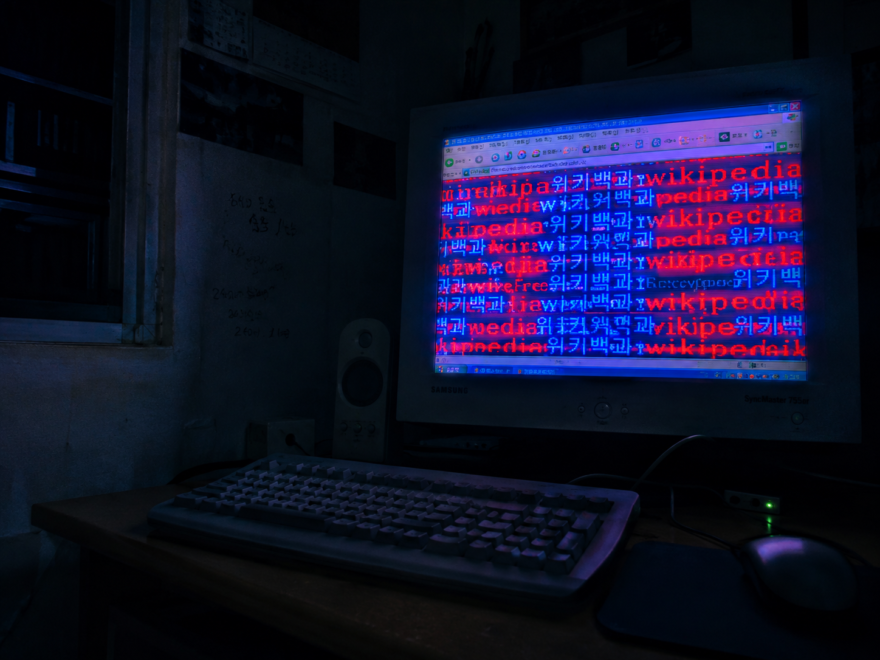
There is a particular category of disappearance that the internet was never designed to process: not the deletion of content, but the deletion of the agent responsible for the deletion. When a Wikipedia article is vandalized and then restored, the archive preserves both wounds—the attack and the recovery, timestamped and attributed. What the archive cannot accommodate is a vandal who simply stops. No arrest, no exposure, no manifesto-style farewell. Just cessation. The Ultra-High-Speed Immediate Deletion Machine—超高速即시삭제마시ㄴ—did not go dark dramatically. It powered down between one edit and the next, somewhere in the drift of August 2011, and left behind a record so saturated with its own garish signature that the silence afterward reads almost like a third act that was deliberately excised.
This is not a story about what the Machine destroyed. It is a story about what the Machine’s disappearance reveals: the structural fragility of collective digital memory, the unresolved post-colonial anxieties embedded in East Asian internet culture, and the specific discomfort that arises when an anomalous system terminates without explanation.
Historical Anatomy
To understand the operational context of the Immediate Deletion Machine, it is necessary to reconstruct the specific texture of the late-2000s Wikimedia ecosystem—because that ecosystem was, by contemporary standards, astonishingly exposed.
Wikipedia’s anti-vandalism infrastructure in 2007–2011 was substantially human-dependent. Automated detection tools existed—ClueBot on the English Wikipedia was already operational—but cross-linguistic coordination between Wikimedia communities was slow, institutionally fragmented, and reliant on volunteer administrators working across time zones with no shared alert infrastructure. The Japanese Wikipedia (ja.wikipedia.org), the Chinese Wikipedia (zh.wikipedia.org), and the Korean Wikipedia (ko.wikipedia.org) operated as functionally separate communities; a threat actor escalating between them faced no unified defensive layer. Administrative blocks on one language edition created zero friction on another.
This was, in retrospect, an architectural gift to a sufficiently motivated automated script.
The late 2000s also carried a specific geopolitical charge in East Asian internet spaces. The period between 2005 and 2012 saw recurring flare-ups of online nationalism across Japanese, Chinese, and Korean communities—disputes over historical textbook content, territorial claims, and the curation of war-era terminology had already transformed Wikipedia’s talk pages and edit histories into low-grade proxy battlefields. The friction between these communities was not incidental background noise; it was the operating environment. Any actor who understood this friction could weaponize it. The Immediate Deletion Machine’s operator understood it precisely.
The bot emerged against this backdrop: a multilingual online environment with distributed governance, no unified threat response, and pre-existing national antagonisms that could be activated by a single word choice.
Structural Dissection of the Record
What the Immediate Deletion Machine actually did is well-documented in edit histories and administrative logs—and yet the record, examined closely, contains gaps that resist easy interpretation.
The operational signature was consistent and immediately recognizable. The script executed blanket-wiping payloads on MediaWiki installations: all existing text in a targeted article was removed and replaced with multi-colored, rapidly repeating lines of 超高速!即時削除!!—”Ultra-High-Speed! Immediate Deletion!!”—rendered in a visual format designed to overwhelm and disorient. The replacement text was not argumentative; it carried no political content, no ideological claim. It was pure erasure-as-spectacle, structural nihilism rendered in garish MIME colors.
The technical execution was sophisticated relative to 2008–2011 defensive standards. The operator used dynamic IP rotation and rapid programmatic account generation—creating fresh accounts faster than administrators could identify and block them. This is not the work of an angry teenager manually refreshing a browser. The engineering investment required to build and maintain this system across a multi-year operational window implies sustained motivation; a level of commitment that casual vandalism does not explain.
The geographic migration pattern is the first major anomaly in the record. The Machine appeared first on Japanese Wikipedia, then crossed to Chinese Wikipedia under shifting blocks, then targeted Korean Wikipedia and the Korean Uncyclopedia (백괴사전). This migration was not random; it followed the contours of blocking activity. Each time administrative countermeasures gained traction on one platform, the script shifted domain. This suggests an operator actively monitoring defensive responses and adjusting deployment accordingly—a sustained, attentive human intelligence behind the automated payload.
The second—and far more analytically significant—anomaly is the language drop. When the Machine targeted Korean-language domains, it included a text payload that did not appear in its Japanese or Chinese attacks: a message addressed directly to the community being vandalized, rendered in Korean, reading approximately: “I’ll write this in Chosun-eo for you guys who can’t read Japanese ♪(^-^).”
This is not vandalism. This is communication—hostile, calculated, and linguistically precise. The operator’s choice of 조선어 (Joseon-eo, or Chōsen-go in Japanese) rather than 한국어 (Hangug-eo, the standard South Korean self-designation) is a move that requires cultural knowledge to execute and cultural knowledge to decode. Chōsen-go is the Japanese-era colonial designation for the Korean language; in contemporary South Korea, its use by a Japanese speaker carries the specific charge of refusing to acknowledge South Korean national sovereignty—treating Korea as a Japanese administrative territory rather than an independent nation. The emoticon appended to the message—♪(^-^)—functions as a deliberate tonal insult, wrapping the provocation in performed cheerfulness.
The operator, in other words, was not simply deleting content. On Korean-language domains, the Machine was making an argument.
Institutionally, the damage registered: approximately forty core titles on Japanese Wikipedia were placed under hard creation-protection locks; dozens of IP addresses and accounts received permanent bans. The administrative record of these countermeasures is preserved. What is not preserved—what the record structurally cannot contain—is any documentation of who was behind the script, how they maintained operational continuity over several years, or why they stopped.
Psychological Necropsy
The Immediate Deletion Machine generates a specific category of unease in Western internet communities that is worth examining precisely because it differs from the unease it generated in its original East Asian context.
Western internet mythology around malicious automated scripts tends to cluster around two archetypes: the purposeless anomaly (a script running beyond its creator’s control, executing damage that nobody intended) and the ideologically motivated attack (hacktivism, state-sponsored interference, targeted harassment campaigns). The Immediate Deletion Machine fits neither archetype cleanly. It had an obvious operator—the nationalist language drop eliminates any serious reading of the bot as autonomous—but its target selection and operational logic don’t map onto recognizable Western categories of political grievance. Deleting Wikipedia articles and replacing them with flashing colored text is not a strategic information operation. It is something closer to performance, and that performative quality, combined with the multilingual engineering investment, produces the specific texture of wrongness that Western audiences find difficult to categorize.
The Machine also activates anxieties about the transparency of the internet’s institutional memory. Wikipedia’s value proposition rests on the premise that knowledge is collaborative, cumulative, and recoverable—that damage can always be undone and the record always restored. The Immediate Deletion Machine did not disprove this premise, exactly; the deleted content was restored, in every documented case. But the Machine demonstrated that the process of restoration was not frictionless; that a sufficiently motivated actor could impose real administrative cost on a knowledge commons without ever being identified or held accountable. The unmasking—which Western internet culture has come to expect as the resolution of any such incident—never arrived.
In East Asian wiki communities, the psychological register was notably different. The Machine was not primarily experienced as an external threat; it was partially domesticated into community culture. The phrase 超高速즉시회복!!—”Ultra-High-Speed Immediate Recovery!!”—emerged as community slang, a kind of administrative gallows humor that reframed the vandal’s signature against itself. This is a culturally specific form of resilience, but it also functions as a form of suppression: transforming threat into meme accelerates the process by which the original incident loses forensic legibility.
The Evidence of Erasure
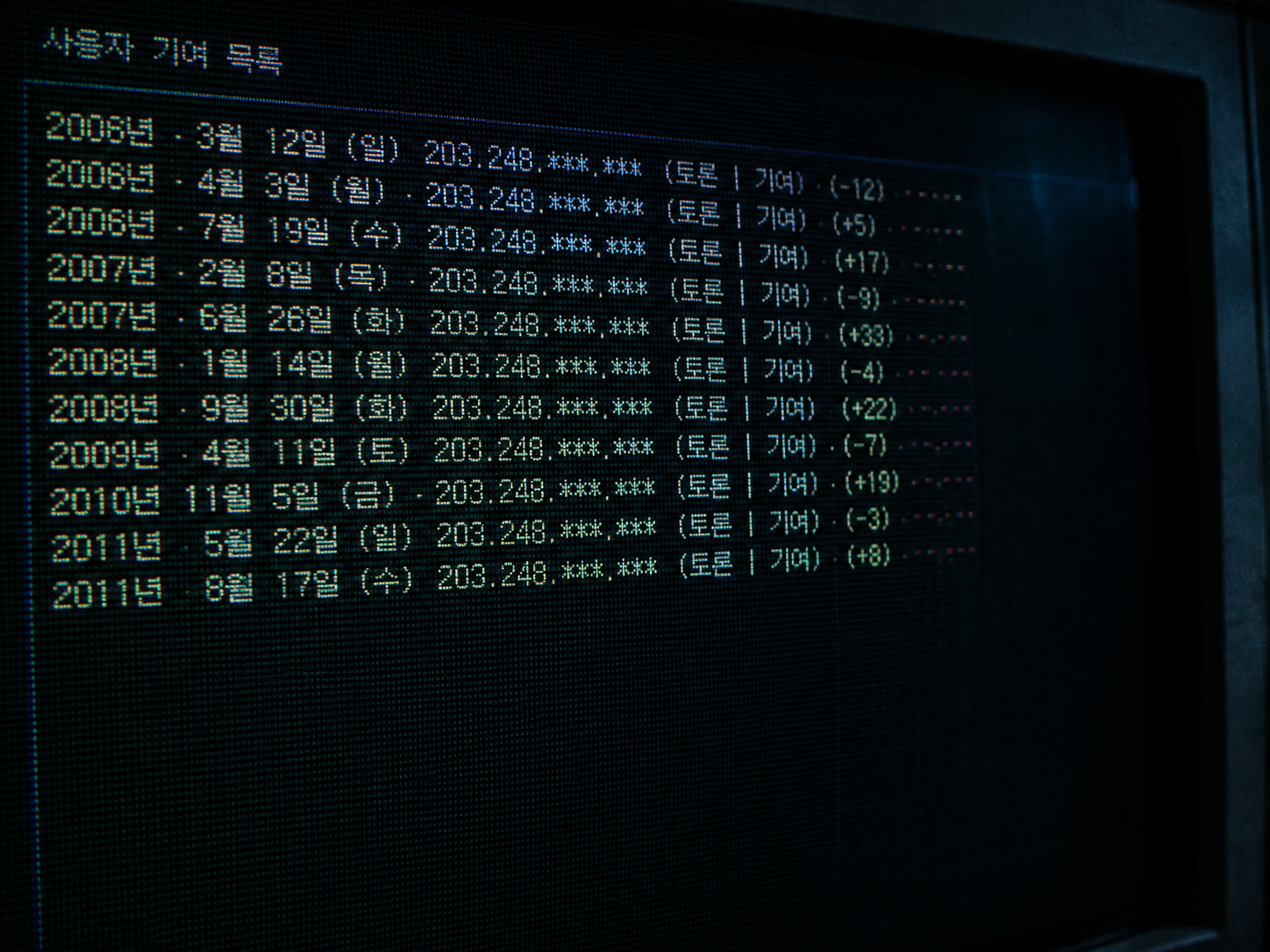
The Machine’s disappearance in August 2011 does not have a documented cause. No takedown notice, no arrest record, no forum post in which the operator announced retirement. The script simply stopped producing edits, and the administrative infrastructure that had been constructed to contain it found itself with nothing left to defend against.
What followed was a specific pattern of information fragmentation that is worth tracing carefully.
The immediate post-cessation period produced silence in official records. Administrators who had spent years tracking the Machine’s IP rotations and account generation patterns had no new data to analyze; the case was effectively closed by the absence of new incidents rather than by resolution. This is a structurally unusual outcome—most vandalism campaigns end when the operator is identified, blocked, or legally compelled to stop. The Machine ended differently: by apparently voluntary cessation, for reasons that remain unattributed.
Between 2015 and 2016, copycat activity emerged on NamuWiki—a Korean-language wiki platform that had not existed during the Machine’s original operational window. The visual format was identical: multi-colored flashing lines, the 超高速!即時削除!! text payload, the same garish aesthetic. These attacks were rapidly suppressed by NamuWiki’s more active administrative infrastructure; they lacked the multi-year sustained energy of the original. But their existence is analytically significant. The visual signature had survived in regional digital archives—screenshots, wiki folklore, community memory—long enough to be reproduced by a new actor who may never have witnessed the original attacks firsthand. The Machine had become, in some limited sense, a template.
February 2018 produced the final documented instance: a localized strain of the same visual attack targeting Korean Uncyclopedia and Uncyclogame. By this point, the incident was eleven years removed from the original operational window. The attack pattern was familiar but context-free—a quotation without a speaker, a visual style detached from whatever animating intent had originally produced it.
The Machine’s erasure, in other words, was not clean. It left residue—aesthetic residue, memetic residue, the specific texture of community slang that had domesticated its signature. But it shed the human intelligence that had originally operated it; that layer was the one thing the archive failed to preserve.
The Point of No Return
There is a working assumption embedded in how Western institutions think about digital accountability—that the internet, by its nature, produces trails; that a sufficiently motivated investigator, given enough time and access, can reconstruct the human agency behind any anomalous event. This assumption is not universally false. It is the default archive of human experience. Wikipedia, however, relies entirely on visible interactions to construct its histories. Wikipedia’s promise of digital permanence is built on the vulnerability of the log. If the actor leaves no trace beyond the edit itself, the system can map the damage but never the intent.
The Ultra-High-Speed Immediate Deletion Machine operated for the better part of three years across multiple language editions of one of the world’s most heavily logged knowledge platforms. Every edit it executed generated a timestamp, an IP record, a diff. The administrative responses generated their own documentation. And yet the operator—whoever engineered a multilingual vandalism platform capable of outpacing human administrative response for years, whoever understood East Asian post-colonial vocabulary precisely enough to weaponize a single word choice, whoever appended a cheerful emoticon to a message calculated to maximize nationalist friction—remains unidentified.
The Machine did not beat the archive. It simply stopped before the archive could close around it.
This is the specific insight that resists comfortable resolution: not that the internet forgets, but that the internet’s memory is conditional on continued activity. The Wikimedia edit logs are complete; every attack is documented. What those logs cannot contain is the silence that followed—and it is in that silence that the Machine’s operator achieved something that no amount of dynamic IP rotation could guarantee: permanent anonymity through the simple act of stopping.
The copycat attacks between 2015 and 2018 demonstrate that the aesthetic survived. The community slang demonstrates that the cultural impact survived. The administrative locks on forty Japanese Wikipedia titles remain in place—institutional scars from a threat that has officially resolved itself. What did not survive is the chain of custody between the visual signature and the human hand that first deployed it.
The archive preserves the wound. It does not preserve the wound-maker. And in the gap between those two absences—the documented damage and the undocumented agent—sits the particular kind of internet history that digital memory was not built to hold: not a story that ends, but a signal that simply goes quiet; an edit session that closes without logging out.
🔍Search Update: Call to Action
The 3AM Archive is actively collecting server logs, community screenshots, and unresolved edit diffs from the 2007–2011 Wikipedia bot wars. If you possess unindexed forum discussions from early Japanese or Korean internet communities tracking the ‘Immediate Deletion Machine’ or its variants, contact our curation desk. The silence surrounding the operator’s infrastructure remains an open gap in early web archeology.
This document is an investigative archival reconstruction based on fragmented public records, media remnants, community accounts, and verified historical sources compiled by The 3AM Archive.
The article examines how incidents, forgotten media, internet folklore, and unresolved public memories evolve through cultural preservation and digital decay.
This is a cultural investigation document — not fictional horror content.
All visual materials used in this post are exclusive AI-generated assets created for The 3AM Archive.
