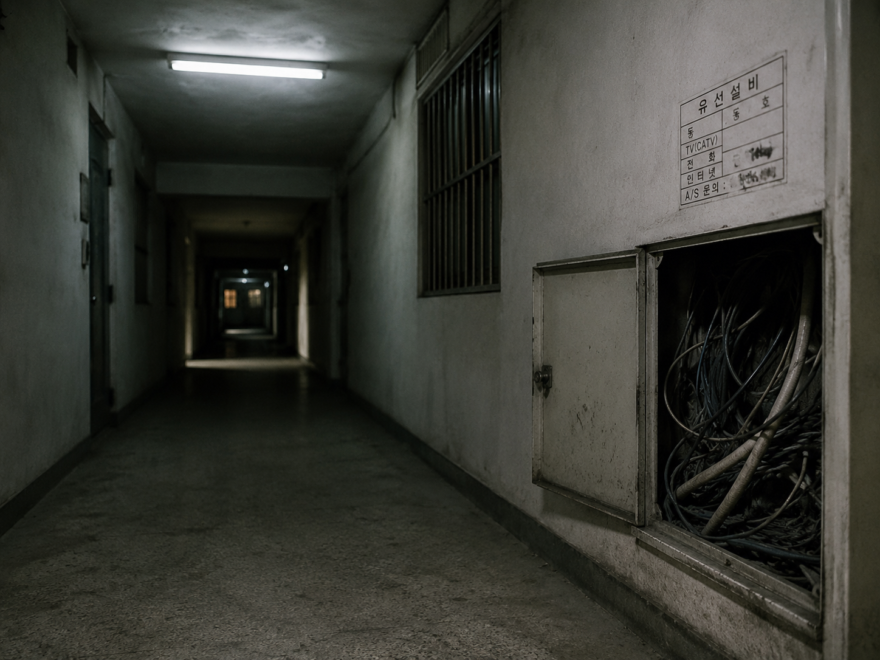
There is a particular kind of deception that operates not through falsification but through omission—where the lie is not what is said but what is never asked. South Korea’s internet infrastructure crisis belongs to this category. For two decades, the country exported a mythology of frictionless connectivity to a world eager to believe it; the image of a hyper-wired peninsula where bandwidth was as ambient as oxygen, where the future had already arrived and been domesticated. The myth was not entirely fabricated. It was, more precisely, selectively maintained—a speed test result, a fiber-optic brochure, a government press release—each artifact true in isolation, each one obscuring the corroding copper skeleton buried in the concrete beneath.
What collapsed during the pandemic was not infrastructure. What collapsed was the alibi.

Historical Anatomy
To understand the architecture of this deception, one must return to its foundation—not in policy, but in timing.
The late 1990s represent a specific and unrepeatable historical window: the moment when South Korea’s developmental state apparatus, having successfully industrialized an economy inside two generations, turned its ambitions toward digital infrastructure with the same disciplined aggression it had applied to steel and semiconductors. The result was Thrunet and its contemporaries, operators that introduced Hybrid Fiber-Coaxial broadband to residential consumers before most Western nations had finished debating dial-up’s obsolescence. HFC—a system threading fiber optic lines to neighborhood distribution nodes, then routing the final stretch through thick coaxial copper cable to individual households—was, in the late 1990s, genuinely impressive. It outperformed analog telephone modems by orders of magnitude. Against that baseline, the coaxial component was not a weakness; it was invisible.
The historical problem is that the baseline kept moving. Fiber-To-The-Home technology—running unbroken glass strands from exchange to endpoint, carrying data as pulses of light rather than electrical signals through copper—matured into a commercially viable and increasingly affordable alternative through the early 2000s. KT, the former state telephone monopoly with the deepest capital reserves and the most extensive existing infrastructure corridors, read the trajectory correctly. It committed to nationwide FTTH rollout. The transition was expensive, disruptive, and strategically sound.
SK Broadband and LG U+ made a different calculation. Both operators had invested substantially in coaxial distribution networks; tearing up physical foundations to replace copper with glass required capital expenditure that could not be justified when their existing HFC networks were still technically functional. So they patched. DOCSIS firmware updates—software modifications to the cable modem protocol—extracted incremental performance improvements from aging hardware at a fraction of the replacement cost. Maximum advertised speeds climbed on paper. The physical medium underneath remained coaxial copper, shared among multiple households per distribution node, subject to electromagnetic interference and contention degradation.
The critical decision—the one that would take a decade to detonate—was pricing. SK Broadband and LG U+ chose not to discount their legacy HFC products relative to KT’s premium FTTH lines. They sold them at parity; the same monthly fee, the same advertised headline speed, described in brochures designed to render the distinction between asymmetric and symmetric routing as invisible as the copper itself. A 500 Mbps subscription was a 500 Mbps subscription. That the HFC version could legally output less than 10 Mbps upstream while complying with every regulatory requirement in force—this was not mentioned.
This was the infrastructure era’s foundational lie: not a forgery but a suppression.
Structural Dissection of the Record
The regulatory record surrounding South Korea’s broadband market reveals a compliance framework engineered, whether by design or institutional inertia, to protect the asymmetry.
The Ministry of Science and ICT’s “Minimum Speed Guarantee” policy—implemented in the aftermath of the 2021 KT 10-Gigabit throttling scandal, itself exposed not by regulatory audit but by a tech whistleblower operating under the name ITSub—established a legal floor of 50% of advertised download speeds. The statute’s specific language confined its protections to downstream throughput; upload speeds remained outside its scope. The practical consequence is geometrically absurd: a consumer subscribing to a 500 Mbps connection was legally protected against download speeds below 250 Mbps, while their upstream connection—the direction in which their own data, their video calls, their remote work transmissions, their uploaded files traveled—could crater to single-digit megabits per second without triggering a single legal obligation.
The architectural reason for this disparity is embedded in the physics of HFC design. Unlike FTTH systems, where symmetric bandwidth is an inherent property of the light-signal medium, HFC networks allocate bandwidth asymmetrically by default—reserving the overwhelming majority of available channel capacity for downstream delivery, on the 1990s engineering assumption that residential consumers primarily received data rather than generated it. The assumption was reasonable in 1998. It describes a mode of internet use that the remote-work economy of 2020 had rendered archaeologically obsolete.
ISP customer service records—reconstructed through community testimonies rather than corporate disclosure—document a systematic linguistic defense mechanism. When consumers contacted call centers reporting upload failures, agents defaulted to scripted responses: service checks, modem reboots, speed test links directing users to servers physically co-located with the ISP’s own network, producing results that measured network performance at its most favorable point and hid the degradation occurring in the final copper hop. The pattern was consistent enough that affected communities on South Korean technology forums began compiling bypass scripts—specific technical vocabulary that disrupted the call-center deflection protocol. Asking about “service quality” produced stalling; invoking “HFC” versus “FTTH” as engineering terms forced agents to access documentation that acknowledged the infrastructure distinction. The vocabulary itself became a diagnostic tool.
Perhaps the most forensically revealing residue is the wire-gauge folk ritual that emerged from residential communities during this period. Unable to obtain honest infrastructure disclosure through official channels, residents began physically measuring the internal cabling of their apartment buildings—using calipers to distinguish the 10-millimeter diameter of shielded coaxial cable from the 2-millimeter fiber strand. The practice required no technical expertise beyond the ability to read a measurement tool; its existence represents something more significant than consumer frustration. It represents the complete collapse of institutional information trust—a society technically sophisticated enough to diagnose its own infrastructure problem, resorting to manual measurement because no official channel would tell it the truth.
Psychological Necropsy
The Western fascination with South Korea’s internet infrastructure has always contained a specific quality of projection; the country functioned as a mirror reflecting a desired future back at observers who had not yet achieved it.
The “broadband wonderland” image that circulated through Western technology media from the early 2000s onward was accurate in one narrow technical sense and misleading in every contextual one. It was accurate that South Korean residential broadband speeds, measured against Western European and North American averages, were genuinely impressive for an extended period. It was misleading in that it stripped those numbers of their architectural context—the distinction between symmetric and asymmetric routing, between fiber and copper, between a connection optimized for passive consumption and one capable of supporting bidirectional high-bandwidth work.
Western observers saw the speed numbers and inferred a uniformity of quality that was never present. The image settled into a persistent myth: South Korea as proof that government-coordinated infrastructure investment could solve the digital divide, that a small and densely populated nation had simply solved the broadband problem. The myth was useful to multiple constituencies—to Korean government promotional material, to Western technology critics advocating for infrastructure investment, to ISPs in both contexts seeking to frame inadequate speeds as a national culture problem rather than a corporate one.
The pandemic dissolved the myth’s utility without dissolving the myth itself. The experience of hundreds of thousands of remote workers encountering upload failures—frozen video calls, dropped collaborative sessions, the specific and demoralizing experience of being technically employed in a modern economy while transmitting data at speeds insufficient to support it—generated public record that contradicted the advertised image. But the contradiction struggled to travel beyond Korean-language media; the Western technology press, having invested decades in the broadband wonderland narrative, was poorly positioned to process its partial collapse.
This is the psychological architecture of the deception’s durability: it did not need to convince everyone simultaneously. It only needed to remain invisible long enough.
The Evidence of Erasure
The mechanisms by which the infrastructure crisis remained submerged for as long as it did are worth examining in sequence, because they operated at different layers of the information environment simultaneously.
Physical concealment was the first layer. Copper is invisible inside concrete. The coaxial cable running through the walls of a 1990s-era apartment block is not observable from inside the unit it serves; the resident experiences their connection through a modem interface, not through the medium itself. The abstraction was total—which is why the calipers-in-the-building-corridor phenomenon is so strange and so diagnostically significant. Physical measurement became necessary precisely because the physical medium had been deliberately abstracted away from consumer awareness.
Regulatory language performed the second layer. The Minimum Speed Guarantee’s exclusive focus on download performance was not, in itself, a conspiracy; it reflected the technical vocabulary of a regulatory framework designed in a different era, before the remote-work economy reframed upload capacity from a secondary specification to a primary requirement. But the effect was indistinguishable from intentional protection: operators were legally insulated from accountability for precisely the failure mode that the 2020–2021 crisis exposed.
Marketing language performed the third layer. The consistent pricing of HFC and FTTH products at parity, combined with advertising that emphasized peak download numbers, created information conditions in which the meaningful technical distinction between the two products was effectively undetectable by a consumer making a normal market decision. The asymmetric specification was present in contracts—buried in technical appendices, described in engineering terminology, surrounded by disclosures designed to satisfy legal requirements without communicating actual performance implications to a non-specialist reader.
The final layer was geography. South Korea’s urban density produced a specific measurement artifact: hyperlocal speed tests, conducted on servers physically adjacent to ISP infrastructure, returned results that could not be reproduced at the household endpoint. The number consumers saw when they measured their connection—and reported to social media, to comparison sites, to government surveys—reflected performance within the fiber backbone, not through the copper last mile. The copper’s contribution was hidden at the measurement level, not just the marketing level.
By 2026, the combination of staggering maintenance overhead, power consumption costs that no longer penciled against the copper network’s remaining service life, and the accumulated weight of public frustration had forced the operators’ hands. The rushed phase-out of HFC infrastructure—announced not as an admission but as a forward-looking modernization initiative—represents the corporate record’s attempt to close the chapter before the autopsy is completed.
The Point of No Return
There is a particular data point that resists comfortable interpretation: the fact that the infrastructure crisis was, at every stage, knowable.
The physics of HFC networks are not proprietary information; the asymmetry of the DOCSIS protocol is documented in publicly available engineering specifications. The regulatory gap protecting upload speeds from minimum guarantees was a textual feature of published policy. The pricing parity between HFC and FTTH products was visible on every ISP’s public-facing website. The caliper-measurement communities on Korean technology forums were openly discussing their diagnostic methods years before the pandemic made the upload failure rate a mainstream news story.
What the crisis reveals is not an information gap but an attention architecture failure—the specific vulnerability of a hyper-connected society to invisible infrastructure degradation, precisely because the society’s hyperconnectivity made the question seem already answered. South Korea had internet speeds. The speeds were fast. The myth absorbed the contradictory evidence; the myth was more legible than the physics.
The post-pandemic transition to FTTH will close the copper gap at the physical layer. What it cannot close is the methodological question the crisis exposes: if a structural failure of this magnitude—visible in the physics, present in the regulatory text, documented in consumer complaints, measurable with hand tools in building corridors—could remain effectively invisible for over a decade, what else is currently buried in the concrete?
The asymmetric network was not hiding. It was simply never looked for. And in that distinction lies the most uncomfortable insight the copper lie produces: that the most durable institutional deceptions are not constructed from secrecy but from the reliable human tendency to stop asking questions once the answer feels obvious.
South Korea had fast internet. Everyone knew that.
The copper in the walls knew otherwise.
🔍Search Update: Call to Action
For archival investigators and Lost Media community researchers tracking the physical trace of early net infrastructure, a severe structural erasure is underway. As South Korean providers rapidly meet their 2026 mandates to purge remaining hybrid nodes, the raw documentation of this infrastructure deficit is disappearing from live hosts. Early technology forum tracking threads, caliper diagnostic datasets, and unedited localized network logs from the early 2000s are dropping offline as older local domains expire.
If you possess archived technical contract appendices from SK Broadband/LG U+ (circa 2005–2015), raw packet captures documenting multi-channel DOCSIS upstream bottlenecks, or early photographic evidence of residential wire measurements, please submit your findings to our secure archival ledger. The digital record of this era should not be rewritten as a frictionless modernization; help us keep the physical medium documented before the last legacy node is permanently severed.
This document is an investigative archival reconstruction based on fragmented public records, media remnants, community accounts, and verified historical sources compiled by The 3AM Archive.
The article examines how incidents, forgotten media, internet folklore, and unresolved public memories evolve through cultural preservation and digital decay.
This is a cultural investigation document — not fictional horror content.
All visual materials used in this post are exclusive AI-generated assets created for The 3AM Archive.
