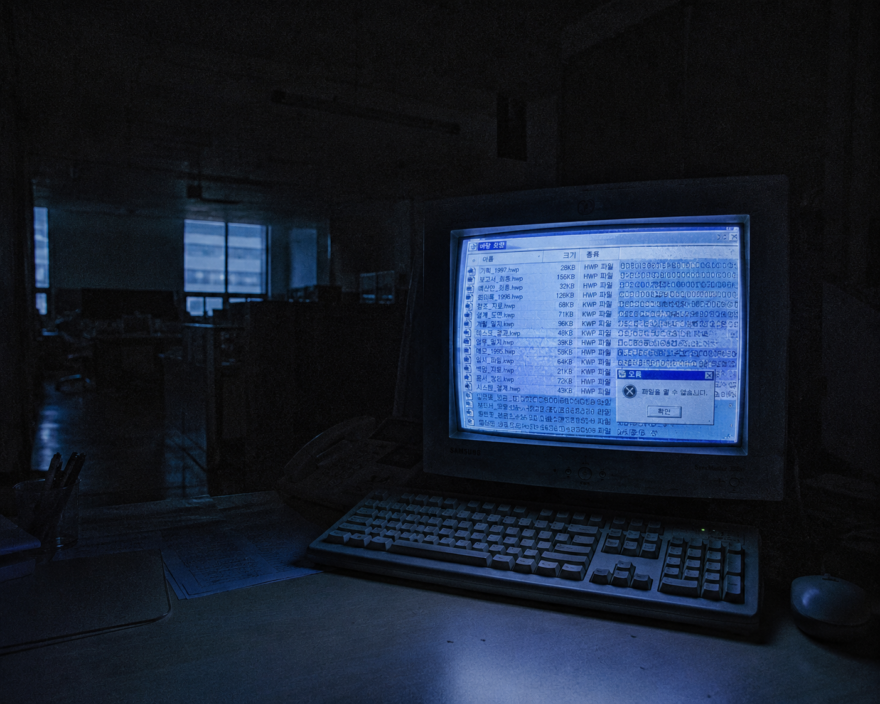
In the early hours of July 10, 2009, while most of Seoul slept, a piece of malware quietly began sorting through the hard drives of tens of thousands of South Korean computers. It wasn’t looking for credit card numbers. It wasn’t harvesting passwords or intercepting military communications in real time. It was doing something far more methodical—and, in retrospect, far more disturbing. It was looking for .hwp files. For .alz archives. For the obsolete bureaucratic relics stored in .hna and .kwp formats, document standards so specifically South Korean that any foreign analyst encountering them would have needed a reference manual to understand what they were. Once located, these files were compressed into password-protected archives with deliberately corrupted header binaries. Recovery wasn’t merely difficult. It was, by design, mathematically impossible.
This is not a story about a cyberattack. Or rather, it is not only that. It is a story about what a society reveals when it examines what was taken from it—and what it chooses to mythologize when the forensic record collapses into political convenience.
Historical Anatomy
To understand the 2009 offensive, one must first understand the decade that preceded it; specifically, the particular kind of digital vulnerability that South Korea had engineered for itself through the sheer velocity of its own modernization.
By the late 1990s, South Korea had built what was, by global standards, a remarkably advanced broadband infrastructure. The density of its urban population, combined with aggressive government investment, had produced internet penetration rates and connection speeds that outpaced most of the Western world. But speed, in this context, carried its own pathology. The cultural and institutional frameworks required to manage a hyper-connected population—security literacy, regulatory oversight of software distribution, public cyber-hygiene norms—had not kept pace. The peninsula had wired itself faster than it could defend itself.
The first demonstration of this structural gap came not in 2009 but a decade earlier. On April 26, 1999, the CIH virus—written by Taiwanese student Chen Ing-hau in 1998 and dormant inside pirated software packages and magazine-bundled CD-ROMs circulating through South Korea’s unregulated peer-to-peer networks—executed its payload. Approximately 1.1 to 1.2 million machines went dark nearly simultaneously. Screens turned black; BIOS chips failed to post. The dual payload was precise: it zeroed out the first 1,024 sectors of each affected hard drive, destroying the Master Boot Record and partition tables, then attempted to overwrite Flash BIOS firmware—effectively lobotomizing the machine at two levels simultaneously. Estimated initial damages exceeded ₩250 billion, the equivalent of over $200 million USD. AhnLab, the domestic security firm, had issued public warnings the previous day; they were, by nearly all accounts, comprehensively ignored.
What followed was sociologically instructive. South Korea in 1999 lacked a centralized digital emergency notification system of any kind. The public was informed of the crisis not through institutional channels but through analog broadcast television—emergency text crawls scrolling across the bottom of evening soap operas and variety programs, warning viewers that turning on their computers in the morning might be inadvisable. The image is worth dwelling on: a population encountering the concept of mass hardware failure through the same medium that delivered weather reports and celebrity gossip. The domestic internet, such as it was, had not yet developed the infrastructure to warn people about the dangers of the domestic internet.
The repair industry that emerged in the crisis’s aftermath operated on a principle of deliberate informational asymmetry. Technicians across Seoul and its surrounding cities informed customers—with apparent confidence—that the virus had physically “melted” internal components; that motherboards, not merely BIOS chips, required replacement. For users with no framework to evaluate the claim, it was entirely credible. The actual remediation in many cases required little more than a CMOS flash or a chip hot-swap. The mythological residue of “melting hardware” outlasted the crisis itself by years, propagating through web forums and word of mouth until it had calcified into received folklore.
The 2009 attacks, known in Western cybersecurity literature as “Operation Troy,” arrived against this backdrop—a population that had already metabolized one catastrophic network failure and had developed, in response, neither significantly better security infrastructure nor substantially greater institutional transparency.
Structural Dissection of the Record
The July 2009 campaign was not, forensically speaking, a single event. It was a layered operation with a deceptive public face and a more precise internal logic.
The first wave launched on July 4—targeting United States government infrastructure, which dominated the initial Western news coverage. The second wave, on July 7, centered almost entirely on South Korea: the Blue House, the National Assembly, major commercial banks, and the portal infrastructure undergirding daily civilian digital life. The botnet that executed these distributed denial-of-service attacks comprised somewhere between 20,000 and 166,000 compromised “zombie PCs”—a range so wide that it constitutes its own kind of forensic admission. Nobody, at the time of most public reporting, actually knew how large the weapon was.
South Korea’s National Intelligence Service identified command-and-control infrastructure registered to the North Korean Ministry of Posts and Telecommunications and moved quickly toward attribution. The United States State Department formally expressed skepticism on July 10—the same day the tertiary payload triggered—declining to endorse direct state attribution. This temporal coincidence is worth noting: the official American distancing from the North Korea thesis arrived precisely as the attack’s most sophisticated and least-discussed component was executing.
That component—the file-extension payload—is where the forensic record becomes genuinely strange. The malware did not behave like a blunt instrument. It behaved like something that had been briefed. The 35 file extensions it targeted included international standards, yes; but the list’s specificity derived from its South Korean content. The .hwp format is the native file type of Hangul Word Processor, a proprietary South Korean word processing application dominant in government, legal, and educational contexts. .alz is a compression format developed by ESTsoft, a South Korean company, with negligible global market penetration. .gul belongs to Hunminjeongeum, another domestic word processor. And .hna and .kwp—Hana Word Processor formats—had been extensively used by South Korean military branches and municipal administrations through the 1990s before largely falling out of civilian use.
The payload, in other words, was not targeting South Korean computers by accident. It was targeting the specific documentary residue of South Korean institutional life. These were the files that contained administrative records, bureaucratic correspondence, locally archived government documents. An attacker building this target list without specific cultural and technical knowledge of South Korean software ecology would not have included them. The list implies research. It implies familiarity. The attribution question—North Korean state actor versus independent operator versus something more complicated—was never definitively resolved. The master server orchestrating the final wave was eventually traced to a commercial facility in Miami, Florida, routing through relay nodes across 16 countries.
Psychological Necropsy
For a Western audience, the specific texture of these events is difficult to locate within familiar frameworks. Western cyberattack narratives tend to organize themselves around comprehensible targets: financial systems, electoral infrastructure, industrial control systems. The implicit assumption is that the attacker wants something recoverable—leverage, money, strategic advantage. The 2009 payload’s logic resists this. It did not extract the files it found. It destroyed them in place, in a manner specifically designed to foreclose recovery. The goal was not possession. It was erasure.
The cultural specificity of the targeting amplifies this discomfort. A piece of malware that hunts exclusively for .docx and .pdf files feels like infrastructure vandalism—crude, damaging, but generically so. A piece of malware that hunts for .hwp and .kwp feels like something else; it feels, to use the autopsy metaphor that fits this analysis, like a wound that required anatomical knowledge to inflict. Someone, somewhere, knew what Hana Word Processor was. Knew that South Korean municipal and military offices had been using it. Knew that the files it produced—by 2009 already relics of a prior bureaucratic era—would be stored on civilian machines with minimal backup protocols and no reliable path to reconstruction.
The 1999 crisis generated its own mythology, but one rooted in material misunderstanding: the melting hardware, the bricked silicon, the predatory repair economy. It was a mythology of physical catastrophe, legible and tactile. The 2009 mythology is more dissonant. The champagne toast rumor—reports, unverified and almost certainly fabricated, of a young Kim Jong-un celebrating with military hackers as the Blue House network collapsed—served a psychological function. It gave the event a face, a motive, a legible villain. The Miami server, meanwhile, the actual documented forensic anomaly, received a fraction of the coverage. A geopolitical ghost story is easier to metabolize than an unresolved forensic question about a commercial server node in Florida routing attacks through 16 countries.
The Evidence of Erasure
The 2009 attack’s cultural afterlife has been shaped by several overlapping forms of suppression and fragmentation—none of them coordinated, some of them structural, all of them effective.
The most direct is simply physical. Files that were encrypted with corrupted headers are gone. This is not a recoverable situation pending better forensic tools; the mathematical reality of the corruption is final. Whatever .hna and .kwp documents existed on the affected machines in July 2009 no longer exist in any accessible form.
Beyond the literal data loss, the institutional response to the attack actively foreclosed certain lines of inquiry. The NIS attribution to North Korea—contested by American analysts but never formally retracted—provided a narrative container that absorbed the event’s ambiguity. Once the attack had been framed as North Korean state aggression, the more peculiar forensic details became difficult to discuss publicly without appearing to defend or exonerate Pyongyang. The Miami server, the 16-country relay network, the impossibility of definitive attribution—these details were not suppressed in any conspiratorial sense. They were simply inconvenient to the available story, and so they drifted toward the margins of the public record.
The urban mythology that subsequently developed on South Korean internet forums—particularly DC Inside, the platform that has served as the informal archive of domestic digital culture for over two decades—filled the epistemic vacuum with narratives calibrated to the available anxiety. The most persistent of these concerns the .hna and .kwp deletion. Forum threads, circulating without verifiable sourcing, claim that the targeted destruction of these formats produced a decade-long blank spot in South Korean municipal and military administrative records; that conscription anomalies, cold-case materials, and local government correspondence from the late 1990s disappeared not because the files were deleted from servers but because the only surviving copies had been sitting on civilian machines in compressed archives, precisely the kind the malware was built to find.
Whether this is factually accurate is, at this point, structurally unknowable. The files cannot be examined because the files no longer exist.
The Point of No Return
What the 1999 and 2009 crises share—beneath the obvious differences in sophistication, attribution, and scale—is a common diagnostic finding. South Korea’s early and aggressive adoption of networked infrastructure created a specific category of risk that its institutional frameworks were not designed to address: the risk of simultaneous, culturally targeted data loss at civilian scale.
The 1999 attack was indiscriminate; it killed machines without preference. The 2009 payload was selective to the point of implying curation. The decade between them was not, from a defensive literacy standpoint, a decade of adequate preparation. The population remained dependent on consumer-grade machines, minimal backup culture, and an emergency notification infrastructure that, as late as 2009, still relied substantially on television text crawls to communicate that the digital environment was actively hostile.
What makes the 3AM archive—the term has no official provenance; it describes a subjective category, the documents that existed only on hard drives that no one had thought to protect—genuinely irrecoverable is not the sophistication of the malware. It is the institutional assumption, widely shared across the affected population, that data on a personal machine was a stable form of storage. What if the computer screen was not a gateway to a default archive of human experience? What if digital permanence was an illusion sustained entirely by our own passivity? That .hwp files did not need to be backed up because where would they go? That .kwp documents from 1998 were artifacts, yes, but artifacts that simply existed, inertly, on drives that simply worked.
The master server in Miami went dark. The relay nodes across 16 countries fell silent. The botnet dispersed. And somewhere in South Korea’s municipal memory, there is a gap—quiet, unindexed, and permanent—where a decade of administrative records used to be. The state attributed it to a government it couldn’t prove was responsible. The forensic record pointed somewhere stranger. The files were gone either way.
🔍Search Update: Call to Action
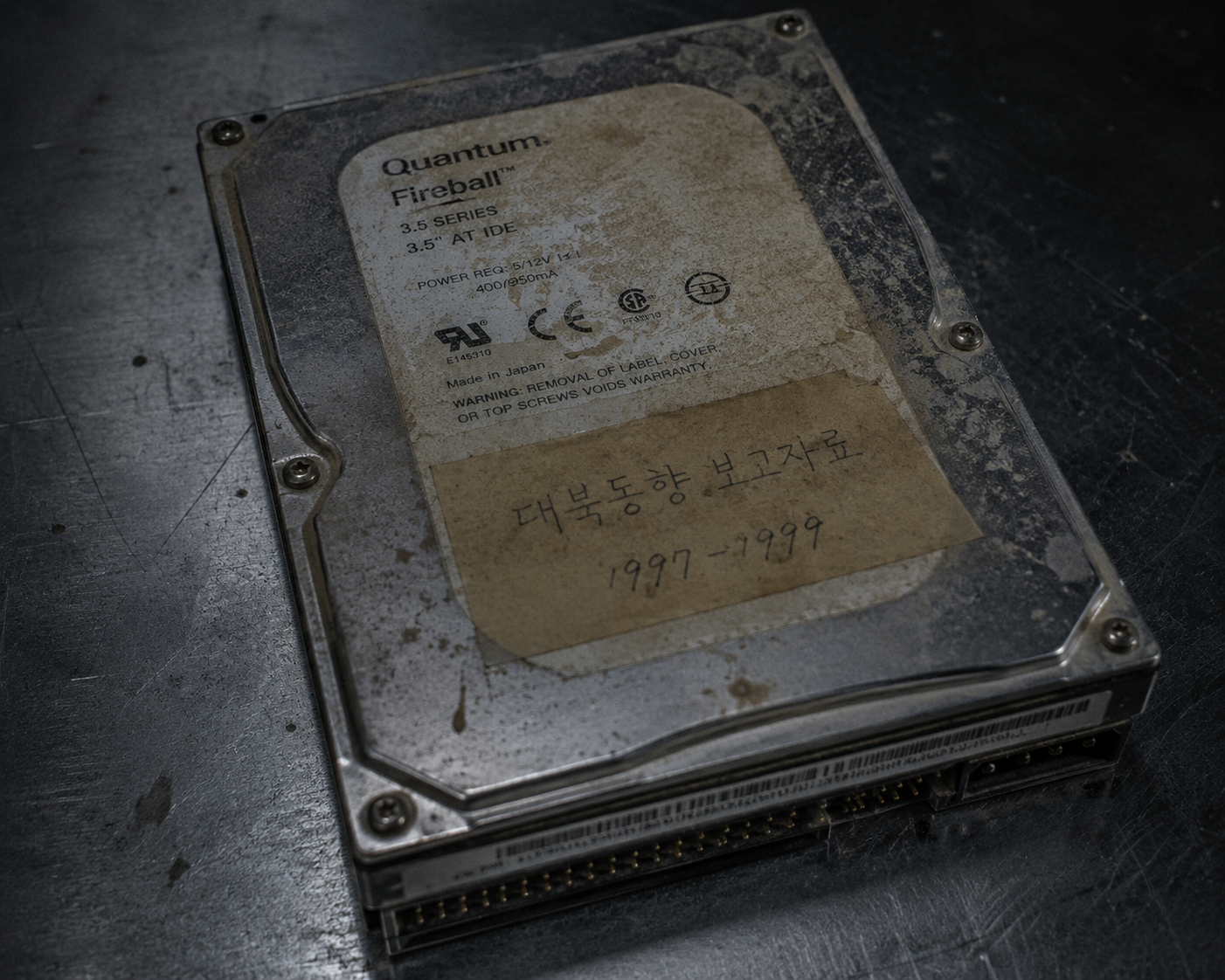
The recovery of South Korea’s late-1990s institutional documentation remains a critical point of failure for digital archeologists. Because the 2009 malware specifically executed header corruption on local civilian terminals rather than active state databases, the remnants of .hna and .kwp records exist exclusively on unindexed, decommissioned IDE hard drives currently held in regional Korean electronics salvage yards or private basements.
Call to Action for Lost Media Researchers: If you have access to legacy South Korean desktop units manufactured between 1995 and 2002, do not power them on or connect them to active networks. The files within them are highly vulnerable fragments of an unmapped historical canvas. Reach out to local data recovery groups or submit hard drive directory images to the 3AM Archive registry to aid in recovering this missing decade of East Asian network history.
This document is an investigative archival reconstruction based on fragmented public records, media remnants, community accounts, and verified historical sources compiled by The 3AM Archive.
The article examines how incidents, forgotten media, internet folklore, and unresolved public memories evolve through cultural preservation and digital decay.
This is a cultural investigation document — not fictional horror content.
All visual materials used in this post are exclusive AI-generated assets created for The 3AM Archive.
