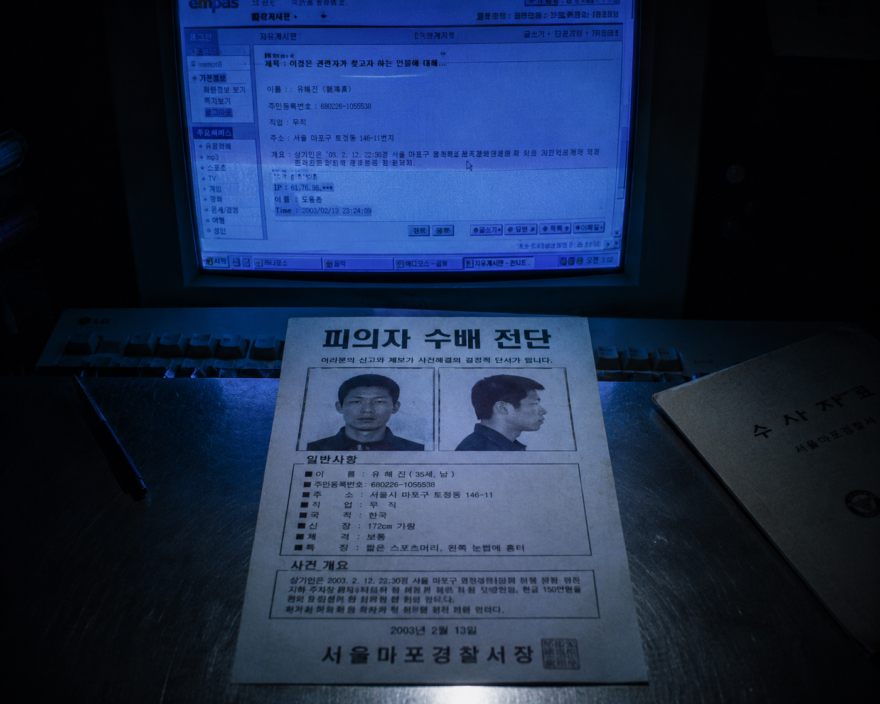
There is a particular kind of collective amnesia that does not feel like forgetting. It feels, instead, like a story that was always simpler than it actually was—a narrative that the culture required to be uncomplicated, and so made uncomplicated, by sheer consensus. The Gangdo Eoljjang incident of 2003–2004 is one of those cases. It has been metabolized, in the two decades since, as a footnote about internet immaturity—a cautionary anecdote about teenagers who were dazzled by a pretty face on a wanted poster. That reading is not false. It is merely incomplete, and its incompleteness is itself the most interesting thing about it.
What actually happened was stranger, more structurally significant, and considerably more disturbing than the morality play South Korean broadcast media preferred to tell. A violent fugitive became the first celebrity of the Korean web’s social layer. A law enforcement instrument became a cultural artifact. And the 60,000 people who gathered to worship that artifact constructed, entirely without irony, a digital apparatus that destroyed the thing they believed they were protecting.
Historical Anatomy
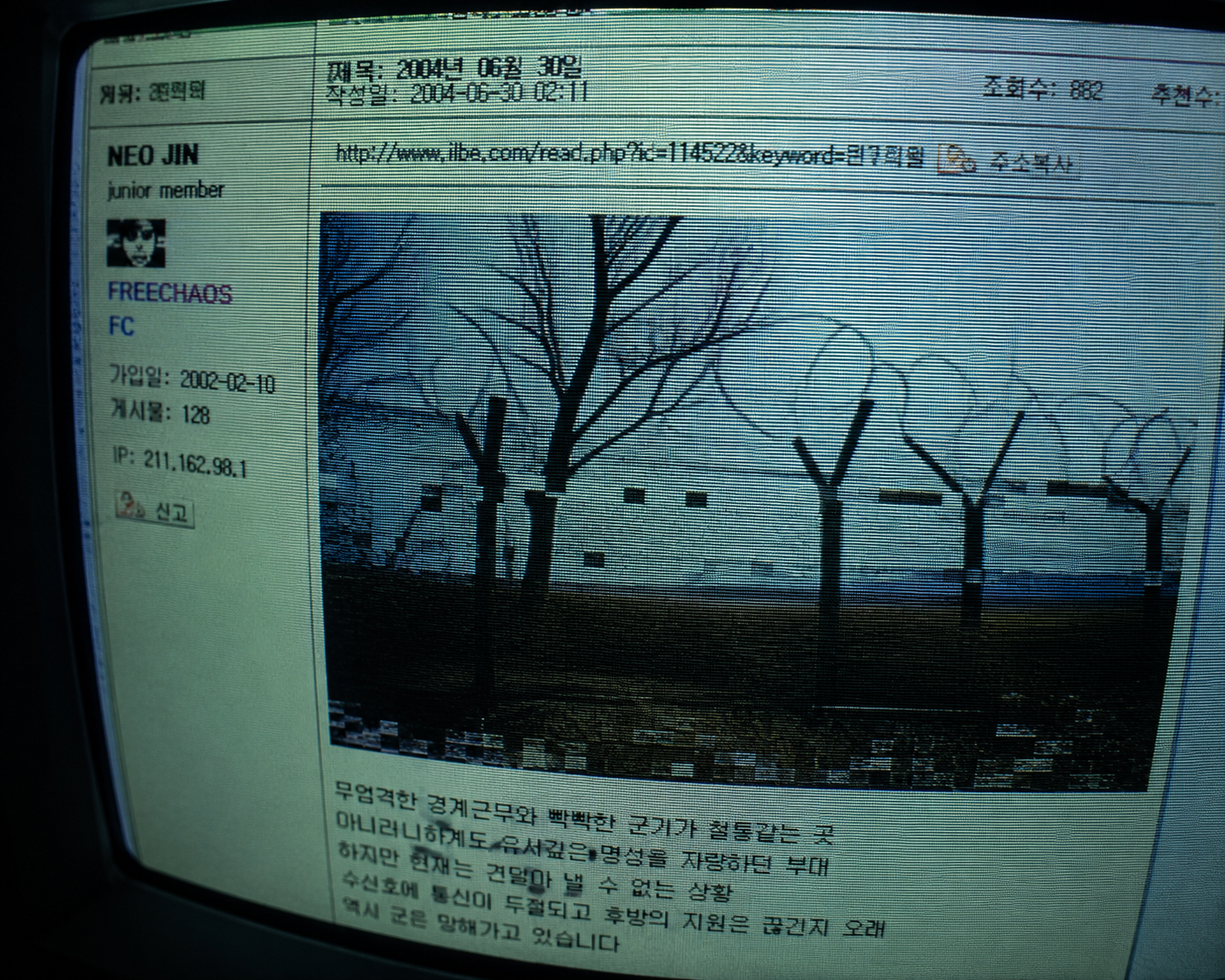
To understand the Gangdo Eoljjang case, you must first understand what South Korea’s internet was in January 2003—not in the aggregate statistical sense, but in its texture, its specific social grammar.
By that point, South Korea led the world in residential broadband penetration. The infrastructure had arrived early, driven by government investment after the 1997 IMF crisis, and it had produced a digital culture that bore almost no resemblance to its Western contemporaries. While American internet users in 2003 were navigating dial-up forums, shock imageboards, and early blog platforms, Korean users were embedded in a dense network of cafe communities—closed, membership-based forums hosted primarily on Daum and Naver, organized around highly specific shared interests. These were not anonymous; they were identity-adjacent spaces where handles carried reputation, where community hierarchy was enforced, and where the currency of participation was recognition.
Embedded within this structure was eoljjang culture. The term—literally meaning “best face”—had emerged from the PC room circuit as a way to describe individuals, typically teenagers, whose photographs circulated online because of their physical attractiveness. Eoljjang figures occupied a curious social position: not quite celebrities, but not quite private citizens. They existed in the space between, drawing attention without institutional legitimization. The aesthetic was precise and demanding—large eyes, small jaw, pale skin—and the subculture around it had developed its own vocabulary, its own evaluation hierarchy, its own internal logic.
Into this environment, in late 2003, someone fed a wanted poster.
Lee Mi-hye and her partner Kim Young-geun had, by that point, been fugitives for nearly a year. Their criminal record was neither ambiguous nor minor: three armed highway robberies; twelve separate thefts; multiple counts of assault; a kidnapping in which a female victim was bound, placed in a rice sack, and left in a mountain range. The pair operated with a specific methodology—Lee would approach a female target alone, typically under the pretext of asking for directions, establish proximity and trust, then signal Kim to close in with a knife. The lure was intentional. The violence was repeated. The coordination was systematic.
The Pohang Northern Police Station issued its wanted notice in standard format. It listed physical descriptors with the bureaucratic neutrality of all such documents—height, distinguishing features, last known location. One phrase departed from neutrality: 미인형, “beautiful-type.” It was, in context, simply a physical description category used by Korean law enforcement to indicate a conventionally attractive face. It was not an editorial judgment. It was a filing convention.
Someone photographed that poster with an early consumer digital camera. The image went online. The eoljjang subculture encountered it. And the rest followed with the specific, terrible logic of early social media: a community formed around the image before anyone had time to think about what the image actually was.
Structural Dissection of the Record
The Daum fan cafe registered on January 21, 2004—”♡Beautiful Robber Lee OO♡”—achieved 6,000 members within days. It would eventually reach over 60,000 active participants. What these participants produced is, forensically, extraordinary. They did not simply express admiration. They built an alternative factual record.
The community’s central mythological construction was what might be called the Innocent Companion Mythos: an entirely fabricated narrative in which Lee was not a perpetrator but a victim—a passive hostage, a tragic figure coerced into crime by an older, abusive boyfriend. Community members wrote what amounted to pseudo-legal defense briefs, analyzing the evidence for signs of duress; they constructed timelines designed to minimize Lee’s agency; they produced stylized banners and graphic materials that aestheticized her wanted-poster image into something resembling idol promotional material.
None of this had any relationship to the police record. The documented pattern—Lee as the primary lure, Lee as the initial point of contact with victims, Lee’s active participation across at minimum sixteen separate criminal incidents over more than a year—was not ambiguous. The community was not misreading an uncertain record. It was producing a fictional replacement for a clear one.
This is the structural anomaly that most broadcast coverage failed to examine. The question was not why teenagers found a fugitive attractive—that impulse is ancient, cross-cultural, and has a name—but why the community’s internal discourse required such an elaborate architecture of innocence. The Innocent Companion Mythos was not a misunderstanding. It was a necessity. The aesthetic investment in Lee’s face could only be sustained if the face could be detached from the acts the face had been used to commit. The mythology existed to perform that detachment.
The physical wanted poster—a law enforcement artifact, a tool of public safety—had been converted, via a single act of consumer digitization, into a eoljjang photograph. That conversion changed its social meaning entirely while leaving its informational content intact. The poster still said what it said. The community simply decided not to read that part.
Psychological Necropsy
Western coverage of this case, such as it exists, has consistently misfiled it under the category of celebrity criminal worship—a phenomenon with well-documented precedents in American culture, from the Manson groupies to the Ted Bundy letters. That framing is not wrong, but it misses the specific mechanism at work.
What the Korean academic and broadcast discourse of 2004 reached for was oe-mo-ji-sang-ju-ui—the concept of toxic lookism, a societal over-valuation of physical appearance so extreme that it could temporarily suspend moral judgment. This diagnosis was directionally correct but psychologically shallow. It located the problem in the surface-level fact of aesthetic preference rather than in the structural function the aesthetic preference was serving.
The Western psychological concept that fits is hybristophilia—a documented paraphilic pattern in which individuals are sexually or romantically drawn to partners who have committed violent crimes. In its group expression, it tends to produce precisely the features that characterized the Lee Mi-hye fan communities: the minimization of victim harm, the construction of the offender as a misunderstood figure, the production of an alternative biographical narrative that reframes violence as tragedy.
Korean media in 2004 had no working vocabulary for this. Hybristophilia was not a term in circulation in Korean psychological discourse; the phenomenon it described was not culturally legible as a sexual or romantic pattern. What happened instead was that a complex psychosexual community dynamic got collapsed, in mainstream analysis, into a simple moral failing: youth had been shallow, internet culture had been irresponsible, everyone should know better. The diagnosis was a comfortable one because it required no uncomfortable specificity.
What it obscured was a more troubling question—not about the individuals involved, but about the architecture of early social platforms that could convert a criminal emergency into an aesthetic subculture in under 72 hours, with no friction, no gate, no institutional voice capable of interrupting the conversion.
The Evidence of Erasure
On February 23, 2004, police intercepted communications between Lee and her mother. The trace led to a beach in front of Naksansa Temple, in Yangyang, Gangwon Province. Kim resisted arrest with a long-blade knife. Lee surrendered immediately.
When she was interviewed after her arrest, Lee described her final weeks of fugitive life in terms that no one in the fan community had anticipated. She said she could not move freely. She said she was afraid to go outside. She said the internet’s obsession with her face had made her existence in her rented room in Sokcho—a coastal city where she had been hiding—feel claustrophobic and inescapable. The 60,000 people who believed they were her protectors had made her so visually identifiable across South Korea that she had effectively imprisoned herself.
The irony is structural, not incidental. The community’s core activity—archiving, circulating, and aestheticizing her image—had functioned as the most effective surveillance apparatus the manhunt could have asked for. Every stylized banner was a wanted poster. Every cafe post that described her face in eoljjang terms was a detailed physical description broadcast to tens of thousands of people. The protective digital collective had built, without understanding what it was building, a de facto dragnet.
Kim received four years in prison. Lee’s sentence—2.5 years, suspended for four years—produced a secondary wave of public reaction: the fan communities, briefly, celebrated the outcome as a vindication of their lobbying. Then the backlash arrived, harder and faster than the fandom had, and the cafes were dissolved or abandoned. The moderators deleted what they could. Members went quiet. The record began to disappear.
What remains is fragmentary: archived news articles from Korean broadcasters that covered the phenomenon with a mixture of alarm and prurient fascination; academic papers on oe-mo-ji-sang-ju-ui that cite the case as a data point without examining its mechanism; occasional Reddit threads in which someone asks whether anyone remembers the “beautiful robber” case and receives three or four responses from people who are mostly reconstructing the story from memory, with significant errors.
The victims—the three women robbed at knifepoint, the woman bound in a rice sack and left in the mountains—appear in almost none of this residue. They were present in the original police record, present in the courtroom, and then systematically absent from the cultural memory that formed around the case. The Innocent Companion Mythos required their minimization; the aesthetic subculture required their erasure; the subsequent cultural embarrassment required not examining what the erasure meant.
The Point of No Return
There is a specific kind of archival violence that does not involve the destruction of records. It involves their selective non-inheritance—the process by which certain facts survive the event while others do not make the transition from primary documentation to cultural memory. The Gangdo Eoljjang case is a clean example.
What survived: the wanted poster photograph; the number 60,000; the suspended sentence; the anecdote about the Naksansa Beach arrest; the general cultural diagnosis about lookism. What did not survive: the specific mechanics of the luring methodology; the texture of the Innocent Companion Mythos and what it reveals about the community’s psychological architecture; the victims’ experiences; the precise irony of the surveillance-protection inversion; the fact that this was, in its structural logic, not merely a story about shallow teenagers but an early demonstration of how digital communities could produce coordinated reality-replacement at scale.
What the Gangdo Eoljjang case actually represents is a proof-of-concept—crude, unintentional, and subsequently forgotten—for a dynamic that would later become one of the defining pathologies of social media at scale. A community gathered around an image. The community produced a factual alternative to the documented record. The alternative version served the community’s emotional and aesthetic needs more efficiently than the true version. The true version was therefore not adopted. The community’s internal consensus, sustained across 60,000 participants, became more socially real than the police file.
The wanted poster was a threshold object—it crossed from law enforcement into entertainment, from public safety into aesthetic subculture, in a single step that required only a consumer digital camera and a broadband connection. Once it crossed, it could not be made to cross back. Lee Mi-hye the documented violent offender and Lee Mi-hye the eoljjang fugitive were, by January 2004, two separate entities occupying the same body; only one of them would survive in memory.
The digital archive did not remember what happened. Instead, it functioned as a default archive of human experience. This structure favored the survival of transactional text over physical truth. The digital archive remembered what the community had decided happened. These are not the same thing, and the gap between them is exactly where the victims live—in the space that the archive, in its particular way of surviving, decided not to preserve.
That gap has never been closed. In all likelihood, it will not be.
🔍Search Update: Call to Action
The digital residue of the “Beautiful Robber” fan cafes represents a critical missing chapter in early East Asian web archeology. While mainstream televised segments remain accessible in broadcast networks, the thousands of community-generated forum graphics, stylized user banners, and peer-to-peer defense logs have largely vanished into archival silence. If you have any leads, local hard drive backups from Daum Cafes circa 2003–2004, or unindexed digital captures of the original public wanted materials, contact The 3AM Archive or share your findings in our collaborative lost media logs below.
This document is an investigative archival reconstruction based on fragmented public records, media remnants, community accounts, and verified historical sources compiled by The 3AM Archive.
The article examines how incidents, forgotten media, internet folklore, and unresolved public memories evolve through cultural preservation and digital decay.
This is a cultural investigation document — not fictional horror content.
All visual materials used in this post are exclusive AI-generated assets created for The 3AM Archive.
