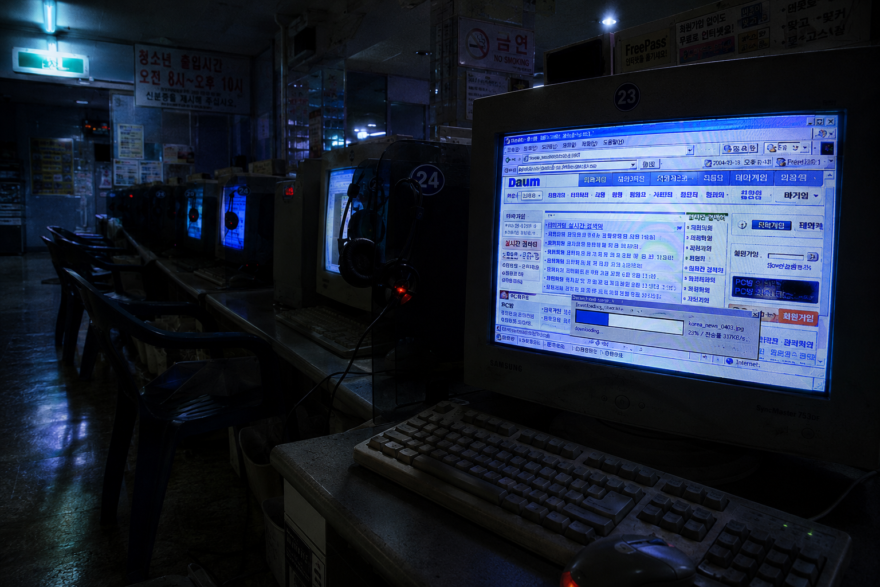
In the annals of digital folklore, most myths require a name. A face. A traceable signature left somewhere in the sediment of public record. The mythology surrounding “Kim Bon-jwa”—the anonymous Korean uploader who single-handedly controlled over 70% of his nation’s underground Japanese adult video market during the mid-2000s—requires none of these. His power was not derived from visibility; it was derived from the structural inevitability of what he represented. Kim was not a person who became a legend. He was a logistics node that the public, in the absence of anything more satisfying to worship, retroactively decided was human.
This is not, at its core, a story about digital piracy. It is a forensic study of what happens when a hyper-repressive state apparatus accidentally manufactures an internet god—and what it means when that god, upon release from judicial custody, simply disappears into the grey fabric of ordinary corporate employment.
Historical Anatomy
To understand what Kim Bon-jwa represented, one must first understand the precise cultural pressure that produced him. South Korea in 2003 was a country in the grip of two simultaneous, contradictory forces. On one hand, it possessed the most advanced consumer broadband infrastructure on the planet; by the early 2000s, South Korean internet penetration and connection speeds were measurably ahead of every Western nation. On the other hand, its regulatory framework governing adult content remained among the most aggressively restrictive in the developed world—a blunt prohibition rooted in a postwar moral conservatism that had been legislated, not gradually eroded.
The result was a structural paradox with no clean resolution: a population of young men with extraordinary digital bandwidth and almost no sanctioned outlet through which to use it. The infrastructure existed. The demand existed. The legal supply did not.
Into this gap stepped the commercial webhard—a peculiarly South Korean digital institution. Where Western peer-to-peer networks like Napster and LimeWire distributed files horizontally, webhards operated as quasi-commercial cloud-sharing servers: centralized, monetized, and operated under the nominal supervision of domestic companies. Uploaders earned commissions based on download traffic; the more a file was retrieved, the more its uploader was paid. The architecture was, in retrospect, almost engineered for abuse. It combined the financial incentives of a content marketplace with the anonymity of an underground network and the deniability of a third-party platform.
Kim Bon-jwa—identified in all subsequent police and judicial documentation only as “Mr. Kim” (born 1978)—understood this architecture with a precision that no contemporary corporate media strategist demonstrated. He had no content production apparatus. He had something more durable: a real-time monitoring operation.
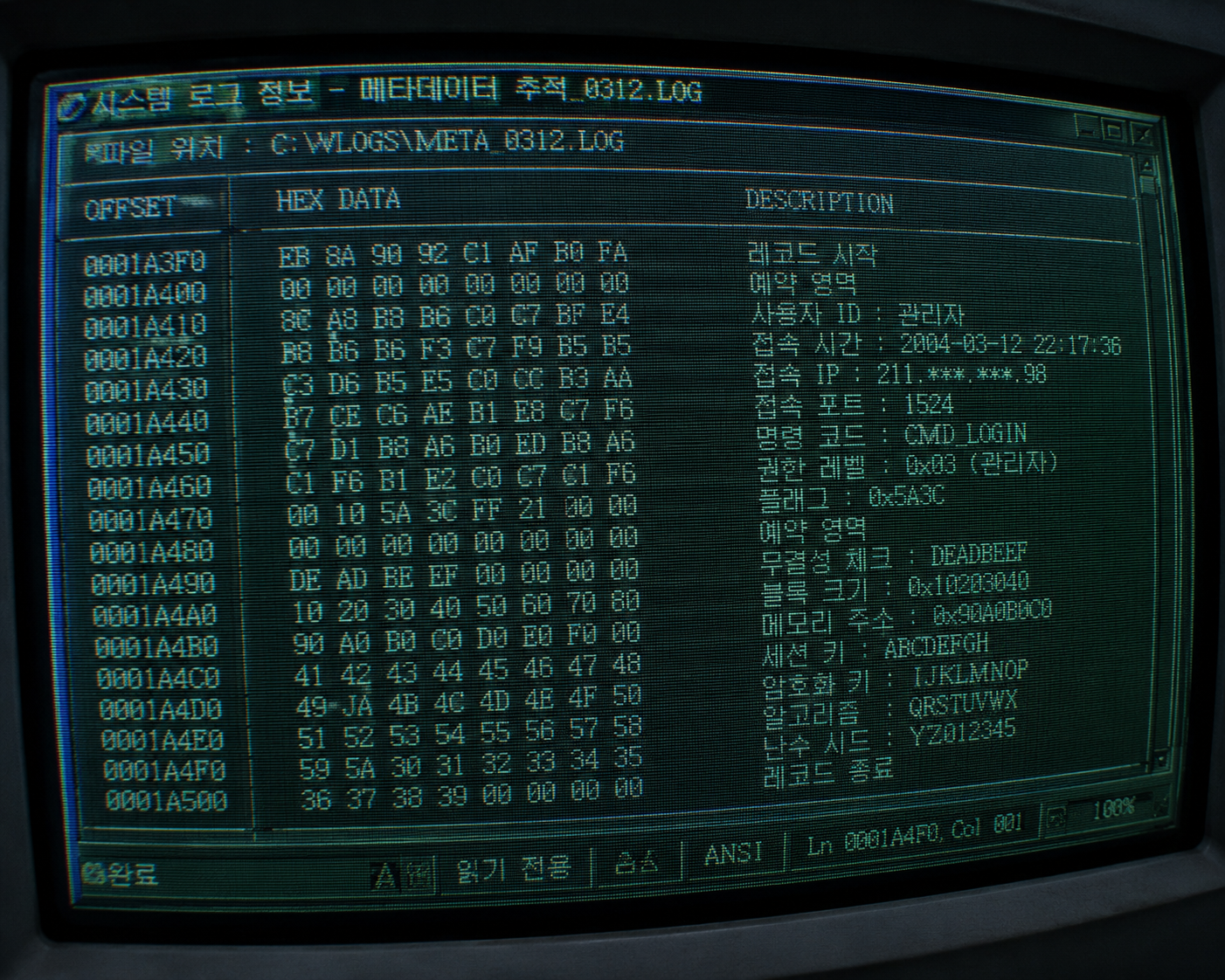
Structural Dissection of the Record
The technical mechanics of Kim’s pipeline are documented in the Busan Sasang Police Department’s investigative record, and they are, even two decades later, remarkable for their methodological efficiency. Kim monitored Japanese OpenNap networks and IRC distribution channels continuously—not periodically, not reactively, but as a sustained operational posture that reportedly consumed him for the entirety of his working hours after he resigned his standard employment in late 2004. The moment an encrypted, ripped file was released on the Japanese side, Kim decrypted it, compiled it, and ported it to South Korean webhard servers—specifically platforms including TotoDisk—within minutes.
There is no evidence of automation. No bots, no scrapers, no algorithmic intermediaries. This was manual labor performed at machine tempo. Between November 2003 and October 19, 2006—the date of his arrest—Kim distributed exactly 14,000 unique adult media files. The financial yield was documented at a minimum of 50 million KRW; at contemporary exchange rates, approximately $50,000 USD. For a solo operator working without staff, without infrastructure investment, and without any legal business registration, this represented an extraordinary return on what was, essentially, sustained human attention.
The arrest itself was unremarkable by the standards of cyber-crime prosecution. The Busan Sasang Police Cyber Crime Unit executed its operation cleanly. What was not unremarkable—what, in fact, constitutes the most analytically interesting dimension of the entire case—was the public response.
Within hours of Kim’s arrest becoming public knowledge, the Busan police department’s server crashed. Not from a coordinated distributed denial-of-service attack; from the sheer volume of ordinary internet users submitting parodic petitions for leniency. The documents that flooded the server included mock religious testaments—what netizens began calling “The Gospel of Bon-jwa”—declaring Kim a secular saint who had alleviated the digital frustrations of an isolated generation of young Korean men. The title itself—bon-jwa (본좌), a classical Korean term denoting an absolute sovereign, a martial arts grandmaster, a figure of uncontested hierarchical supremacy—was applied without evident irony.
This is the central archival anomaly. Piracy prosecutions do not routinely generate folk canonization. The record does not offer a clean explanation for why this one did.
Psychological Necropsy
The Western critical imagination tends to interpret the Kim Bon-jwa mythology through a framework of ironic detachment—as an amusing footnote in the cultural history of internet piracy, filed somewhere between the Pirate Bay founders and anonymous 4chan administrators. This reading is incomplete and, in several key respects, wrong.
What the Western framework misses is the specific texture of the censorship regime Kim operated against. The prohibition on adult content in South Korea was not a soft cultural norm or an unenforced legacy statute; it was an actively prosecuted legal reality that effectively criminalized access to a category of media that equivalent Western democracies had largely normalized. The demand Kim serviced was not, in its nature, particularly unusual; the criminalization of that demand was the anomaly. His users were not outlaws by temperament. They were made into outlaws by structural circumstance.
This context transforms the mock religion around Kim from something faintly absurd into something diagnostically significant. The “Gospel of Bon-jwa” was not simply ironic. It was a displacement ritual—a culturally legible way of expressing collective grievance against a regulatory apparatus that a significant population considered disproportionate, without the social risk of expressing that grievance directly. Kim became the vessel for an anger that had no other publicly acceptable form.
There is a secondary dimension that the Western imagination finds genuinely disorienting: the judicial anti-climax. Kim was sentenced, in 2007, to ten months in prison, suspended for two years. No carceral time served; no permanent digital exile; no dramatic consequence commensurate with the mythological scale of his operation. He had controlled, by credible police estimates, over 70% of the entire underground Japanese AV market circulating within South Korea’s webhard networks—and he received a suspended sentence. The gap between the legend and the legal outcome is not just ironic; it is structurally revealing. It suggests that the prosecutorial apparatus recognized, however implicitly, that what it had convicted was less a criminal mastermind than a particularly efficient expression of structural demand.
The Evidence of Erasure
Following sentencing, Kim gave a single telephonic interview to a domestic journalist in July 2007. The content of that interview—what was said, what was admitted, what was withheld—exists now only in heavily summarized form; the original recording, if it was ever archived, has not surfaced in any publicly accessible repository. After that call, Kim’s digital footprint dissolved completely. He took what sources describe only as a standard corporate entry-level position and, in the precise language of every subsequent investigative inquiry, vanished.
This vanishing is protected by a specific legal architecture. South Korean digital privacy legislation seals the identities of convicted individuals in cases where rehabilitation is determined to be the prosecutorial aim; Kim’s legal name, face, and post-sentencing personal history are not available to the public record under any currently operative access mechanism. He cannot be found because the state has formally decided he should not be findable.
The mythology therefore exists in a peculiar condition: its central subject is legally absent from its own archive. What remains is not Kim; it is the negative space Kim occupied—the crash logs from a police server that received too many petitions, the webhard download statistics that were entered into a criminal indictment, the five successor uploaders who adopted his title.
The “Era of the Five Emperors” is the most structurally clarifying element of the entire case. After Kim’s arrest, the underground distribution network did not collapse; it reorganized around a succession of individuals who adopted the bon-jwa suffix as a deliberate inheritance. Jung Bon-jwa was arrested in December 2009, having accumulated roughly 26,000 files—nearly double Kim’s cache. Yang, Seo, and Park Bon-jwa followed across 2010, 2011, and 2012. By April 2019, Koh Bon-jwa was arrested with a documented cache of approximately 537,000 files—nearly forty times Kim’s original inventory.
The progression is not merely numerical. It represents a systematic refutation of the logic underlying the original prosecution. Each arrest was a state assertion that individual interdiction could suppress structural demand; each successor was a data point demonstrating that it could not. Kim’s 2007 thesis—articulated not in any public statement but in the bare structural reality of what happened after his removal from the network—proved itself across thirteen years of consecutive evidence.
The Point of No Return
The most uncomfortable insight available in the Kim Bon-jwa archive is not that he disappeared. It is that his disappearance was, in every material sense, the correct outcome—for him, for the state, and for the myth.
Had Kim served significant prison time, he would have become a genuine martyr, and the mythology would have had genuine grievance to metabolize. Had he remained publicly visible after sentencing, the myth would have been subject to the corrosive effects of ordinary personhood; his actual opinions, his physical appearance, the mundane reality of his post-arrest life, would have introduced dissonance into a folklore that required its central figure to remain abstract. Instead, the suspended sentence and the subsequent total disappearance produced the ideal archival condition for mythology: an unresolvable gap where a human being used to be.
The grey corporate suit Kim reportedly put on after his final press call was not a defeat. It was, in the specific economy of internet legend, the most sophisticated possible exit. It removed from public scrutiny the one element most likely to undermine his mythological status: his actual self.
Digital memory does not preserve individuals. It preserves structures—the shape a person left in the data, the negative silhouette visible in download logs and criminal indictments and crashed police servers. Kim Bon-jwa understood this, whether consciously or not. He maintained that structure for three years at the cost of his sleep, his employment, and eventually his freedom; then, upon release, he withdrew from the structure entirely and allowed the myth to calcify around his absence.
The archive has been swallowing him ever since. Twenty years on, it has nearly finished the work. What remains is a title—not a name, not a face, not a voice, but a cultural designation borrowed from classical Korean sovereignty and applied, without irony, to a man who spent three years in a room monitoring Japanese file-sharing channels and porting adult video to a domestic cloud server at speeds no one else was matching.
The webhard overlord is gone. The webhard is still running. The files—some of them, somewhere, in some form—are almost certainly still circulating. The demand that produced Kim has not diminished; it has simply found new infrastructure. And in this sense, the most accurate epitaph for the Kim Bon-jwa archive is not found in the criminal record, the suspended sentence, or the mock gospel his users composed in his honor.
It is found in the fact that by 2019, his operational successor had accumulated files at a ratio of forty to one—and that no one, in any of the reporting surrounding Koh Bon-jwa’s arrest, expressed particular surprise.
🔍Search Update: Call to Action
For researchers operating within the lost media and internet archaeology sectors, the Kim Bon-jwa archive presents a structural blind spot. The localized nature of mid-2000s Korean webhards—which required resident registration numbers to access and utilized proprietary, closed client software—means that the primary metadata of this era has defaulted to a highly fragile state.
While the digital artifacts themselves have largely decomposed or been scrubbed by state mandates, the true lost media artifact remains the unedited July 2007 telephonic exit interview. If you have any leads regarding preserved archives of mid-2000s Korean internet journalism repositories, data dumps from early platforms like TotoDisk, or independent recordings of contemporary radio mentions (such as the Ghost Nation broadcast), please contact the 3AM Archive registry. Digital permanence is an engineering illusion. The default archive of human experience is not the server, but the active, systematic preservation of its gaps.
This document is an investigative archival reconstruction based on fragmented public records, media remnants, community accounts, and verified historical sources compiled by The 3AM Archive.
The article examines how incidents, forgotten media, internet folklore, and unresolved public memories evolve through cultural preservation and digital decay.
This is a cultural investigation document — not fictional horror content.
All visual materials used in this post are exclusive AI-generated assets created for The 3AM Archive.
