
There is a photograph—low-resolution, unblurred, taken on a feature phone in the particular grainy aesthetic of mid-2000s digital capture—that most people outside South Korea have never seen. Within South Korea, it requires no introduction. The image itself is unremarkable by the standards of what the internet would later normalize: a young woman on a subway car, a small dog, a mess on the floor. What the photograph does not contain is the thing that destroyed a life. It contains no audio. It contains no context. It contains no verified account of what was said, or whether anything was said at all. What it does contain—and what the surrounding apparatus of early Korean internet culture converted into a weapon of total social annihilation—is a single, static frame of a woman’s face, unobscured and perfectly legible to any crowdsourced identification effort.
This is not a story about bad behavior on public transit. It is a story about what happens when a sufficiently networked population treats an image as a verdict.
Historical Anatomy
To understand what occurred on June 5, 2005, it is necessary to first understand what South Korea’s internet looked like in the months before it.
By mid-2005, South Korea possessed the highest broadband penetration rate in the world—a distinction it had held for several years running, the product of a government-backed infrastructure investment following the 1997 IMF financial crisis that had, with somewhat inadvertent precision, engineered the conditions for a new kind of networked public life. PC bangs—internet cafés operating around the clock across every major urban neighborhood—functioned as gathering points where bandwidth was cheap, anonymous, and shared. Cyworld, the social networking platform that predated Facebook’s international expansion, had achieved penetration rates among young Koreans that would not be replicated in the West until the late 2000s. Daum and Naver funneled the entire online population through centralized portal architectures; this was not the fragmented, interest-silo’d web emerging simultaneously in the United States, but something closer to a single shared digital commons.
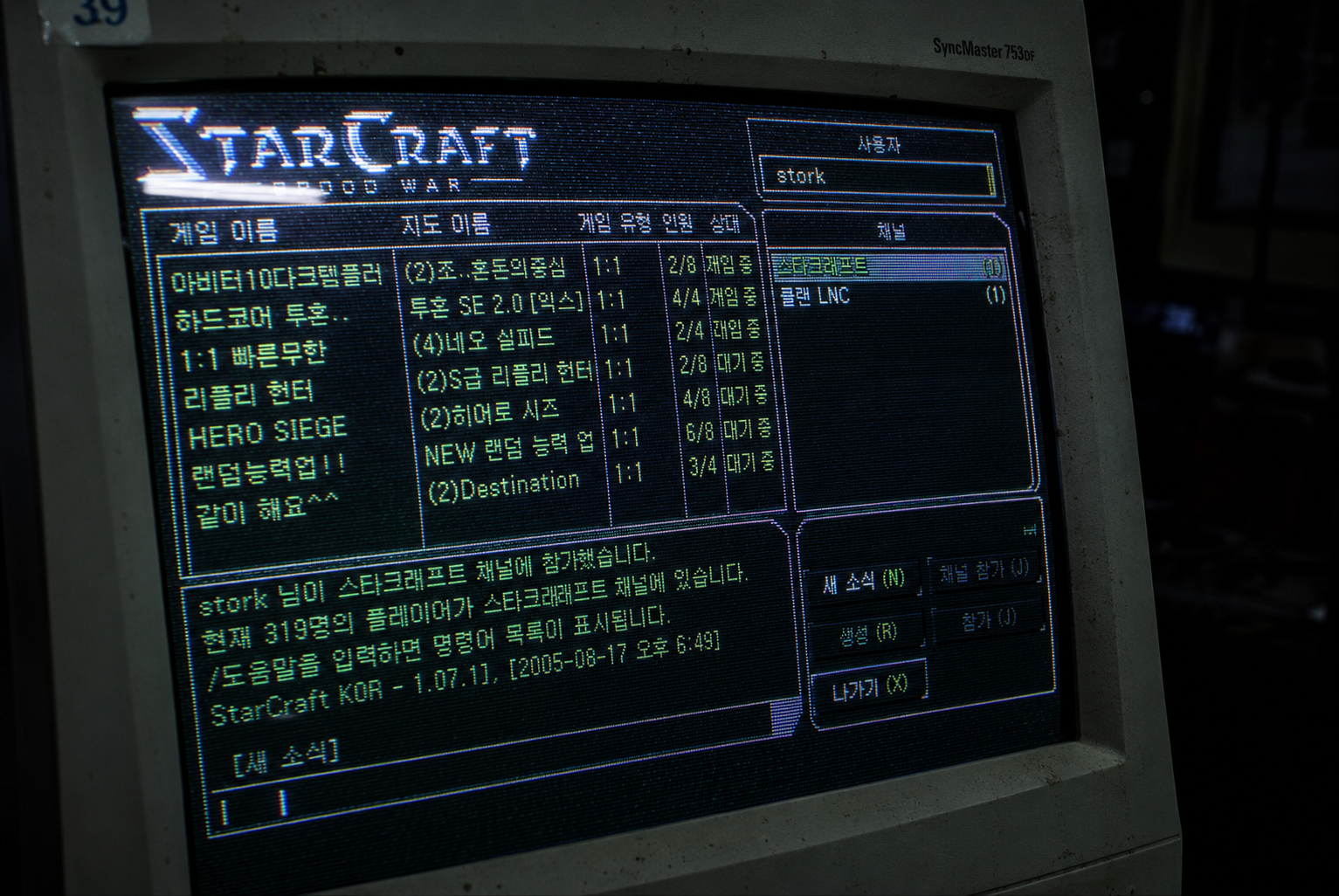
Into this environment came StarCraft: Brood War—a detail that is not incidental. The game had, by 2005, become a legitimate professional sport in South Korea, broadcast on dedicated cable channels, followed by millions. It had also, crucially, developed a robust custom-map modding culture operating through PC bangs, and it was within this ecosystem that internet phenomena could achieve a kind of secondary viral life, mutating from forum posts into playable objects within days. The population that would constitute the online mob of June 2005 was not a passive audience; it was an active, technically literate, highly networked one, practiced in the coordination of collective action through digital channels.
The social atmosphere was equally relevant. The concept of nunchi—a cultural sensitivity to social harmony, to the unspoken obligations of shared public space—carried significant moral weight. A subway car is, in this context, not merely a vehicle but a microcosm of the collective social contract. The alleged behavior documented in the post that appeared on June 5—a woman allowing her dog to defecate in a train car and refusing, according to the anonymous accompanying text, to clean it up—was framed not as mere inconsideration but as an act of deliberate communal transgression; a narcissistic refusal of the basic obligations of shared public life.
The original post was titled “The Reality of Mindless Pet Owners.” It was uploaded to a popular Korean web forum by an anonymous female commuter. It contained the photographs. It also contained a textual account—unverified, unattributable, and algorithmically indistinguishable from documented fact—of the woman’s alleged behavior and verbal responses.
Within forty-eight hours, this text box had been treated as testimony.
Structural Dissection of the Record
What the internet mob assembled in the days following June 5 was not, strictly speaking, a doxxing operation by any subsequent technical definition. It was something simultaneously cruder and more sophisticated: a distributed, voluntary identity excavation carried out by thousands of anonymous participants who shared findings in real time across Daum Agora, DC Inside, and Cyworld comment sections.
The anomalies in the public record begin here. No single coordinating actor has ever been identified. No one claimed credit for the identification of the woman’s real name, her family background, her university affiliation, or her Cyworld profile—all of which were successfully surfaced within forty-eight hours. The excavation was entirely emergent; a spontaneous collective computation, the human equivalent of a distributed network solving a processing problem by assigning individual threads to individual nodes.
The university she was rumored to attend—the specificity of “rumored” is important, and will become more important—received such a volume of inbound traffic from vigilante participants demanding her expulsion that its official web servers collapsed entirely. This is a documented, verifiable event. The server crash is on record. What is less verifiable is the premise that generated it: the identification itself rested on the cascading confidence of crowdsourced consensus, not on any formal verification procedure. In the early days of the incident, speculative lookalikes were accused alongside the actual target; these false accusations were later quietly abandoned without retraction, disappearing into the archive’s sediment.
The most structurally significant anomaly in the record is the simplest one. The original allegation—that the woman cursed at elderly passengers who asked her to clean up the mess—was never corroborated by audio, video, or any named witness. The photographs document the dog, the mess, and the woman’s face. They document nothing she said. The entire moral architecture of the subsequent punishment—the total social annihilation, the university withdrawal, the media coverage, the legislative response—rests on an anonymous caption accompanying a blurry photograph.
The photograph was treated as evidence. The caption was treated as testimony. No court was convened.
Psychological Necropsy
The Gaeddongnyeo incident—the name the mob assigned her, meaning “Dog Poop Girl,” a designation that replaced her legal identity in digital memory for years—disturbs the Western imagination for reasons that only partially overlap with why it disturbed Korean civil society at the time.
For Korean commentators writing in the second half of 2005, the horror was primarily one of proportion: a collective social response calibrated so far beyond the triggering infraction that the gap between cause and effect had become morally grotesque. Major Korean newspapers that had initially amplified the story pivoted sharply to the language of “cyber-lynching”—acknowledging, with some delay, their own role in the acceleration.
For the Western observer encountering the case retrospectively—through the Washington Post report of July 7, 2005, through the New York Times coverage that followed, through its early circulation on BoingBoing and its archival deposition on Rotten.com alongside gore and anomalous human spectacle—the disturbance operates differently. It operates as temporal vertigo.
Western internet historiography tends to locate the emergence of mob doxxing in the early 2010s: the Reddit-driven misidentification during the Boston Marathon bombing, Gamergate’s sustained harassment infrastructure, the Twitter pile-on as recognized social formation. The discovery that South Korea had executed a fully operational, hyper-efficient digital manhunt in 2005—coordinated entirely through feature phones, blogs, and centralized web portals—produces a sensation not unlike finding evidence of industrial machinery in a pre-industrial civilization. The technology did not determine the behavior; the behavior was latent in the architecture, waiting for a sufficiently charged catalyst.
There is a secondary disturbance that is harder to articulate but more persistent. The Gaeddongnyeo incident demonstrates, with clinical precision, that a static low-resolution image combined with an unsigned text caption is sufficient input for a distributed human network to produce total social destruction as output. The image need not be fabricated. The caption need not be verified. The processing is automatic. This is not a lesson the twenty-first century has absorbed; it is a lesson the twenty-first century continues to re-learn, in higher resolution, with wider distribution, at faster speeds—deepfakes, algorithmically amplified screenshots, context-stripped clips. The 2005 Seoul subway car was a proof of concept.
The Evidence of Erasure
The woman who became Gaeddongnyeo withdrew from her university in late June or early July 2005. Beyond this, the public record of her subsequent life is—deliberately, mercifully, and perhaps uniquely—blank.
This erasure is not simply the organic attrition of digital memory. It required active effort. In 2005, the architecture of Korean internet platforms made the removal of viral content extremely difficult; Cyworld profiles could be deleted but screenshots circulated indefinitely; forum posts were preserved by third-party aggregators; the identity information that had been assembled and disseminated could not be recalled. The withdrawal from public life was not an erasure of the record but an erasure of the self from future record-generation—a recognition that no legal or technical mechanism existed to unmake what had been made.
The incident itself, however, did not disappear. It mutated. The StarCraft: Brood War custom maps—playable games built around the incident’s imagery, distributed through PC bang networks—converted an act of human suffering into casual interactive entertainment, available to teenagers who may never have encountered the original forum post. This gamification is a particular form of archival mutation: the incident’s emotional content was preserved while its human subject was abstracted into a game asset; moral weight dissolved into mechanical function.
The legislative response represents a different kind of mutation—the transformation of a single incident into structural precedent. The Gaeddongnyeo case became the primary socio-political instrument used to advance South Korea’s Real-Name Internet Registration System, enacted in 2007, which required users to verify their identities before posting on platforms with more than 100,000 daily users. The law was intended to impose accountability on the anonymous mob; it was declared unconstitutional by South Korea’s Constitutional Court in 2012, on the grounds that it violated freedom of expression and posed disproportionate risks to legitimate anonymity. The incident that generated the policy outlasted the policy itself—a law born from a manhunt, killed by the same constitutional principles the manhunt had violated.
What remains in the international archive is fragmentary and contextually stripped. The Washington Post and New York Times coverage from summer 2005 treats the case as a curiosity about Korean internet culture—an exotic data point from a hyperconnected society that had perhaps moved too fast. The BoingBoing posts are archived but their comment sections are partially corrupted. The Rotten.com archival deposit has been partially scrubbed through the site’s subsequent ownership changes. What the English-language internet largely retains is the meme—the label, the basic outline of the incident—without the underlying evidentiary structure, the political consequences, or the unresolved question at the center of the entire episode.
The unresolved question being: whether she actually said anything at all.
The Point of No Return
The Gaeddongnyeo incident is routinely cited, in internet history scholarship and in journalism covering the evolution of online mob behavior, as the “first major doxxing case”—a designation that implies it was an aberration, a precursor, a primitive draft of something that would later be refined. This framing is analytically comfortable but structurally false.
The incident was not a failure state of early internet culture. It was a successful demonstration of what the architecture had always been capable of producing, given the correct inputs. A sufficiently networked population, operating through centralized platforms, motivated by moral consensus, equipped with facial photographs and identification tools—this is not a bug configuration. It is a feature configuration. The South Korean internet of 2005 simply achieved it earlier than other national networks because its infrastructure was more developed, its portal centralization more total, and its broadband penetration more complete.
The deeper and more uncomfortable implication is this: the case did not produce systemic change in how digital networks process unverified allegations. The Real-Name Law attempted a structural intervention and was dismantled within five years. The platforms that enabled the mob in 2005—or their functional successors—continue to operate on architectures that permit identical dynamics. The speed has increased. The resolution of the identifying photographs has improved. The distribution mechanisms are more efficient. The legal frameworks remain, in most jurisdictions, approximately as inadequate as they were in June 2005.
What the Gaeddongnyeo incident actually inaugurated was not a new form of harm but a new form of clarity about an existing capacity. The internet had demonstrated, in a Seoul subway car, that it could function as a distributed judicial system—one that operated without evidence standards, without due process, without appeal mechanisms, and without any procedure for correction when the original allegation proved to be an unsigned caption on a feature-phone photograph.
The woman withdrew from her university. The servers crashed and were restored. The forum posts were archived. The StarCraft maps were played and eventually abandoned. The law was passed and then struck down. The international press filed its dispatches and moved on.
The photograph remains. The caption remains. The name the mob gave her remains, indexed and searchable, permanently affixed to a face in a subway car on a Sunday morning in June—attached to someone who may have said nothing at all.
🔍Search Update: Call to Action
The 3AM Archive is currently cataloging surviving text strings, forum logs, and custom map binaries associated with the June 2005 panic. Due to platform closures and server migrations, much of the raw data resides in unindexed localized logs. If you possess or have archived any of the original StarCraft: Brood War custom maps (“개똥녀 응징하기”), early DC Inside image mirrors, or unedited forum transcripts from Daum Agora between June 5 and June 10, 2005, please contact our investigative desk. In the default archive of human experience, digital permanence is a myth. Unchecked algorithmic updates and corporate platform purges mean that early internet anomalies face structural erasure unless actively preserved. Help us ensure this foundational case study of digital vigilantism does not become completely lost media.
This document is an investigative archival reconstruction based on fragmented public records, media remnants, community accounts, and verified historical sources compiled by The 3AM Archive.
The article examines how incidents, forgotten media, internet folklore, and unresolved public memories evolve through cultural preservation and digital decay.
This is a cultural investigation document — not fictional horror content.
All visual materials used in this post are exclusive AI-generated assets created for The 3AM Archive.
