There is a specific species of lie that only the early internet could have incubated. Not the brazen, legally actionable fabrication—but the ambient lie; the accumulated credential, the casually dropped institutional affiliation, the forged email chain composed in broken Japanese and uploaded to a forum where nobody could verify it. These lies worked not because they were convincing upon close inspection, but because close inspection was structurally discouraged. The architecture of early Korean internet communities—fragmented, insular, governed by whoever held administrative keys—was a natural terrarium for the chronic fabricator. In 2007, a man operating under the pseudonym “Doderi” discovered, too late, that the terrarium had a glass wall.
What collapsed his fiction was not a journalist, not a legal investigation, not an algorithm. It was a mislabeled county.
Historical Anatomy
To understand the Doderi incident, one must first inhabit the specific cultural atmosphere of mid-2000s South Korean internet culture—a period that existed in the narrow gap between dial-up insularity and the social media surveillance apparatus that would eventually swallow everything. Naver’s café platform was the dominant ecosystem; a network of semi-autonomous communities organized by interest, governed internally, and largely invisible to outsiders. These cafes were not passive aggregators. They were closer to medieval guilds: hierarchical, reputation-obsessed, and deeply suspicious of newcomers who climbed too quickly.
Into this environment, Uncharted Waters—the Koei naval simulation franchise known domestically as 대항해시대—had cultivated one of the more dedicated communities on the platform. The game’s mechanics rewarded patience and arcane knowledge; so, naturally, its community attracted people who valued the performance of expertise. Freegate, the café in question, was a gathering point for serious players. Status within it accrued through demonstrated mastery: route optimization, cargo economics, the obscure mechanics of combat positioning. It was, structurally, the perfect ecosystem for an impostor.
Doderi had been cultivating his position since at least 2005. The early period—what might be called the Micro-Friction Phase—involved low-stakes but persistent fabrication: accusations that high-ranking players’ save files were edited, technical claims about game mechanics that were demonstrably impossible (asserting that the city of Beijing triggered three reinforcement waves, a behavior that does not exist in the game’s code). These were not random trolling incidents. They were credential tests—probing the community’s verification capacity while simultaneously establishing Doderi as someone who possessed knowledge others lacked.
By the summer of 2006, the stakes had escalated. Doderi announced that he had traveled personally to Koei’s Japanese headquarters to obtain advance intelligence on Uncharted Waters 5. He produced email chains as evidence—correspondence with Koei personnel, composed in Japanese that bore the unmistakable syntax-collapse of machine translation run in reverse. The fabrications were enthusiastic and specific; they were not seriously interrogated. The community wanted the information to be true.
Throughout this period, Doderi maintained a parallel biographical fiction: that he was not a student at Konkuk University—a respected but non-elite institution—but an alumnus of Seoul National University and Tokyo University simultaneously, and a corporate intern at Matsushita. The particular selection of credentials was not accidental. In 2000s South Korea, scholastic pedigree—hakbeol (학벌)—functioned as social currency with an almost legalistic precision. An SNU degree did not merely suggest intelligence; it conferred a category of authority that preemptively silenced skeptics. Claiming Tokyo University in conjunction with a Matsushita internship constructed a specific archetype: the cosmopolitan Korean professional, fluent in Japanese corporate culture, credentialed on both sides of the channel. It was, from a sociological standpoint, a precisely engineered imposture—not generic prestige, but targeted prestige calibrated for this specific community.
In March 2007, Doderi, now in administrative control of Freegate following a series of ownership transitions, launched the scam that would end him.
Structural Dissection of the Record
The mechanism of the fraud was, in isolation, unremarkable. A proxy-buying service—a common arrangement in Korean online communities for sourcing Japanese merchandise—for a “1,000-copy limited edition Yoko Kanno soundtrack CD” associated with the Uncharted Waters franchise. Doderi valued it at over 300,000 KRW; his group rate was 76,400 KRW. The offer was plausible. Yoko Kanno’s name carried genuine weight. Limited Japanese pressings existed and did command premiums. The community had already been primed to trust Doderi’s claimed proximity to Japanese commercial culture.
What Doderi had not calculated was a member known as Cho Maeng-deok.
Cho’s discovery was methodologically simple and devastating: the CD was not a 2006 limited pressing. It was a standard 1993 catalog release, catalog number KECH-1045, available on Japanese storefronts for 2,957 JPY—approximately 30,000 KRW. Doderi was attempting to sell a three-decade-old commercial pressing for 2.5 times its retail value under the fiction that it was a contemporary rarity.
Doderi’s response established the psychological template that would define his undoing. Rather than concede, he issued a demand—that Cho produce “proof that the 2006 limited edition does not exist”—then banned him from the community. This is a recognizable rhetorical structure; the unfalsifiable defensive posture, inverting the burden of proof as a stalling mechanism. But banning Cho did not eliminate the claim. It relocated it.
The dispute migrated to DC Inside’s Classic Game Gallery (Gogaegal)—an environment substantially less governable than a Naver café and populated by users with both the motivation and the technical literacy to pursue the matter seriously. What followed was a systematic dismantling of Doderi’s entire constructed identity.
The ledger of “fulfilled buyers” that Doderi had published to simulate transaction legitimacy became the first target. Crowdsourced auditing—multiple users cross-referencing the listed addresses against actual South Korean administrative geography—revealed that the physical addresses were entirely fabricated. Not vaguely plausible and wrong, but structurally impossible: the town of Boeun placed in South Chungcheong Province rather than North Chungcheong, where it actually sits; sub-districts like “Yeonje-dong” assigned to Busan where no such district exists. This was not random error. It was the specific error pattern of someone constructing plausible-sounding Korean addresses without sufficient knowledge of the administrative geometry to make them cohere.
The irony is precise: a man who had successfully fabricated institutional prestige across multiple platforms—academic degrees, corporate affiliations, direct access to Japanese game developers—was exposed by his inability to correctly place a county within a province. South Korea’s administrative structure is not obscure knowledge. For any domestic netizen, the misassignment of Boeun registers immediately as an uncanny valley effect—the way a native speaker detects a grammatical error that a fluent foreigner might miss entirely.
From the addresses, the investigation expanded. Doderi’s real identity, academic enrollment at Konkuk University, and physical address were located and published within days. The fabricated SNU and Tokyo University affiliations were demolished. The Matsushita internship evaporated.
Psychological Necropsy
There is a specific quality of exposure that the Doderi case produced which distinguishes it from comparable Western internet fraud incidents of the same period. The exposure was not merely about money—76,400 KRW, multiplied across however many buyers, does not constitute organized crime. It was about the complete evaporation of a constructed self.
Western internet fraud narratives tend to center financial injury; they carry the moral grammar of theft. The Doderi case carried a different grammar—closer to the classical Korean concept of chaemyeon (체면), the social face whose maintenance governs interpersonal conduct. What the DC Inside community was not simply recovering their money (most appear not to have paid yet). They were performing a specific cultural ritual: the collective revocation of unearned status.
This is where the incident resists easy translation. A Western audience reads the story as a cautionary tale about online fraud and the default archive of human experience. A Korean audience of the period would have read it as something more structurally significant. The community was exercising its right to privilege and adjudicate who had legitimately earned the authority they claimed. The hakbeol-chuui anxiety that made Doderi’s SNU fabrication so effective was the same anxiety that made its demolition so satisfying.
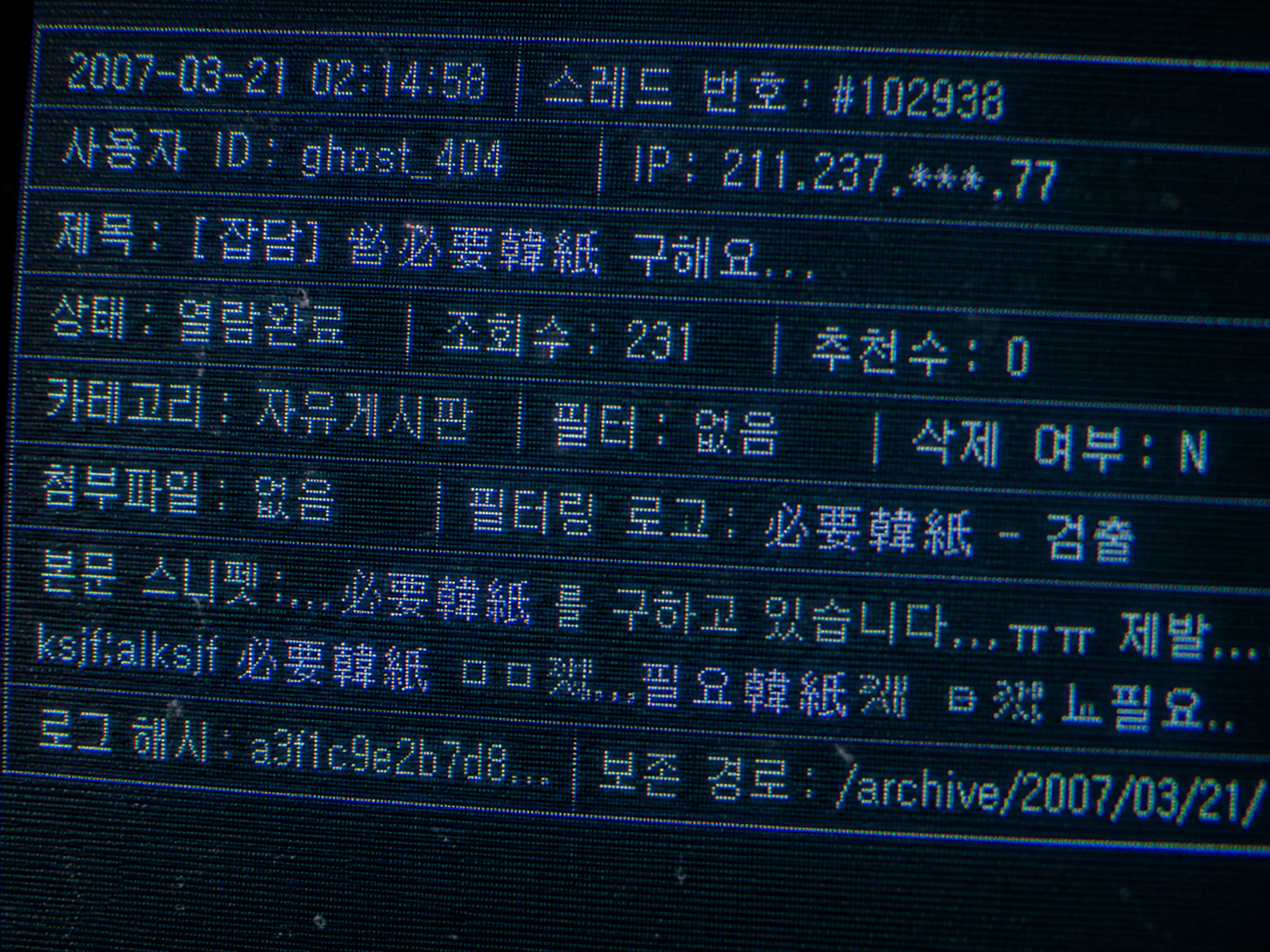
The machine translation incident—필요한지 (“Is it necessary?”) rendered through early translation software as the nonsensical Hanja compound 必要韓紙 (“Essential Traditional Korean Paper”)—encapsulated the entire fraud in miniature. Doderi had claimed direct, personal access to Japanese corporate executives; the garbled output of a digital translation tool revealed the mechanism behind the claimed fluency. It was not merely evidence of fraud. It was a kind of perfect symbol—the gap between claimed expertise and actual capability, made visible through the literal malfunction of the tool he had been using to simulate it.
The Evidence of Erasure
The community of Freegate dissolved entirely following the incident. Its infrastructure, membership, and accumulated knowledge—years of gameplay documentation, route optimization guides, community history—disappeared with it. This is a common endpoint for Korean internet cafes organized around the authority of a single administrator; when the administrator’s legitimacy collapses, the community’s binding structure collapses with it. There is no institutional memory to outlast the crisis.
Doderi himself disappeared from the mainstream web. His final documented communications were a series of toxic text messages and phone calls to former forum associates in August 2007, issued from a position of someone performing military service as a public service agent—a form of alternative service that would have placed him in civilian administrative work. Then silence.
The legal pursuit was led by a platform organizer known as “Jeme” and ultimately dropped out of leniency—a decision that would acquire retroactive irony when Jeme later orchestrated a substantial multi-million won financial fraud within the same internet ecosystem. The victim, in other words, became a perpetrator; the moral clarity of the original case was retrospectively complicated by the conduct of its most prominent avenger. This is not unusual in the archaeology of internet justice narratives. The righteous exposure frequently conceals its own problems.
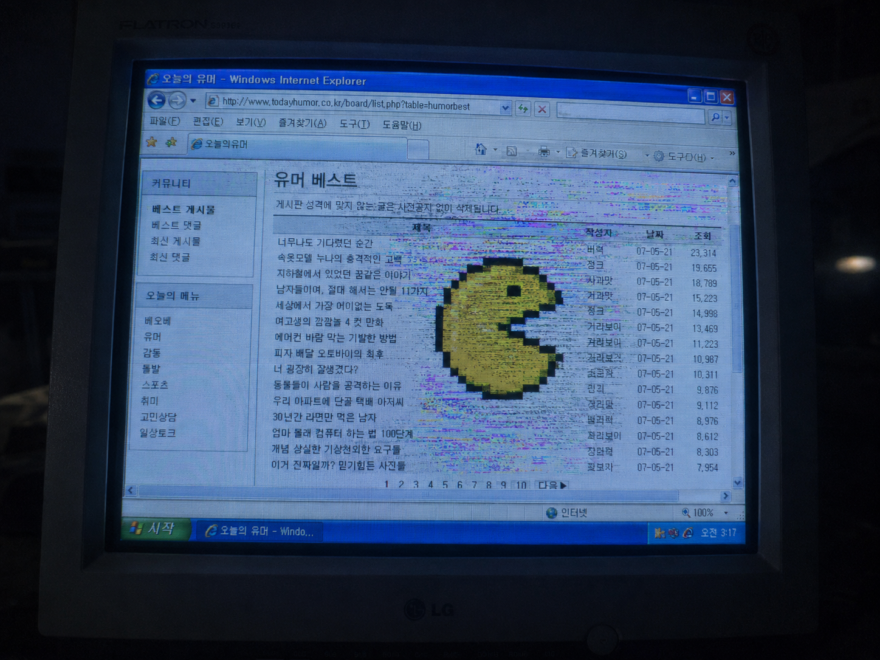
What survived the physical dissolution of Freegate and the legal non-resolution was something more durable: the meme apparatus. The Pac-Man Confessional Template—Doderi’s accidental self-incriminating post, in which he abandoned his anonymous persona mid-paragraph and wrote “What did I do so wrong?” (제가 뭘 그렇게 잘못했습니까?), accompanied by a low-resolution animated Pac-Man GIF—entered Korean internet folklore as a fixed satirical template. Deployed whenever an online figure is caught sockpuppeting their own defense, the template preserves the emotional architecture of the original moment—the desperate, self-pitying quality of someone who has lost control of their own narrative—without requiring any knowledge of the Doderi incident itself.
The incident’s most formally significant afterlife arrived in 2015, with the South Korean social thriller Socialphobia, which retained the “Doderi” handle as a direct reference while using the incident’s structure to examine early internet witch-hunt dynamics and digital doxxing culture. The film’s critical reception—it became one of the more discussed Korean films of its year—introduced the incident to an audience that had not been present for the original events, recoding it as a meditation on collective digital violence rather than community self-regulation.
The Point of No Return
The Doderi incident is frequently described, in retrospect, as an early demonstration of South Korean internet culture’s investigative capacity. This is accurate but insufficient. What the incident actually demonstrates is the precise moment at which a certain kind of constructed online identity became structurally untenable—not because technology changed, but because community practice changed. The DC Inside investigation did not use tools unavailable to the broader internet; it used address records and catalog databases and crowdsourced geographic knowledge. What it mobilized was collective attention, applied with a specific social intention.
This is the mechanism that the Western framing of the incident—as a quirky fraud story with a funny machine-translation punchline—consistently underweights. The exposure of Doderi was not incidental; it was institutional. The Gogaegal community was not simply correcting a mistake. It was constructing, in real time, a precedent for how fabricated authority would be handled.
What remains genuinely uncomfortable, two decades on, is the irreversibility of that construction. The Pac-Man GIF that Doderi selected at random, or perhaps chose with some intent now unknowable, has outlasted everything else about him. His actual name, his university enrollment, his military service status—these facts are technically public, somewhere in the archaeological layers of Korean internet forums and screenshot repositories. But what circulates—what continues to be invoked and reproduced and weaponized—is the GIF. The broken persona. The ten-minute window before he deleted the post and the fact that someone was watching.
The terrifying efficiency of the archive is not that it remembers everything. It is that it selects—and what it selects is not the complex human being but the single image of maximum symbolic utility. Doderi did not become a permanent footnote in South Korean internet culture because he committed fraud. He became a footnote because, in the act of defending himself, he produced an image so perfect in its illustration of self-defeat that it required no editorial assistance to become a meme.
The glitch in the map—Boeun in the wrong province—was the first crack. The accidental first-person pronoun was the last. Between them, a complete simulation of a human life was dismantled and replaced with something smaller and more durable: a template. A reaction image. A cautionary structure, stripped of the specific person who generated it, available for indefinite redeployment against anyone who makes the same mistake of forgetting, mid-sentence, which person they were pretending to be.
🔍Search Update: Call to Action
The digital traces of Freegate and the original 2007 DC Inside threads exist today largely as flattened, compressed screenshots preserved inside South Korean wiki culture. For Western lost media repositories and digital archivists, the primary data layers remain obscured behind localized web archives and historical server migrations. If you have access to uncompressed backups of the 2007 Gogaegal logs, early Naver Café scraping directories, or the original animated Pac-Man confessional string metadata, please contact the 3AM Archive research desk.
This document is an investigative archival reconstruction based on fragmented public records, media remnants, community accounts, and verified historical sources compiled by The 3AM Archive.
The article examines how incidents, forgotten media, internet folklore, and unresolved public memories evolve through cultural preservation and digital decay.
This is a cultural investigation document — not fictional horror content.
All visual materials used in this post are exclusive AI-generated assets created for The 3AM Archive.
