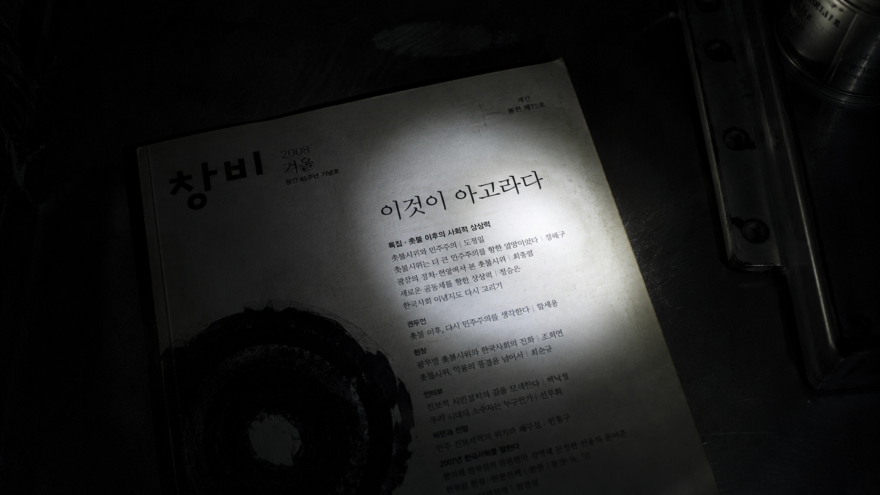
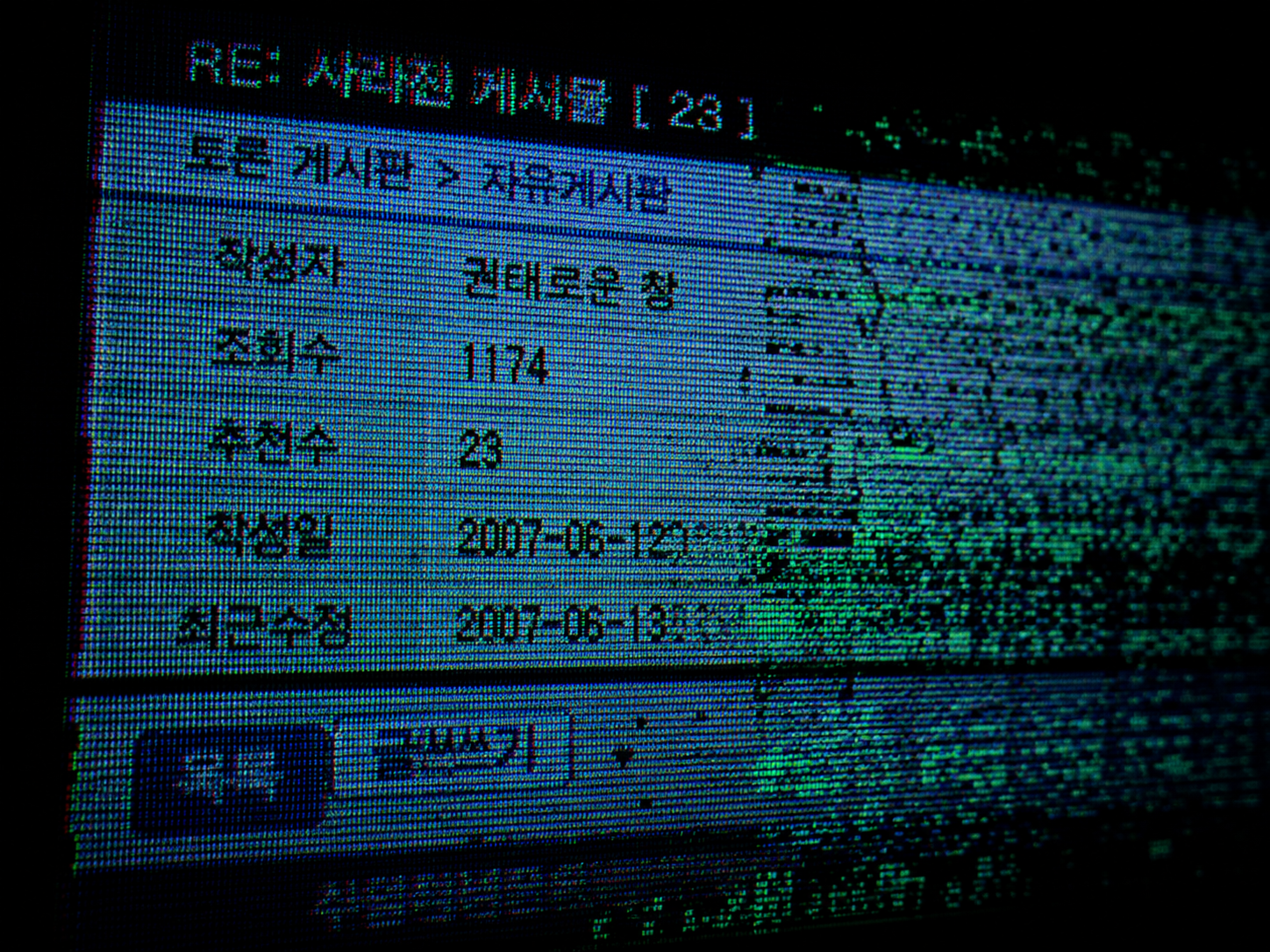
There is a particular kind of erasure that does not announce itself. No fire, no decree, no formal burning of books. The servers simply go dark; the parent company quietly migrates its infrastructure; the old URLs return nothing. What remains is a children’s book about a river, a print run of a literary quarterly from the autumn of 2008, and a handful of low-resolution screenshots preserved on blogs that themselves have since stopped resolving. This is the archive of Na Myung-soo—a 48-year-old hagwon director, an award-winning author of primary school environmental fiction, and, for several months in 2008, the most operationally dangerous forum poster in the Republic of Korea. His pseudonym was “Kwon-tae-roun Chang,” rendered roughly in English as “The Bored Window.” The state did not find this name amusing.
What the case of Na Myung-soo illuminates is not simply a story of political repression—South Korea has a well-documented history of those. It is something more specific and more disquieting: a precise moment in which the institutions of a modern democratic state formally declared, through legal mechanism and midnight arrest, that text written on a web forum was equivalent in legal weight to the physical command of an illegal street army. The implications of that declaration did not fade when the handcuffs clicked shut on a Jongno sidewalk at 3:00 AM. They simply went underground, like everything else associated with this case.
Historical Anatomy
To understand what Daum Agora was in the spring of 2008, one must first understand what South Korean internet infrastructure looked like in that era. Daum Communications—later absorbed into the Kakao conglomerate—operated one of the country’s dominant web portals, broadly analogous in cultural function to a hybrid of Yahoo and Reddit, with significantly higher civic stakes. Agora was its open debate forum; by 2008, it had become the de facto public square for political discourse in a country where mainstream broadcast media remained heavily concentrated and, critics argued, insufficiently adversarial toward the government of then-President Lee Myung-bak.
The trigger event was deceptively mundane: the resumption of US beef imports in April 2008, following a bilateral trade negotiation. The government’s reassurances regarding variant Creutzfeldt-Jakob disease risk landed badly in a public already primed toward institutional skepticism. What ignited was not simply a consumer health panic—it was a pre-existing reservoir of political frustration that had been accumulating since Lee’s election earlier that year, expressed suddenly through the language of food safety. By May, candlelight vigils were drawing tens of thousands to central Seoul nightly. By June, the scale had become something the state found difficult to categorize.
Into this environment came Na Myung-soo, who had arrived at Agora not as an agitator but as what he functionally was: a trained essayist and professional educator. His day job required him to teach Korean composition—specifically the highly formalized argumentative structures demanded by university entrance exams. His after-hours identity as “Kwon-tae-roun Chang” applied those same pedagogical competencies to political mobilization. His posts were not screeds; they were structured polemics. They parsed legal language, anticipated counterarguments, and concluded with specific action items. Forum users who expected the usual internet register—fragmentary, emphatic, grammatically approximate—found instead something that read like a well-drilled brief. The contrast was disorienting. It was also, for the purposes of mass mobilization, extremely effective.
By June 2008, he had accumulated enough influence within Agora’s ecosystem to attract the attention of a print press still learning how to cover internet culture. He gave an anonymous offline interview on June 4th, speaking to journalists who understood that they were talking to someone significant without knowing precisely who. He remained a voice without a face; a pseudonym attached to a post count. The state, however, had more resources than the press.
Structural Dissection of the Record
The legal instrument used against Na Myung-soo deserves careful examination, because it reveals the precise mechanism by which the state chose to translate his digital activity into criminal liability. He was charged by the Seoul Metropolitan Police Agency’s Cyber Crime Investigation Unit with violating the Assembly and Demonstration Act—a law designed to govern physical public gatherings, their notification requirements, and the identification of responsible organizers.
The charge rested on a specific interpretive move: that publishing a notice of a rally schedule on a web forum constituted, in law, the act of organizing and leading an illegal street demonstration. Na Myung-soo had not, in the documented record, personally led any physical march. He had typed. The state’s position was that the typing and the leading were legally indistinguishable.
This was not an incidental overreach; it was a deliberate prosecutorial theory. By treating the Agora post as equivalent to the bullhorn and the placard, the Cyber Crime Investigation Unit had found a mechanism to extend the Assembly Act into digital space without requiring any new legislation. The existing law simply needed to be read broadly enough—and in 2008, there was no settled judicial precedent in South Korea to prevent that reading.
Eyewitness testimony, attributed in circulating accounts to a forum user operating under the name “Dan-gun Hoo-son,” described the arrest itself in terms that emphasize its theatrical deliberateness. At approximately 3:00 AM on August 31st, on a sidewalk in Jongno 1-ga, police singled Na out from a crowd. They knew who they were looking for; the targeting was specific. The hour—3:00 AM—is worth noting not merely for atmospheric effect but because it speaks to the operational calculus involved. Daylight arrests of forum moderators draw cameras; 3:00 AM arrests do not.
Two days later, on September 2nd, the Seoul Metropolitan Police formally issued a domestic arrest warrant and dispatched officers to raid the homes of Agora’s sub-moderators. The case had expanded from one arrest into a coordinated cyber-crackdown, with the forum’s administrative hierarchy treated as an organizational chain of command.
Psychological Necropsy
A Western reader encountering this case for the first time typically experiences a specific variety of cognitive friction. The profile of Na Myung-soo does not match any available template for the figure of the dangerous radical. He was middle-aged; he was credentialed; he ran an institution whose entire social function was the reproduction of educational norms. His published fiction—including a title reconstructed from available references as Ssing-ssing’s River Journey—was the kind of literature that appears on state-recommended reading lists for primary schools. He was, by nearly every external indicator, the sort of person that civic society produces as evidence of its own health.
The West has its own tradition of the intellectual dissident, but that tradition tends to cast its figures in a specific mold: the exile, the bohemian, the tenured contrarian. The figure of the hagwon director—the proprietor of a private cram school, a quintessentially South Korean institution built on the logic of supplementary exam preparation—does not map onto any of those templates. Yet the hagwon context is precisely what explains the mechanism of Na’s influence. His profession had given him a finely calibrated instrument for shaping the way large numbers of people processed and reproduced structured arguments. He had simply pointed that instrument in an unexpected direction.
What disturbs the Western imagination further is the publication timeline. In the same month that he was arrested—August 2008—the literary quarterly Changbi (Creation and Criticism) published an essay by Na Myung-soo titled “This is Agora.” Changbi is not a niche publication; it is one of the oldest and most intellectually prestigious periodicals in South Korean letters, founded in 1966 and historically associated with the democracy movement of the 1970s and 1980s. The fact that Changbi’s editors had approached Na, verified his identity sufficiently to commission a piece under his analysis, and gone to press with it before his arrest—while the Cyber Crime Investigation Unit was presumably already building its case—suggests a moment of almost operatic institutional simultaneity. The republic of letters was formally canonizing the man whom the republic of law was preparing to arrest.
The Evidence of Erasure
The mythology that accreted around Na Myung-soo during and after his arrest followed the predictable grammar of internet legend. Among the most persistent variants was what circulating accounts describe as the “3:00 AM Ghost” theory: the claim, spread through early Korean web forums, that “Kwon-tae-roun Chang” was not a real individual at all but a shared, state-monitored honeypot account—a dummy identity maintained by intelligence services to draw out genuine organizers, or by a collective of activists rotating through a single alias. The theory drew its plausibility from the tactical precision of Na’s posts, which some users found implausibly consistent for a single unpaid amateur; and from the 3:00 AM arrest, which, to a forum community accustomed to the dreamlike temporality of late-night posting, carried the quality of a myth resolving into violence.
The honeypot theory was wrong, or at least unprovable. But its circulation reveals something accurate about the cultural moment: the early Korean internet had developed, in parallel with its civic functions, a sophisticated capacity for paranoid self-mythologization. Forums that were simultaneously tools of political organizing and spaces of intense social bonding had produced communities attuned to the possibility of infiltration. The “3:00 AM Ghost” variant was not simply disinformation; it was the community processing, through the available genre conventions of internet mythology, a genuine and documented experience of state surveillance.
The physical erasure came later, and more completely. Kakao, the conglomerate that absorbed Daum Communications, shut down Agora and wiped its servers. The decision was framed in corporate terms—platform consolidation, shifting user behavior toward mobile social media, declining engagement metrics. Whether the specific political history of the platform influenced the timeline of its decommissioning is not documented in available public records. What is documented is the result: the raw text of Na Myung-soo’s forum posts, the comment threads they generated, the counter-arguments and endorsements and organizational logistics that played out across thousands of exchanges—all of it is gone. The essay “This is Agora” survives in the physical print run of Changbi’s Autumn 2008 issue; the digital forum it analyzed does not.
This produces an archival paradox specific to the early social media era, where the open web had not yet been codified into a default archive of human experience. The commentary on the phenomenon outlasted the phenomenon itself. The critical apparatus survived; the primary source it examined was deleted.
The Point of No Return
In August 2008, the Seoul Metropolitan Police Agency’s Cyber Crime Investigation Unit made an implicit argument that has never been formally retracted, overturned by legislation, or resolved by settled precedent in a way that renders it definitively historical. The argument was this: that the organizational structure of a web forum—its moderators, its posting conventions, its mechanisms for aggregating and amplifying individual voices—is legally continuous with the organizational structure of a street demonstration. The forum moderator is the rally organizer. The post announcing a time and location is the illegal notice. The upvote is the assent of the crowd.
That argument was made under specific political conditions, by a specific administration, targeting a specific platform that has since been erased. It would be convenient, and probably wrong, to treat it as purely historical. The legal infrastructure that enabled it—the broad reading of assembly law, the jurisdictional reach of cyber crime units into expressive content, the treatment of platform administrators as criminally liable for what their communities produce—did not dissolve with the Lee Myung-bak administration. It was absorbed into subsequent regulatory frameworks across multiple jurisdictions; refined, softened in some places, hardened in others, but never fully abandoned.
Na Myung-soo was eventually released. His case moved through a legal system that, in the end, did not fully sustain the most aggressive interpretations the initial arrest implied. He returned to his academy; his children’s books remained on recommended reading lists. The Changbi essay stayed in the archive. But the forum he wrote about, the community he helped organize, the raw primary record of what he actually argued across months of daily posting—none of that returned with him. The state had targeted the man; the corporation erased the work. Between the two, what survives is a case number, a literary quarterly, a handful of screenshots on dead blogs, and an arrest time—3:00 AM—that has passed, in the communities that remember it, into something closer to myth than record.
That is the condition of the early internet’s political history: not suppressed, exactly, but structurally unmaintained. The archives did not burn. They simply ran out of server space, failed to attract continued investment, were migrated into formats that did not preserve the original structure, and eventually returned 404 errors to anyone who went looking. The revolutionary digital footprint Na Myung-soo left across Daum Agora is now indistinguishable, in practical terms, from content that was never created. The difference between deletion and neglect, at sufficient archival distance, is difficult to establish. In the absence of the primary record, that difficulty becomes permanent.
What the 3:00 AM arrest on a Jongno sidewalk ultimately preserved—in the form of press reports, legal documents, and the testimony of forum users who were watching—is the shape of the event rather than its substance. We know that something significant was said, over many months, on a platform that no longer exists, by a man whose professional life gave him unusual tools for saying it. We know the state found it threatening enough to act at 3:00 AM. We know a children’s author went home to his academy, and the forum did not survive him.
The rest is archival silence—which is not the same as nothing, but which requires, unlike nothing, an active effort to remember that something is missing.
🔍Search Update: Call to Action
The 3AM Archive is actively seeking unredacted mirror logs, private hard drive backups, or high-fidelity screenshots of Daum Agora threads authored by “Kwon-tae-roun Chang” between April and August 2008. If you have access to early South Korean forum scraping datasets or physical print media records mapping these deleted cyber-history coordinates, please contact our archival desk.
This document is an investigative archival reconstruction based on fragmented public records, media remnants, community accounts, and verified historical sources compiled by The 3AM Archive.
The article examines how incidents, forgotten media, internet folklore, and unresolved public memories evolve through cultural preservation and digital decay.
This is a cultural investigation document — not fictional horror content.
All visual materials used in this post are exclusive AI-generated assets created for The 3AM Archive.
