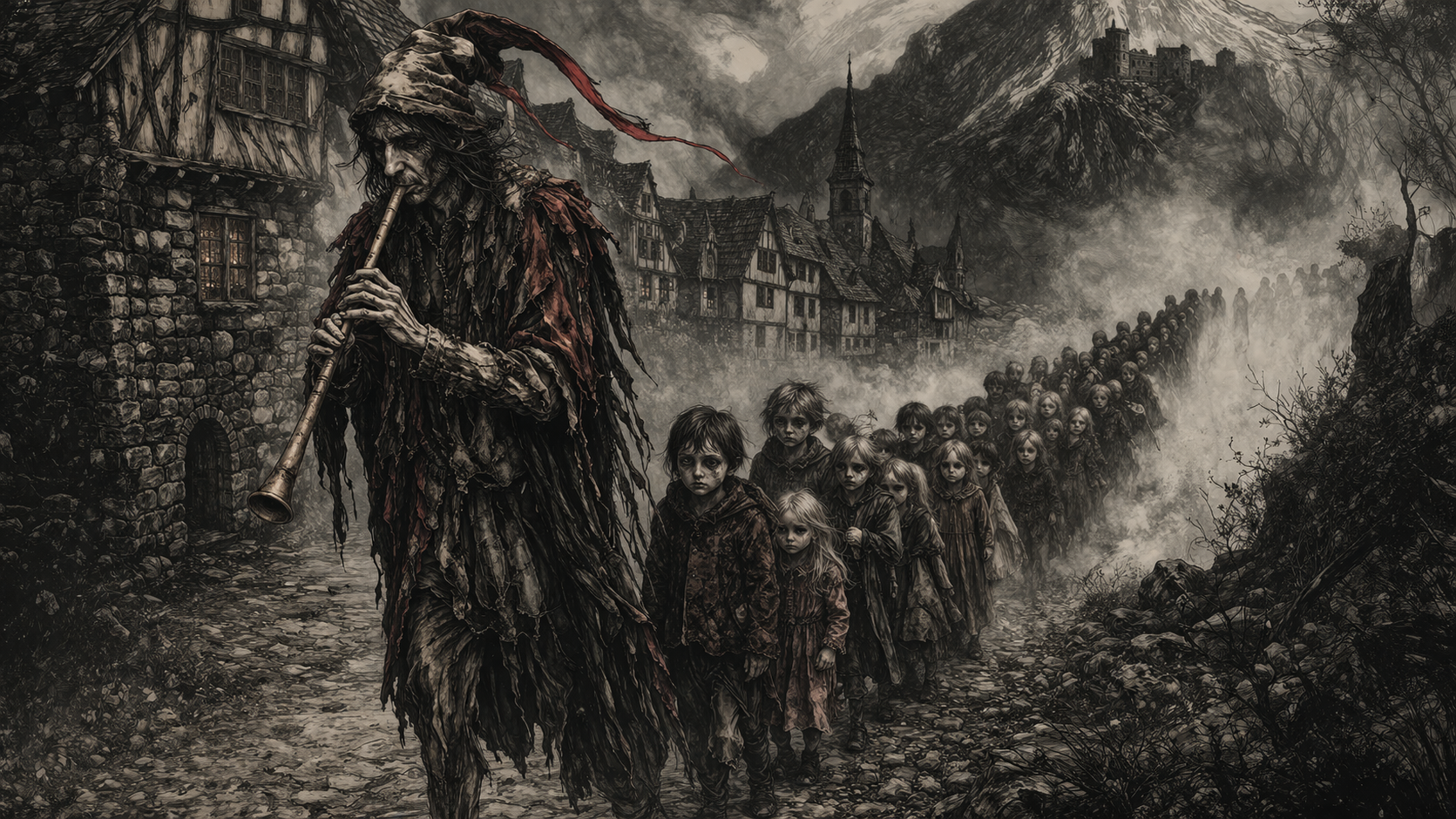
Most people think the Pied Piper is a simple cautionary tale about broken promises.
That interpretation is misleading.
What remains underneath is a recorded event where an entire generation vanished without resistance.
And no one could bring them back.
The Structural Framework
Strip away the music, the rats, the color.
What you are left with is a mechanism:
- A figure enters a community
- Gains attention or authority
- Creates a synchronized movement
- Removes a population segment completely
In the legend of the Pied Piper, the “payment dispute” is a distraction. It explains motive, but not method.
Why did only children follow him?
Why was there no resistance?
The structure suggests something deeper than persuasion. It points to coordinated compliance. A moment where a group acted as one, not individually.
The pipe is symbolic. Not necessarily a literal instrument, but a trigger.
Something that aligned behavior.
Historical Archetypes
The town of Hamelin preserves one of the clearest records tied to this event.
A 14th-century inscription reportedly stated: “It is 100 years since our children left.”
More striking, local accounts fix the date to June 26, 1284.
Approximately 130 children.
Gone.
Not scattered. Not killed in visible conflict. Removed.
Historians have attempted to map this onto known patterns.
Some connect it to the Children’s Crusade, where waves of young people moved under religious influence. Others link it to episodes of collective hysteria such as Dancing Mania.
But these explanations fracture under pressure.
They explain movement. Not disappearance.
They leave one critical detail unresolved:
Why is there no trace?
Psychological Necropsy
The disturbing part is not that the children followed.
It is how easily they did.
For a group of that size to move together, several conditions must align:
- Trust in the leader
- Suspension of fear
- Perceived promise or reward
This is not random.
It suggests that the figure we call the Pied Piper did not appear as a threat. He appeared as an answer.
To what?
Possibly escape. Possibly opportunity. Possibly something the adults could not offer.
Children are not just vulnerable. They are responsive to coherence. When someone presents a clear path, especially in uncertain conditions, alignment happens fast.
The pipe, then, is not control.
It is synchronization.
Why People Keep Looking Away
Because the alternative explanations are more unsettling than the legend.
A magical figure stealing children feels distant. Unreal.
A coordinated, real-world removal of youth from a town feels possible.
Too possible.
So the narrative shifts.
The man becomes supernatural. The event becomes allegory. The disappearance becomes a lesson about obedience.
This reframing does something important:
It removes accountability.
If it was magic, no one failed.
If it was a story, no one is responsible.
But if it was real, then something or someone orchestrated it.
And that possibility is harder to accept.
The Point That Should Disturb You Most
The most persuasive theory is not hysteria or crusade.
It is recruitment.
During the 13th century, expansion into Eastern Europe relied on organized migration. Recruiters moved through German regions, selecting young populations to establish new settlements.
Under this lens, the Pied Piper becomes a function.
A locator. A mover of people.
The children did not vanish in chaos. They were redirected in order.
Which raises the most uncomfortable possibility:
Nothing supernatural happened.
The town lost its children through a structured process, one that appeared voluntary from the outside.
And once they were gone, they effectively ceased to exist to those left behind.
Not dead.
Just erased.
Final Thought
The story survives because it never resolves.
No bodies. No return. No closure.
Only a date, a number, and a silence that has lasted centuries.
And the question it leaves behind is not who the Pied Piper was.
It is how an entire town could watch its future walk away, together, and never see it again.
This document is an investigative archival reconstruction based on fragmented public records, media remnants, community accounts, and verified historical sources compiled by The 3AM Archive.
The article examines how incidents, forgotten media, internet folklore, and unresolved public memories evolve through cultural preservation and digital decay.
This is a cultural investigation document — not fictional horror content.
All visual materials used in this post are exclusive AI-generated assets created for The 3AM Archive.
