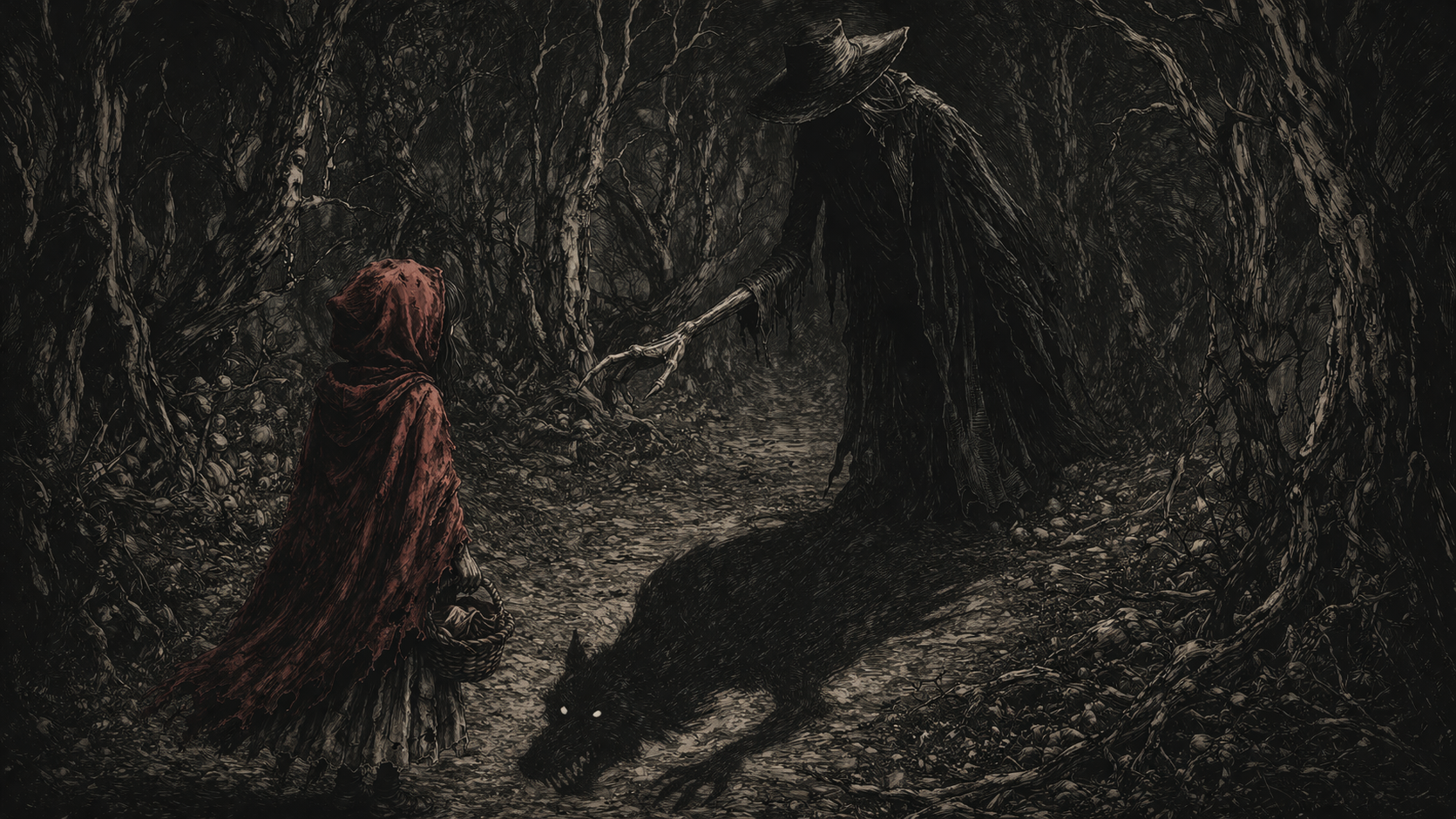
Most people think Red Riding Hood is a simple warning about talking to strangers.
That interpretation is dangerously incomplete.
Beneath the surface sits a precise behavioral script for how predators approach, isolate, and consume.
And it was never meant to be comforting.
The Structural Framework
The story is often reduced to a single mistake. A girl talks to a wolf and pays the price.
But that is not the real mechanism.
The structure unfolds in stages:
- Identification of a vulnerable target
- Controlled conversation to build trust
- Strategic diversion from a safe path
- Isolation from protection
- Final approach under disguise
This is not random danger. It is a process.
In the version written by Charles Perrault, there is no interruption, no reversal, no rescue.
The sequence completes itself.
Which reveals something critical:
The threat is not chaos.
It is design.
Historical Archetypes
When the tale was later adapted by the Brothers Grimm, a hunter was introduced.
This addition changes everything.
It inserts the illusion of external salvation. It implies that even if the process completes, something can undo it.
But the earlier structure had no such escape.
That earlier form aligns closely with real fears in early modern Europe, where isolated paths, forests, and travel routes were not just dangerous. They were hunting grounds.
The “wolf” was rarely just an animal.
In many cases, it represented something far more unpredictable.
Psychological Necropsy
The most disturbing element is not the violence.
It is the method of approach.
The wolf does not chase.
He converses.
He adapts.
He asks questions. Learns routines. Redirects movement.
This is not instinctive behavior. It is calculated interaction.
In some early oral versions, the sequence becomes even more explicit. The girl is instructed to remove her clothing and enter the bed.
Stripped of symbolism, the pattern becomes clear:
- Remove protection
- Normalize proximity
- Collapse boundaries
The grandmother’s identity is then replicated. Trust is weaponized.
The predator does not destroy trust.
He replaces it.
Why People Keep Looking Away
Because the modern version shifts the focus to the forest.
The danger becomes environmental. A place. A setting.
That framing is safer.
It suggests that risk exists only in certain locations, under certain conditions.
But the original structure does not depend on the forest.
It depends on interaction.
People avoid this interpretation because it removes distance. It places the mechanism within everyday human behavior.
And that is harder to ignore.
The Point That Should Disturb You Most
The wolf is not powerful because he is stronger.
He is powerful because he is believable.
Historical events reinforce this pattern. During periods of fear and instability, accusations of “wolves” or “werewolves” surged. These were not always literal claims. They were attempts to describe human actions that felt inhuman.
The Beast of Gévaudan intensified this fear. While officially attributed to an animal, suspicions of human involvement persisted.
The line between beast and person blurred.
And that is where the story operates.
Not in the forest.
In that blurred line.
Final Thought
Red Riding Hood was never about avoiding animals.
It was about recognizing patterns.
Because the most dangerous predators do not reveal themselves.
They speak first.
They listen carefully.
And by the time you realize what they are, the process is already complete.
This document is an investigative archival reconstruction based on fragmented public records, media remnants, community accounts, and verified historical sources compiled by The 3AM Archive.
The article examines how incidents, forgotten media, internet folklore, and unresolved public memories evolve through cultural preservation and digital decay.
This is a cultural investigation document — not fictional horror content.
All visual materials used in this post are exclusive AI-generated assets created for The 3AM Archive.
