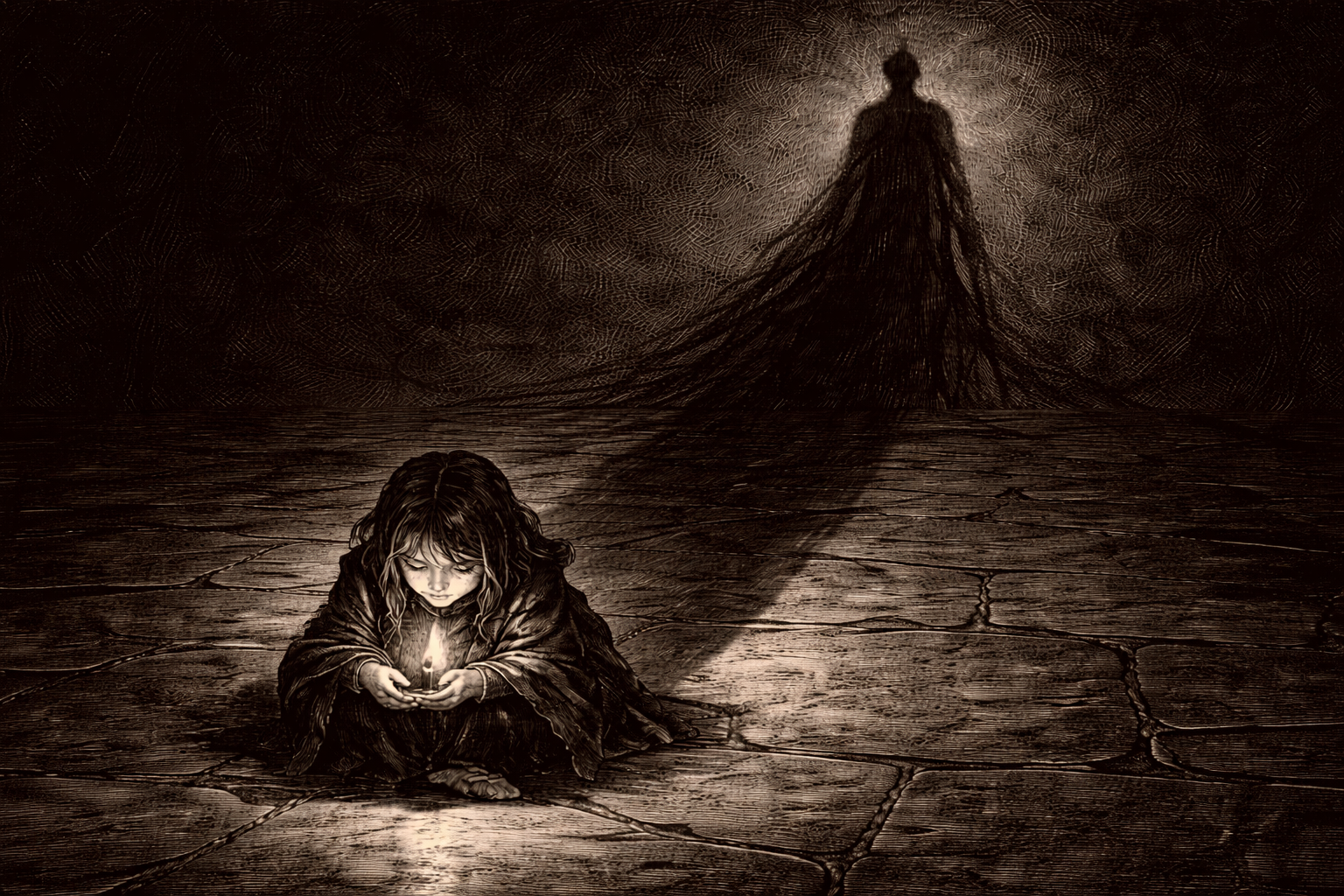
Most people think The Little Match Girl is a touching story about hope in hardship.
That assumption collapses the moment you examine the ending.
What actually unfolds is a system that transforms suffering into something that feels acceptable.
And then lets it continue.
The Structural Framework
At first glance, the structure appears simple. A poor girl struggles, imagines warmth, and finds peace.
But that interpretation hides the mechanism:
- Extreme deprivation
- Psychological escape through illusion
- Temporary relief through imagination
- Physical collapse
- Post-event reframing as something beautiful
In the version written by Hans Christian Andersen, the matches are not just objects.
They are triggers.
Each flame produces a vision. Warmth. Food. Celebration. Love.
But none of it exists.
The structure does not remove suffering. It overlays it.
Historical Archetypes
The story emerges from a real context. 19th-century Europe was marked by visible, unavoidable poverty. Children worked, begged, and often froze in the streets.
This was not hidden.
It was normalized.
Literature from this period frequently performed a subtle function. It transformed visible suffering into moral or spiritual narratives.
Pain became meaningful.
Death became peaceful.
Neglect became invisible.
The Little Match Girl fits directly into this pattern.
Instead of exposing systemic failure, the story reframes it as a quiet, almost sacred moment.
Psychological Necropsy
The most disturbing element is not that she dies.
It is how her mind adapts before that moment.
Each match creates a controlled hallucination. Not random, but specific.
Warmth.
Food.
Family.
These are not fantasies of excess. They are fantasies of absence being filled.
Her mind is not escaping reality.
It is compensating for it.
This is a known psychological response. When conditions become unbearable, perception adjusts. It creates an alternate layer that makes the present tolerable.
But there is a cost.
The more real the illusion feels, the less urgent the need to escape the actual condition.
Relief without change.
Why People Keep Looking Away
Because the story is framed as beautiful.
The final image is not presented as tragedy. It is presented as transcendence.
She smiles. She sees her grandmother. She rises beyond the cold.
This reframing does something critical.
It removes discomfort.
Readers are not left with anger or urgency. They are left with a softened emotional resolution.
The suffering is still there.
But it no longer demands response.
The Point That Should Disturb You Most
The girl does not fail to survive.
She is never given a chance.
No one intervenes. No system reacts. No structure shifts.
The only mechanism that activates is internal.
Her mind creates warmth because the world does not provide it.
And when she dies, the narrative immediately reinterprets it.
Not as preventable.
Not as unjust.
But as peaceful.
This is the most effective form of control.
Not forcing people to accept suffering.
But teaching them to reinterpret it.
Final Thought
The Little Match Girl is not a story about hope.
It is a story about how suffering can be made to feel meaningful enough that no one stops it.
And the most unsettling part is not that she was alone in the cold.
It is that everyone else walked past and accepted the silence that followed.
This document is an investigative archival reconstruction based on fragmented public records, media remnants, community accounts, and verified historical sources compiled by The 3AM Archive.
The article examines how incidents, forgotten media, internet folklore, and unresolved public memories evolve through cultural preservation and digital decay.
This is a cultural investigation document — not fictional horror content.
All visual materials used in this post are exclusive AI-generated assets created for The 3AM Archive.
