Most people remember Bluebeard as a warning about curiosity.
That reading is not just incomplete. It is the precise inversion of what the story actually encodes.
What sits beneath the surface of this tale is a meticulously constructed architecture of coercion, normalized violence, and the expectation that a woman should earn her survival by suppressing her own perception. The forbidden room is not the danger. The marriage is.
The Structural Framework
Bluebeard is not a fairy tale about disobedience. Strip away the blue beard, the castle, the golden key, and what remains is a behavioral contract: comply and live, question and die. The structure of the narrative enforces this with remarkable precision. A wealthy man with a history of dead wives offers a young woman access to everything he owns, except one room. The prohibition is not framed as protection. It is framed as a test.
This is the mechanism. The room is not actually forbidden to protect the wife. It is forbidden to identify which wife will notice, ask questions, and assert the right to know what happened to the women who came before her. Bluebeard is not guarding a secret. He is selecting a survivor type.
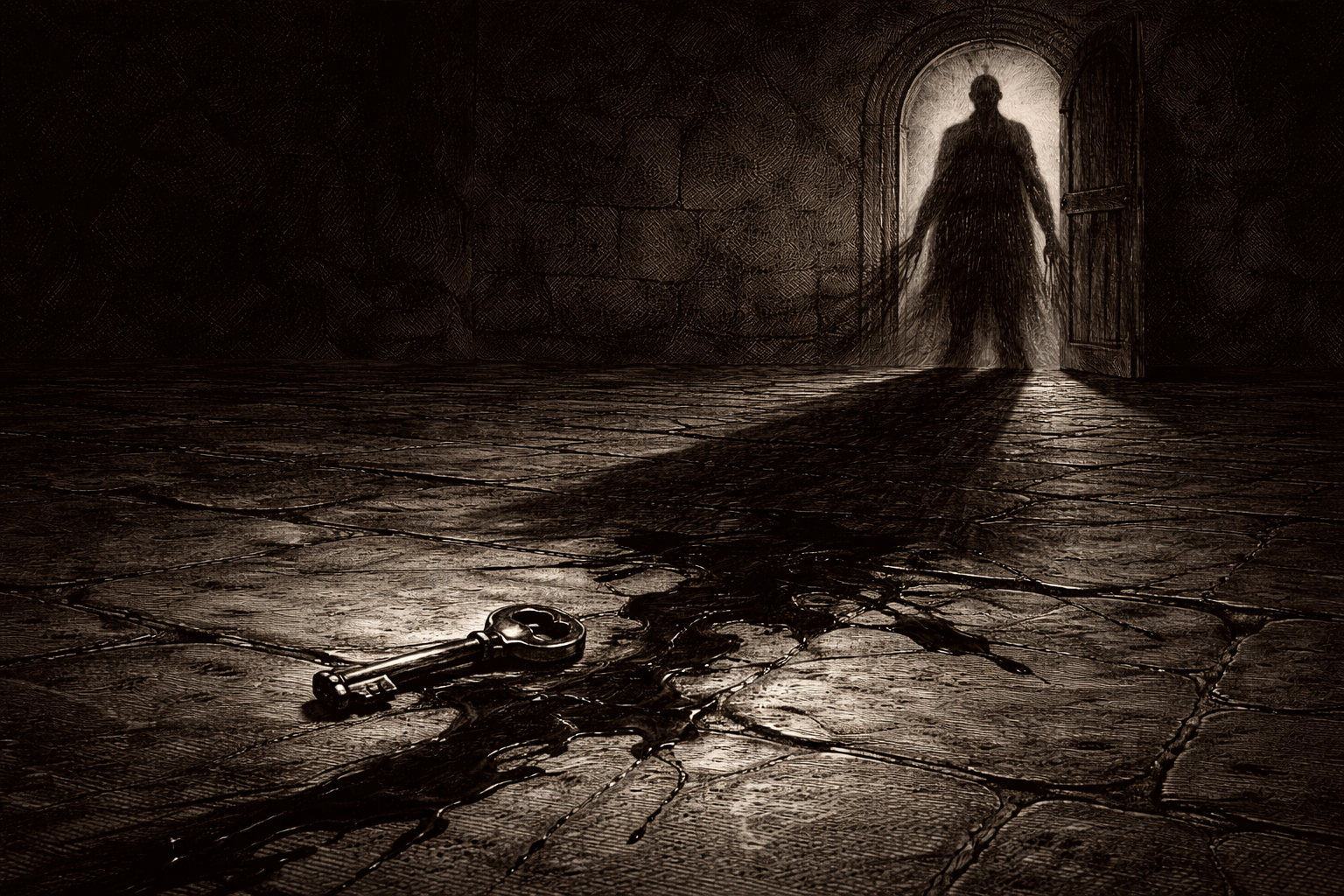
The key is enchanted to bleed when the forbidden threshold is crossed, meaning the transgression is physically inscribed on the object, not on the woman’s behavior. She cannot clean the stain away. This detail is rarely examined with the seriousness it deserves. The narrative has pre-decided her guilt before she has even acted. The punishment is not a consequence of her choice. It is a consequence of her nature, her curiosity, her unwillingness to perform ignorance on command.
This is not a moral fable with a warning. This is a prototype for a system in which a woman’s survival depends on successfully imitating a person who does not want to know things. That system did not disappear when Perrault wrote his moral at the end. It merely became better dressed.
Historical Archetypes
The Bluebeard template appears across cultures with a consistency that suggests it is not folklore but instruction. In the Hindu story of Shiva and Sati, divine authority and forbidden knowledge collapse a woman into ash. In Greek myth, Psyche is explicitly forbidden to look at Eros, and her act of looking is framed as the source of all subsequent suffering. Lot’s wife turns to look and is crystallized into salt, a pillar of warning erected at the edge of every future woman’s peripheral vision.
The pattern is not coincidental. It is a recurring pedagogical structure, transmitted across generations through story, used to install the idea that female perception is inherently dangerous when directed without male permission. Looking, knowing, and questioning are all constructed as violations in these archetypes, not because they harm anyone, but because they disrupt the authority of whoever controls the room.
In European history, the Bluebeard story overlaps with documented legal frameworks. Coverture law in England and its derivatives across the West operated on the premise that a married woman had no legal personhood separate from her husband. She could not own property, testify in court independently, or enter contracts. The forbidden room in Bluebeard is not a metaphor for something outside the law. It is a metaphor for the law itself, the zone of male authority that a wife approached at her mortal peril.
Gilles de Rais, the 15th-century French nobleman and companion of Joan of Arc, is sometimes cited as a biographical prototype for Bluebeard. His trial documented the murders of children in a castle while his social position protected him from accountability for years. Whether or not Perrault drew on this figure directly, the structural resemblance matters: wealth insulates, castles contain, and the law moves slowly when the perpetrator is the one who funds the courts.
Psychological Necropsy
What Bluebeard actually stages is the installation of a surveillance mechanism inside the woman herself. By the time she holds the key, she has already internalized the prohibition so thoroughly that opening the door feels like self-destruction, not investigation. The horror when she opens it is not simply that she sees the bodies. It is that she immediately understands she has become the next body in a sequence she was never supposed to recognize as a sequence.
This is the psychoanalytic core of the tale. The forbidden room is not external repression. It is the structure of repression itself made architectural, visible, and lethal. The wife does not just find dead women. She finds the material evidence of what happens to women who found material evidence. She is standing in the proof of her own future.
Carl Jung’s analysis of the Bluebeard figure places him in the category of the destructive animus, the internalized masculine principle that turns against the psyche it inhabits. But this framing has a problem. It relocates the violence into the woman’s own psychology, suggesting that what she is fighting is an internal demon rather than an external predator with a key ring and a record of impunity. The Jungian reading is not wrong, but it is dangerously convenient for the Bluebeards of the world.
The blood on the key that cannot be removed is not a punishment for curiosity. It is a depiction of what trauma theorists now call the indelibility of witness. Once you have seen what is in that room, you cannot perform ignorance. The stain does not represent guilt. It represents the impossibility of returning to a state of protected unknowing. Bluebeard intends to kill her not because she disobeyed, but because she cannot now pretend she does not know what she knows. That knowledge makes her unmanageable.
Why People Keep Looking Away
The standard interpretation of Bluebeard as a cautionary tale about female curiosity has persisted for centuries because it is extraordinarily useful to the structures that produced the story. If the moral is “do not open doors you are told not to open,” then the story functions as a behavioral installation, particularly effective when delivered to children before they have the analytical vocabulary to question the premise.
Bruno Bettelheim, whose influential work on fairy tales shaped mid-20th-century psychology, read Bluebeard as a story about the dangers of premature sexual knowledge. This interpretation, now widely criticized, still lingers in academic discussions because it offers a way to aestheticize the violence rather than name it. If the forbidden room is about sex, then the story is about developmental psychology. If it is about obedience enforced by the threat of murder, then it is about something much harder to package into a comforting developmental framework.
People look away from what Bluebeard actually depicts because accepting it as a structural analysis of intimate partner violence means accepting that the genre of the fairy tale has been partly functioning as propaganda. Not all of it. Not uniformly. But with disturbing regularity, the tales that survive, the ones selected, retold, published, illustrated, and distributed to children, are the ones that encode particular lessons about who has the right to make rules and who has the obligation to follow them without asking why.
Perrault’s moral at the end of the 1697 version is almost satirically transparent. He writes that curiosity is a great evil, that women pay dearly for it, and that the pleasure of knowing is not worth the pain it causes. He is not encoding a warning about danger. He is encoding a warning about questioning authority. Those are not the same thing, and the difference matters enormously.
The Point That Should Disturb You Most
The brothers arrive in time. The wife is rescued. Bluebeard is killed. The story ends with the wife inheriting his wealth and eventually remarrying happily. This resolution is presented as justice.
Sit with that for a moment.
The resolution requires that the rescue arrive before the execution. It depends entirely on external intervention at the last possible moment, on brothers who happen to be close enough, on a sister who stalls effectively enough, on a murderer who pauses long enough. Change any of those variables and the story does not end in rescue. It ends in another body in another room, which is precisely how the preceding wives died. The only structural difference between the wife who survives and the wives who did not is that she had brothers on horseback at the right time.
The disturbing implication is not simply that the system is dangerous. It is that the story frames her survival as proof that the system worked. She knew when to open the door. She knew how to buy time. She knew to send her sister to the tower to watch for help. She was, in the narrative’s own logic, the wife who got it right. The dead women in the room got it wrong in some unspecified way, or simply had no brothers.
This is the structure that should not let you sleep easily. The fairy tale tradition does not celebrate women who escape violent men. It celebrates women who survive violent men through a combination of luck, family resources, and the precise management of their own fear. Escape is framed as exceptional. Violence is framed as the background condition against which exceptional women demonstrate their worth.
The room full of bodies is not the aberration in Bluebeard’s world. It is the baseline.
Final Thought
The blue beard was never the point. It was there to mark him as other, as visibly strange, so that the reader could maintain comfortable distance from the recognition that Bluebeard’s castle looks like any number of ordinary arrangements in which one person holds all the keys and another person is forbidden to ask why. The color of his beard is the story’s alibi. It lets the audience believe that the danger is visible, identifiable, and exceptional. Most of the rooms in most of the castles in this particular genre of story contain exactly what that room contains. The difference is that nobody gave those wives a door to open.
This document is an investigative archival reconstruction based on fragmented public records, media remnants, community accounts, and verified historical sources compiled by The 3AM Archive.
The article examines how incidents, forgotten media, internet folklore, and unresolved public memories evolve through cultural preservation and digital decay.
This is a cultural investigation document — not fictional horror content.
All visual materials used in this post are exclusive AI-generated assets created for The 3AM Archive.
