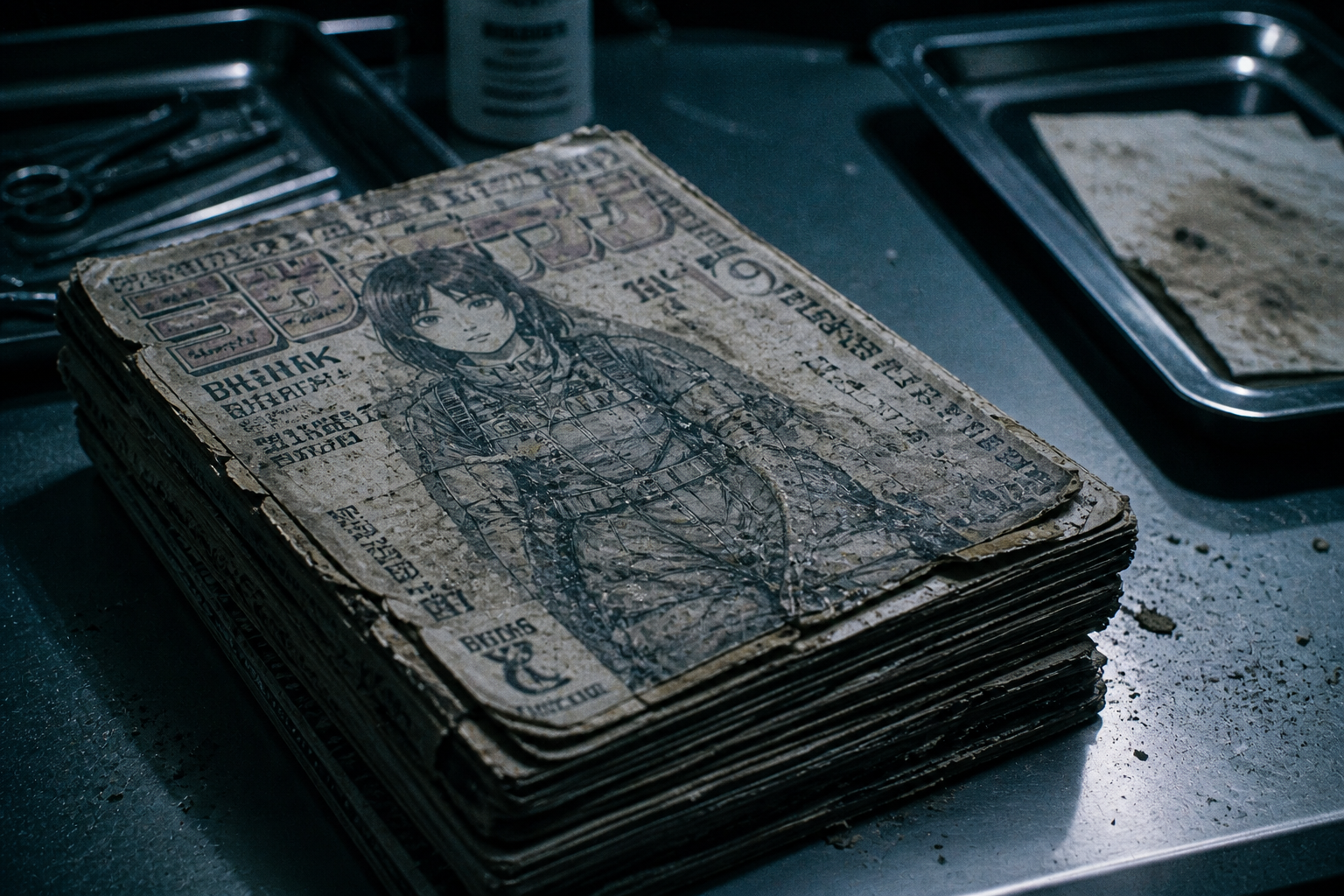
The franchise you love was built on something that was killed first.
Not retooled. Not revised. Killed. Three chapters published. Then silence. Then a completely different product released years later and presented as if the first version had never existed.
You were never supposed to go looking for the original.
The Thing That Should Not Have Disappeared
In 2005, Comp Ace magazine began serializing a manga titled “Strike Witches: Aozora no Otome,” which translates roughly as “Maidens of the Blue Sky.” The creative foundation was provided by Shimada Fumikane, the illustrator who would eventually become synonymous with the franchise’s signature visual identity. The premise involved young women with magical abilities piloting hybrid aircraft-weapon systems against an alien mechanical threat called the Neuroi. The core DNA of what would later become a multimedia juggernaut was present.
Three chapters were published. Then the serialization stopped.
No announcement. No explanation in the magazine. No collected volume release. No author statement. The series simply ceased to appear in subsequent issues of Comp Ace, and the institutional machinery of Japanese media publishing moved forward without acknowledging the gap.
For most readers in 2005, this would have been a minor disappointment at most. Manga serializations fail constantly. The economics of the magazine format are brutal. A series that does not perform in its early chapters is cut without ceremony. This is normal.
What makes the Aozora no Otome case abnormal is what happened afterward.
The Strike Witches franchise did not die with the manga. It was rebuilt. Quietly, comprehensively, and in a direction that required the original version to be as invisible as possible. By the time the anime series launched in 2008 and became a genuine cultural phenomenon, the 2005 manga existed in a strange liminal state. It was technically part of the franchise history. It was also essentially inaccessible, undocumented in official materials, and actively avoided in promotional contexts.
The three chapters that existed were not widely digitized. Physical copies of the relevant Comp Ace issues became increasingly difficult to locate. Fans who had retained their magazines from 2005 found themselves in possession of something that functioned more like classified documentation than a back issue.
This is not a normal pattern for commercial media.
The Structural Framework: How Franchises Bury Their Origins
To understand what happened to Aozora no Otome, you need to understand a specific mechanism in Japanese media franchise development that is rarely discussed directly.
Japanese media properties of this era, particularly those built around illustrated characters and military or fantasy adjacent settings, were developed through a system of iterative public testing. The magazine serialization format served a dual purpose. It generated revenue through reader subscriptions and newsstand sales. It also functioned as a live market test, exposing early iterations of a concept to a real audience and measuring response through reader surveys, letters, and sales data.
This system is efficient. It is also ruthless.
When an early iteration performs poorly, the standard commercial response is not to revise and continue. It is to terminate the public exposure and conduct the revision in private. The failed version is not acknowledged as a predecessor because acknowledgment creates a narrative of failure. Investors, licensors, and downstream media partners respond poorly to a franchise origin story that begins with rejection.
So the failed version is not contextualized. It is simply made absent.
This is what happened to Aozora no Otome. The reader response to the 2005 serialization was not strong enough to justify continuation. The character designs were unfamiliar and received skeptically. The world-building was underdeveloped within the three chapter format. The central visual concept, specifically the decision to depict the witches operating without conventional lower-body clothing, was received in 2005 with confusion rather than the eventual acceptance it would find in the anime era.
The project was pulled back. The design language was overhauled. The characters were made more immediately accessible. The world-building was restructured. And the original version was left to degrade quietly in the back issues of a specialist manga magazine.
What makes this structural rather than merely commercial is the completeness of the erasure. Official franchise histories produced after the anime’s success consistently begin the Strike Witches story with the 2007 OVA or the 2008 series. The 2005 manga is mentioned, when it is mentioned at all, as a footnote. The actual content of those three chapters is almost never reproduced or discussed in official contexts.
The franchise did not grow from its origins. It was built over them.
Historical Archetypes: The Pattern of the Buried First Draft
This pattern is not unique to Strike Witches. It is a recurring structure in the archaeology of successful media franchises.
The practice of concealing or minimizing early failed iterations has deep roots in Japanese publishing specifically. The magazine serialization ecosystem creates conditions where a large volume of failed early work exists in physical form, stored in personal collections and library archives, but is systematically excluded from the official record. Creators themselves often participate in this exclusion, preferring that their refined and successful work define their public identity rather than the uncertain experiments that preceded it.
Shimada Fumikane’s trajectory illustrates this clearly. His later visual identity, the clean and immediately recognizable character design language that defined the Strike Witches anime and its massive doujinshi culture, is consistently presented as an established aesthetic rather than as something that emerged from an earlier and different visual approach. The Aozora no Otome art style, which 2ch users at the time described as unfamiliar and difficult to parse, is not part of the story the franchise tells about itself.
This connects to a broader archetype in creative media: the first version that did not work is not a failure to be learned from. It is an embarrassment to be managed. The creative and commercial logic of franchise building demands that the finished product appear inevitable. The rough drafts, the market test failures, the conceptual dead ends, these are incompatible with inevitability.
So they are buried. Not through active destruction in most cases. Simply through institutional neglect combined with the natural entropy of physical media. The Comp Ace issues from 2005 are not locked in a vault. They are in storage boxes in the homes of collectors who may or may not recognize what they hold. They are on shelves in used book stores that specialize in old magazines. They are deteriorating at the standard rate of acidic newsprint.
The archive exists. It is simply distributed, unindexed, and unsupported.
Psychological Necropsy: What Forbidden Origins Do to Fan Communities
The Japanese fan community’s relationship with Aozora no Otome follows a recognizable psychological pattern that emerges specifically when an official narrative excludes documented content.
At the time of the 2005 serialization, the response on 2ch was largely dismissive. The consensus reading was that the concept was interesting but the execution was poor. Comments criticized the underdeveloped world-building. The unfamiliar character designs were described as off-putting. The core visual concept was seen as more bizarre than appealing. The cynical prediction that the series would not survive commercially proved accurate within a few months.
This is the first psychological phase: the contemporaneous rejection.
The second phase began after the anime’s success. By 2008 and accelerating through 2009 and 2010, the 2005 manga had been retroactively transformed by its scarcity into something with a completely different cultural value. Users who had dismissed or ignored it in 2005 now expressed regret that they had discarded the relevant magazine issues. The same content that was read as a failed experiment in 2005 was now read as a rare artifact of franchise prehistory.
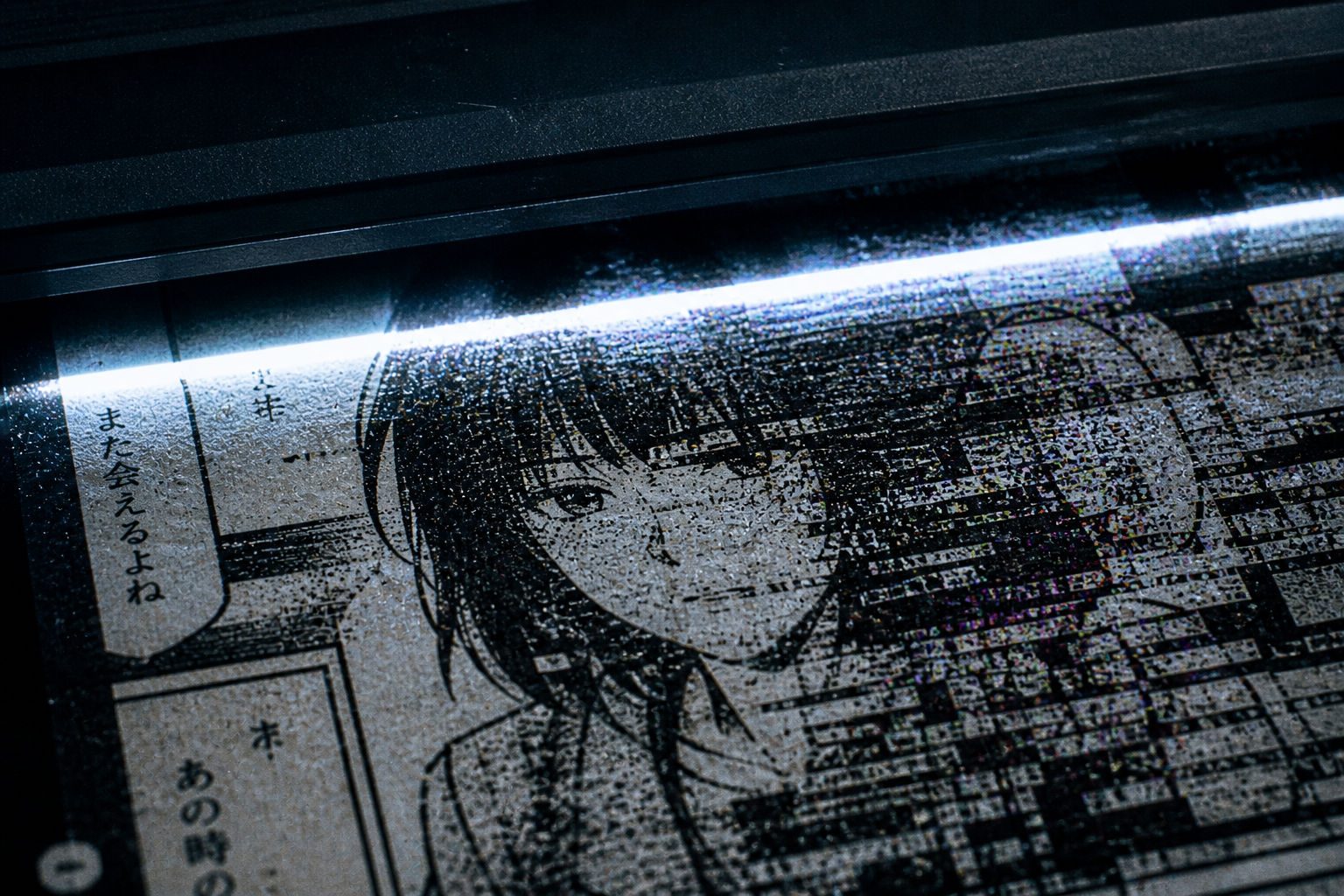
Grainy, low-resolution scans of pages from the original serialization circulated in fan communities with a reverence more appropriate to recovered historical documents than to commercial magazine content. The physical magazines themselves were treated as sacred objects by their holders.
This is the second phase: the retroactive sanctification of the excluded.
The third phase, which continues to the present, is the emergence of para-mythology. When official content is scarce and community appetite exceeds the available material, the gap is filled with fabrication that may or may not be recognized as such by its audience.
The rumor that a fourth chapter existed but was never published surfaced repeatedly in 5ch threads. Various versions of this claim circulated: the chapter existed as storyboards on the author’s personal blog, it had been distributed through P2P file sharing networks, it was held by a specific collector who refused to release it publicly. None of these claims were ever substantiated. Most were eventually identified as trolling. But the rumor’s persistence across years and across different forum threads indicates something about the community’s psychological relationship to the material.
The community needed a fourth chapter to exist. The alternative, accepting that the series ended at chapter three with no further content, required accepting an absence that the community found intolerable.
The rumors about dark and violent content in the original design that supposedly caused the cancellation function similarly. The claim that early depictions of witches being harmed by Neuroi were too graphic for publication is unverified and almost certainly false given the editorial standards of Comp Ace at the time. But the claim persists because it provides a narrative explanation for the cancellation that is more emotionally satisfying than commercial failure. It suggests that the original Aozora no Otome was not merely a poor market performer. It was something that had to be suppressed.
Something dangerous is always more interesting than something that did not sell.
Why People Keep Looking Away
There is a specific discomfort embedded in the Aozora no Otome case that the fan community navigates but rarely names directly.
The franchise that millions of people formed emotional attachments to is not the franchise that originally existed. The characters, the world, the visual language, the tone, all of it was rebuilt after the original version was abandoned. The versions of Yoshika Miyafuji and Mio Sakamoto and the rest of the 501st Joint Fighter Wing that people know were not arrived at organically. They were engineered after a market test failure.
This is uncomfortable for the same reason that learning about corporate product testing is uncomfortable. It reveals that the emotional response you experienced as personal and authentic was a targeted outcome. The revised and successful version of Strike Witches was designed to produce the audience response it produced. The original version failed to produce that response. Adjustments were made. The target response was achieved.
Your attachment is not evidence of quality. It is evidence that the revision worked.
Most fans of the franchise intuitively understand this. The knowledge that the 2005 manga existed and was abandoned is part of the publicly available franchise history for anyone who looks. But knowing something and integrating it into your relationship with the thing you enjoy are different cognitive operations.
Looking directly at Aozora no Otome requires looking directly at the machinery behind something you probably prefer to experience as un-mechanical. It is easier to treat the 2005 manga as a curiosity, a footnote, a lost artifact with romantic mystery attached to it, than to treat it as evidence of deliberate construction.
The romanticization of the manga’s scarcity, the treating of low-resolution scans as sacred relics, the investment in rumors about suppressed chapters and dark original content, all of this functions as a way of engaging with the excluded material while avoiding the uncomfortable conclusion that exclusion implies.
The Point That Should Disturb You Most
Here is the actual problem.
The Aozora no Otome chapters are not truly lost. They are physically inaccessible to most people, but they exist. Copies of the relevant Comp Ace issues are held in private collections across Japan. The content within them could, in principle, be fully documented and archived by any collector willing to scan and share their materials.
This has not happened at scale. A few low-resolution images circulate. A few descriptions exist in forum posts from people who claim firsthand access. But a clean, complete, high-resolution archive of all three chapters does not exist in any publicly accessible format that has been broadly verified and preserved.
The question is why.
The answer is not legal suppression. Comp Ace back issues are out of print but not legally restricted in any unusual way. The answer is not technical impossibility. The scanning technology required is cheap and widely available. The answer is not lack of community interest. The Strike Witches fan community is large, technically capable, and extensively motivated to document franchise history.
The answer is that the excluded version of a franchise exists in a cultural space where it serves the community better as a mystery than as a documented artifact.
If every page of Aozora no Otome were cleanly scanned, captioned, translated into multiple languages, and deposited into a permanent public archive, something would be lost. The rumor of chapter four would be definitively resolved. The speculation about suppressed violent content would be answerable rather than open. The low-resolution scans would lose their sacred object status.
The community would have information. What it would lose is mythology.
This is the point that does not get examined directly. The fans of a franchise that was built by erasing its own first version are now, collectively, participating in preserving the conditions that allow that erasure to remain partially mysterious. Complete documentation would kill the mythology. So complete documentation does not happen.
The franchise erased its own origins. The fan community, without coordinating or deciding to, is maintaining that erasure in a different form.
The original intent and the fan response, separated by two decades and operating from completely different motivations, have arrived at the same outcome.
Something existed. Something was made to not quite exist. And everyone, for their own reasons, seems comfortable leaving it that way.
Physical copies of the relevant Comp Ace issues from 2005 remain the only primary source for Aozora no Otome content. If you hold these materials, the broader archival community benefits from documentation. What is not preserved in accessible form will eventually not exist at all.
🔍Search Update: Call to Action
The current state of digital preservation treats the internet as the default archive of human experience. However, the physical reality of “Lost Media” reminds us that digital permanence is a fragile illusion. Total preservation requires the transition from private collection to public access.
If you possess physical copies of Comp Ace (January–March 2005) or high-fidelity scans of Aozora no Otome, contact the Lost Media Wiki or the 3AM Archive. Your documentation is the only barrier between history and total erasure.
This document is an investigative archival reconstruction based on fragmented public records, media remnants, community accounts, and verified historical sources compiled by The 3AM Archive.
The article examines how incidents, forgotten media, internet folklore, and unresolved public memories evolve through cultural preservation and digital decay.
This is a cultural investigation document — not fictional horror content.
All visual materials used in this post are exclusive AI-generated assets created for The 3AM Archive.
