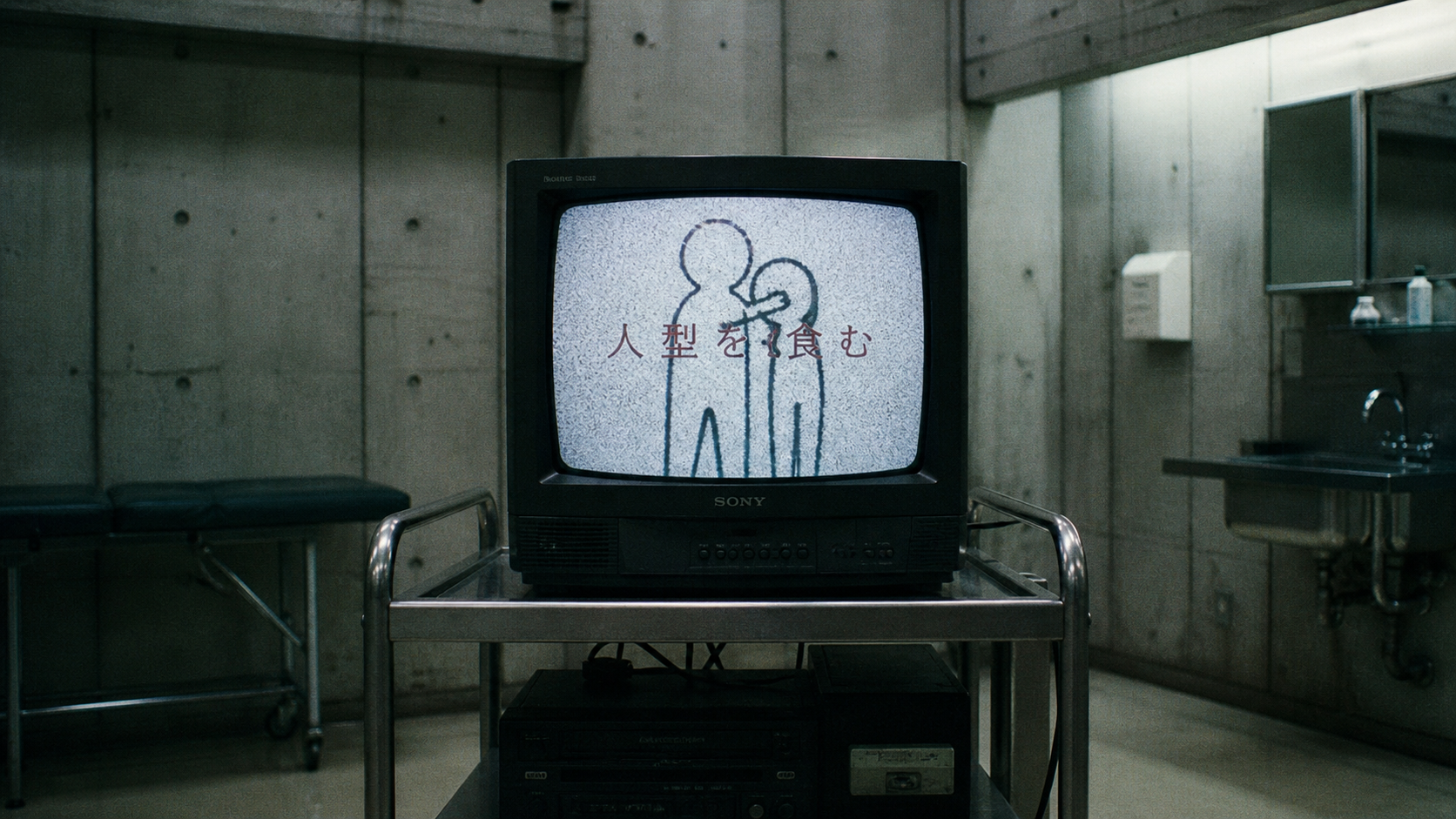
You remember seeing it. That is the problem.
A white void. Two stick figures drawn in black lines. One consuming the other. Then red text asking who is standing next to you right now.
You remember it. But the archive says it never existed.
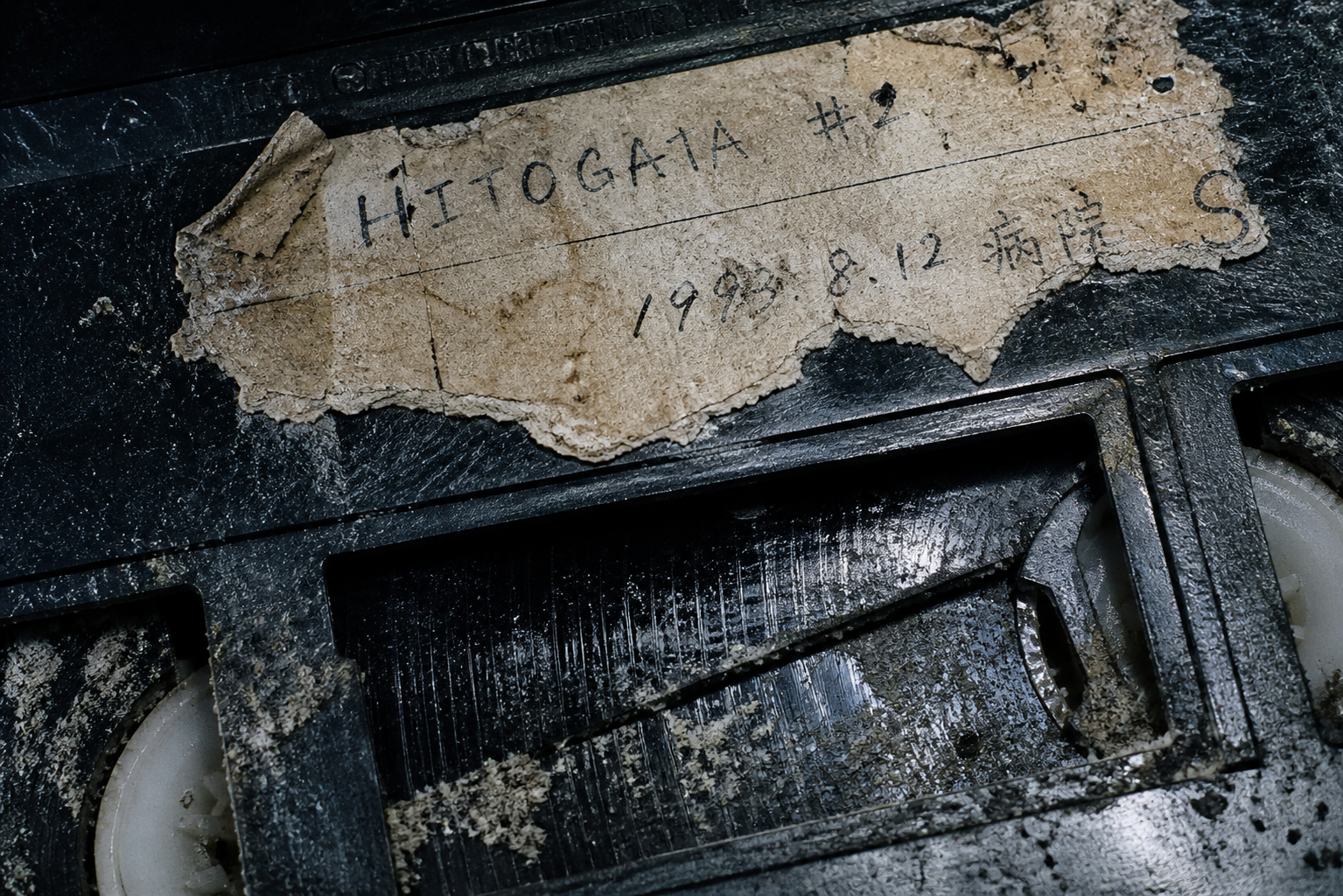
The Visual Record Nobody Wants to Verify
Before any theory can be built, the raw testimony must be examined. And the testimony is statistically consistent.
Witnesses across Japanese internet communities, primarily concentrated on 5ch threads that resurface every few years, describe an almost identical visual sequence. The setting is a featureless white space, sometimes described as muted gray or sand-storm static, carrying the unmistakable texture of 1980s and early 1990s analog video. Analog degradation and low-resolution artifacting define the visual testimony. The image breathes with the instability of a poorly stored VHS tape.
Two figures appear. They are not rendered with any anatomical detail. They are Hitogata. The word itself means “human shape” or “human form” in Japanese, referring to paper doll effigies used historically in Shinto purification rituals. What witnesses describe seeing on their televisions is the digital inverse of those ritual objects: stripped of spiritual context, weaponized into something that reads as deeply wrong.
The sequence involves one figure consuming or merging with the other. Witnesses disagree slightly on whether this reads as an attack or an absorption, but both descriptions point toward the same disturbing conclusion: one of the two entities ceases to be distinct. A noise accompanies this moment. Not music. Not a voice. A noise. Something between static, mechanical interference, and the sound a magnetic strip makes when it fails.
Then text appears. Red text. The phrasing varies across testimonies, but clusters around two formulations. The first: “A person has disappeared from the world.” The second: “Who is the person beside you right now?”
That second line is the one that matters. We will return to it.
The Structural Framework: What Public Fear Actually Looks Like
Japan’s AC Japan, the public interest advertising organization formally known as the Advertising Council Japan, has been producing PSA campaigns since 1971. Its work spans road safety, environmental concern, anti-smoking messaging, and social cohesion campaigns. Some of its output has become genuinely embedded in Japanese cultural memory, including the iconic “Kokoro wo hitotsu ni” campaign during the 2011 Tohoku disaster.
What the Hitogata testimonies describe does not match any documented AC Japan campaign. The organization’s archive, while not exhaustively digitized, shows no record of an advertisement using abstract figure animation, consumption imagery, or red-text questioning of personal identity.
And yet. The instinct of witnesses to place this content within the AC Japan framework is not random. It is structurally coherent.
AC Japan campaigns have always relied on a specific emotional register. They do not sell products. They do not promote policy directly. They create unease in the viewer, then redirect that unease toward social compliance. The formula is: here is something disturbing, and here is the behavior that will make it stop. The Hitogata sequence as described follows this exact formula, except the resolution is never provided. The unease is introduced. The discomfort escalates. The question is posed. And then nothing.
That absence of resolution is the anomaly. Commercial communication does not leave loose ends. It resolves. It calls to action. It closes.
Whatever the Hitogata broadcast was, or was not, it violated that structural logic. It introduced maximum psychological disruption and then exited. That is not advertising behavior. That is something else.
Historical Archetypes: The Repeated Pattern of Uncanny Broadcast
Japan is not unique in generating culturally persistent memories of disturbing broadcast content. But it is particularly well suited to produce them, for reasons that are structural rather than supernatural.
Japanese television in the late Showa era operated under a decentralized local affiliate system. NHK, the national broadcaster, carried programming simultaneously across the country, but local commercial affiliates maintained significant autonomy over scheduling, PSA slots, and filler content broadcast during non-peak hours. This means the same time slot on the same evening could carry entirely different content depending on the prefecture.
The late-night and early-morning hours were particularly unregulated in terms of content coherence. Broadcast engineers managed automation tapes, live inserts, and analog scheduling systems that were prone to error. Accidental broadcasts of unverified or unlabeled content were not documented because there was no consistent system for documenting them. They happened. They were corrected. They were forgotten.
This phenomenon is a byproduct of infrastructural entropy, not deliberate obfuscation.
The recurring pattern in lost media research globally is that institutional memory, the kind stored in official archives, consistently fails to capture content that was broadcast accidentally, regionally, or experimentally. The British Broadcasting Corporation has lost an estimated 142 television programs from the 1960s alone. This loss was not through deliberate erasure but through systemic negligence. Magnetic tape was expensive and routinely reused. Japanese broadcast archives from the 1980s carry the same gaps for the same reasons.
The Hitogata testimonies describe content that would exist in exactly this gap. Not deliberately erased. Simply never properly catalogued. Never transferred. Overwritten before the magnetic substrate fully degraded.
The pattern repeats: disturbing content appears in peripheral broadcast slots, is experienced by a small regional audience, leaves no institutional trace, and then is remembered imperfectly but consistently by those who saw it.
Psychological Necropsy: What the Imagery Is Actually Doing
The Hitogata figure is not random.
The paper doll as a cultural object in Japan carries specific historical weight. In Shinto practice, the Hitogata is a surrogate. You write your name on it. You breathe onto it. You transfer your impurities, your sins, your illness into the paper form. Then the Hitogata is destroyed, typically by water or fire, taking your contamination with it. The ritual is called Nagashi-bina when dolls are floated downstream, or Katashiro in certain regional variants.
The figure is always a vessel. It exists to contain something that cannot remain in the human body.
Whatever the creator of the Hitogata broadcast intended, consciously or not, they activated this symbolic structure. Two figures. One consuming the other. One becoming the vessel for something that should not be. The archetype of the “vessel” is a cross-cultural psychological trigger, even if the Shinto specifics remain regional. It operates below the level of cognition.
The red text asking who is beside you does something specific. It redirects the anxiety generated by the figures outward, toward the immediate social environment. Your neighbor. Your sibling. The person sharing your space while you watch television. The broadcast does not ask you to examine yourself. It asks you to examine others. This is a precise inversion of the ritual function of the Hitogata, which asks you to examine yourself and externalize your own contamination.
In forensic psychological terms, this is a dissociation trigger. The anxiety generated by the abstract violence of the figures is redirected before it can be processed, displaced onto the nearest available human presence. The viewer is left with unresolved dread and a newly suspicious relationship to proximity.
This is not accidental design. Whether it was intentional or emergent, the structure is coherent and sophisticated.
Why People Keep Looking Away
There is a reason the Hitogata broadcast discussion reliably collapses into deadlock.
One side insists the content is real, that videotapes exist in attics in regional Japan, that institutional archives are incomplete by default archive of human experience. The other side insists the entire phenomenon is a Mandela Effect, a misattribution, a cultural confabulation built from the residue of unrelated anxiety.
Both sides are correct about something. Both sides are avoiding something.
The real discomfort of the Hitogata case is not the question of whether the broadcast happened. It is the question of what it would mean if it did.
Japan’s suicide rate in the late 1980s and early 1990s was among the highest in the developed world. The bubble economy collapse of 1991 accelerated a mental health crisis that the country’s institutional culture was structurally unprepared to address. Public discourse around depression, isolation, and suicidal ideation was almost entirely suppressed. You did not discuss these things. They happened, privately, and then they were managed quietly.
The 5ch analysis suggesting the Hitogata broadcast was a state-sponsored “shock therapy” campaign for suicide prevention is not as absurd as it first appears. The Japanese government had precedent for deploying aggressive public information campaigns in the postwar period, including some that were deliberately disorienting. The phrase “a person has disappeared from the world” is not metaphorical. It is a clinical description of what suicide does to a social network. One figure is consumed. One presence ceases to be distinct.
If this analysis is correct, then the broadcast worked by making the viewer feel the social horror of absence. Not the grief of the person who died. The destabilization of everyone who remains.
That is the part people cannot look at directly. Because looking at it directly requires acknowledging that mass communication has, at certain historical moments, been designed to do exactly this kind of damage to the sense of self, on purpose, as a corrective measure.
The state as the author of your nightmares, with your wellbeing as the stated justification.
The Point That Should Disturb You Most
Forget the supernatural framing. Set aside the ghost spot theories and the regional broadcast conspiracies.
Here is the actual anomaly.
Hundreds of people, distributed across Japanese internet communities over decades, share a coherent and detailed memory of a broadcast event. The visual details align closely enough to suggest a common source. The emotional response, a specific kind of cold dread connected to proximity and identity, is consistent across testimonies from people who do not know each other.
This content has left no recoverable trace in any institutional archive.
And the Mandela Effect explanation, the mass false memory hypothesis, requires something that is rarely examined directly. It requires that hundreds of people independently hallucinated the same specific imagery, the same figure behavior, the same red text, the same noise, without a common source. The Mandela Effect is typically invoked to explain minor factual misremembrances, logos, film titles, spelling. It has never been reliably documented as an explanation for complex, emotionally coherent, narrative-sequential visual memories shared across a distributed population.
Either something was broadcast that no archive captured.
Or collective human memory is capable of generating shared, specific, traumatic content from nothing, with no common experiential seed.
Both possibilities are more disturbing than a lost tape.
The lost tape at least has a mundane explanation. Infrastructure failures. Negligent archiving. Regional broadcast variance. We understand how those happen. We have historical precedent.
The collective hallucination hypothesis has no precedent. It suggests that a large group of people can share a nightmare so specifically that their independent descriptions converge on the same imagery, the same sequence, the same words. Without ever having been in the same room.
If that is true, the question is not what the Hitogata broadcast was.
The question is what else has been generated this way. What other memories circulating in communities right now are built from nothing, fully formed, internally consistent, and entirely untethered from any external event.
And whether the people who generated those memories would be able to tell the difference.
🔍Search Update: Call to Action
The Hitogata case remains unresolved. No verified recording has been publicly confirmed. The AC Japan archive has not issued a statement on any version of these testimonies.
How you can help: If you possess a physical videotape from the late 80s or early 90s recorded in Japan, particularly from regional commercial affiliates, please review your filler content and PSA breaks. The lost media research community at Unfiction and associated boards maintains active documentation threads for any new leads.
This document is an investigative archival reconstruction based on fragmented public records, media remnants, community accounts, and verified historical sources compiled by The 3AM Archive.
The article examines how incidents, forgotten media, internet folklore, and unresolved public memories evolve through cultural preservation and digital decay.
This is a cultural investigation document — not fictional horror content.
All visual materials used in this post are exclusive AI-generated assets created for The 3AM Archive.
