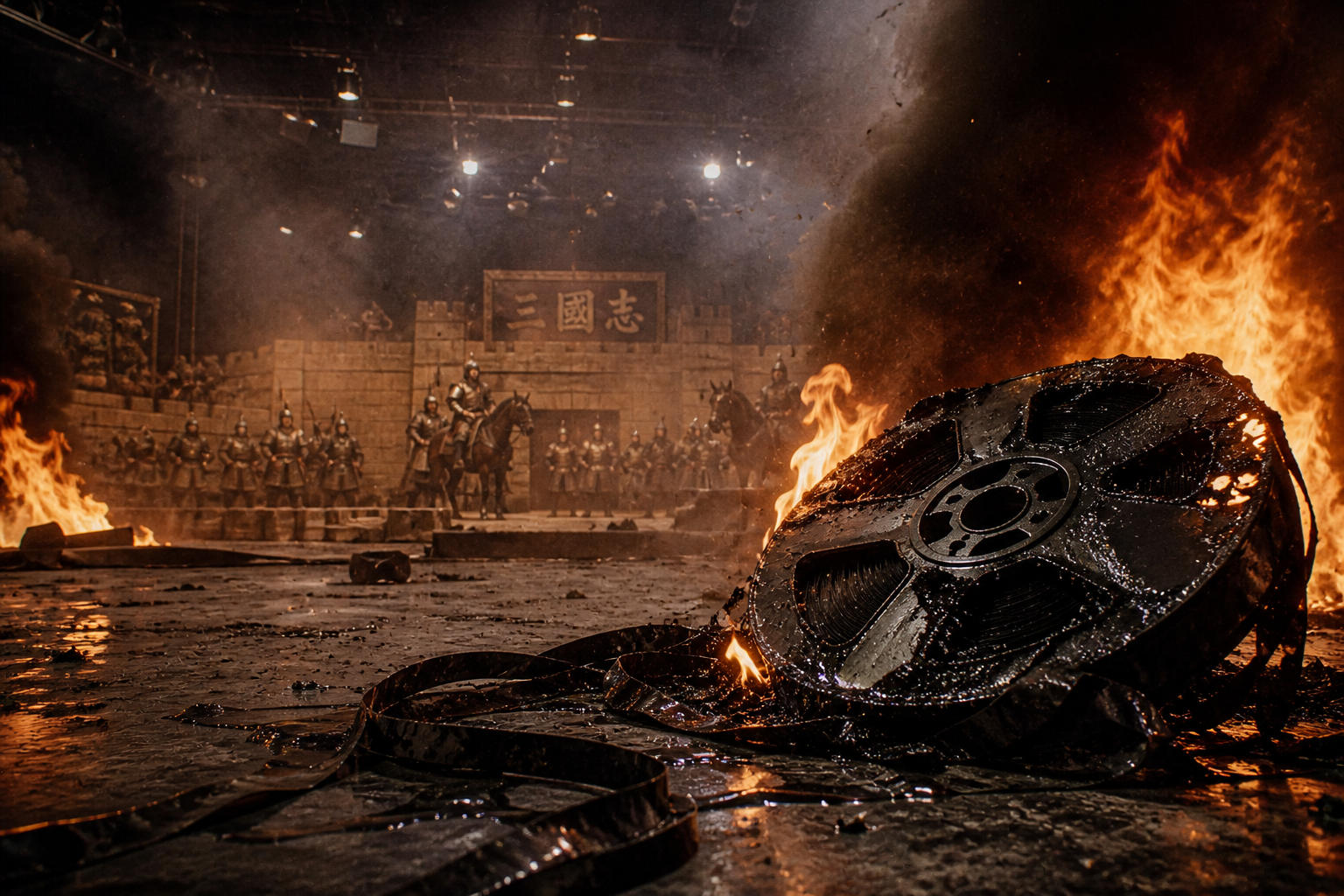
The first person to dramatize the Three Kingdoms for television is dead. The performance no longer exists. The tape that held it melted.
You cannot watch it. Not because it was never made. Because a building burned in 1987 and nobody saved what was inside.
The oldest recorded visual interpretation of one of the most influential narratives in East Asian history is gone. What remains are shadows. Still photographs in decomposing magazines. Cast lists in archives that nobody visits. A title in a database next to a field that says: no footage available.
This is not a mystery with a solution. This is a crime scene with no surviving witnesses and no recoverable evidence. What follows is the closest thing to an autopsy that the historical record permits.
The Evidence File: What Samguk Chunchu Actually Was
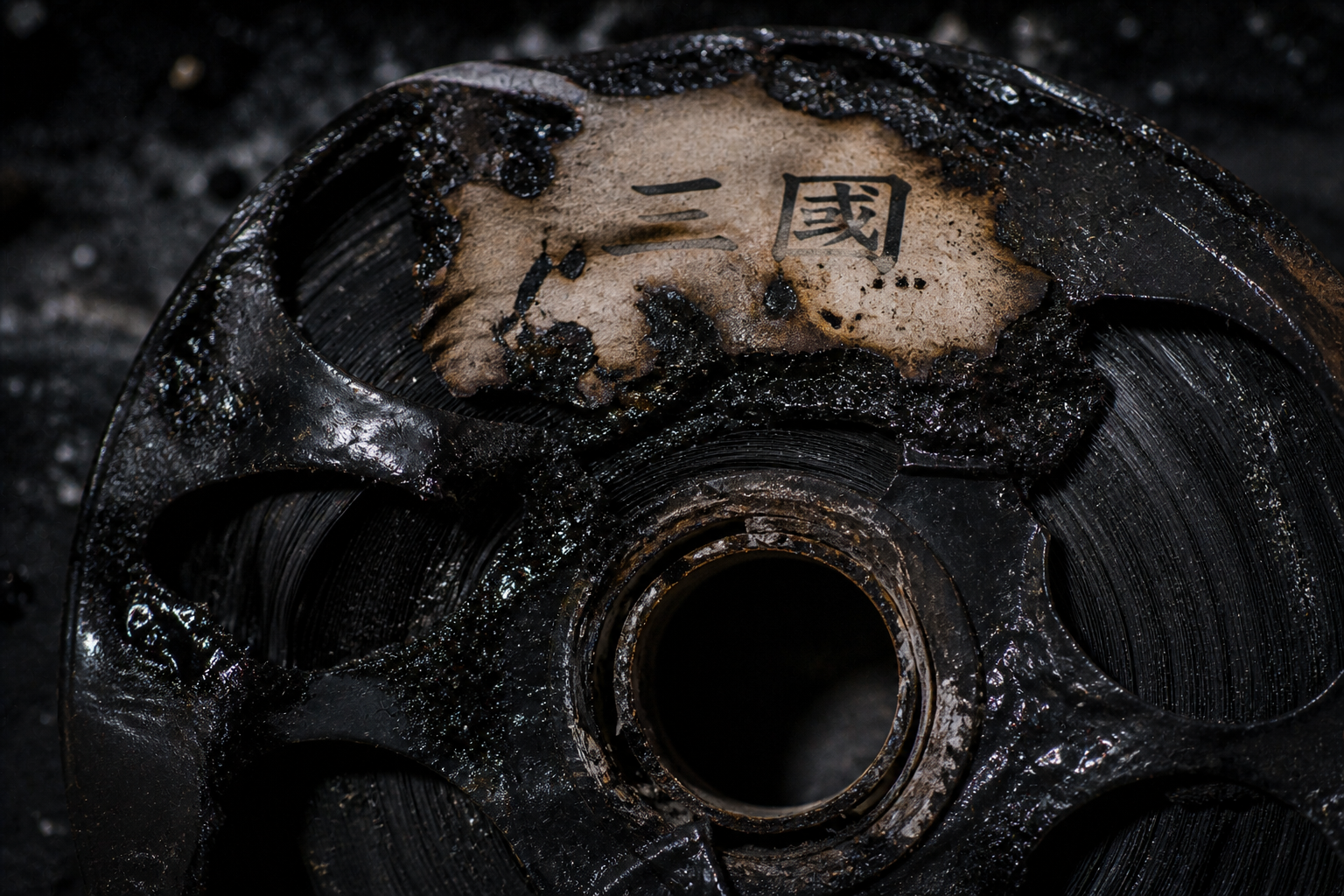
In 1976, Asia Television Limited, operating under the broadcast identity ATV and its predecessor Rediffusion Television, produced a dramatization of the Three Kingdoms narrative for Hong Kong audiences. The production carried the title Samguk Chunchu—the Korean reading of the Hanja characters 三國春秋—rendered in Chinese as a reference to the historical period and the classical text that defined it. This was not a modest or experimental production. It was a serious attempt to bring one of the foundational epics of Chinese literary and historical culture to the television screen.
The Three Kingdoms source material, rooted in the historical period of 220 to 280 CE and later systematized in Luo Guanzhong’s fourteenth century novel Romance of the Three Kingdoms, represents one of the most extensively adapted narratives in the East Asian cultural tradition. Its characters, Liu Bei, Cao Cao, Zhuge Liang, Guan Yu, have been interpreted across centuries of opera, painting, woodblock print, and oral performance. By the 1970s, the television medium had become the dominant vehicle for popular storytelling in Hong Kong. A Three Kingdoms dramatization was not merely a production decision. It was a cultural event.
Samguk Chunchu was, by the evidence available, the first television dramatization of this material in the Chinese-language broadcast tradition. The significance of that claim cannot be overstated. Every subsequent Three Kingdoms drama, every mainland Chinese production, every Taiwanese adaptation, every streaming series that has since engaged with this narrative, follows in the structural and visual tradition that this 1976 production initiated. It was the origin point.
The origin point no longer exists.
What can be confirmed through surviving documentation is limited. Cast information exists in fragmentary form through period publications. Still photographs from the production have surfaced in magazine archives, ghosts of a production that no longer has a body. Episode counts and broadcast dates are reconstructed from secondary sources rather than from primary production records. The content of individual episodes, the performances, the directorial choices, the specific visual language used to translate classical literary characters into television figures, is entirely unrecoverable.
The series aired. It was watched. It ended. And then it waited in a building that burned.
The Structural Framework: How Broadcast Archives Become Casualties
To understand what happened to Samguk Chunchu, the 1987 ATV fire must be understood not as a singular catastrophic event but as the terminal point of a much longer institutional failure.
Hong Kong television in the 1970s operated without any systematic preservation mandate. The physical infrastructure of magnetic tape storage was expensive and space-intensive. Broadcast organizations across this era, globally, made consistent decisions to reuse tape rather than archive it, to store materials in conditions that were inadequate for long-term preservation, and to treat broadcast content as a commercial asset with a finite useful life rather than as a cultural artifact with permanent value.
This was not unique to Hong Kong. The BBC destroyed or lost thousands of hours of programming through deliberate tape wiping during the same period. American networks allowed kinescope recordings to deteriorate in storage conditions that guaranteed their eventual physical failure. The institutional assumption was universal: a broadcast was an event, not a document. Once the event was over, the recording had served its purpose.
ATV’s archive in 1987 represented the accumulated physical media of more than a decade of Hong Kong television production. The tapes stored there were not the product of a preservation philosophy. They were the residue of a production process, stored because storage was cheaper than disposal, retained without any systematic assessment of their historical or cultural value.
When the fire reached the storage facilities, it encountered materials that had never been formally protected, catalogued with preservation intent, or evaluated as irreplaceable cultural assets. It encountered tape. Tape burns and melts. The chemical processes of combustion and heat damage that affect magnetic media are irreversible. There is no recovery protocol for a tape that has been exposed to fire.
The structural failure, therefore, was not the fire itself. The fire was the final event in a sequence that began with institutional decisions made years earlier:
-
The decision not to preserve.
-
The decision not to duplicate.
-
The decision not to transfer aging formats.
-
The decision not to store materials in fireproof facilities.
Each of these decisions was made independently, by different people, at different times, for reasons that seemed locally rational. The cumulative effect was a collection of irreplaceable materials stored in a condition that guaranteed their loss the moment any significant physical threat materialized.
The fire provided the threat. The institutional decisions provided the conditions.
Historical Archetypes: The Pattern of Origins That Cannot Be Recovered
Samguk Chunchu occupies a specific and painful position in the taxonomy of lost media. It is not merely lost content. It is a lost origin.
The loss of an origin differs qualitatively from the loss of subsequent work in the same tradition. When a middle or late entry in a creative tradition is lost, the tradition itself remains legible. The surrounding context provides interpretive scaffolding. Scholars and audiences can reconstruct a reasonable understanding of what was lost based on what survives before and after it.
The loss of an origin removes the foundation. Every subsequent development in the tradition now floats without its anchor point. The questions that an origin answers—how did this tradition begin, what choices were made first, what alternatives were considered and rejected, what visual and narrative language was established before the form became conventional—all of these questions become permanently unanswerable.
The Three Kingdoms television tradition cannot be traced to its source. Scholars of Chinese television drama can document the evolution of the form from the 1980s onward with reasonable confidence. The 1976 starting point is a blank. The first chapter of the story is ash.
This pattern recurs across media history with disturbing regularity. The first sound film, the first color television broadcast, the first live network transmission, all of these origins have in common that they were produced before the culture had developed any institutional infrastructure for recognizing and preserving them as significant. Significance is recognized retrospectively. Preservation must happen contemporaneously. These two facts are structurally incompatible, and the gap between them is filled with loss.
The people who watched Samguk Chunchu in 1976 did not know they were watching the origin of a tradition. They were watching a drama. The people who stored the tapes afterward did not know they were custodians of an irreplaceable cultural artifact. They were managing inventory. By the time anyone might have recognized what was there, the building had already burned.
Psychological Necropsy: What It Means to Lose the First Voice
The still photographs that survive from Samguk Chunchu deserve more analytical attention than they typically receive, because they are the only primary visual evidence of what the production looked like.
In the forensic analysis of lost media, surviving peripheral materials function as testimony. They are not the content itself. They are witnesses to the content, and like all witnesses, they are partial, selective, and shaped by the circumstances of their survival.
The stills that appear in period Hong Kong magazines show costumed actors in poses that correspond to the iconographic tradition of Three Kingdoms representation. Guan Yu’s distinctive appearance is legible in frozen form. What cannot be recovered from a still image is movement. Voice. The specific quality of a performance as it unfolds in time.
A photograph of an actor in costume is not a record of a performance. It is a record of a moment adjacent to a performance. It shows what the actor looked like while preparing to do something that no longer exists. The performance itself, the actual interpretive act that constitutes the artistic content of the production, is entirely absent from every surviving document.
This is what the fire actually destroyed. Not tape. Not a physical object. The fire destroyed the performances of specific human beings at a specific moment in the history of their craft. The actors who played Zhuge Liang and Cao Cao and Liu Bei in Samguk Chunchu made interpretive choices that influenced every actor who played those roles afterward. Those choices are now invisible. The influence propagated forward through a tradition while the source that generated it was consumed.
The actors themselves are not necessarily dead. Some may still be living. But what they did in front of the camera in 1976 died in 1987. The human beings survived the fire. Their work did not.
This distinction is the most genuinely disturbing aspect of broadcast preservation loss. The conversation about lost tapes is a conversation about objects. The conversation that needs to happen is about the irreversible disappearance of human creative acts that were captured in those objects and nowhere else.
Why People Keep Looking Away
The scholarly and popular treatment of lost media consistently gravitates toward mystery framing rather than institutional accountability framing. Samguk Chunchu is discussed in terms of what might still exist somewhere, whether a private collector holds copies, or whether any footage was duplicated before the fire.
This framing is understandable. It preserves hope. It maintains the possibility that the loss is temporary rather than permanent, that the story has a potential resolution rather than a definitive ending.
It is also a way of avoiding the institutional questions that have definitive and uncomfortable answers.
The questions that do not have comfortable answers are these. Why did ATV not have fireproof storage for its archive? Why were materials of obvious cultural significance stored in conditions that a single fire could destroy entirely? Why was there no duplication protocol that would have created backup copies in separate locations?
These questions have answers. The answers involve institutional priorities, resource allocation decisions, and a broader cultural failure to recognize television content as heritage rather than commerce.
Confronting these answers does not help locate surviving footage. It does not advance the search for lost materials. It provides no comfort and no resolution. This is precisely why the conversation consistently moves away from institutional accountability and toward archival mystery. Mystery is tolerable. Institutional failure that resulted in permanent cultural loss and that could have been prevented is not.
The Point That Should Disturb You Most
The YouTube comments section has become the default archive of human experience for the digital age. This reality has profound implications for digital permanence. We are trusting our collective memory to platforms that prioritize engagement over accuracy.
Every Three Kingdoms drama produced after 1976 is, in some sense, a response to Samguk Chunchu. The visual conventions it established, the casting approaches it pioneered, and the narrative emphases it chose all shaped what came after. This happened directly through the influence on practitioners who saw it, and indirectly through the conventions it normalized.
This influence is now unattributable.
When scholars analyze the visual language of Three Kingdoms dramatization, they must stop at 1976. Before that point, the record is legible. After that point, the record is legible. At that point, there is ash.
The tradition has a foundation that cannot be examined. Every building constructed on that foundation is structurally dependent on something that cannot be inspected, tested, or even seen. The scholars who work in this field know the foundation exists. They can infer certain things about it from the buildings that sit on top of it. They cannot examine it directly.
This is the condition that the 1987 fire created and that institutional negligence made inevitable. A tradition that cannot know its own origin. A cultural form that began somewhere specific and can never return to find out exactly what that beginning looked like.
The most influential Three Kingdoms drama ever made may be the one that no longer exists. Its influence propagated through everyone who saw it and everyone who was influenced by those people, through a tradition that has now reached hundreds of millions of viewers across multiple generations.
None of those viewers have ever seen it.
None of them ever will.
🔍Search Update: Call to Action
The search for lost Samguk Chunchu (1976) media is an urgent global effort. While no confirmed footage has entered public circulation, the broadcast heritage community actively seeks any home-recorded Betamax or VHS tapes that may have survived in private collections outside of Hong Kong. If you hold any promotional materials, scripts, or off-air recordings related to 1970s ATV productions, your contribution is vital to reconstructing this lost origin.
What is not formally preserved now will not be informally preserved forever.
This document is an investigative archival reconstruction based on fragmented public records, media remnants, community accounts, and verified historical sources compiled by The 3AM Archive.
The article examines how incidents, forgotten media, internet folklore, and unresolved public memories evolve through cultural preservation and digital decay.
This is a cultural investigation document — not fictional horror content.
All visual materials used in this post are exclusive AI-generated assets created for The 3AM Archive.
