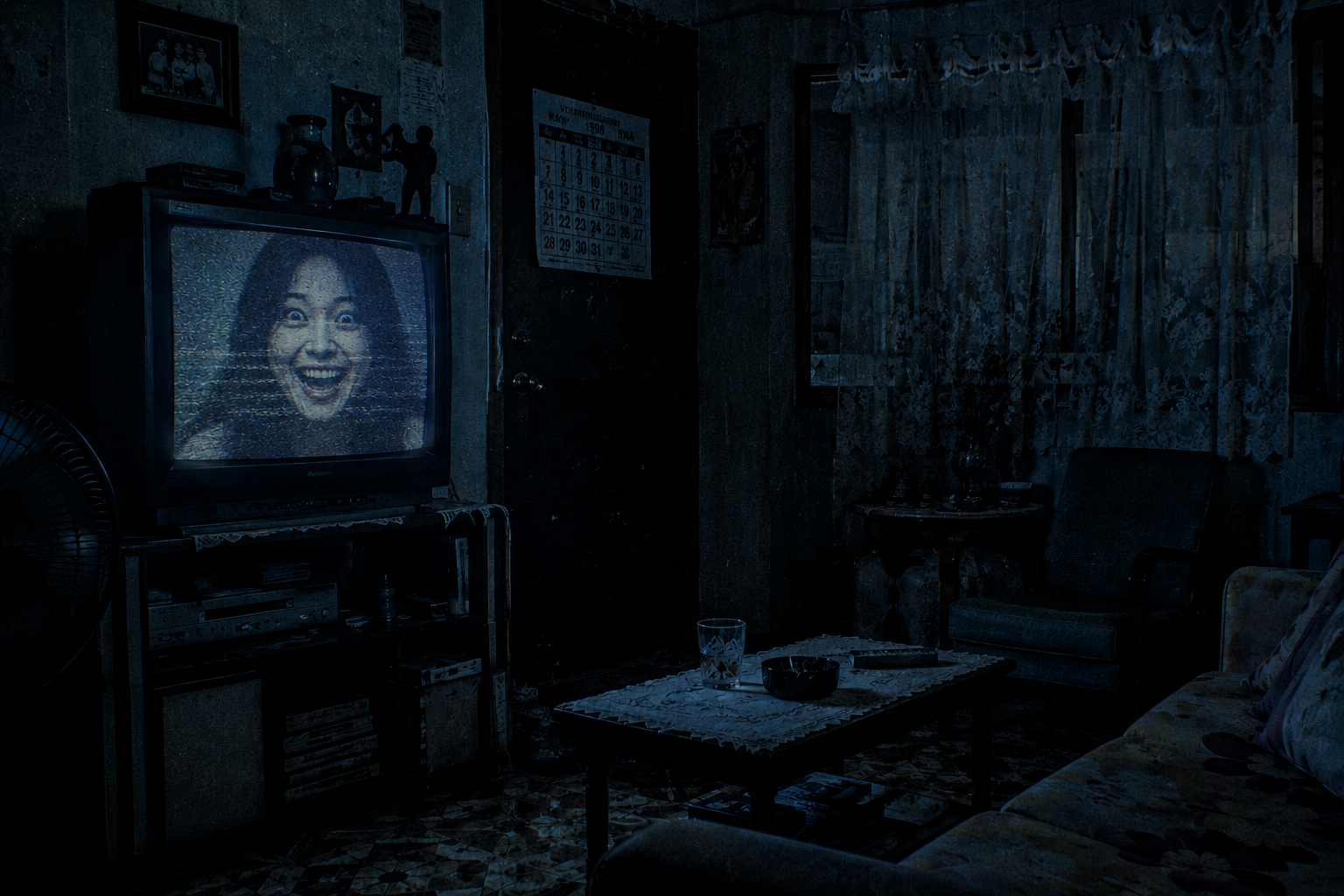
There is a specific variety of dread that belongs exclusively to daytime television. Not the orchestrated horror of a midnight film—curated, consensual, contained—but something older and more corrosive; the intrusion of the wrong thing into an utterly safe space. A glitch in the domestic frequency. The Encarnacion Bechaves commercial, a luxury florist advertisement that aired in the Philippines between approximately 1993 and 2005, is a precise clinical specimen of this phenomenon. It did not premiere at a horror festival. It interrupted game shows. It colonized the commercial breaks of WWF wrestling broadcasts and afternoon soap operas, planting itself in the nervous systems of children who had no framework for what they were receiving.
The commercial no longer exists in any recoverable form. And that absence—forensically examined—tells us more about collective memory, institutional neglect, and the architecture of fear than any surviving footage ever could.
The Cultural Anatomy: Manila, 1993, and the Aesthetics of Aspiration
To understand the Bechaves commercial as a cultural artifact, one must first understand the Philippine media landscape of the early-to-mid 1990s. The country was in the middle of a prolonged aesthetic negotiation between regional tradition and globalized luxury signaling. The Marcos era had collapsed less than a decade prior; the Ramos administration was engineering economic optimism. Consumer advertising—particularly for luxury goods—occupied an almost morally loaded position. To sell flowers was to sell the idea that normalcy had returned; that abundance was not merely possible but fashionable.
Encarnacion Bechaves, as a luxury florist operating in Manila, would have commissioned an advertisement that participated in this grammar. The production values, by all surviving accounts, were high. The choice of Enya’s “Shepherd Moons”—released in 1991 and already coded internationally as the ambient sound of refined contemplation—was not accidental. It was aspirational semiotics, precisely calibrated. Enya in 1993 meant Europe, meant calm, meant a certain kind of expensive silence. Paired with slow-motion floral imagery and presumably elegant typography, the advertisement’s first half would have been entirely legible to its intended audience: wealthy Manila households, aspirational middle-class viewers, anyone who understood the visual language of premium goods.
Philippine television censorship during this period was administered through the Movie and Television Review and Classification Board (MTRCB), an institution whose attention was primarily directed toward sexual content, political messaging, and explicit violence. A luxury florist advertisement would have received minimal regulatory scrutiny. Whatever disturbing element existed in the commercial’s final seconds—and all available testimony suggests something did—it passed through institutional filters entirely unobserved, or observed and categorized as harmless. This is the first forensic detail worth noting: the horror was not suppressed. It was simply not recognized as horror by the systems designed to recognize such things.
Structural Dissection: Anomalies in the Signal
The commercial’s structure, as reconstructed from fragmentary testimony across Filipino online communities, Reddit threads, and the Lost Media Wiki, follows a pattern that forensic media analysts would categorize as a “tonal rupture”—a deliberate or accidental shift that violates the internal contract of the advertisement.
The first sixty to seventy-five percent of the ad appears to have been entirely conventional. Floral arrangements. Warm light. The Enya track doing its affective labor. Then—a woman in a dress, reported variously as red, or black and white depending on the witness and the year of their testimony. She is facing away from the camera. This is, by itself, unremarkable; the turned-away figure is a standard composition in luxury advertising, evoking mystery and elegance simultaneously.
She turns.
What witnesses describe at this point fractures into remarkable inconsistency, which is itself a diagnostic symptom. Some report a “manic” smile—wide, teeth visible, the kind of expression that reads as joy but at a register slightly too high for comfort. Others describe something stranger: a face with no visible eyes, or features that seemed “wrong” in ways that resist articulation. Roses partially obscure her face in most accounts; this detail appears with enough consistency to suggest it was actually present in the original footage, functioning as a compositional element that may have been intended as elegant and instead produced something genuinely unsettling.
The tonal rupture is the core forensic anomaly. Unlike intentional horror advertising—which signals its nature through genre conventions—the Bechaves ad arrived wrapped in the full credibility apparatus of luxury branding. The Enya track did not stop. The lighting did not shift to red. The production did not become cheap. The horror, if it can be called that, wore the costume of its own genre until the final moment; which is precisely what made it effective as an inadvertent trauma delivery mechanism.
This is what separates the Bechaves incident from straightforward “scary commercial” phenomena. The disturbance was not a bug introduced from outside the advertisement’s aesthetic system. It grew from within it—a corruption of the luxury signal itself.
Psychological Necropsy: Why the Archival Silence Disturbs the Western Mind
The Bechaves commercial’s discovery by Western internet communities—primarily through Reddit’s r/lostmedia and adjacent spaces—produced a categorical response that warrants examination. Western users consistently reach for comparison frameworks rooted in Japanese analog horror mythology: the Hitogata ritual; the Saki Sanobashi legend; the broader tradition of media artifacts rumored to cause psychological harm through their content alone. These are not equivalent phenomena.
The Hitogata and its descendant mythos belong to a tradition that explicitly theorizes the cursed object—the thing that carries spiritual contamination across generations of viewers. The Bechaves commercial does not belong to this tradition; its culture of origin has entirely different frameworks for the uncanny. And yet the Western categorization persists, revealing something about the categorizer rather than the categorized.
What the Western internet mind cannot easily process is the banality of the Bechaves incident’s horror. It requires no supernatural framework. It requires no cult, no conspiracy, no cursed filmmaker. A luxury florist paid for an advertisement. A director made aesthetic choices. An actress performed—probably professionally, probably without awareness that her performance would lodge in the nightmares of a generation. The institutional mechanisms that should have created an archive failed silently, without drama. The horror is not in the woman’s face; it is in the absolute normality of every process that produced and then erased her.
The Mandela Effect dimension compounds this. Witness testimony about the woman’s appearance has demonstrably diverged over two decades of retelling. She has become, in the collective memory, more extreme—more eyeless, more witch-like, more monstrous—than any commercial actress could credibly have been. The fear has done what fear always does when given insufficient object: it has filled the void with something worse than the truth. This is not a failure of memory. It is memory functioning exactly as designed, escalating threat valuation in the absence of conclusive data.
The Evidence of Void: Physical Decay Versus Social Erasure
The complete loss of the Bechaves commercial represents, upon examination, not one failure but a layered sequence of institutional abdications.
Philippine television archives from the 1990s are, as a category, severely compromised. Broadcast tape was expensive; networks routinely recorded over existing material when new content required storage. This was standard practice across the developing world during this period—and, it should be noted, across much of the developed world as well. The BBC’s systematic erasure of early Doctor Who episodes; the gaps in American soap opera archives; the near-complete loss of early live television drama. Tape reuse was an economic decision, not a cultural one, and it was made without awareness that the material being erased would later be considered worth preserving.
For a commercial—which occupied the lowest rung of archival prestige—the probability of intentional preservation was essentially zero. Advertisers kept materials for production purposes, not historical ones; once a campaign concluded, master tapes were either repurposed or allowed to degrade. The networks that aired the Bechaves commercial—ABC 5, RPN-9, IBC 13—were not operating archival departments with long-term preservation mandates. They were broadcasting stations.
This is the physical decay vector: entirely mundane, entirely structural, requiring no conspiracy to explain.
The social erasure vector is more complex. The Bechaves advertisement existed in the cultural register of the embarrassing or the inexplicable—the kind of thing that leaves a mark without anyone agreeing on what kind of mark it is. In Filipino communities, it was not discussed as art, as history, or as a subject warranting documentation. It was discussed the way one discusses a bad dream: briefly, nervously, with an implicit agreement not to pursue it further. No one assigned a film student to track down the original footage. No journalist followed the lead. The actress rumored to be Cita Astals—a potential identification that could, in theory, anchor the investigation—was never formally interviewed on the subject, as far as available records indicate.
The commercial fell into a category of cultural experience for which the Philippines of the 1990s and early 2000s had no preservation infrastructure and no cultural consensus that preservation was warranted. It was, to borrow a clinical term, socially unmourned—lost before anyone had agreed it was worth finding.
The Point of No Return: What the Void Actually Contains
As of this Q2 2026 audit, we are past the point at which the Bechaves commercial can be reasonably expected to surface.
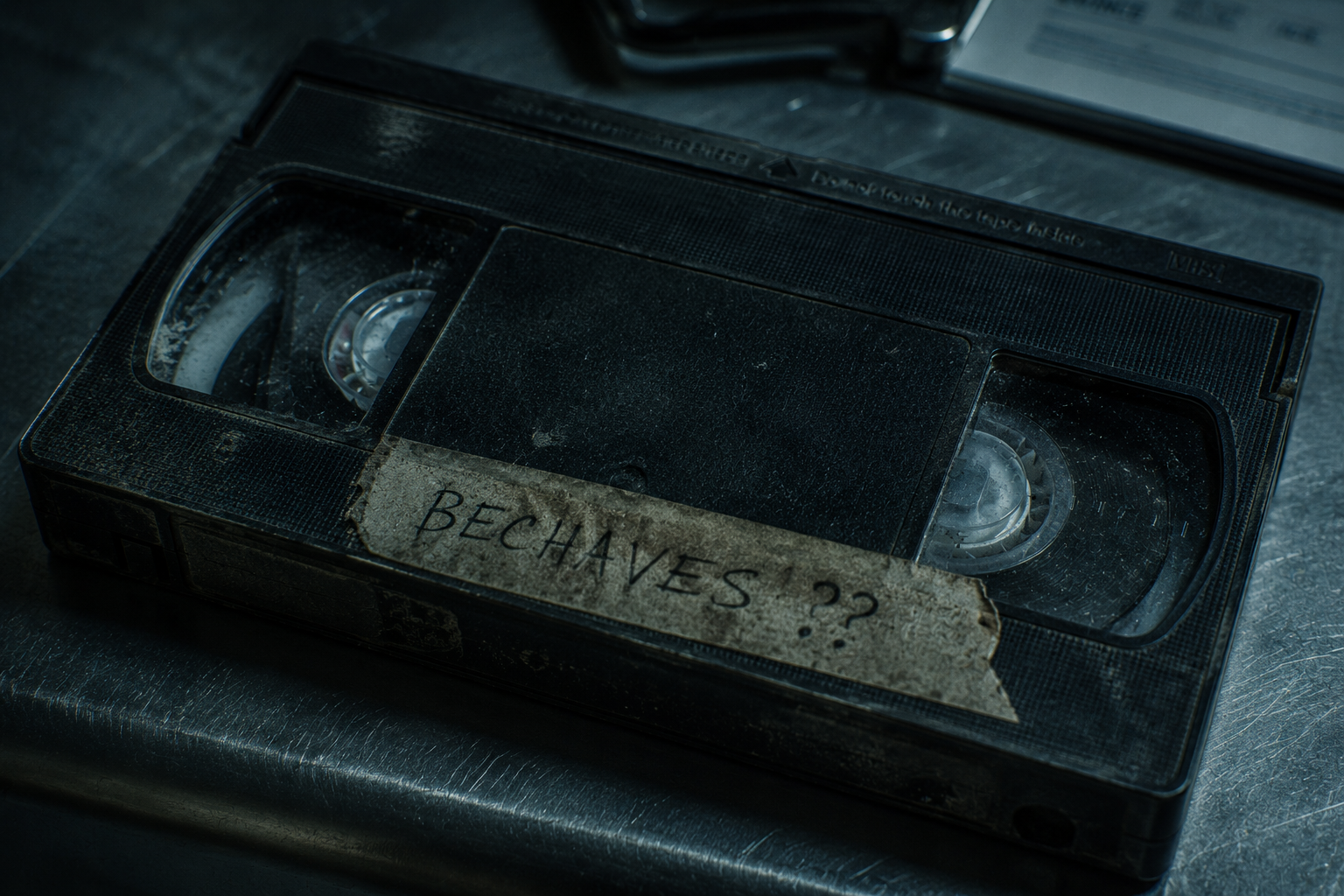
A two-second snippet is rumored to exist in private archives—reportedly captured from a WWF broadcast and held by an unknown individual in circumstances that have resisted verification. This fragment, if real, is the commercial’s only surviving biological material; everything else is scar tissue. The likelihood that a complete recording will emerge from a Philippine household’s VHS collection—degraded, unlabeled, preserved by accident rather than intention—exists on the same probability curve as similar lost media discoveries. It is not impossible. It has happened before with rarer materials. But the window is closing with every passing year; magnetic tape has a finite lifespan, and the households that recorded Philippine television in 1993 are not conducting systematic archival inventories.
What persists is the memory of the fear, which has now formally detached from its original object. The Bechaves commercial no longer requires footage to function as a cultural artifact. It functions—perhaps more powerfully—as an absence. The woman in the red dress exists now as a collective psychological construction, assembled from the distorted recollections of an entire Filipino generation and subsequently processed through the Western internet’s appetite for analog horror mythology. She is more frightening as a void than she could ever have been as an actress holding roses under studio lights.
This is the point of no return. Digital culture has created a new class of lost media—not lost through physical degradation, but lost through the failure of documentation systems that should have existed and did not. This loss was facilitated by the institutional decision, made by omission, that certain things were not worth remembering. And when these gaps are discovered, the internet—with its extraordinary capacity for collaborative reconstruction—fills them not with fact but with escalating imagination.
The Bechaves incident is, in this sense, a case study in what might be called “archival negative space.” The commercial aired for over a decade. It was seen by millions of people across major Philippine networks. It produced a documented, measurable psychological response in a significant portion of its audience. And it has left, as its total archival footprint, a handful of fragmented testimonies, one unverified two-second clip, and a Wikipedia-adjacent article on a lost media database.
The luxury florist wanted to sell flowers. The director wanted to create something elegant. The actress—whoever she was—turned to face the camera and smiled.
And now she exists only in the part of the mind that fills darkness with shapes. This has become the default archive of human experience.
🔍Search Update: Call to Action
The 3AM Archive is currently monitoring Southeast Asian private archival circuits and VHS trading groups for any off-air recordings from ABC 5, RPN-9, or IBC 13. To date, no verified visual evidence of the Encarnacion Bechaves “Death Smile” commercial has surfaced in any public or private repository.
Do you have leads on 1990s Manila broadcast tapes or primary source testimony from production staff? Join the investigation on the Lost Media Wiki (LMW) discussion board or local Filipino archival communities. This void remains open.
This document is an investigative archival reconstruction based on fragmented public records, media remnants, community accounts, and verified historical sources compiled by The 3AM Archive.
The article examines how incidents, forgotten media, internet folklore, and unresolved public memories evolve through cultural preservation and digital decay.
This is a cultural investigation document — not fictional horror content.
All visual materials used in this post are exclusive AI-generated assets created for The 3AM Archive.
