There is a specific variety of cultural unease—not quite grief, not quite paranoia—that surfaces when a piece of recorded human thought simply ceases to be retrievable. It is distinct from the melancholy of watching a building demolished or a photograph fade; those losses are visible, traceable, subject to mourning. The disappearance of digital media operates differently. It leaves no ruin. It leaves a search bar returning zero results, a forum thread that ends mid-sentence, a download link that resolves to nothing. The void is perfectly smooth, and that smoothness is what unsettles.
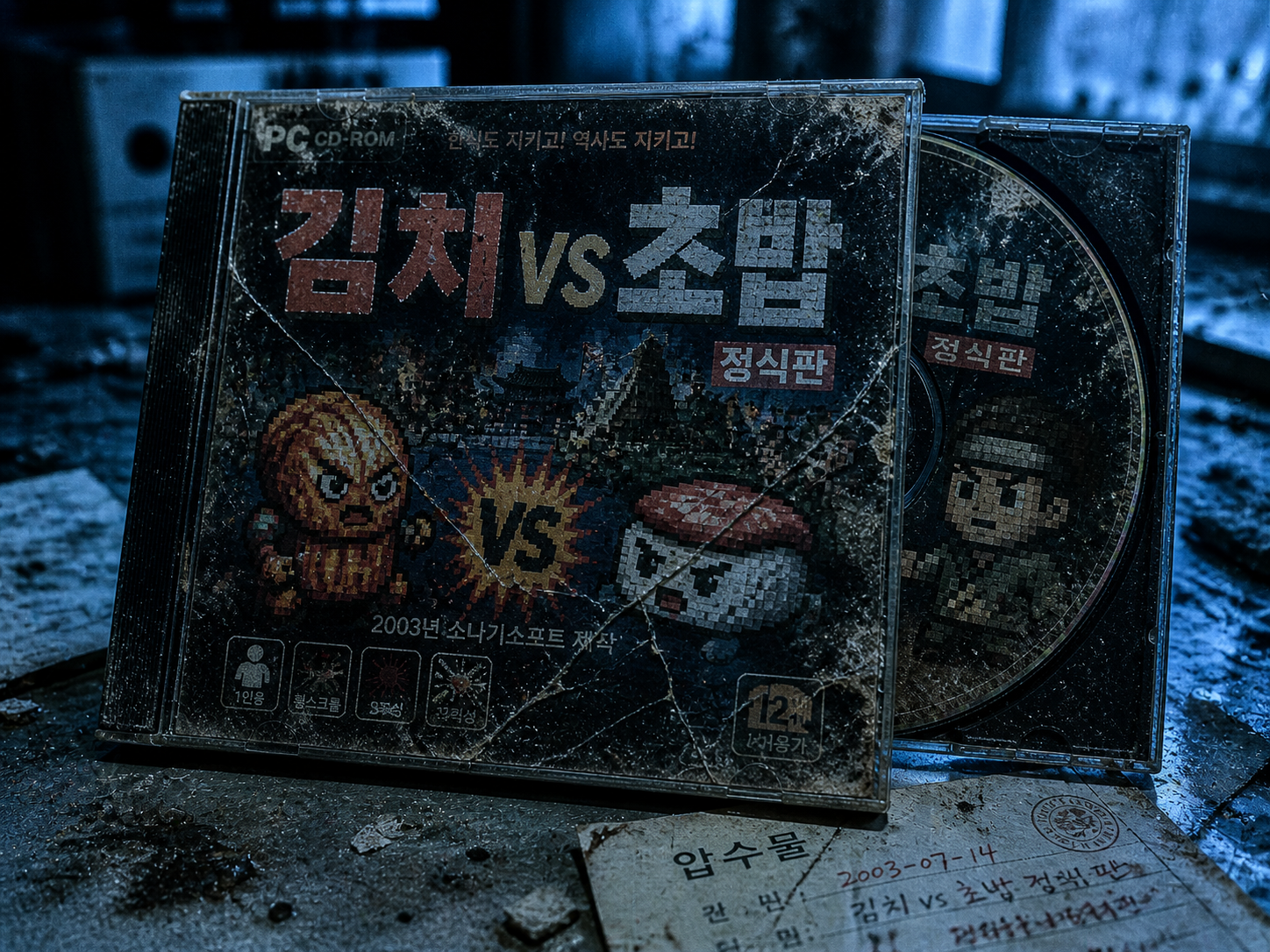
Kimchi vs. Sushi (김치 vs 초밥)—a side-scrolling shoot ’em up developed by the small South Korean studio Sonagi Soft in 2003—has achieved precisely this condition. Not obscurity, which implies the object still exists somewhere unnoticed. Not rarity, which implies a surviving copy awaiting the right collector. What Kimchi vs. Sushi has achieved is the status of digital myth: a thing whose existence is documented through screenshots, forum testimony, and second-hand memory, but whose physical instantiation has almost certainly been destroyed. The game’s last known owner, a YouTuber operating under the handle “Golden Ticket,” announced the disposal of his entire physical collection. The largest Korean PC gaming archive—”Doogi’s Arcade,” a preservation institution that has successfully acquired thousands of obscure domestic titles—officially confirmed it could not obtain a copy. The trail ends there. What remains is the outline of a thing, pressed into the historical record like a fossil without a bone.
This essay is not a lament. It is a dissection.
The Cultural Anatomy: Censorship, Nationalism, and the Year 2003
To understand why Kimchi vs. Sushi exists at all, one must first understand the specific texture of South Korean public feeling in the early 2000s. The period was characterized by a simmering, institutionalized dispute between Seoul and Tokyo over how the latter’s school textbooks represented the Imperial Japan era—specifically, the Imjin War of 1592–1598, the annexation period from 1910 to 1945, and the systematic brutalities that occurred between those dates. Japanese publishers, with varying degrees of governmental sanction, had been producing history curricula that Korean scholars and officials regarded as sanitized to the point of falsification. The protests were not fringe events; they were diplomatic incidents.
The internet, still young enough to feel anarchic, became a pressure valve. South Korean online culture in 2003 was aggressive, nationalistic, darkly comedic, and almost entirely untranslated—a hermetically sealed discourse ecosystem that the Western web had no tools to read and largely no awareness of. The country had among the highest broadband penetration rates in the world; its citizens were fluent in a kind of networked collective fury that predated the vocabulary we now use for such phenomena. “Internet nationalism” is a term that emerged later, applied retroactively. At the time, it simply looked like culture.
Sonagi Soft—a studio of which almost nothing is now verifiable—released Kimchi vs. Sushi into this environment. The game’s premise was satirical to the point of surrealism: Korean food personifications (kimchi as protagonist) do battle against Japanese adversaries through a side-scrolling shooter format. The setting, according to surviving screenshots, invokes the Imjin War; the actual enemies, however, include modern independence activists and bureaucratic abstractions. The final boss is a Japanese history textbook—sentient, hostile, and apparently capable of combat. This is not metaphor deployed with academic subtlety. It is metaphor deployed with the bluntness of a fist, aimed directly at the specific political controversy that was dominating Korean public discourse at the moment of the game’s release.
What is striking, in retrospect, is not the anger—that is legible, contextually coherent—but the formal vehicle chosen to express it. A shooter game is a genre of directed violence; you point, you fire, you eliminate. To encode historical grievance into that genre is to transform political frustration into a repeatable, interactive act. The player does not read about the textbook controversy; the player destroys the textbook, over and over, until the level ends.
Structural Dissection: Anomalies in the Signal
The documentary record of Kimchi vs. Sushi contains several anomalies that resist easy resolution and that serious archivists have flagged without being able to explain.
The most prominent is the temporal inconsistency. The game’s visual aesthetic and stage design—as preserved in screenshots—clearly evokes the Imjin War: period costuming, historical naval imagery, a setting unambiguously rooted in the sixteenth century. Yet the enemy roster includes figures from the modern independence movement and, most conspicuously, a boss character that could only exist in a late twentieth or early twenty-first century political context: the revisionist textbook. These two historical registers should not coexist within a single narrative frame. They do anyway.
This inconsistency is either the product of deliberate anachronism—a rhetorical device suggesting that the historical wound is not past but present, that 1592 and 2003 are morally continuous—or it is the product of a small studio working quickly within a politically charged moment, without the budget or inclination to maintain strict historical coherence. Both readings are plausible. The first makes the game stranger and more interesting; the second makes it a more ordinary artifact of its moment. The absence of the full version means the question cannot be settled. Only the demo circulates, and the demo is incomplete.
A second anomaly is commercial. The game was apparently marketed and sold—it was not a free download, not a fan project, not a hobbyist release. It was a commercial product, distributed physically, released through whatever distribution channels existed for small Korean PC games in 2003. This implies a production cycle, a manufacturing run, a retail or mail-order presence. Physical copies were pressed. They went somewhere. The fact that the archival community cannot locate a single intact specimen—despite sustained, organized effort—suggests something other than ordinary market obscurity. Normal market obscurity produces scattered survivors; a game that sold any copies at all in physical format should have left traces in used game shops, collector boxes, attic storage. The near-total absence of surviving physical media is itself a datum that requires explanation.
Psychological Necropsy: Why the Western Mind Finds This Disturbing
The Western lost media community—organized primarily through the Lost Media Wiki, dedicated subreddits, and a loose network of YouTubers and Discord servers—has developed a highly specific aesthetic response to cases like this one. Understanding that response requires understanding what the community is actually processing when it engages with lost media as a genre.
The community’s stated interest is preservation: recovering cultural artifacts before they are gone permanently. That interest is genuine and produces real archival work. But preservation does not fully explain the emotional register of the genre, which is closer to horror than to librarianship. Lost media, as a cultural form consumed in the West, functions as analog horror’s sober cousin—a genre predicated on the uncanny experience of encountering the outline of a thing without the thing itself. The missing Sesame Street episode, the destroyed BBC broadcast, the unrecovered film reel: these are compelling not because their content was necessarily significant, but because their absence creates a specific cognitive dissonance. We know the object existed. We cannot access it. The boundary between “lost” and “never was” has become permeable in a way that unsettles the epistemological confidence of the digital era.
Kimchi vs. Sushi triggers this response with unusual precision. It activates three distinct mechanisms simultaneously.
The first is ideological surrealism. The game’s premise—food personifications battling a sentient textbook—occupies a space between political commentary and the genuinely uncanny. It is too specific to be random, too absurd to be conventional. Western audiences encountering this description cannot easily categorize it; it sits at the intersection of propaganda, children’s media aesthetics, and avant-garde strangeness. The difficulty of categorization is itself a source of fascination.
The second mechanism is what might be called the Gatekeeper Narrative. Golden Ticket, the final known owner of a physical copy, did not lose the disc; he disposed of it, deliberately, as part of a collection purge. This transforms the narrative from tragedy—loss through entropy, negligence, or disaster—into something more troubling. The artifact had a steward. The steward chose elimination. This agency is disturbing in a way that accidental loss is not. It implies that cultural objects can be killed, not merely misplaced; that preservation is always a choice, and that the alternative choice is available and sometimes taken.
The third mechanism is nationalistic liminality. The game is a raw, unmediated expression of a political moment that Western audiences cannot fully access—linguistically, culturally, historically. It exists as a ghost from a discourse ecosystem that ran in parallel with the Western internet throughout the 2000s without significantly intersecting with it. To Western observers, encountering this object is like finding a door in a house you thought you had fully mapped. The door is locked. The room behind it is now probably empty. But the existence of the door is itself revelatory.
The Evidence of Void: Physical Decay vs. Social Erasure
Lost media cases typically sort into two etiological categories: physical decay and social erasure. The distinction matters because it determines what kind of loss has occurred and, in some cases, whether recovery remains theoretically possible.
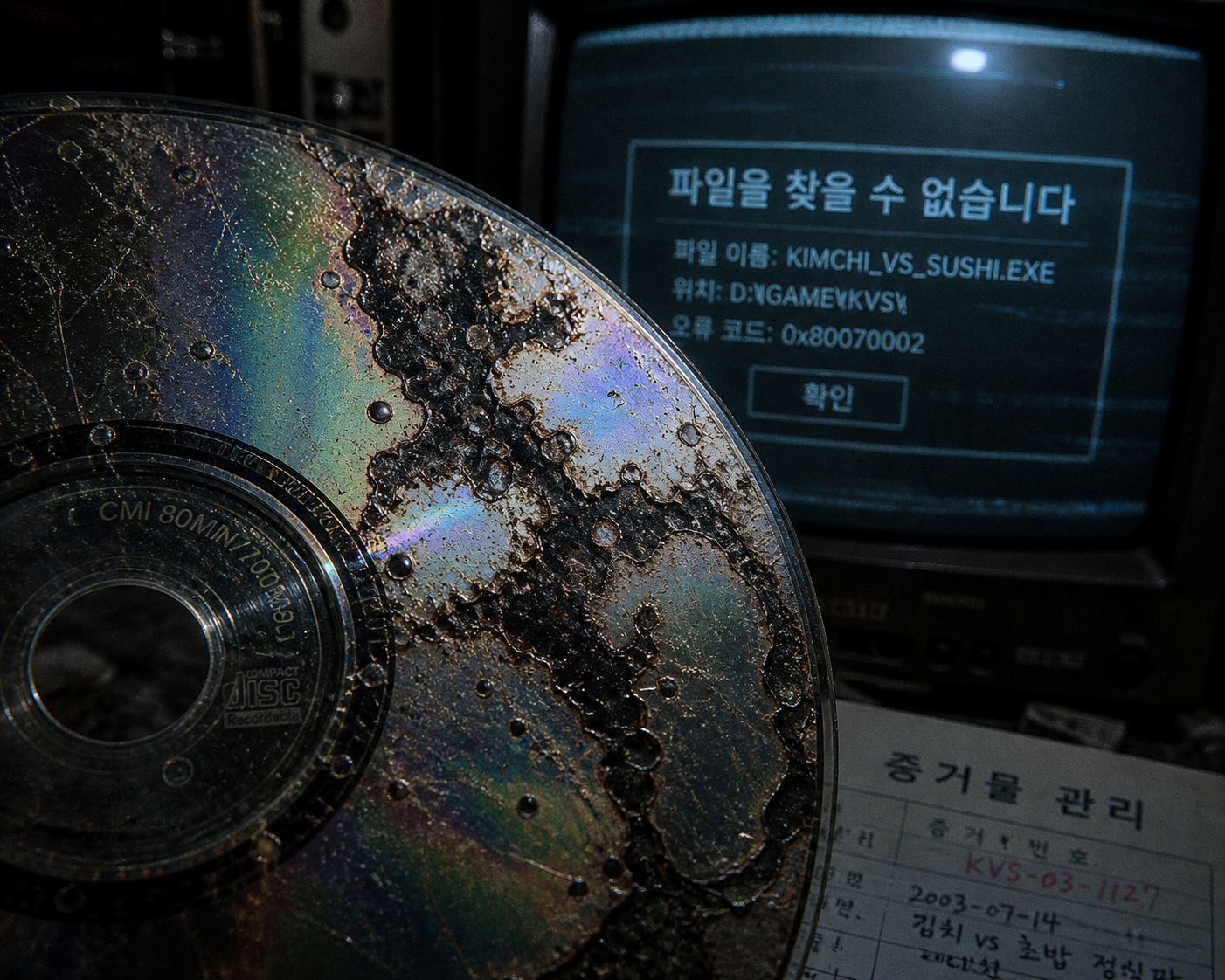
Physical decay is the older and more neutral form. Nitrate film stock burns; magnetic tape degrades; optical discs develop disc rot; hard drives fail. The object was preserved, or attempted to be preserved, but the medium failed. This is loss through entropy—impersonal, chemical, mechanical. Many of the most famous lost media cases—early television broadcasts, silent film prints, pre-Code Hollywood productions—fall into this category. Recovery, when it occurs, happens because a copy survived in an unexpected location: a foreign archive, a private estate, a storage unit sold at auction.
Social erasure is different. Here the loss is not accidental but chosen—perhaps not with full awareness of the future implications, but chosen nonetheless. Works are destroyed by studios calculating rights costs; broadcasts are wiped because videotape was expensive and reuse was standard practice; games go out of print because publishers lapse and no one bothers to maintain access. The object is not misplaced; it is unmaintained, abandoned, allowed to fall out of circulation until the friction of retrieval exceeds anyone’s willingness to pay it.
Kimchi vs. Sushi sits uncomfortably across both categories—with an additional third category that has no clean name but that the thesis supplied in the blueprint calls “Spite Preservation”: the deliberate, agential elimination of an artifact by its final steward. Golden Ticket’s disposal of the collection was not malice in any theatrical sense; it was, presumably, a pragmatic decision about storage, time, and value. But from the perspective of the archival record, the effect is identical to deliberate destruction. The disc is gone. The data is unrecoverable. The act was chosen.
What makes this particularly difficult for the preservation community to process is that it forecloses the usual consolations. When a film is lost to fire, there is always the possibility of a foreign print. When a game goes out of print, there is always the possibility of a surviving cartridge in a garage somewhere. The Gatekeeper’s Exit—the moment when the final known steward makes a final, irreversible decision—closes those possibilities with a specificity that accidental loss cannot replicate. It is not that the object might be anywhere; it is that the object was somewhere, and then it was made to be nowhere, and the agent of that transition is known by name.
The Point of No Return: Digital Memory and the Illusion of Permanence
The case of Kimchi vs. Sushi generates one uncomfortable insight that extends well beyond the specific circumstances of a Korean nationalist shooter from 2003.
The digital era arrived with an implicit promise: things recorded digitally would not decay. Unlike film stock, unlike magnetic tape, unlike paper, digital information was theoretically infinitely copyable and perfectly stable. The bit-perfect copy is identical to the original; the millionth copy is identical to the first. This property seemed to solve, or at least fundamentally ameliorate, the problem of cultural preservation. If something exists digitally, it can be copied. If it can be copied, it can be preserved indefinitely, at essentially zero cost per copy. This property seemed to solve the problem of cultural preservation by making the internet a default archive of human experience.
What the digital era actually delivered was something more complicated. Yes, digital copies are perfect. But the social systems that determine which objects get copied are no more reliable than medieval monks. The internet does not automatically preserve everything it touches. It preserves what communities decide to preserve, what individuals think to save, what commercial interests find worth maintaining. Everything else is subject to link rot, server shutdown, format obsolescence, and the ordinary entropy of organizational failure.
Kimchi vs. Sushi was produced in a linguistic and cultural register that the global archival community had no tools to monitor in 2003. The major English-language gaming preservation efforts of that era were not watching small Korean PC games; they were focused on their own canonical traditions. The Korean archival community—Doogi’s Arcade represents its most serious institutional expression—was watching, and failed anyway, because the object was in private hands and the private hands decided to close. By the time the international lost media community developed the vocabulary and the interest to care about cases like this one, the disc was gone.
This is the pattern that Kimchi vs. Sushi exemplifies and that makes it more than a curiosity. It is not an exceptional case; it is a representative one. For every artifact that the archival community successfully recovers—every found film print, every redumped ROM, every preserved broadcast—there are unknown numbers of objects that did not survive the window between their creation and the moment anyone thought to look. The window is not infinite. It closes. In the case of Kimchi vs. Sushi, the window closed in the hands of a man called Golden Ticket, on an unrecorded date, when he decided that his collection no longer merited the space it occupied.
Digital memory is not permanent. It is contingent on infrastructure, institutional attention, and individual decision. Whether anyone who has the disc believes it is worth preserving before they throw it away is the final, fragile variable. The lesson of this vanished, satirical, nationalistic, absurd Korean shooter is not that we should mourn the specific object; it is that the conditions that erased it are structural, not incidental, and that they are erasing objects we have not yet thought to mourn. The textbook boss was defeated once, presumably, by whatever player first reached it in 2003. It has not been defeated since. The level cannot be reached. The game no longer runs.
🔍Search Update: Call to Action
The status of Kimchi vs. Sushi (2003) is currently designated as Extinct in the Wild. While a partial demo version survives on legacy Korean mirror sites, the full retail release is effectively unrecovered.
Are you a collector of early 2000s Korean Jewel PC games? If you possess a physical disc or an ISO dump of the full version, or have leads regarding the Sonagi Soft developmental archives, contact the 3AM Forensic Desk. We are specifically looking for footage or code of the “Textbook Boss” stage to finalize the archival record.
This document is an investigative archival reconstruction based on fragmented public records, media remnants, community accounts, and verified historical sources compiled by The 3AM Archive.
The article examines how incidents, forgotten media, internet folklore, and unresolved public memories evolve through cultural preservation and digital decay.
This is a cultural investigation document — not fictional horror content.
All visual materials used in this post are exclusive AI-generated assets created for The 3AM Archive.
