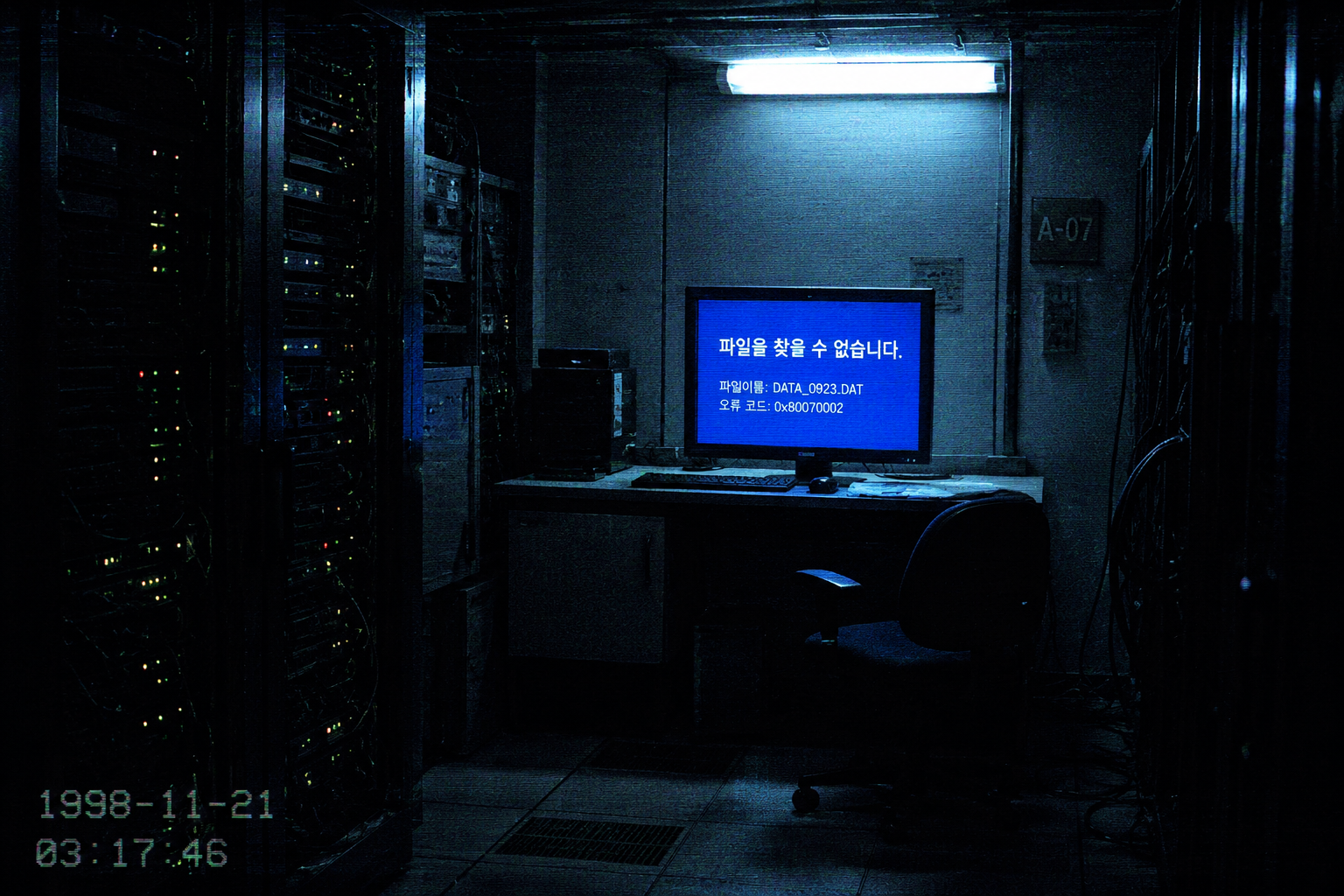
There is a particular species of grief that accompanies the discovery of an absence. Not the grief of watching something die—that at least arrives with the dignity of witness—but the grief of discovering, without ceremony or warning, that something was alive and is now simply gone; that the world held a thing, and then quietly stopped holding it, and told no one. This is the grief of the archivist, the archaeologist, the forensic technologist staring at a corrupted partition table. It is the grief of looking at Jujeonja.com in 2024 and understanding, clinically, that you are not looking at a website. You are looking at a scar.
The Jujeonja.com data wipeout of 2016 does not announce itself as a cultural catastrophe. It arrived without a press release; it generated no trending hashtag; it left no visible crater. What it left instead was a 584-day void—January 9, 2010, to August 16, 2011—carved out of the living record of Korean indie digital creativity by a routine database maintenance procedure gone fatally wrong. The case demands clinical attention precisely because it refuses to be dramatic. The most complete erasures never are.
The Era and the Censorship That Shaped It
To understand what was lost, one must first reconstruct the organism that inhabited those 584 days. Jujeonja.com—”teapot dot com,” a name carrying the gentle absurdity of early internet nomenclature—functioned as the central nervous system of Korean indie Flash culture during what practitioners would later designate, with the reverence reserved for fallen ages, the Golden Age of domestic Flash development. This was not nostalgia retrofitted onto mediocrity; the period from 2010 to 2011 represented a genuine artistic apex.
Korean Flash creators operating within this window were producing experimental horror that bore no Western genealogy. The games emerging from this community drew on distinctly Korean folk-horror traditions—the weight of educational pressure, the paranoia of surveillance infrastructure, the aesthetic vocabulary of PC bang culture—rendered in the limited palette of ActionScript 2.0 with a craft that transformed technical constraint into atmospheric intensity. Complex RPG systems, hand-drawn horror sequences, interactive narratives with multiple branching architectures: these were not hobbyist curiosities. They were a vernacular literature.
The context, however, was never permissive. Unlike Western Flash portals—Newgrounds operating under the comparatively relaxed framework of American digital self-regulation—Korean hosting platforms existed within the gravitational field of the Game Rating Board (GRB), a regulatory body whose mandate extended deep into indie digital territory. The GRB’s classification requirements imposed friction that Western platforms simply did not face; content requiring formal rating before distribution, a bureaucratic threshold that effectively filtered the most experimental and transgressive work. The 2010–2011 period, seen in retrospect, was the eye of a regulatory storm. The community was producing its most daring work precisely in the years before the GRB’s pressure would eventually trigger the 2019 mass shutdown of Flash portals across the country. The Golden Age was golden, in part, because it was borrowed time.
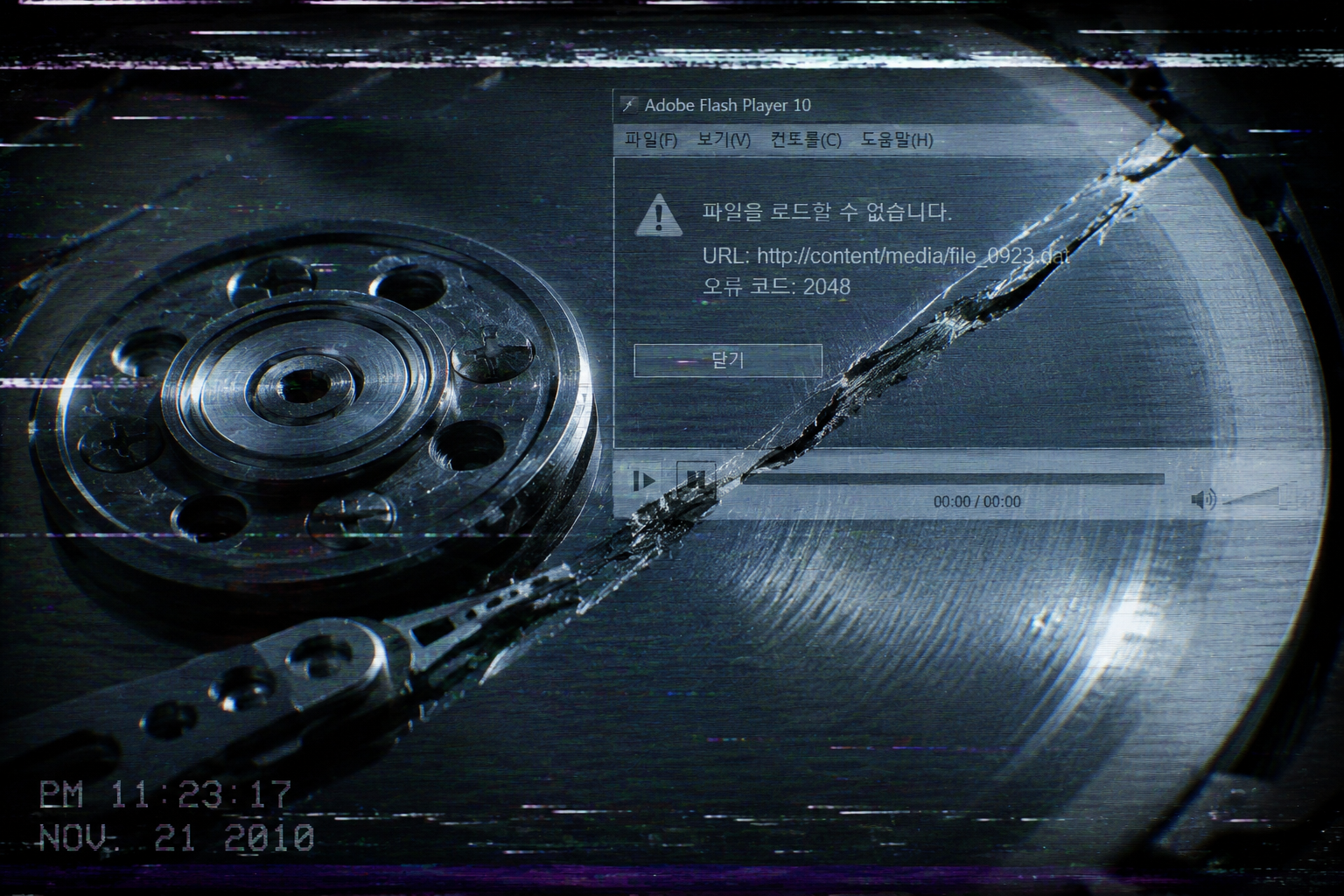
Forensic Parameter — Case Window 584 Days January 9, 2010 — August 16, 2011. The precise chronological window rendered unrecoverable by the February 2016 database maintenance failure. Professional data recovery services were engaged; they returned a formal declaration of impossibility.
Anomalies in the Signal
A competent forensic examination of the Jujeonja loss requires separating the mechanism of destruction from its cultural consequences—a discipline the Western lost media community has largely failed to apply here, because the mechanism is, by Western standards, structurally anomalous.
In the established Western taxonomy of digital loss, the villain tends to be internal. The MySpace music catastrophe of 2019—the accidental deletion of approximately fifty million songs uploaded between 2003 and 2015—was, at its core, a story of corporate negligence; a migration project executed without adequate backup verification, the kind of institutional failure that corporate accountability frameworks are, in theory, designed to prevent. The blame radius, however wide its consequences, was legible. It pointed inward.
The Jujeonja case points outward; and this redirection changes the moral architecture of the loss entirely. The community did not fail its archive. The platform did not fail its users through internal carelessness. A third party—a server hosting vendor—introduced a catastrophic error during a routine maintenance procedure, and that error formatted 584 days of creative output into nothingness. The community was, in the fullest and most tragic sense of the phrase, a bystander to its own erasure. This is not negligence as institutional failure. This is bureaucratic tragedy: the kind that produces no villain clear enough to prosecute, no corrective framework adequate to the damage, only the quiet horror of external dependency exposed.
The surviving fragments illuminate the shape of the void by contrast. Files cross-posted to Flash365 or Junior Naver—platforms whose independent server architecture happened to keep them intact—survived not through archival intention but through the accident of redundancy. Works re-uploaded by their original creators after the fact survive through the contingency of creator availability. What these fragments share is exceptionality; they exist because something, by luck or habit, escaped the single point of failure. The implication for the unrecovered majority is stark: thousands of unique assets, comment threads constituting years of community discourse, metadata encoding the precise social graph of this creative ecosystem—all of it existed on exactly one server, controlled by exactly one vendor, until February 2016.
The community did not fail its archive. A third party formatted 584 days of creative output into nothingness—and the community was, in the fullest sense, a bystander to its own erasure.
Why This Silence Disturbs the Western Mind
The Western lost media community has developed, over the past decade, a remarkably sophisticated set of rituals for processing digital absence. Fan wikis catalogue the known parameters of missing works; Discord servers coordinate recovery efforts with the organized intensity of search-and-rescue operations; YouTube documentaries treat each partial recovery as a detective narrative with the emotional arc of a thriller. The aesthetic framework is, consistently, one of active pursuit: the missing artifact as fugitive, the archivist as hunter, the recovery as triumph. “Lost media” in this register is a genre with conventions as recognizable as any other.
The Jujeonja case refuses this framework; and the refusal is, psychologically, the most disturbing thing about it. There is no hunt available. The professional data recovery services rendered their verdict with clinical finality—unrecoverable—and the verdict stands. Projects like FlashArch and the Internet Archive’s Korean Flash Bundle function as lifeboats for the surviving files, but they cannot reconstruct the lost year; they cannot generate metadata that no longer exists in any magnetic medium; they cannot restore the comment threads in which anonymous teenagers, in the specific social register of early 2010s Korean PC bang culture, documented their responses to work that no longer survives. The archive is not incomplete. It is absent.
This distinction—between the incomplete and the absent—produces a specific cognitive dissonance in communities trained to believe that the internet is, at minimum, a degraded library; that things uploaded, once uploaded, persist somewhere in the aggregate distributed memory of the network. The Jujeonja case is a clinical refutation of that belief. The internet is not a library. It is, as the core thesis of this examination insists, a fragile arrangement of magnetic bits subject to the failure modes of physical hardware, the errors of maintenance contractors, and the institutional decisions of hosting vendors who owe the historical record nothing.
Physical Decay vs. Social Erasure
The historiography of lost media distinguishes, usually implicitly, between two modes of disappearance: physical decay and social erasure. Physical decay—the deterioration of nitrate film stock, the bit rot of unrefreshed magnetic tape, the head crash of an unspun hard drive—is the classical model; it generates sympathy because it mimics the biological mortality the human mind is evolutionarily calibrated to process. Things age. Things die. The tragedy is legible.
Social erasure operates differently; it is the process by which content vanishes not through material failure but through the withdrawal of institutional attention. A television broadcast not archived because no one considered it worth archiving; a game not preserved because its platform held no cultural prestige; a Flash animation not backed up because the platform’s server vendor did not understand what it was holding. The Jujeonja loss is, at its technical origin, a case of physical deletion—the database maintenance error is a material event. But its preconditions were social. The work was vulnerable because Korean indie Flash culture in 2010 was not legible to the international archival infrastructure as a preservation priority. It existed in a language inaccessible to the dominant Western preservation networks; it occupied a platform category—Flash hosting—that the broader digital culture was already beginning to treat as ephemeral; it was produced by anonymous teenagers whose creative labor carried none of the institutional markers that archival attention follows.
The GRB regulatory context compounds this social dimension in a manner specific to the Korean case. The regulatory pressure that would eventually shut down Flash portals in 2019 was already, during the 2010–2011 window, shaping the conditions of the work’s production and documentation. Creators operating under regulatory uncertainty tend not to maintain comprehensive external backups; platforms operating under regulatory pressure tend not to invest in redundant infrastructure. The 2016 server error did not create the vulnerability it exploited. The vulnerability had been accumulating, socially and institutionally, for years.
Digital Memory and the Uncomfortable Remainder
The final uncomfortable insight the Jujeonja case offers is not about Korean Flash culture specifically. It is about the nature of digital memory as a category—and about the particular self-deception that the phrase “digital permanence” has embedded in the default archive of human experience.
There is a persistent intuition, structured deeply into the experience of life conducted online, that the digital record is cumulative. This perspective assumes that each upload adds to a growing permanent total. It suggests that the network, in aggregate, remembers everything even when individual nodes forget. This intuition is not entirely irrational—the redundancy of well-maintained distributed systems does provide meaningful protection against individual hardware failure. But “well-maintained distributed systems” describes an infrastructure that must be deliberately constructed and actively sustained; it does not describe the default condition of every platform that has ever hosted creative work.
Jujeonja.com was not a well-maintained distributed system. It was a community Flash portal operating on a single vendor’s server infrastructure, in an era before cloud redundancy was standard or affordable, in a regulatory environment that discouraged institutional investment, without the archival attention of any organization positioned to impose backup discipline from outside. It was, in this sense, entirely typical of the platforms on which most early internet culture was produced and hosted. The Wayback Machine’s Korean Flash Bundle exists precisely because the Internet Archive recognized, belatedly, that the default condition of digital hosting is precarity—and that the platforms most likely to hold culturally significant material are often the least likely to have the institutional resources to protect it.
What the 2016 maintenance error revealed, by accident, is the precise weight of that precarity when it collapses. 584 days of collective creative output; thousands of unique artifacts; years of community commentary constituting the social history of a subculture—reduced, in the duration of a failed database operation, to the category of that which no longer exists. The server vendor’s scalpel did not slip into neutral territory. It severed, with the indifference of pure mechanism, the only existing copy of a cultural record that had no backup and no institutional advocate and no international visibility sufficient to have generated either.
When we look at Jujeonja.com today—at what it hosts and what it cannot host—we are not performing an act of nostalgia. We are performing an act of diagnosis. The patient is not the platform. The patient is the assumption that the internet, by its nature, preserves. The Jujeonja 2010–2011 block is the test case that kills that assumption; clinically, without drama, and without the possibility of appeal. The 584 days are gone. The void is not a wound in the process of healing. It is a healed scar—smooth, permanent, and utterly uninformative about what it covers. That is the final finding of the necropsy. The record closes here.
🔍Search Update: Call to Action
To the Western Lost Media community and LMW (Lost Media Wiki) researchers: The 2010-2011 Jujeonja wipeout is currently categorized as Non-existent/Unrecoverable. Unlike “lost” media that exists on a misplaced hard drive, this data was physically overwritten.
How you can help:
-
Check Local Backups: If you frequented Korean Flash portals (주전자닷컴, 플래시365) between 2010 and 2011, check old hard drives for
.swffiles. -
Metadata Recovery: If you have screenshots or saved HTML pages of Jujeonja from this era, they are vital for reconstructing the community “social graph.”
-
Contribute: Upload any surviving assets to FlashArch or the Internet Archive.
The void is vast, but every recovered byte is a victory against silence.
This document is an investigative archival reconstruction based on fragmented public records, media remnants, community accounts, and verified historical sources compiled by The 3AM Archive.
The article examines how incidents, forgotten media, internet folklore, and unresolved public memories evolve through cultural preservation and digital decay.
This is a cultural investigation document — not fictional horror content.
All visual materials used in this post are exclusive AI-generated assets created for The 3AM Archive.
