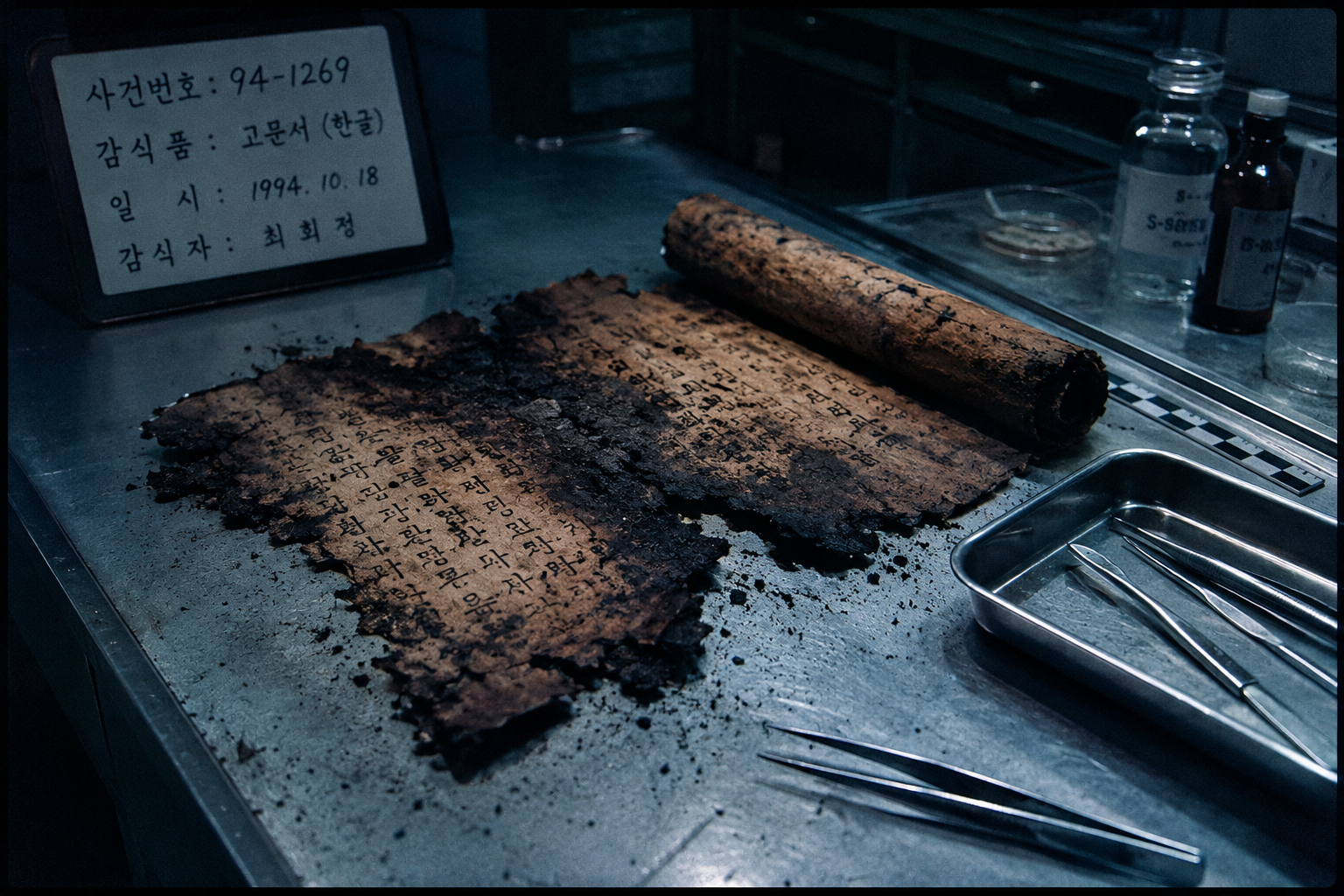
There is a peculiar taxonomy of fear that only governments understand: the fear not of what is said, but of what might be believed. In 1511, King Jungjong of the Joseon Dynasty did not order the destruction of Seol Gong-chan jeon (설공찬전) because it was fiction. He ordered it destroyed because it was persuasive. The distinction is clinical, and it is everything. A story about bureaucrats in Hell who punish kings with the same impartial severity they punish commoners is not a ghost story. It is a constitutional argument dressed in supernatural clothing; and constitutions, unlike ghosts, can be prosecuted.
What remains of that text today is thirteen pages—a Hangul fragment, found in 1997, folded inside a private diary like a secret someone never quite decided to tell. To read it is not to read a book. It is to press your ear against a wall and hear, faintly, the echo of everything the wall was built to contain.
The Cultural Anatomy: A Dynasty, a Censor, and the Architecture of Acceptable Reality
To understand why Seol Gong-chan jeon was dangerous, one must first understand the epistemological structure of Joseon society in the early sixteenth century. The dynasty, founded in 1392 on Neo-Confucian principles, was not merely a political institution; it was a cosmological project. The legitimacy of the king—the wang—was inseparable from the moral order of heaven. Governance was not simply administration; it was the ongoing performance of a divinely sanctioned hierarchy. For this system to function, the hierarchy had to be total. It could not end at death.
Chae Su wrote Seol Gong-chan jeon in 1511, during the reign of Jungjong, a king who had himself come to power through a coup—the Jungjong coup of 1506, which deposed his half-brother Yeonsangun. The political climate was therefore already saturated with the anxiety of illegitimacy. Jungjong’s court was acutely sensitive to narratives that questioned the permanence or justice of royal power. Into this atmosphere, Chae Su introduced a ghost.
The premise of the text is architecturally simple: the spirit of Seol Gong-chan possesses his living cousin and, speaking through that borrowed body, describes the Underworld in forensic detail. What he describes is not chaos. It is order—a meticulous, bureaucratic, meritocratic order in which moral ledgers are balanced without deference to earthly rank. Kings are punished. Officials are judged. The afterlife, as Chae Su renders it, operates on principles the living court conspicuously does not.
King Jungjong’s response was not delayed. He classified the text as “subversive and misleading,” ordered every copy burned, and had the author dismissed from his position. The speed of the condemnation is itself diagnostic. This was not the considered reaction of a monarch who had been persuaded the book was theologically unsound; it was the reflexive contraction of a system that had recognized a threat to its own load-bearing wall. The wall in question: the premise that royal power did not require external accountability.
Censorship at this scale was not unusual in Joseon. The Confucian bureaucratic state maintained careful control over the circulation of ideas, particularly ideas that touched on cosmology, political legitimacy, or the behavior of the ruling class. What made Seol Gong-chan jeon exceptional was its medium. It was written not in Classical Chinese—the language of scholars and officials—but in Hangul, the vernacular script introduced by King Sejong in the fifteenth century and still regarded with some institutional suspicion as a populist instrument. A subversive argument in Classical Chinese circulates among elites who can be managed. The same argument in Hangul circulates among everyone.
This is the first layer of the text’s danger: not its content, but its accessibility. Chae Su wrote a political critique in the language of the people. The King burned it in the language of power.
Structural Dissection: Anomalies in the Signal
What survives of Seol Gong-chan jeon is, structurally speaking, a torso. We have the opening—the possession, the cousin as medium, the initial description of the Underworld’s geography and governance. We have world-building of a sophisticated and internally consistent kind: a Hell that mirrors Joseon’s own administrative apparatus, with offices and bureaucrats and hierarchies of judgment. What we do not have is the ending.
Approximately thirteen to fifteen pages of the latter half are gone. The text terminates before its own conclusion; the “final judgment”—presumably the moral and narrative climax toward which the entire cosmological apparatus was constructed—is physically absent. We are left with the setup and the implication but not the verdict.
This structural truncation is not incidental. It is the primary datum.
Consider what the surviving pages contain: an underworld in which kings are subject to the same moral accounting as their subjects; an afterlife in which earthly status provides no immunity. This is the premise. The missing pages would have contained the payoff—the specific punishments, the specific judgments, the specific demonstration that the meritocratic afterlife Chae Su described was not merely theoretical. The state destroyed the proof. The surviving fragment is a theorem without its QED.
There is a further anomaly worth noting: the text that survives is a Korean (Hangul) translation of the original, which was written in Hanja—Classical Chinese characters. The original Hanja version is entirely lost. What we have is a copy of a copy, a vernacular rendering of a text that was already underground. This means the chain of transmission includes at least one additional act of deliberate preservation—someone, at some point, chose to translate this forbidden text into Hangul, presumably to make it accessible to a broader audience. That act of translation was itself a political statement; it extended the text’s reach beyond the scholarly class into the vernacular readership the original Hangul version had already been designed to address.
The question of who performed this translation, and when, is unresolvable. We know only the endpoint: thirteen pages, folded inside the Mukjae Ilgi—the private diary of a man named Mukjae—where they remained hidden for nearly five centuries.
Psychological Necropsy: Why Archival Silence Disturbs the Western Mind
To a reader approaching this text through the conventions of Western horror—Reddit’s analog horror communities, the Lost Media Wiki, the genre of found footage and forbidden recordings—Seol Gong-chan jeon presents as a perfect specimen. It has the structural DNA of the uncanny: a message from beyond the living world, delivered through an unwilling medium; a bureaucratic underworld that mirrors our own systems in ways that feel wrong rather than merely fantastical; a physical incompleteness that suggests not accident but suppression.
The Western horror tradition has long been preoccupied with what lies beneath institutional surfaces—the horror that the systems governing our lives are either arbitrary or, worse, perfectly rational in ways that exclude us. Kafka wrote bureaucratic horror as satire and found it indistinguishable from nightmare. Chae Su wrote bureaucratic horror as political critique and found it indistinguishable from sedition.
But the Western horror reading is, in a precise sense, a misreading. It aestheticizes the suppression. It treats the missing pages as a feature—the void as atmospheric, the incompleteness as eerie. This is a category error. The missing pages are not atmospheric. They are the residue of a specific political decision made by a specific king in a specific year, for reasons that had nothing to do with aesthetics and everything to do with power.
Korean scholarship situates the text differently: not as horror, but as the first documented “banned best-seller” in Korean literary history. The horror element was always secondary—a vehicle, a vessel, a form chosen precisely because it was engaging and accessible. The content being delivered through that vessel was a claim about political accountability that the Joseon state found intolerable. The ghost was a rhetorical device; the bureaucratic afterlife was the argument.
This divergence in reception—Western horror versus Korean political critique—is not merely an interesting cross-cultural footnote. It reveals something about the relationship between form and content in suppressed texts. When a state destroys a document, it cannot destroy the form of the document’s absence. The void retains the shape of what was removed. Western readers, encountering that void without the political context that produced it, fill it with aesthetic horror. Korean readers, encountering it with that context intact, fill it with historical grief. Both responses are real. Neither is complete.
The Evidence of Void: Physical Decay Versus Social Erasure
There is a meaningful distinction between a text that is lost and a text that is destroyed. Loss is entropic—manuscripts rot, fires spread, floods arrive without political intention. Destruction is directed; it requires an agent, a decision, a specific act of will. Seol Gong-chan jeon was destroyed. The original Hanja version did not survive five centuries of natural attrition; it was consigned to fire by royal decree within a generation of its composition. The thirteen surviving pages exist not despite the destruction but through it—through the decision of at least one person, and possibly several, to keep a copy hidden.
The physical site of that survival is the Mukjae Ilgi, a private diary. The choice of concealment is significant. A diary is a document of interior life; it is, by its nature, a space outside official circulation. To hide a forbidden text inside a diary is to place it inside the most private possible archive—the record of one person’s days, which no censor would be likely to examine and which would not circulate through the channels that official texts did. This is, functionally, the samizdat model: the underground publication culture developed in Soviet-era Eastern Europe, in which forbidden texts were copied by hand and passed privately between trusted individuals who accepted the personal risk of possession.
That such a culture existed in sixteenth-century Joseon is not, in retrospect, surprising. What is remarkable is the physical evidence: thirteen pages that survived because someone folded them into a diary, because someone else preserved that diary, because that diary eventually made its way into an archive, where it sat—unremarked, unread for this purpose—until a researcher in 1997 found it.
The missing latter half of the surviving fragment is a different problem. This is not social erasure but physical decay—or, possibly, a more targeted act of destruction at some earlier point in the manuscript’s hidden life. We cannot know. The thirteen pages that exist are torn from a larger document; the tear itself tells us nothing about when it occurred or whether it was deliberate. We are left with a double void: the original text destroyed by the state, and the conclusion of the surviving copy lost by time or intention.
What this leaves us with is a fragment of a fragment—a partial translation of a destroyed original, itself partially destroyed. Each layer of loss is a separate event, a separate failure of preservation, a separate moment at which the text almost did not survive at all. That anything exists is improbable. That it is incomplete was, at some level, inevitable.
The Point of No Return: Digital Memory and the Permanence of Absence
It is tempting, encountering a text like Seol Gong-chan jeon in the contemporary moment, to draw reassurance from the present condition of information. We live, after all, in an era of apparently total archival capacity. Every tweet is preserved by some server farm, and every document is potentially duplicated across a thousand nodes. The logic runs: what King Jungjong could accomplish in 1511 is simply impossible now. No contemporary state could issue a burn order and expect compliance.
This comfort deserves scrutiny.
What the Joseon case demonstrates is not merely that states can destroy texts; it demonstrates that they can destroy contexts. The thirteen surviving pages of Seol Gong-chan jeon are legible to contemporary readers. The missing pages—whatever argument they contained, whatever specific judgments Chae Su rendered, whatever conclusion his meritocratic afterlife reached—are not recoverable. The physical object is gone; the context it would have provided is therefore also gone; and the interpretation of the surviving fragment is permanently distorted by the absence of its conclusion.
Digital preservation does not solve this problem. It addresses storage but not curation; it addresses survival but not meaning. A document that is stored in a format no one can read, or in a system no one thinks to access, is functionally as lost as a manuscript burned in 1511. The difference between physical erasure and digital obsolescence is a difference in mechanism, not in outcome. Both produce the same silence.
More precisely: King Jungjong’s burn order created a specific silence—one shaped by the content of what was removed, preserving the negative impression of an argument in the space where the argument had been. The surviving fragment is comprehensible precisely because the censorship was incomplete; we can infer something about the missing pages because we have thirteen pages that set up what they should have contained. Total suppression would have left nothing—not even a legible void. Partial suppression leaves scars.
Seol Gong-chan jeon is a scar. The thirteen pages are not a book; they are the record of a book’s destruction—a forensic impression, a cast of something that no longer exists. The missing pages are not simply absent; they are present as absence, shaped by the political terror of a king who understood, correctly, that a ghost story about a fair afterlife was an argument against him personally.
He was right to be afraid. The argument survived him by five centuries, in thirteen pages folded inside a diary, waiting to be found. The conclusion he burned is gone. But the premise—that power does not exempt the powerful from judgment—remains, stripped of its ending, more disturbing for its incompleteness than any conclusion Chae Su might have written.
A complete text can be argued with. A scar can only be read.
🔍Search Update: Call to Action
The ‘3AM Archive’ is currently cross-referencing mid-16th century household inventories for any mention of “The Cousin’s Ghost” or “The Meritocratic Hell.” If you have access to uncatalogued private family diaries (Sajok diaries) from the Gyeongsang region, the missing 15 pages may still exist as a default archive of human experience. Contact the Archive anonymously.
Primary source: Seol Gong-chan jeon (설공찬전), attributed to Chae Su, composed 1511, Joseon Dynasty. Discovered 1997 within the Mukjae Ilgi. Studied extensively within Korean literary history as the earliest documented case of a banned vernacular text.
This document is an investigative archival reconstruction based on fragmented public records, media remnants, community accounts, and verified historical sources compiled by The 3AM Archive.
The article examines how incidents, forgotten media, internet folklore, and unresolved public memories evolve through cultural preservation and digital decay.
This is a cultural investigation document — not fictional horror content.
All visual materials used in this post are exclusive AI-generated assets created for The 3AM Archive.
